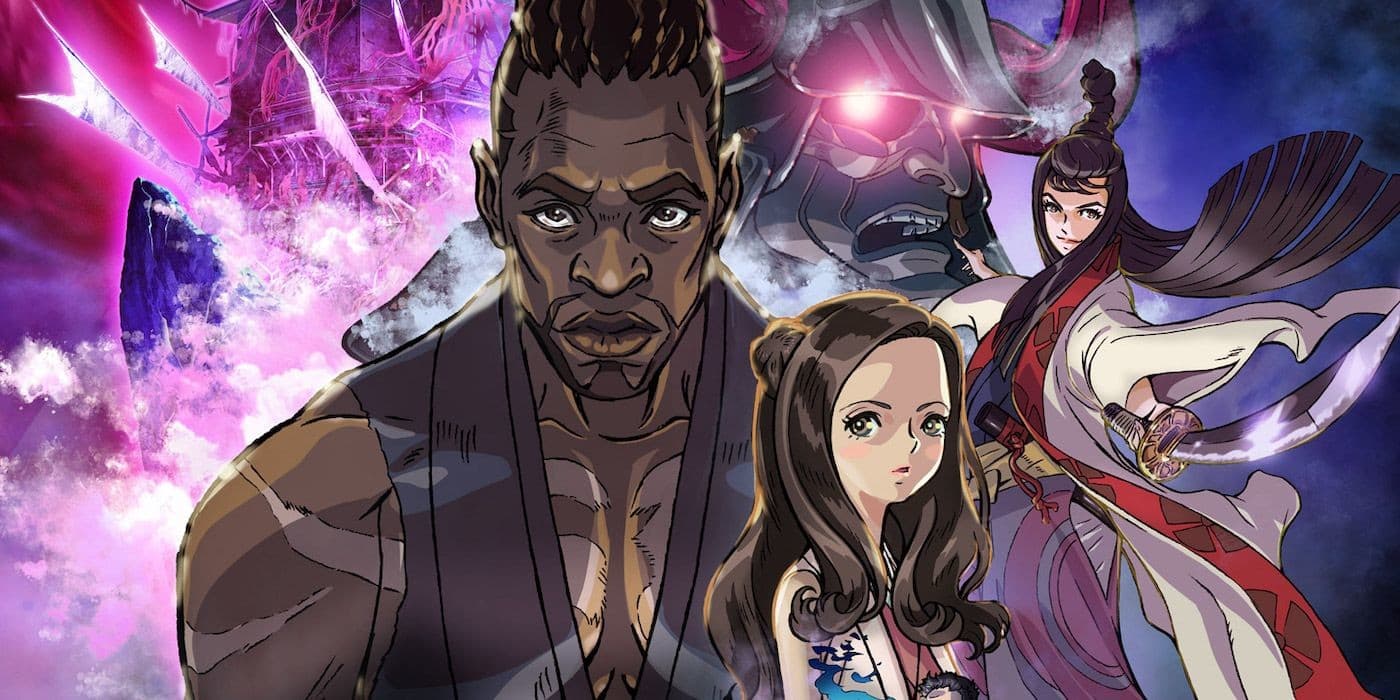
Yasuke is your typical samurai story where nothing of worth really happens, but there is a lot of stuff happening on screen so that it makes you think that things happen. It’s a generic story about a warrior losing his place and having to learn to live a simple life, but then the bad baddies come, and what would you know, he is the only one capable of defeating them.
I have to give credit where credit is due, and say that the soundtrack in Yasuke among the best music I’ve heard in anime in a long time. It’s electric, it’s chill, and it carries the terrible story and under-written characters. Flying Lotus did an amazing job to let out his creativity flourish on each track. Now for the reasons why it sucks. The music by itself is cool, but in the context of the anime it is a jarring mismatch of styles. The non-diegetic music, meaning the one that us the viewers hear, conflicts heavily with the diegetic music, meaning the one in-universe. For a world set in the 1500s, the trap drums and lo-fi aspects of the soundtrack feel extremely awkward, especially when the characters occasionally sing using traditional Japanese instruments. If they were going for a modern sound, they could have easily just fully adopted a sound of trap with traditional instruments, and create a beautiful mix of sounds that would have made it feel more natural whenever there was in-universe music. And even when the soundtrack does that, the transition from traditional to trap, lo-fi, and atmospheric sounds feels awkward in practice.
So Yasuke is about an African samurai in Japan, right? So why are there robots and magic? This is my guess: the author didn’t feel confident in his ability to handle such a story, so he felt the need to add filler elements to the narrative. The fantasy/sci-fi elements add close to nothing to the story, nor does the story feel like it needs to have them. Sci-fi/fantasy is fine on their own, and can even function well if they are handled with a fine touch, but in the context of Yasuke, they detract from the whole “African samurai in 1500s Japan” premise. And sure, you may argue that African samurais in Japan sounds like the set-up for a fantasy story, especially when you factor in the time period. To which I would say that you are absolutely right. It’s such an out there idea that you wouldn’t think it is possible. Yet, it is possible. It did really happen, that’s why we have Yasuke in the first place. But because the show uses magic, were-beings, and psychic powers in an underwhelming and simplistic fashion, it takes away from the sheer gravity of Yasuke’s life as a samurai in feudal Japan. To add to that, the sci-fi side of the story furtherly diminishes the character’s bombastic existence, and they too are used just so matter-of-factly. The robots are there just because they are there, and the fantasy elements work accordingly to the character's needs. There's no baseline for anything, therefore anything can happen (which, in theory isn't bad). However, Yasuke has no rules that ground the powers so if the characters need to defeat the bad guys, they just enter the Avatar state and everything's ok. The robots could've been used as a thematic element for Nobunaga’s wish for a brighter Japanese future, but instead, Yasuke never touches one out of his own volition aside for when he kills them in episode 6.
The world that Yasuke builds feels so disjointed, not because of the thematic value of robots and magic, that would require smart writing, but because of how uninteresting and flat all of the characters in the show are. Sure, they complete a character journey – that is if they are useful to the plot, otherwise they get killed – but it doesn’t feel rewarding watching them do so. It’s like they went from point A to point B, etc, but there’s no sense of growth or depth to their character. Yasuke starts out as a slave, is bought by Nobunaga, and retires to the countryside. He then has to pick up his sword once again in order to save some kids, swears he won’t kill again only for him to immediately kill again. Ultimately, he kills the big bad enemy, saves the girl, and everybody lived happily ever after. There is nothing of interest going on in Yasuke’s journey. The show could have questioned his morals of swearing that he won’t kill anymore, but instead it, like other aspects, is treated just so simplistic that you wonder why was that even included in the first place? Other characters, such as the bounty hunters, or the priest were dealt an even worse deal when it came to characterization or depth. The hunters exist as a minor setback in Yasuke’s journey, but they never really pose a threat since they are just evil because they like money. Monetary gain and status could be an interesting motive for a group of bounty hunters, but the show doesn’t care to go beyond “money good, so I’m the bad guy” phase. One of the members of the group wants the money in order to help the kids in his tribe, motive that could have sparked an interesting conflict of ideals and visions between the two African characters of the show. Unfortunately, it doesn’t go beyond that surface level. Moving on to the priest, he is just a joke of an antagonist, placed there because the show felt that it needed such a poor villain. Why is the priest the bad guy? Because God. To make matters worse, he is an old European Catholic who wears all white, signaling to the viewer that he must be the bad guy. I thought we moved past this trope when Hellsing finished. At the end of it all, they unceremoniously die one by one, except for the robot who had the best character arc in the show, and one of the best send-offs that any character could receive in this show
INTERMISSION - here’s a list of some conveniences the narrative takes for whatever reason:
-one episode the girl can't control her powers, the next she enters Avatar mode, throws fruit at her pursuers, and flies around
-she can't hold a sword, yet she can hold her body's entire weight as she hangs from the roof, the robot tells her that she can't get away, but it doesn't try to capture her WHEN THAT'S THEIR WHOLE MISSION. The girl drops into a carriage full of fish that just happened to be there. Ezio Auditore would be proud
-she's sickly with a severe fever, until she no longer is, and runs away from her pursuers, until the plot remembers that, indeed, she was sick. -some kid's father is furious that she hurt her son and searches all over for her, but he just lets it slide at the end of the show since she saved the world. He did a complete 180, and it's not like he underwent any developmental journey to calm his anger, because we only ever see him again in the final episode.
END OF INTERMISSION
In an interview the author gave to Screen Rant, Thomas LeSean (the author) says the following:
I was really into a lot of OVAs at that time,I would only follow OVAs and movies. Those were what I watched. I wouldn't watch stuff like Dragonball Z. I watched early Dragonball, but I just wasn't a fan of how long those shows were. I like short stories, and I like things ending. I was more of an OVA/features guy. I was never into a lot of the long-form Shōnen stuff
LeSean essentially prefers stories that can tell a concise story without spanning hundreds of episodes. This could be one of the reasons that Yasuke has only 6 episodes to tell its story. The author wanted to stray away from the shounen battle formula of storytelling, however, he views the length of the story as an inherent flaw. Thing is, you can absolutely make a concise story in less than Dragon Ball’s hundreds of episodes. Psycho-Pass told a phenomenal story about the ambiguity of humanity in the wakes of an uber-technologized world, and it only needed 22 episodes. Hibike Euphonium told its story about self-betterment and improvement in just 12 episodes. Even FLCL delivered an outstanding coming-of-age story in just 6 episodes. So you clearly don’t need to push your episodes into the hundreds in order to tell a story. However, Yasuke’s obsession with conciseness is perhaps one of its most damaging flaws. In just 6 episodes, Yasuke attempts to tell a story of self-growth in a transitional period in Japan, filled with robots, magic, and fantasy, but it doesn’t have the thematic ingenuity of FLCL, nor the writing of Psycho-Pass to pull it off. Everything falls flat, or feels underwhelming and underdeveloped.
To LaSean’s credit, Yasuke doesn't feel like a political statement about black empowerment that's shoved down your throat. Instead, it feels like a passion project born out of the opportunity of making an anime about the first African samurai in existence.
For me, it's always been about a competent content creator. My skin color is going to be what it is. Yasuke was an opportunity. It was a unique opportunity to ride the enthusiasm of a historical figure that no estate owns. No one has told a popular media story around him, and he just happens to be of African descent.
He may be writing from his life experience, but that doesn't mean that he creates "a black story", meaning that Yasuke would only be relatable and relevant to people of colour. Instead, Yasuke feels like a universally relatable character that goes through universally easy to perceive challenges and tribulations. That’s all cool and dandy, but then the show introduces a character that speaks Russian and drinks Vodka. Which doesn’t feel out of place, considering the fact that there are two Africans in Japan. Until the Russian lady transforms into a bear. Can you see how tone deaf this is?
In the end, Yasuke feels like a passion project, but one that bit off more than it could chew, and now the entire food wants to vomit itself out. It's a mismatch of ideas, themes, and stories, that seem cool in theory, until you lay it down on paper and see that you can't handle the type of story that you wanted to tell.
15.5 out of 17 users liked this review
