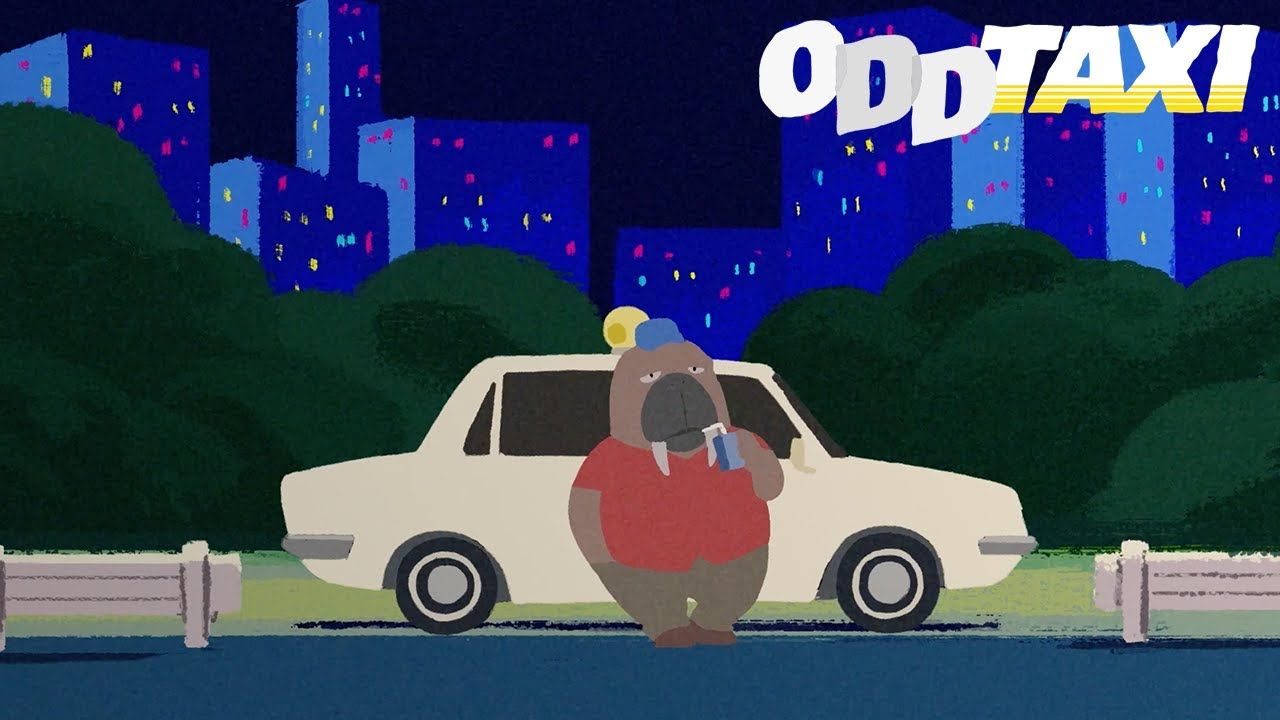
ODDTAXI
a review by saulgoodman
a review by saulgoodman

ODD TAXI reads off like Scorsese characters doing standup routines in fur suits. As much of an affront as that statement may sound, all that you'll hear from me are hymns and praises of this show. Though, trying to effectively analyze the rabbit holes to a dark Wonderland and the tangling spider-webs of interconnections of ODD TAXI is a dizzying endeavor. Above all the whimsical dialogue, unexpected characterization, superb foreshadowing and addictive mysteries; exists the overarching theme of fragile appearances and their consequences.
Shoutouts to Kazuya Konomoto's ornate writing. Despite giving all the characters their distinct and memorable personalities and conflicts, he's crafted them to contribute to the looming theme of fragile appearances. How he generally conveys this is through observation of modern-day dilemmas, ie. "clout chasing", online validation, online dating, game addictions. Despite the cast of furry animals, ODD TAXI reads off as one of the most authentic depictions of the modern-day millennial. The portrayals of these issues exist through the severe conflicts of the characters; such as Kabasawa's desperation for online virility manifesting a crazed internet hero persona, a gacha-game addict pulling a Travis Bickle after losing a SS+ pull and Kakihana being lured into a yakuza badger game from his happy-go-lucky attitude in dating apps; that may certainly be exaggerated in nature, but still effectively point to the holes and consequences when these problems manifest on real-life grounds. Though, these aren't just boomer-esque signaling and lecturing that trends and phones are bad (well, perhaps in Kabasawa's case, when Dobu choke-holds him and tells him to go touch grass), because everyone's conflicts doubling as modern-day situational observation also plays into the theme of appearances.
Kabasawa, as mentioned, possesses an internet-hero persona after gaining viral status for his ally-of-justice video promising to take down Dobu. His cult following, resulting hubris and pitiful downfall all occur behind his mask of the computer and phone screen. Oh, but do consider following his Twitter! His conflict resolution stifled a chuckle in me, though, as it was the perhaps the only preachy instance of the observational aspect of the show, though with truth weighted behind it, as Dobu lectures Kabasawa about using the Internet as escapism from his insecurities and throws his phone into the sea as a grand finale to his conflict. I was almost expecting Dobu to turn to the camera to break the fourth wall and say "And you, too anon, there's more to life than what's on your screen". So, remember kids, appearances aren't limited to the physical form, but also character and get off your stinking phones.
Perhaps the most extreme of these modern-day observations is Tanaka's gacha-game addiction. Though, "addiction" is perhaps a bit too light a word to realize the weight of his conflict. In contrast to the rather ambiguous and vague characters of the show, Tanaka strikingly comes off as the deranged antagonist chalk-full of irrationality. Though, I have to say, his stand-alone episode is by far my favorite of the entire show. Starting off as a musing and recollection of his childhood days of collecting erasers, his monologue steadily meanders to a darker path as his life deprecates, a gacha-game at the center, finally projecting all his frustration against Odokawa. Pinning this all as commentary of gacha-addiction is easy but false, Tanaka's situation examines how the show utilizes modern-day situational observation to characterize. Gacha is simply one of the gears turning Tanaka's life in a downward spiral, others being scammed by an auction seller for an eraser as a child, losing a SS+ pull and his pet bird dying the same day. In the grander scheme of things, Tanaka's situation points how seemingly mundane actions and events can snowball for years, building up pent-up unhealthy thoughts and feelings, and their boiling point is nothing but irrationality. Contrary to the literal mask he wears to hide his identity as he goes on a vendetta killing spree, Tanaka possesses an additional mask; temporary, superficial pleasure. This is where one can say the gacha commentary comes into play. Though, it's much more overarching of an observation, being also applicable to numbing social media and other virtual escapism that plagues many of us today. Whereas Kabasawa's "go touch grass" resolution may be amusingly truthful, Tanaka's situation has a nihilistic tone to it. Hiding behind the numbing pleasures present on the screen, from the bitter reality of life. Hits a bit close to home, huh?

Taking a break from the discourse of modern-day situational observation, Odokawa possesses the most interesting mask of the cast. Lacking context behind his character, besides his brief flashbacks of his parents figures, Odokawa is a vague individual to dissect and the audience can only rely on his dry-natured interactions with his clients and friends for characterization. Despite being numbed to his cold remarks and biting sarcasm, it becomes increasingly obvious that Odokawa holds his friends dear to his heart, his enemies closer to defeat them. Though this tsundere tendency to this grumpy walrus isn't the particular mask I'm meaning to dissect; it's his entire character.
Odokawa never fails to keep a vague, unrevealing air to him. Though he generally initiates conversations and can banter with anyone he meets, Odokawa keeps his wit by withholding personal information. Throughout the majority of the show, nothing is known about Odokawa other than his missing parents. Though, this vagueness is all but frustrating, as Goriki's investigation behind Odokawa's past makes the mystery of Odokawa increasingly tantalizing in each passing episode. As much as we can see through his disguised concern for his friends, Odokawa keeps an impenetrable mask of mystery. How can he immediately recognize people he's met just once? Why is he talking to someone in his closet? Is there even someone in the closet? Where one question seemingly ends, two more are asked.
 ___
___Though Odokawa's vague air is the main course of his appeal, the overarching missing case of the Negima girl is what both supplements it and exemplifies the amazing mystery writing of this show. Several characters suggest Odokawa kidnapped her, the likelihood heightened by the brief, chilling scenes of him seemingly talking to someone in his closet with vague lines. However, as the mystery slowly unravels, perhaps Odokawa finds himself as an unfortunate Red Herring.
Though I'm not much of one to participate in weekly discussions anymore, it was incredibly fun sharing and swapping hints and details in the episodes to create, back up and reject theories. One of which, was the Human Theory.
Despite the anthropomorphic nature of the character designs, there have hints and clues of something off throughout the episodes. For one, an animal with a human anatomy in Goriki's office. The sheer amount of real-life references to celebrities like Bruce Springsteen. The vague reactions other characters gave to Odokawa when he explicitly states their species name. Director Baku Konoshita states that the animal designs were intended as a juxtaposition between the gloom of the urban crime setting and the cute designs, but by God, the anthropomorphism paid off for the biggest plot twist towards the end of the show. The finale episode tales Odokawa's tragic past at last, how his trauma and car accident left him seeing everyone as the animals that he's adored so much as a child. Throughout the scope of the show, we've been seeing the world through his eyes, unable to cope with his past and his perpetual fear of humans. Until that is, he opens his eyes after an accident and his vision returns back to normal, everyone removed from their anthropomorphic caricatures now. It's underwhelming to state how much catharsis came from this, and proved the talented capabilities behind the writers.
New facts and foreshadowing continue to pile up when questions are seemingly answered, often leaving off on unexpected and impeccably timed cliffhangers. ODD TAXI's rewatch potential is scarily high, as you find yourself realizing the dots laid in place and the ridiculous amount of Chekhov's guns riddled in the dialogue. For instance, how Imai comments how "Mitsuya's" dancing has become sloppy since when he first saw her, when in fact the real Mitsuya had been killed and replaced by a look-alike. Or how Ichimura jokes that Nikaidou would and probably has killed someone to get ahead for her idol career, when in fact Nikaidou intended to kill Mitsuya if she refused to step down as the group’s leader. With a plethora of other "oh shit, I get that now" moments that'd fill up a thesis paper, it's clear how well-planned and written the script of ODD TAXI is. Seriously, I'm going to rewatch this show for the second time after I release this review.
As awkwardly silent as my sparse experiences with taxi drivers have been, ODD TAXI is a gala of rapid blathering and standoffish comedy. Though the popping visuals that the opening would leave one to believe, this show is devoid of ocular appeasement, instead cherishing the difficult art of conversational and observational comedy through the colorful interactions of the anthropomorphic cast. The 41 year-old cynical walrus Odokawa stands as the centerpiece, with the audience eagerly awaiting his dry remarks, sarcastic rebuttals, irritated comments and his aloof tone all owed to Natsuki Hanae's impeccable voice acting. Memorable voice acting aside, let me gush about Kazuya Konomoto's writing even more, as he brings out colorfulness of the voice actors through the well-maintained humorous banter and well-timed rebuttals, often rivaling the conversational comedy of the Monogatari series. The banter has flavorful variety, from good, old-fashioned manzai poking at the characters to the observational comedy of Odokawa dryly commentating on how popular tweets are nothing but superficial nothings. Speaking of well-timed, it's impressively worth noting that Baku Kinoshita hired professional comedians (comedian duo Atsuhiro Tsuda and Yuusuke) as voice-actors and prerecorded lines before the animation and drawing process to fully realize the authenticity and timing of rapid banter and conversations. As someone not fond of genre tropes and tirelessly repeated running gags, the downplayed nature, yet punch-packing quips and retorts of the characters has won my heart.
In conjunction with the conversational comedy, ODD TAXI is also equipped with impressive observational comedy that dually serves thematic purposes, as discussed above. Though smartphones and social media are commonplace in some shows and give off a modernized feel, ODD TAXI takes several strides further in depicting the dilemmas of the modern day. Though it touches on social media validation, gacha game addiction, online dating; the show rarely comes off as a preachy boomer newspaper comic depicting how the modern day teen's brain is turned to slush from trends. The commentary of said topics come off more subtlety, as they're moreso utilized as characterization devices and, of course, observational comedy. Odokawa's biting comments of viral tweets amounting to superficial events come off less as boomer mentality, more just entertaining remarks with some truth behind them. Paired with the conversational comedy, ODD TAXI feels like an extended standup routine of deadpan and observation. And it hits it right on the head of the nail every time.

ODD TAXI stands out as the dark horse of this season. Featuring superbly engaging dialogue on par with Monogatari and Showa Rakugo, the conversational antics immediately pull you in. The banter between Odokawa's dry rebuttals and other distinctly flavorful characters are a par above many comedy series I've seen. Apart from the dialogue, ODD TAXI also engages in rather offish comedy, such as a rapping porcupine and an alpaca practicing capoeira that'll make one go "Oh...I guess that happened?". In the midst of engaging the audience with oral whimsies, ODD TAXI sneakingly builds up a spider-web of varying, interconnected mystery subplots. Where one question is seemingly answered, two more are posed at the cliffhanger of an episode. I've had the pleasure of experiencing this show week-to-week, creating new theories based on the hints riddled throughout the current episodes and anxiously awaiting for confirmation or rejection. The subtlety warrants endless rewatches and I plan to engage in my second one soon enough.
Though the show features quirky anthropomorphic designs, ODD TAXI is surprisingly humanizing. At its pinnacle, is its authentic observation of modern-day plagues. Social media, gaming addictions, online dating; the show utilizes such topics to simultaneously give characterization to many characters and give nuanced commentary on said topics in a generally non-preachy manner.
Ultimately, ODD TAXI stands out a cut and two above the shows I've watched, with its well-placed quirkiness that doesn't exaggerate nor render the delicate themes meaningless. The characters, dialogue and mysteries revel in themselves as some of the best I've seen within the last few years. And remember, always tip a good cabbie at least 10% of the fare.
302.5 out of 307 users liked this review
