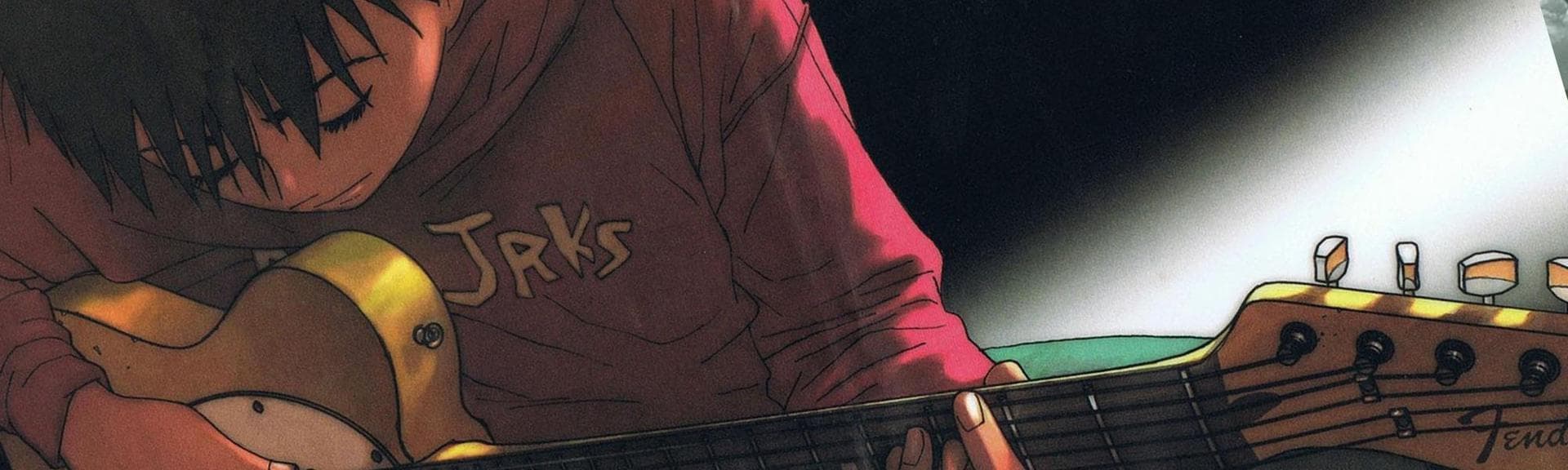
14 year old Yukio Tanaka, AKA Koyuki, is at an awkward point in his life. Beset by the ennui of adolescence, he’s at that stage where he needs to start seriously thinking about his future... But how can he figure out what he wants to do when he grows up, when he can’t even figure out what he wants to do now? Devoid of passion and with no sense of direction in life, a series of chance encounters lead him to the doorstep of Ryusuke Minami, a moody musician with big dreams and ruthless ambition, as well as a spunky younger sister who’s just about as mercurial as he is.
It’s thanks to the Minami siblings that Koyuki’s hidden talent for singing is finally discovered, lighting a fire in his heart and leading him down the long, turbulent path of music. Sensing Koyuki’s potential, Ryusuke recruits an energetic screamer, a stoic bassist and a savant drummer to help fulfill his dream of forming the ultimate band; Beck. They have the chemistry, they have the talent, but with every step step forward it seems like they’re forced to take two giant steps back. Will this ragtag group of nobodies fall victim to the harsh realities of a cruel and unforgiving industry, or were they truly meant to hit in America?
I don’t particularly enjoy saying negative things about this show, so let’s just rip this band-aid off now... The animation in Beck sucks ass. It looks okay at times, but it looks like someone spilled their beer all over the animation cells at other times. There are plenty of anime that I’ve forgiven for occasionally slipping into what other reviewers have called the ‘runny egg aesthetic,’ Toradora being a noteworthy example, but not only is it used way more often in Beck, it’s used right off the bat, taking up the majority of the first two episodes and never really going away completely.
You could argue that it’s a reflection of Koyuki’s mindset evolving throughout the series, but I pulled that explanation directly out of my ass, and I don’t know how well it holds up. It probably doesn’t. What’s more realistic is that it’s probably just a matter of mid-2000s budget crunching, as the animation never looks quite good, but it only ever drops below the bullshit line right before some massive concert scene needs more money poured into it. Thankfully, those concert scenes are usually pretty impressive looking, even if they had to rely on simple animation cycles juxtaposed against some dodgy mid-2000s CGI to pull off what they did.
This is a Studio Madhouse production, however, meaning that while the animation quality is heavily inconsistent, the artwork quality is anything but. The level of detail is nothing short of immaculate, with every single setting feeling like it has it’s own unique personality and history. The character designs are mostly realistic, with almost everyone in the main and supporting cast looking like people you could actually see walking around in Japan, with the exception of a certain bully character, two patchwork dogs whose frankensteiny appearance is never adequately explained, and one of Maho’s friends who looks disturbingly like the long lost little sister of Junji Ito’s fashion model.
It’s kind of hard to talk about the ost, because this show doesn’t actually have one, at least not in the traditional sense. Beck is a show about music, and Madhouse made the interesting choice to limit the entire soundtrack to just music being played in-universe. Unless someone’s holding an instrument or listening to a recording, the only thing you’re hearing in the background is the environment around the characters. Distilled chatting, crickets, flowing water, traffic and the like, and to that effect the sound design is just exquisite.
As far as the actual music goes, I’m gonna be real with you guys, I don’t know jack shit about music. Most of what I like is associated more with positive memories than actual critical taste for me. I’d love to hear what someone who’s actually familiar with musical theory has to say about it, but all I can tell from my untrained ears is that it sounds really cool. It’s a bit on the generic side, but I mean that in a good way, as it has a timeless quality to it, like I could hear it on the radio in any generation and it would blend right in, occasionally cheesy lyrics be damned.
It’s mostly rock, but with elements of punk and grunge(I think) but the most impressive thing to me is that some of the songs are written in English even in the sub, and it doesn’t sound broken or poorly translated at all, which is kind of a rarity in anime. This may be due to the fact that The Beat Crusaders, whose music is featured heavily in the series, were themselves inspired by American indie rock, and had a lot of previous experience with English lyrics. Having said that, I’m a monolingual dumb English speaker, and listening to English language songs in a heavy Japanese accent is kind of distracting, but that’s where the English dub comes in.
It’s pretty common in anime for insert songs to be left in Japanese, mainly due to either a lack of effort or resources from the studio, or some issue regarding the rights to the music. Thankfully, Beck is one of those rare shows where the entire in-universe soundtrack is dubbed in English, and Funimation clearly had a blast putting it together. Most of the heavy lifting here is performed by Greg Ayres, a musician in his own right who has an impressive track record for singing anime songs in character, and Beck is no exception. He plays Koyuki mostly in his natural voice, tweaked slightly to crack with puberty, and he approaches his character’s songs as Koyuki naturally would... Rough at first, but well pitched and with a hint of vibrato that grows as his delivery softens. Even with the language barrier removed, he generally sounds a lot smoother than the seiyuu.
For the most part, my preference for English dubs is a personal choice, rather than a matter of objective quality, and my preference for genuine English over non-native broken English is much the same. There’s a lot of instances in this show of Japanese people trying to speak or sing English, and at least when it comes to the singing, I can understand people liking the charming awkwardness of Koyuki’s singing, but there’s a part of the show where it does become kind of an issue. Ryusuke and Maho are canonically bilingual, having spent much of their childhood in New York, and if they had been played by seiyuu who had similar childhoods... AKB0048’s Rina Hirata, for one recent example... This could have been pulled off believably, but they did not go that route, and the results are awkward to say the least.
Granted, portraying an English speaking character at all in a dub can be tricky, what with the rest of your characters not speaking it. A show as grounded in reality as Beck probably couldn’t get away with subbing in a different language like Azumanga Daioh did, so they went a different route by ignoring the language barrier almost completely. Aside from one or two jabs between Koyuki and Maho, it’s never brought up, and I guess I can understand why this might be annoying for some people, but if I have to choose between this and some supposedly native English speakers trying their damnedest to sound natural off of phonetic cue cards, I’ve made my choice.
Luckily, the rest of the cast is just as solid as Greg Ayres. I don’t think anybody would be surprised to know that voice acting heavyweights like Eric Vale, Jerry Jewel and Johnny Yong Bosch slot perfectly into their roles within the main cast, or that Justin Cook goes absolutely nuts playing the band’s wild hype man, or that actors like R Bruce Elliot, Jason Douglas, Laura Bailey and Colleen Clinkenbeard pop in from time to time with some damn near unforgettable supporting roles, but extra credit has to be given to Brina Palencia. This role was relatively early in her career, but it’s a hard one to forget, as she nails all of Maho’s nuances while sounding cool doing it. She doesn’t have too many song numbers, but she harmonizes with Greg Ayres perfectly, and her performance of Moon on the Water is so good she’s still getting requests to sing it at conventions to this day.
It’s hard to be objective when this is my favorite English dub of all time, and aside from some awkwardness I can’t totally condemn the sub, but at the very least, do yourself a favor and watch the dub at least once.
So how does one critique an anime? Do we analyze the plot, talk about the characters and story, quantify the production values and compare all of that to our over-all personal enjoyment of it? Well, normally yes, something like that. But there are exceptions. Every so often, you come across an anime where the core value isn’t so much in the intricacies of the plot, but in personal experience. It’s not so much whether it’s good or bad, but whether or not you’re picking up what it’s putting down. Shows like FLCL, Wolf’s Rain and Serial Experiments Lain eschew the normal conventions of story-telling to instead explore high concepts in ways that risk alienating viewers that aren’t along for the ride, in order to deliver a more meaningful experience for the viewers that are. Even some eclectic comedies like Nichijou, Ebiten and the second Negima series can honestly come off as try-hardy and exhausting for anyone who isn’t vibing with their particular brand of off-beat, goofy comedy.
I don’t know if it’s fair to place Beck under this category, as it’s a very normal and straightforward series at it’s core, but at the same time I can definitely see why some people would consider it kind of boring. Beck is undeniably a slow paced, low stakes anime with no real plot to speak of. Normally a show like that would be some sort of comedy, with a small group of extreme personalities with a common interest/situation bouncing off of each other, but Beck isn’t really that either. That’s not to say it can’t be funny, it definitely can, but it seems to be more concerned with drama and character development than actual entertainment, and in all fairness, that sort of thing can be a hard sell for anybody, so what kind of experience does it have to offer that elevates it beyond those limits? Well, if you’ll excuse the hyperbole, I believe Beck to be the greatest coming of age anime ever told.
To be fair, coming of age anime aren’t rare. Studios Gainax and Trigger have built empires on the foundation of growing-up stories, after all, and countless slice of life comedies have ended with the cast moving onto the next stage of life, usually graduation. What these shows usually seem to forget, however, is that the age range this genre covers is also one of the most important transitional periods in a person’s life. Coming of age stories shouldn’t be about overcoming some evil force, and they shouldn’t just cover four years of fucking around until suddenly you have to study for entrance exams. They should be about choices, and not just choices between right and wrong, but the small, seemingly insignificant choices and random encounters that can ultimately determine your path in life.
I mean, you can watch any anime while pointing at deceptively pivotal moments, but I’ve never felt as conscious of the butterfly effect in action as I am during Beck. Koyuki met the Minami siblings through a series of encounters, choices and occurrences. These same factors lead to him meeting his mentor, a gung-ho bachelor who coaches him in swimming and guitar. A random encounter leads him to an extortionist who turns the school against him, and an impulsive decision he makes in the face of that leads him to meeting his new best friend, a music nerd who would go on to replace the band’s drummer. Koyuki’s relationship with Maho is riddled with a series of choices, coincidences and mistakes that make their dynamic so addictive and yet so frustrating.
Every turn this show takes, there are doors opening, doors closing, low moments, high moments, and above all, the ever present passage of time. Issues take multiple episodes to resolve, fights between friends last for weeks, and in that time, life is still happening. Characters leave the story not because their arcs are complete or because they died, but because they just naturally weren’t meant to be in Koyuki’s orbit forever, and their paths just diverged, but it never feels like lazy writing. It never feels like a missed opportunity, even when it canonically very much is. There’s a reason there are so many insignificant moments in this show, separated by listless fades to black like a series of old memories.
Beck has an intense vibe of nostalgia to it, and part of that comes from the atmosphere of the story. I mentioned earlier that the artwork was immaculately detailed, and the OST was made up of purely in-universe sounds, and these two factors merge brilliantly to create a sense of immersion that puts you right there in Koyuki’s shoes, and I’m not exaggerating when I say there are scenes where I can practically smell the air around him, whether it’s the dense sweaty musk of an excited crowd in the shitty basement of some night club, or the mist of a lonely school pool that’s so empty you can practically sing with your own echoes.
When you write a story about adolescent angst and ennui, you don’t just run the risk of melodrama, you accept the inevitability of melodrama, but a good show knows how to keep that shit in it’s proper lane. Koyuki’s everyday issues aren’t the end of the world, and hell, aside from an admittedly questionable storyline from Ryusuke’s backstory, there’s no real danger to anyone, no lives at stake, and no ticking clock. As such, this show doesn’t really have a proper ending, because until you die, neither does life. The conclusion doesn’t really concern itself with tying anything up, or letting you know how each character’s future is likely to pan out, rather, it sets out to answer a question that’s applied to all of us at some point; Is Koyuki ready to travel the path that he’s established for himself? Are you, as the viewer, confidant that he won’t peak after his accomplishments are behind him, and that the sacrifices he made to get there won’t hurt him in the long run?
Beck Mongolian Chop Squad is available from Funimation. The original DVDs, released under the title of Beck, are no longer available because... Well, you can probably guess. I’m kind of surprised they tried to release it under it’s original title in the first place, but if you’ve ever handled a copy of Shangri-la, you’re probably used to Funimation messing up their property titles. They eventually released a SAVE DVD set under the name Mongolian Chop Squad, which is an acceptable alternative to the out of print Beck copies, but if you alphabetize it under M instead of B, I will find you and make it my business. The original manga is available from Comixology, and I just learned yesterday that there’s a live action movie. I’ve watched a couple of clips, and it looks pretty solid. The original soundtrack is way out of print, but it’s surprisingly easy to find an affordable used copy on Ebay. As for the dubbed version of the songs, I don’t know, try a Youtube ripper.
Remember before, when I said that I could understand Smartphone Isekai being someone’s comfy anime? Beck is my comfy anime. It’s not a perfect show, for sure... There are a few episodes in the middle that are tedious even by my standards... Koyuki’s mom has a presence throughout the series, but not nearly as much as she should have, all things considered... And, again, there’s the animation. The fact that it doesn’t give me the feels as often as Battle Athletes Victory does is the main reason it’s been stuck just outside of my top ten all this time, but that’s still some pretty high praise. This is another anime that I secretly wanted to review back when I still had a blog, and frankly, I’m glad I waited until I was ready.
I give Beck: Mongolian Chop Squad an 8/10.
25.5 out of 26 users liked this review