Gin Tama
a review by AnotherBadger
a review by AnotherBadger
"I started chasing after that weirdo samurai's back, and without even knowing why, I kept chasing after it and never stopped."
- Shinpachi, Lesson 601
So, where to start with Gintama?
When I first started reading this series, I was completely blindsided. I went in knowing that it was a comedy... and that was about it. I had no idea what was coming and I am so grateful for that.
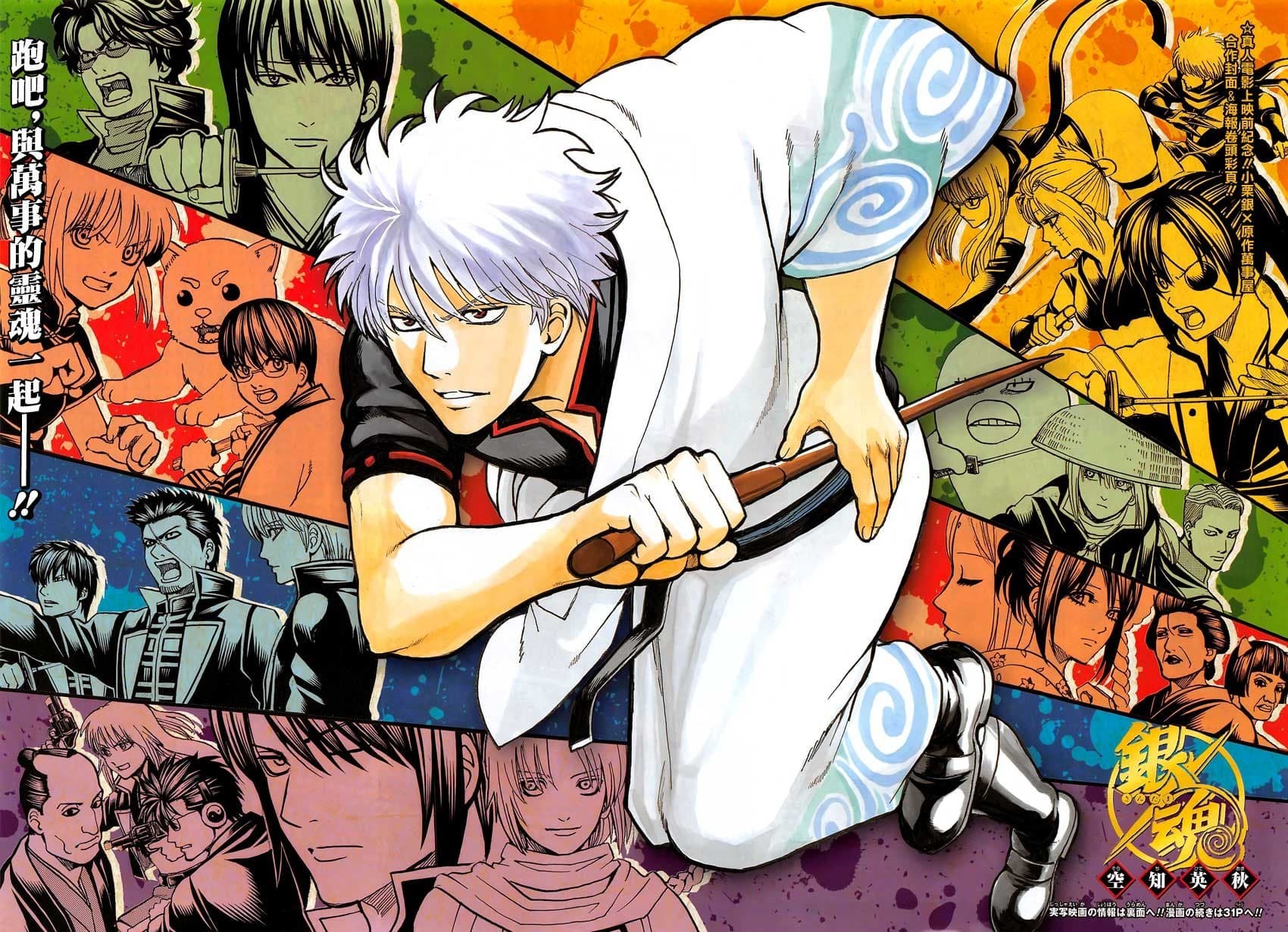
Easily the best element of this incredible series is the cast of characters that populate its pages. Sorachi has the unique and underappreciated skill to be able to write so many well-developed characters and have them remain memorable. Where other mangas would often cast-off characters, or struggle to balance a large cast, Gintama manoeuvres between characters with ease. From the main cast to the one-off appearances, Gintama really demonstrates how to create interesting and engaging characters, whether they are based on historical figures or are entirely new creations. I have yet to see anyone have the same top ten characters which really shows how much of an impact each character has on the series.
Part of what makes the Gintama cast great is that when we meet them, they are at their worst.
Not in the typical Shōnen way where they are at their weakest and only need a bit of training., No. These characters are the worst versions of themselves and they barely change. The lead is a lazy samurai who would rather spend his day picking his nose and reading Jump. Our heroine is an alien kid who picks up on the worst habits that humanity has to offer. Then rounding off the trio is a pair of glasses that struggles to maintain his straight man routine.
The rest of the cast isn’t much better: a stalker ninja, a stalker gorilla, a mayonnaise addict, an uncontrollable sadist, a man in a duck suit, and more fill this series to the brim. And, while some of these traits may take a while to get used to, they become just as important to the characters as their good traits.
Every character is an important part of Gintama, helping to build the world that surrounds the main trio and becomes reassuringly familiar to the readers. Watching characters from previous one-shot stories come back is a great joy and part of the reason this works so well is that they are allowed to be the main characters of their own stories:
“It is those imperfect people that are the perfect protagonists.”
Another reason that the characters work so well is that they are built by Gintama’s style of comedy. They are shown to be human (and amanto) in painfully relatable ways. While their worst character traits are often exaggerated, a lot of their struggles ring true to everyday life. From a homeless man choosing between a steady job or his morals to a shogun who wants to experience normality, there is a breadth of experiences covered which means there will be stories for everyone to enjoy.
The comedy itself can be very subjective. For some, the toilet humour will be too much and some jokes may fly over your head. I will say that this series is a great way of finding new things to read and watch, or at least appreciating these series more. The comedy can be eclectic, but most chapters will provide at least a couple of laughs. This is a remarkable achievement when you realise just how many short comedy stories there are.
Sorachi is also a master of parody; either picking apart a well-used trope or targeting a particular series. A character could be going about their day and suddenly find themselves embroiled in a battle against ‘Breiza’ for a packet of cigarettes. The intergalactic setting really gives Gintama the scope to do anything and everything and it certainly doesn't waste this potential.
While some have suggested skipping the comedy chapters, that would be one of the biggest mistakes you could make. These are the arcs where you fall in love with the cast, where we learn about their fears, hopes and dreams. These are the arcs where we learn that the main character has a crippling fear of ghosts, or that the badass courtesan of death can’t handle her alcohol. Removing the. comedy arcs would change the experience of reading Gintama entirely.
The comedic stories also have some really important lessons to learn hidden in them, and establish the key character traits that are followed throughout the series. This is perhaps most succinctly summarised by Kagura:
“I like to fight. That’s the Yato’s instinct… but I won’t give in to it. However, from now on, I’ll fight with my Yato blood. I’m going to fight to change.”
The impact of these comedic arcs can be felt in serious arcs. From Kagura mirroring her bloodthirsty brother to Gintoki often having his past reflected by the antagonists he faces. The longer, serious arcs may have been what launched it into the pantheon of manga and anime, but Sorachi is an absolute master of the short story; with some of the most emotional arcs spanning only a couple of chapters yet stirring up an all-consuming whirlwind.
Over the series, you can feel Sorachi’s confidence grow as he begins to spin more intricate tales, all while not losing his usual self deprecating style. It would have been easy to forego the comedy of Gintama in favour of telling a completely dramatic story, but this doesn’t happen. The moments of absurdity and comedy remain, preventing the series from becoming something unrecognisable.
The serious arcs really work to solidify the relationships formed over the series. While it usually rests on Gintoki to ground the cast when things become overbearing; Sorachi allows other characters to fill this spot. It is these moments where the series really shows its heart. Watching a young alien risk her life for her adopted home even if those who reside there scorn her, or the Shinsengumi trying to protect those they care about despite the politics, we become a part of their world. Sorachi tackles a wide variety of themes through these characters and manages to make it work really well.
Perhaps it is stubbornness, not only his part but on the part of the characters themselves. Even when they change, it is never in a way that feels out of character, and if it is; you can bet that someone is waiting on the side-lines to push them back on track:
“If one of us goes astray, the other two will beat some sense into him. It’s always been like that. That’s why we’ll always stay on the straight and narrow.”
What makes Gintama truly stand out beyond everything else is Sorachi’s commitment to its premise and the willingness to go above and beyond to create some unique storylines that would not work in any other story. There are two prominent examples that push Gintama into being something more than manga. The Character Poll Arc is probably the most famous instance of this, with Sorachi committing to the idea in such unexpected, but ingenious ways, that it will catch any new reader off guard.
The other arc that completely pushes the boundaries is the Kintama Arc. It perfectly encapsulates everything that Gintama is while contained in a plot that only Gintama could pull off. This is down to many converging reasons and, if any had been out of balance, it could have easily gone wrong or lacked meaning. But Gintama shows how well Sorachi balances the comedy, drama, and characters while including enough self-awareness to keep the reader on their toes:
“The whole point of this ‘Kintama’ arc was to show just how pathetic a protagonist you are, Sakata Gintoki… No… to show just how deplorable the manga known as Gintama is.”
Sorachi’s confidence in his storytelling is mirrored by the growth of his art style. Numerous panels demonstrate how much he has grown, with the serious arcs really demonstrating his skill. This is especially true of Sorachi's ability to capture facial expressions. I can easily remember my favourite panels and pages, with Lesson 516 being a prime example of his skill.
Gintama also does a really good job of mimicking other art styles to really nail the parodies and Sorachi never shying away from portraying the characters in an unaesthetic light. It is a series that revels in imperfection.
And this is what makes it such a comforting series to read. It may sound surprising to those who haven’t read it, but there is a deep reassurance in Gintama. Maybe life won’t be spectacular or meet some impossible standard set by those around us. Maybe we won’t be Pirate Kings or become Hokage, but that doesn’t mean we've failed. There is a constant reassurance that it’s ok to feel lost and unsure. As long as we stay true to ourselves, and protect those we care about, we can keep our heads held up high. It might not be easy, but the characters who we grow respect are those who stick to this belief.
In most series, characters grow at such a rapid pace that they sometimes barely resemble who they once were. But the cast of Gintama remain highly flawed, and these flaws are a part of what unites them. It ties them to each other and it ties us to them. It wouldn’t be Gintama if they were anything other than imperfect in such noticeable ways.
Gintama also has one of my favourite takes on friendship; foregoing the usual notion of being connected no matter what, or that similarities will unite us in spite of differences. Instead, it is the differences that bond these characters together:
“We’re not a family or anything. We’re not connected by blood and were born in totally different places. We’re not connected at all. And it’s because of that, that we won’t let these hands go.”
Sorachi really created a masterpiece buried under an impressive amount of toilet humour. Gintama is a series that will always stay with you if you give it a chance.
A Short Summary -
Gintama is one of the most unique reading experiences to exist. The characters, the comedy and the plot are out of this world and the art improves in such a natural way that it is almost unnoticeable until you compare the first and final chapter.
The only two reasons to not read Gintama is if A) you don’t like manga with a lot of writing, because a lot of Gintama relies on speech and wordplay, or B) you really, really, really don’t like whacky/absurd comedy or toilet humour.
If these don’t apply to you, then give Gintama a shot because if you do enjoy it, then it will be one of the most rewarding reading experiences you could have. Just be warned, if it hits the mark for you, it will make a lot of other series pale in comparison.

87.5 out of 90 users liked this review
