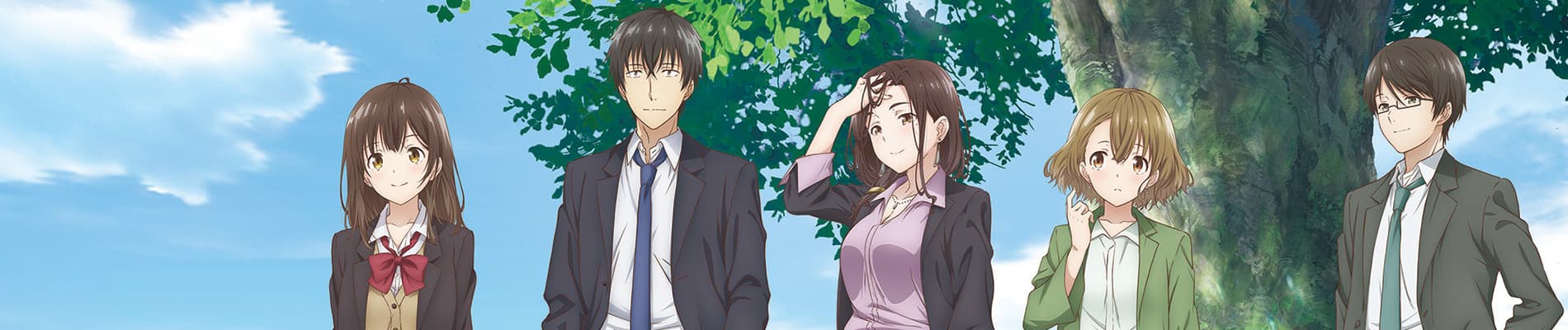
HigeHiro is the embodiment of a series with good intent proceeding to then absolutely shit on them while being comically unaware of its failings. It covers a highschool runaway turned prostitute by the name of Sayu, who crashes in at the place of our resident main MC Yoshida, starting a rather heartwarming story about her increasingly finding family in Yoshida as well as others and becoming more and more self-sufficient on her own. This works for the first stretch of the series, but runs into numerous issues even early on that only become more and more exacerbated.
Even early into the show, there's a heavy emphasis on Sayu needing to pick up her bag and head back to her family - which considering this is a highschool runaway with clear traces of emotional abuse, is obviously out of the question for any sane person to do, yet Yoshida and the rest of the cast keep insisting on this like it's the only option before even bothering asking Sayu why she ran away in the first place. Sayu is desentized involving sexual activity, and this is unsurprising considering her experiences until meeting Yoshida, yet her flirting with him only increases as the series goes on regardless of what happens - even if Yoshida rejects her advances. This colors their interactions in a rather inappropriate romantic light, with the two often blushing at events like going to the fireworks or stumbling on top of each other in a manner reminiscent of a romantic comedy - which is a problem, because this show's romance is rather poor and it certainly can't be described as comedic, especially the later into the show we get.
This series has precisely zero tact involving the subject matter it is covering. This includes Yoshida's coworkers chastising him for keeping a girl with him and encouraging him to kick her to head home - which is doubly astounding considering that all of these people are adults and as such should be aware that her reasons for running away must have been rather heavy if she had to resort to the measures she had. It doesn't help that neither character is well-developed, with the majority of their characterization surrounding their feelings for Yoshida or position on Sayu staying with him, but never much about them personally - in fact, we don't get to know much about the cast at all minus Sayu and her later friend (and easily best character in the series) Asami. Asami is the closest thing the series has to a well-rounded character, and her characterization involving going against her parent's wishes on what to study as well as friendship with Sayu was fairly well done and marked what I consider to be the strongest point of the series. Unfortunately, the later into the series we go, the more its issues run rampant.
A point of criticism against the series in Japan is that Yoshida's actions are illegal, as keeping a minor against the wishes of their parents with an adult is legally perceived as kidnapping (though isn't considered kidnapping if the parents don't press charges/nobody reports it). While I cannot speak to the validity of the criticism made by locals, it misses another point entirely, being that she had no clear authorities to turn to for her troubles (something unfortunately common among most victims of various shades of abuse and mental trauma worldwide) and had to resort to leaving her family entirely. Various series have explored these points in different ways; Ryukishi's work in the Higurashi and Umineko visual novels, for example, extensively cover how abuse can occur in tight social structures, helped greatly by Ryukishi's own experiences as a social worker and how these experiences can materialize. Monogatari, for all its flaws, extensively covers this subject in several character arcs - shown from both the perspectives of victims as well as perpetrators - and handles it exceptionally well, particularly in Nekomonogatari and Second Season. Chi no Wadachi is a pretty neat psychological horror manga, showing to what extent abuse can scar someone and diving fairly deep into the victim's psyche. And there's countless media in the sphere that has covered this topic with quite a bit of care on some level - the recently finished airing fantastic Fruits Basket reboot being yet another example, the Little Busters visual novel's Haruka route being one as well to cap things off.
Unfortunately, as mentioned before, HigeHiro is not a case where this is handled particularly well. Sayu gets guilt-tripped all series long to essentially fuck off and return to her family, and her backstory showcases her family being sociopathic asshats who didn't care for her trauma at worst, and negligent at best. Her mentioning her background unfortunately does not change the pace at which she is pushed to leaving Yoshida and returning to her family, which is doubly astounding considering that everyone interacting with the situation minus Sayu is an adult, and her family as insanely toxic - her mother, for example, is absolute scum, immediately conservatively enquires on her daughter's chastity and talks about the trouble she caused her. One would expect the narrative to confront the incredibly conservative attitudes being shown here, which played a huge role in Sayu fleeing from her family. Instead, Yoshida bows his head to her and everything is resolved seamlessly, which leads me to another issue involving the series; it has no idea how to deal with antagonists.
The earliest instance of an antagonistic character in the series is some playboy who attempts to rape Sayu, which actually is a pretty accurate portrayal of standard sexual assault; victim already knows the perpetrator, blackmail, sexual harassment and so on. The issue is that once the playboy is chased off, the next time he's in an episode he's suddenly conscious of hiding Sayu from her brother stalking the supermarket they're working and is all of a sudden portrayed in a positive light, with his previous actions forgotten. This...is a recurring problem in the series, with Yuzuha and Sayu's moms similarly being victims of the series' strange willingness to forgive people who probably really shouldn't be forgiven, and sweep their actions under the rug due to its clear conservative tint.
There are, however, unique problems to the anime that do not exist in its light novel or manga counterpart. Volume 3 of the LNs - which gives Yoshida quite a bit of backdrop and characterization - is casually skimmed through, making Yoshida himself come off as rather flat, with very little characterization. In both other versions of the story, he's given some exploration of his past with a previous girlfriend, and his distant approach to personal relationships is emphasized to contrast with Sayu's, who receives similar development in the next volume that the anime adapted more concisely. 5 volumes is quite a bit for a 1 cour anime, and while I do think Project No. 9 had a lot on their plate here - this being a decently budgeted anime right after releasing Tomozaki-kun - this show clearly needed more runtime to expand on its cast of characters, and I say this as someone familiar with the source material and up to date with the manga as of the time of this writing. This could have at least somewhat recontextualized some of the dynamic between Sayu and Yoshida, and I'm not sure why Yoshida's backstory was dropped out of the anime in favor of a fireworks date.
Perhaps no larger offender of HigeHiro's issues exists than its ending, which while acts as a bookends to the beginning of the story, also serves as a clear romantic conclusion considering the romantic and sexual friction between both Sayu and Yoshida - culminating in a rather questionable conversation between the two before his flight home wherein he mentions that he wouldn't mind being romantically engaged with her once she comes of age, but won't wait for her to pursue a different relationship. Judging by the fact he was willing to invite her into his apartment post-timeskip, that leaves very little to the imagination about his relationship status and where their relationship goes from her - while I do think age gap stories can be interesting depending on their execution, there's no mention of the disproportionate power dynamic between the two or the fact Sayu very clearly spent so much time being unhealthily attached to Yoshida, who while her savior also acted as a guardian over the course of the story.
On a technical level, the series is competent; it's decently directed and nice to look at, the character designs are attractive to look at and the animation remained largely consistent, with clear jumps in quality in better moments in the series. The sound design is worth of praise, with pretty good voiceacting, a neat OST and consistent sound effects - to say nothing of the OP, which is pretty nice, and the ED, which is pretty catchy and highlights what I consider the series' best parts. Some people found the fanservice distasteful and while I can't say it bothers me much, I can see where they're coming from involving how the show covers it.
In conclusion, HigeHiro starts off decently enough, but rapidly disintegrates under the weight of its subject matter and themes, of which the author is clearly unequipped to tackle. I wish 'em the best of luck in future endeavors - the series' better moments are clear indicators of what they're capable of - and that they'd improve from this series' failings.
Thanks to anyone and everyone for reading this review. Any and all feedback would be appreciated.
Source for the Japanese reception to HigeHiro: https://www.youtube.com/watch?v=jDwtfXUGiZ4
306.5 out of 399 users liked this review
