DISCLAIMER: My english is bad etc. I think it’s readable tho. Corrections are appreciated anyway.
Most of the review can be understood without spoilers as most of them are just examples made to prove my points and such. Some mild spoilers are present however, as the spoiler format for anilist really breaks the text's fluidity.
Saint Seiya is a 1986 battle shounen manga written by the influential Masami Kurumada and it might be the best one to represent his early career. While Saint Seiya was surely popular and it´s both loved and hated by a fair amount of people, most of it´s readers(more like watchers, actually) thoroughly ignore pretty much everything in the manga except maybe the character´s names and techniques. It´s a work treated as unraveled, but you never see anyone discussing it´s themes or story and almost no one seems to understand it even in the most basic level. I´m also guilty of this, as it´s the anime that got me into anime and I've known it for almost two decades, but still took me all of that time, two watches and three reads(one incomplete and two full) to truly grasp it.
If you believe in everything I said until now you must be asking “Why is that? Is Saint Seiya truly such a complex work of art?” and the answer is: no, not really. I believe there´s two major explanations for this phenomenon. First, most of the people who consumed Saint Seiya did so trough the anime adaptation which is shaky at best and completely ruins the manga´s fluidity and cohesion. And second, the action in the manga is so frenetic and constant that´s easy to simply forget to scratch it beyond it´s surface, as there seems to be entertainment enough in it´s fights and it´s one-liners.
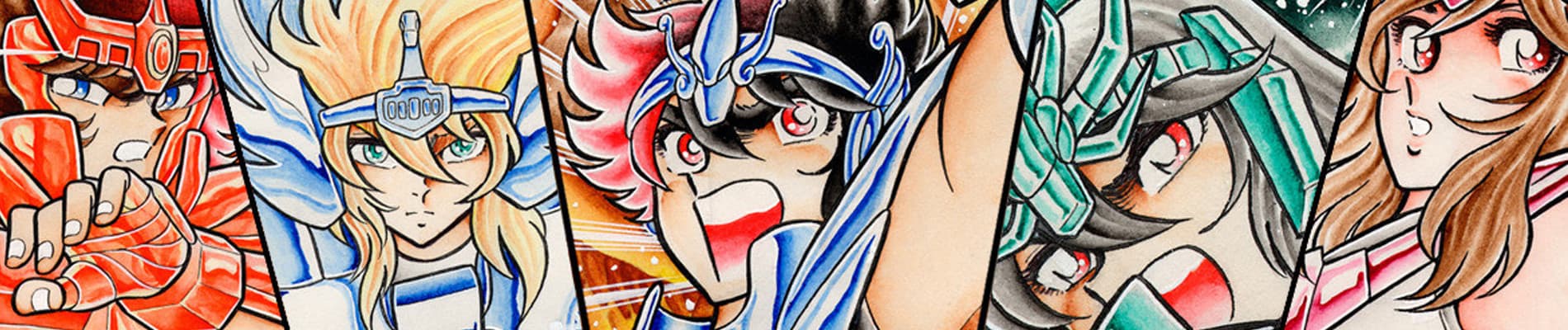
There are three major points that makes Saint Seiya a unique and truly great manga and battle shounen. Two of these points call for longer explanations, but there´s one I can summarize in this one paragraph: character visibility. The only other battle shounen I can think were the main cast is so equally worked on is maybe Yu Yu Hakusho. I actually believe this to be one of the main reasons why Seiya is so hated on the fan base(besides the anime killing half of his personality). Saint Seiya is one of the few manga were it won´t really hurt you to hate the protagonist, as every character has their own spotlights in every arc and you can pick your own favorite from the main 5 with no fear. They will constantly have good fights and be worked on for the rest of the manga.
Before going on the next two points, I’d like to clear some misconceptions about the manga. A lot of people disseminate that it’s a work riddled with blatant plot holes at every corner, and while that’s true, it’s something exclusive to it’s animated version. The anime writing changes several points that end up creating severe contradictions on the story(such as
Spoiler, click to viewclick to hide
having 2 Popes, the Sagittarius Gold Cloth initially being presented as the only Gold Cloth, Hyoga’s master, Aldebaran losing to a weak specter without being deaf, Shura being loyal to Athena, eliminating Shaka’s and Aiolia’s first appearances and etc.) and the manga dialogues are so diluted in filler lines created to gain time that they actually become mostly incomprehensible and meaningless on the animated version. Not to mention terrible decisions such as making the main characters
Spoiler, click to viewclick to hide
strangers rather than brothers, removing almost every dialogue with personality and a LOT of other things. The manga plot is actually heavily and adequately foreshadowed and it’s mostly consistent; characters also aren’t nearly as shallow as their anime counterparts.
Another common complaint is that the arcs all follows the same formula. I don’t really think that’s a problem, as one-on-one fight corridors are the ideal format for a battle manga in my opinion, but even then that’s not really true. The Black Saints arc don’t have match-ups as well established as other arcs, the one-on-one sequence on Poseidon is interrupted at the arc’s climax and leads to a pretty interesting conclusion and Hades’(which is pretty much 1/3 of the manga) doesn’t resemble the formula in the slightest.
Now to the first major point. Saint Seiya is great at working it’s themes and keeping loyal to them. You have a pretty big number of them since there are a lot of more allegoric fights made to send a point across(
Spoiler, click to viewclick to hide
Seiya vs Misty, Hyoga vs Camus, every Shiryu fight, you name it), but the two main ones are Brotherly Love and Self-Sacrifice. The main 5 characters are orphans who grew up in an abusive environment and were sent to face death-threatening training in isolated parts of the world, spending all of their young years with barely any warmth and human company. However, by becoming Saints they truly form family bonds and find the happiness of loving and being loved, even a midst their harsh trials and deadly fights. From the point the main 5 finally become a family, their dialogues when reunited are always touching and wholesome and really makes you understand the value they put in their relationship(and again, that’s something absent in the animated version), there also quite a few one-to-one dialogues in key moments that makes wonders to show the bond they share, especially Ikki whose character pretty much resolves around being the rigid yet caring big brother for the group. The second major theme is the most important, but also the most silent of them all, as rather then being constantly shouted, it’s demonstrated trough actions and character progression. As the name implies, the Saint’s journey is a journey to become Saints. They gradually go from characters with personal motivations to nearly inhuman warriors of selflessness, as that’s the destiny they chose to accept. Saint Seiya(and Kurumada in general) is heavily influenced by Buddhism and Christianity and that really shows in their characters.
Spoiler, click to viewclick to hide
Aiolos and Saga can easily be compared to Jesus Christ and Judas, and while Saga may be a bit more far fetched, the figure Aioros represents in the story is truly that of a holy martyr, he is even purposefully presented as an eminent figure even while being the brother of an important and live character and remains immaculate even when all the other dead gold saints are somewhat dishonored. That’s the general idea, but I’ll develop it a little more with spoilers next.
Spoiler, click to viewclick to hide
We learn almost every character’s motivations pretty early on. Seiya became a Saint in order to get help to find this lost sister, Hyoga wanted to be strong enough to visit his mother’s icy grave, Shun and Ikki wanted to be reunited, and Shiryu wanted to become strong as consequence of the poor and violent lifestyle he led as an infant. It’s good to start talking about this trough Shiryu because he is the greatest exception in the main group. He actually found a family trough his training, he has a close father figure and a romantic interest. He also has grown to be honored and humbler thanks to his master. But the first thing this master tests as soon as Shiryu becomes a Saint, is his willingness to sacrifice him. Similarly, Hyoga’s master Camus sinks his mother grave beyond his reach so he get over this attachment. These are both acts that show us very early what is to be a true saint. It’s not that Saints must be heartless, but they should always be prepared to abandon what they love for the greater good. All the five intially reject that notion actually, all they want is to live peaceful lives and reach their goals. There are quite a few moments that contribute as turning points to that attitude, but the main factor is exactly the relationship they develop. By founding out they are brothers and are not alone, even sharing the sames hardships and fights, they find happiness in their destiny as Saints. By learning the warmth of a loving family, they finally can appreciate how precious that is, and that’s why they are willing to sacrifice anything, even themselves or the happiness they finally found in order to protect the lives of every human on earth. Hyoga is the greatest embodiment of the self-sacrifice theme: he has to abandon his mother, kill his master and brother disciple with his own hands and even put to risk his last family in the world in bloody battles. Seiya, on the other hand, has the greatest progression. He is the most rebellious at first, but learn that maybe Athena is worth protecting while risking their lives together against Jamian. He then sees the willingness of his old rival to sacrifice himself for the woman he loved at the Leo Temple and in the confront with Saga he finally encounters his resolve to fight to the very last consequences, the ultimate abandon and selflessness. That’s why by the end of the manga Seiya looks so peaceful even as he takes a fatal blow from Hades, knowing he’ll never see the sister he searched for so much. At that moment Seiya becomes a true Saint. I could keep listing moments of self sacrifice on this manga endlessly, but I believe this point is already obvious enough.
The third major quality in Saint Seiya is the fights, and all that they encompass. There are essentially two types of fight in the manga: a) fights there are simply power comparisons. Usually for show-off purposes. These are especially common from the Galaxian Wars arc up until the Silver Saints Arcs, but also show up at the beginning of Poseidon and Hades’ arcs. These can still be quite fun and they do a great job at establishing power levels; b) fights were the tension or conclusion originates from external factors rather then the result of a simple power clash. The arc of the 12 Temples is the prime example, since all of it’s fights are this type. There’s no doubt that every Gold Saint is generally far stronger then the main cast, except for
Spoiler, click to viewclick to hide
Shun(and even he draws in his last fight). Rather then powering up and straight up defeating every opponent, the fights are resolved with suicide strategies, moral victories and other sorts of uncommon solutions. That doesn’t mean, however, that these fights are boring in any way. It’s quite the opposite, actually. It’s an arc with nothing but memorable fights and antagonists. These fights also occur on the pattern that the main character is stronger than the opponent, but is somehow handicapped physically or emotionally, such as
Spoiler, click to viewclick to hide
Seiya vs Moses, Hyoga vs Izaak, Shaka vs Saga, Shura and Camus and etc. These “b)” types of fight are were Saint Seiya truly shines. Not only they make a great job of preserving a consistent power level from the beginning to the end of the series, but they also show Kurumada’s ability to understand what makes a fight entertaining and to write battles that go far beyond simply battling. Creative conflicts, character diversity, aesthetic techniques, and an endless archive of one-liners make the experience of Saint Seiya’s battles one of the best in all battle shounen.
The most divisive point in SS and Kurumada’s works in general is the art, without doubt. And while a lot of people dislike his character design(which is fine, I suppose. It does take some using to), I believe is undeniable that his backgrounds, techniques back drops, use of particles and armor design are all really good and can be universally appreciated. So while I can’t say the art is incredibly good, I can say with confidence that is not bad and it’s perfectly readable.
That is not to say Saint Seiya is perfect. The storytelling has a fair amount of flaws, such as important characters being abruptly introduced(such as Kanon and Izaak), the rushed Sanctuary arc conclusion and the really cool but a quite confusing concept of “the same technique never works twice against at a Saint!”. Even so, there is no doubt it’s a criminally underrated manga and anyone who says it’s bad almost infallible fall in one of three categories:
-people who only watched the bad anime adaptation
-people who don’t like the art
-people who weren’t willing to do the most basic text interpretation
So yeah, Saint Seiya is pretty good and if you enjoy battle shounen and have never read you’re missing on one of the most satisfying and fun experiences in the genre.