
I have always been drawn to the infectious capability of raw amateur passion. The clarity and fulfillment that come with the small victories of self-driven creative endeavors are irreplaceable, but capturing that indescribable feeling on screen is an elusive task. ON-GAKU: OUR SOUND is an intrepid venture into the act of creation, and an honest portrayal of the gratification that comes with turning sound into music.
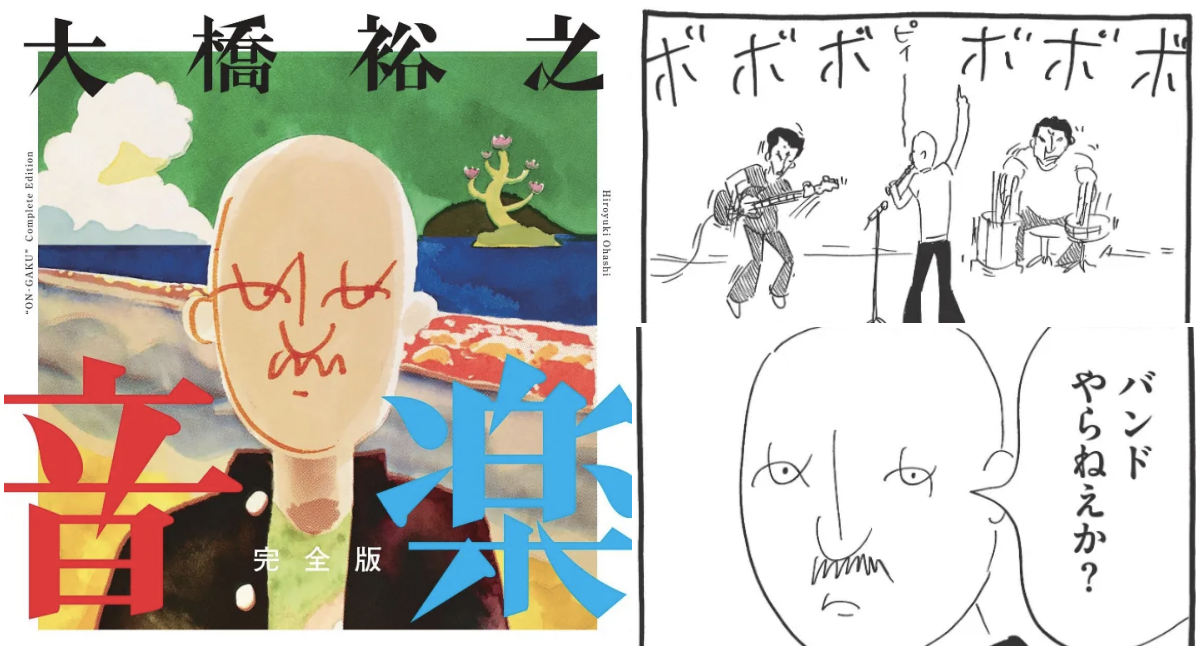
The project itself is a heartfelt illustration of those very ideals and is essentially a one-man show from director, designer, writer, and animator Kenji Iwaisawa. It took a sprawling seven and a half years (obligatory REDLINE meme) through the painstaking process of rotoscoping for this adaptation to come to fruition, with Iwaisawa drawing over 40,000 frames on his own. There’s something inherently courageous about a creator diving into a project without a clear end goal or the established structures to achieve it. By putting the process first, you give up control in exchange for agency. You can feel that sense of going off the cuff and rolling with the process that embodies the spirit of the original work so well. Iwaisawa almost puts himself in the work through the adaptation process, and presents something truly genuine in its wake.
The result is a deadpan buddy comedy with a matter-of-fact delivery, capturing the blithe capriciousness of youth with an effortless swagger. Its particular focus is on the meandering curiosity of a trio of ambitionless delinquents, and their discovery of the limitless possibilities that the power of music offers. De facto leader Kenji, voiced by musician Shintaro Sakamoto, unceremoniously acquires a bass on the street in front of the local dive bar and decides to start up a rock band with his clumsy compatriots on a sudden and formless whim. What follows is not a story of their path to stardom, but rather a proud declaration of DIY sensibilities that is unapologetically frank about its message.
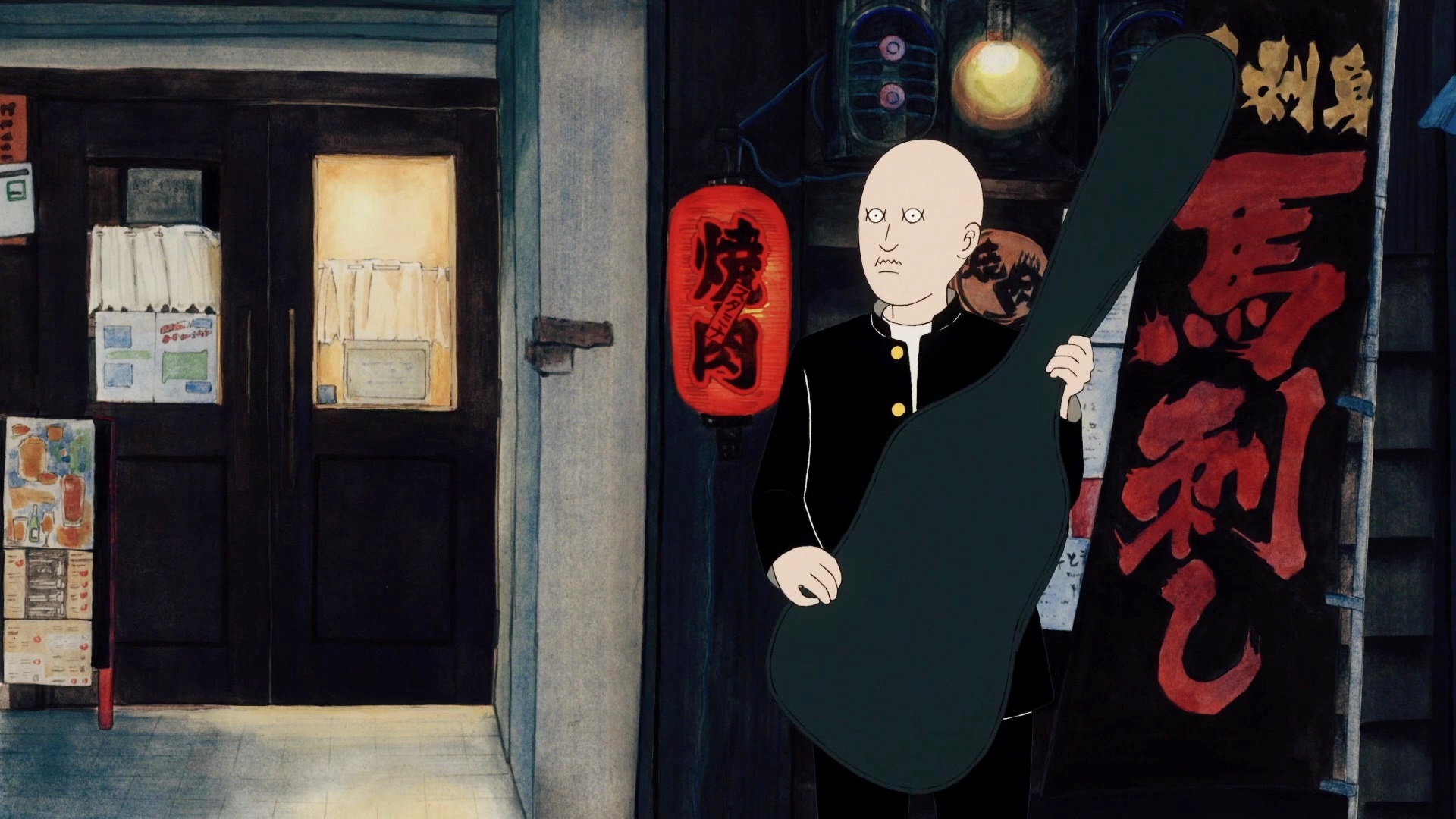
The coarse visual style of the film is no doubt the biggest hurdle to overcome for many anime fans. There’s almost an indulgent level of simplicity to its presentation. It bears a closer resemblance to American cartoons like Beavis and Butt-Head, than it does to the angular and wide-eyed designs of Japanese animation. This is a boon stylistically, but it can be jarring if you’re not prepared. Understanding the process of the film’s production allows a certain amount of forgiveness, but it is undeniably rough around the edges. The characters are depicted with limited and scrawny line work, but this gives a strange richness to their dry expressions, heightening the comical effect of their monotone dialogue. It has a nonchalant temperament that leans into its charming clumsiness as a tool for conveyance rather than a limitation. I always appreciate a unique design approach, even if the result can be a bit messy. Despite that, there is an innocuous fluidity to its rigid designs that provides consistency, and this allows its eventual stylistic machinations to attain a deliberate significance.
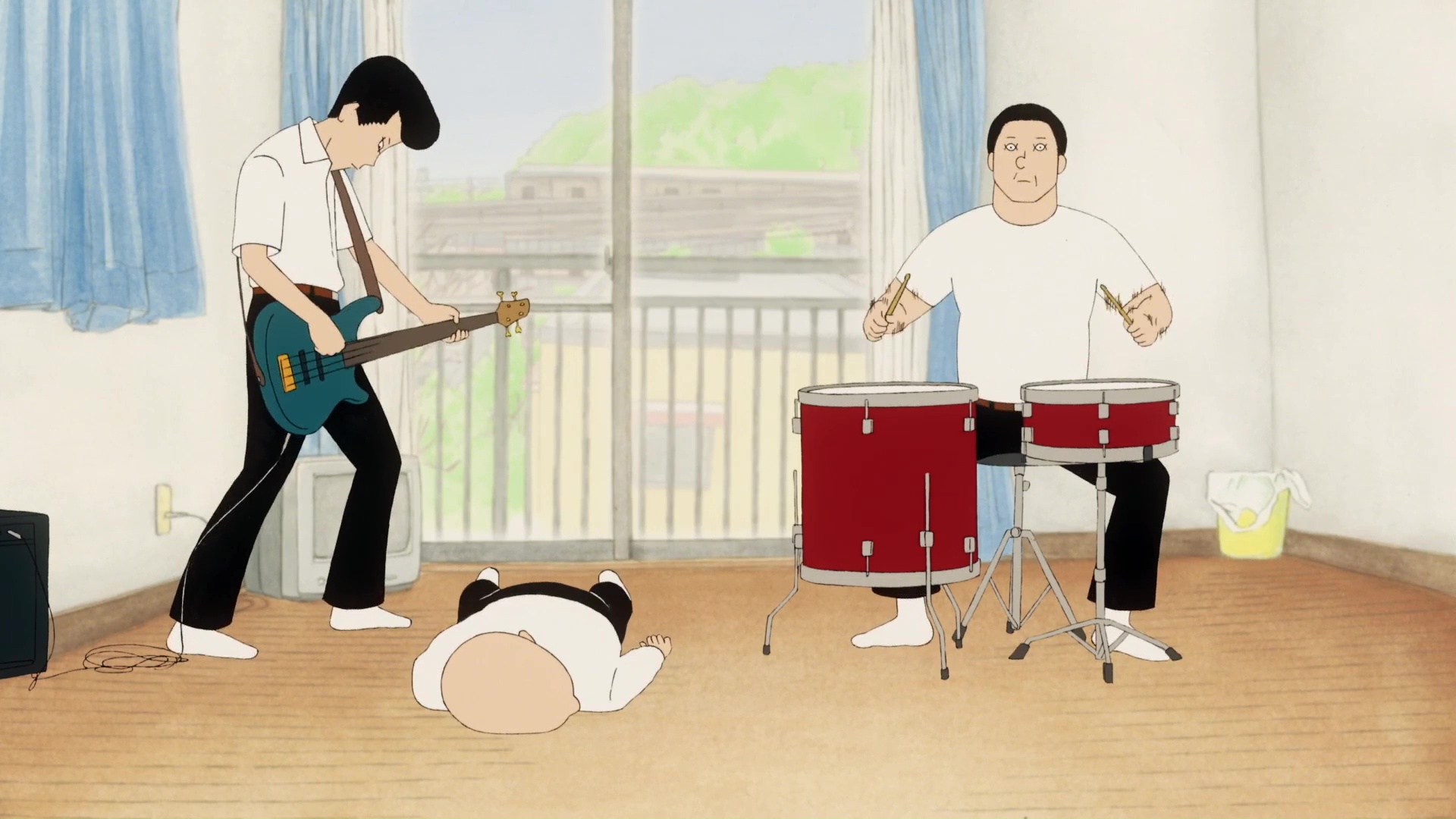
In contrast, the early portions of the film take a purposeful stance of seemingly wasteful stillness. Elongated moments of the camera holding still on the characters’ static expressions, or extensive vibe-inducing walk sequences of our band of miscreants patrolling around town give an endearing frankness to the storytelling. These patient moments of committed monotony lay the groundwork for the personality and lived experiences of the characters, and despite inaction, they are never dull. This is in part due to the appealingly grungy underscoring, but these moments have an innate absurdity and sheer willful energy that is irresistible.

This is later juxtaposed against messy collages of warping perspectives, flavorful motion, and cerebral color usage that culminate in a cacophony of musical exuberance. Closer examination reveals that these hallucinatory pencil sketchings, which are rotoscoped over live footage of Japanese bands such as Galaxiedead and Oshiripenpenz, contain an intentional thematic weight. The amount of fluidity and expression granted to a character's motion, models, and colors in the film is directly proportional to their connection with music at that moment. The sound within them is given shape and form, illustrating the visceral expressiveness of sound made from the soul.

It would be one thing if the dissonance of its motion was solely a byproduct of the fact that the production process was mostly a one-man show, and perhaps it is, but the fact that a choice was made to integrate those limitations into a creative representation of the ideas and themes of the film is an ingenious feat. Iwaisawa deserves all the credit he has been afforded and more. It is a loose thematic throughline of adolescent blasé that is neither overly dense nor unnecessarily vague. This stems from a more grounded take on the coming-of-age experience, and it’s comforting to see a work that avoids the usual pitfalls of the music genre. The fulfillment and gratification that the characters experience in this story aren’t tied to the usual metrics of music anime like financial/competitive success, or the power of friendship. That’s not to say it’s above a little self-indulgent dramatics, but it comes from a place of emotional truth.

“Without music, I’m nobody" —Morita
Set in an era when rock and roll was just getting its footing in Japan, ONGAKU: OUR SOUND has a quiet and nuanced auditory delivery despite the proximity of its premise to rock music. Much of its soundscape serves to create a comfortable hum of human activity. It draws the audience into its adolescent atmosphere with a deft assurance of its mood. The film’s humble background ambiance sets the stage for the show’s true star: the music.

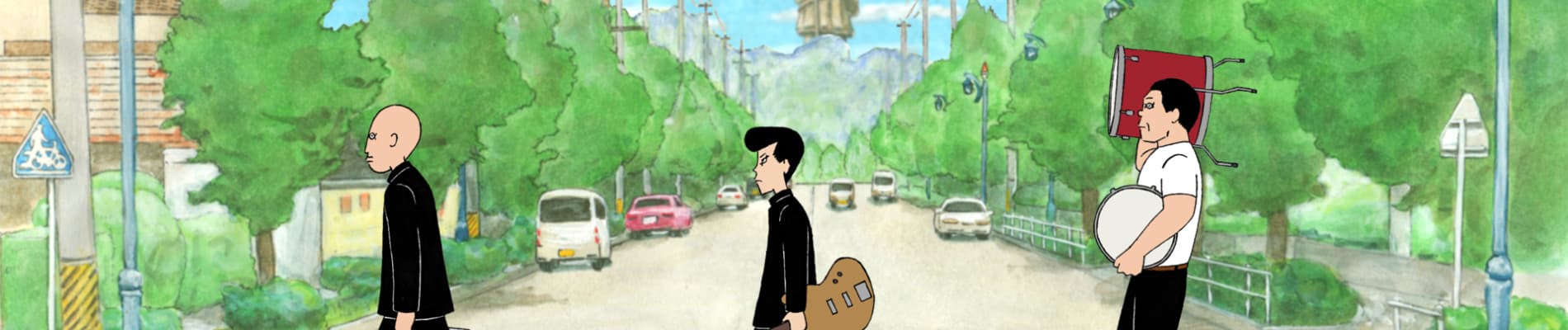
The passionate musical infusion of ONGAKU begins with its references to classical rock. Iwaisawa admitted that much of the storyboarding of the film’s more psychedelic passages were influenced by the Beatles’ animated feature Yellow Submarine. These moments use famous rock records as a visual motif, referencing the likes of Tarkus, Who's Next, Led Zeppelin, Sailin' Shoes, Tubular Bells, and Atom Heart Mother. It isn’t entirely obtuse with its referential winks, tossing some more recognizable allusions like the appearance of the screaming face of the 21st Century Schizoid Man himself, or when Kenji and gang cross Abbey Road with their newly “acquired” instruments.

As expected, the depth of the film’s respect for the history of rock music is matched by the stripes and talent of the musicians who underscore it. In contrast to the rest of the film's production, the score was a labor of love from an eclectic group of musicians and producers. Much of the music for the film was written and performed by Tomohiko Banse, with tracks like “Nakunatta Home & Bass" (Missing Home and Bass), "Bobobo", "Kimi no Yokogao" (Your Profile), and “Bankara Bokuchi" (Rough Land). Wataru Sawabe of Skirt fame, who since went on to perform the ODDTAXI opening, is also credited on the title track “Ongaku”. The outro song is fittingly titled after unsung musician and composer Peter Ivers and is performed by the dresscodes. This group of misfit rock enthusiasts, under the composition supervision of GRANDFUNK, come together to deliver an endearing blend of garage and drone-rock acoustics with a deliberately unschooled delivery. Its purposeful bumbling suits the characters and the modest world they inhabit immaculately.
”On-Gaku: Our Sound was nominated to the Long Contrechamps Category and won the Best Original Music Award at the “2020 Annecy International Animated Film Festival”, which is one of the 4 largest international animation festivals around the world.” — the staff comments on the award can be found at Anime Anime Global
Comparing it to other indie film productions seems woefully unrepresentative of the time and effort that went into this project. Having gone through the growing pains of promoting an unknown band in the punk rock scene myself, as well as numerous other ~~failed~~ creative ventures, its message and delivery resonate deeply with me. My attachment to the style and substance of ON-GAKU: OUR SOUND, as well as its musical identity, make it a difficult film to evaluate in a vacuum. It can be tough to objectively assess a work with such heart and passion imbued in it, and equally as challenging to assign a numerical value to such a sparse yet focused final product. This is a film that will sit in my memory for a long time, one that I will revisit with friends and recommend passionately. Even if it can’t quite stand up to the production values of a large scale team project, or match the thematic density and nuanced character writing of the best of the best anime, it’s still remarkable for what it is and stands as one of the best indie productions to come out of Japan in recent years.
Despite Iwaisawa winning Best Animated Feature at the Ottawa International Animation Festival, I can’t imagine he made the rounds at film festivals with critical reception in mind, but rather as an avenue to get as many eyes on OUR SOUND as possible. Even if I can only comprehend a fraction of the investment required of a project like this, the message of the film is clear to anyone who has so much as whiffed the creative process; art is an action, not a thing. The final product is outlived by the process of creation, and when “our sound” of listless youth finds purpose, it becomes music.
Special thanks to @jrextelevi and @JMack24 for helping to decipher the music references and @maklax for translating some of the musician credits so that I could give a more complete view of the artists who wrote and performed the score for the film.
And of course, big thanks to @wavieff bringing the boys together, and for always kicking me in the ass and motivating me to write in a more official capacity. You are the Kenji to my Morita.