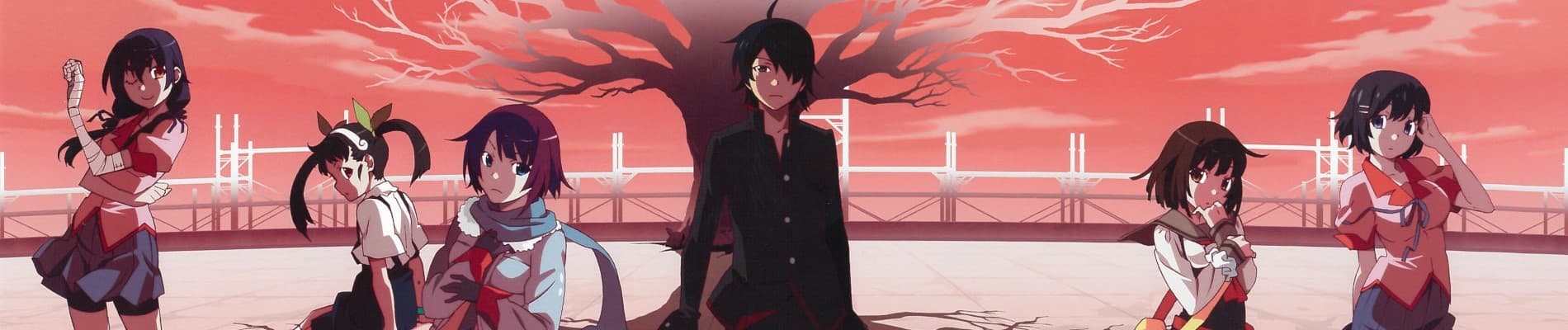
Monogatari Series: Second Season is one of the more critically acclaimed instalments of the Monogatari series and for a good reason. It continues the story and the character arcs in very compelling, and sometimes highly unexpected ways.
Each arc of Second Season takes the characters, and gradually unravels them over the course of their respective arcs in a very engaging, elegant way. Mainly through immensely entertaining, odd and expertly crafted dialogue, which tends to lead into a very rewarding climax, whether it would be exciting, emotional or a mix of both. It is the sort of storytelling that makes Monogatari so satisfying and immersive to watch. Pretty much every arc of Second Season uses this structure masterfully and utilising it for some great character development.

The arc also introduces the Head of Specialists, Izuko Gaen, in addition to marking the first on-screen appearance of the vampire hunter, Episode. Gaen makes a strong first impression, seemingly helpful, yet with an odd air of tension behind her politeness, which makes for a memorable entrance for her. Episode unfortunately does not leave nearly as strong a first impression, not showing much of a personality aside from being kind of smug.
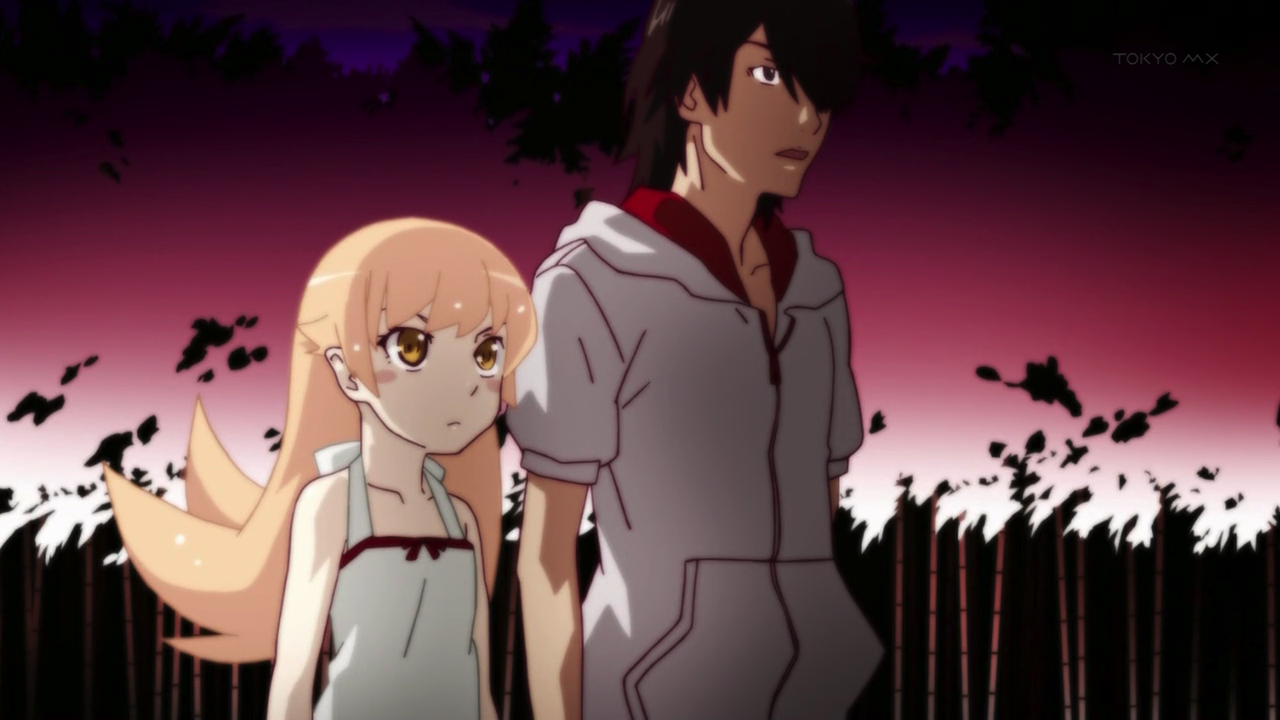
Thankfully, the questionable set-up aside, the rest of Mayoi Jiangshi is phenomenal. It actually focuses on Koyomi and Shinobu’s relationship far more than it does on Mayoi (more on that later) and it does so incredibly well. The duo has fantastic interactions as well as individual character development throughout the arc. Shinobu is made to reflect on how incidental her current reality is, revealing a level of emotional complexity that we have seen very little of from her prior. Koyomi meanwhile once again has his saviour complex blow up in his face spectacularly, leading him to question this aspect of his identity more. Mayoi Jiangshi takes these two characters who were both already very interesting, and adds even more layers to them, while very skilfully progressing both of their development.
Another thing of note about Mayoi Jiansghi is the fact that it brings back the character of Yotsugi Ononoki from Nisemonogatari. She appears for a conversation with Koyomi, which gives us some much appreciated insight into Yotsugi as a person. We learn of what exactly she is, and a bit about her nature as a revenant. More importantly however, we gain a bit of an understanding of how she feels about her own nature. She is unsure of what her true purpose is, what she wants, and if her current role is really all there will ever be to her life. It was a great moment, which immediately made me care about Yotsugi so much more than I did before.


Outside of that however, I honestly do not have any issues with the arc’s other three episodes. Much like Mayoi Jiangshi did with Shinobu, Shinobu Time really puts Mayoi in the spotlight more than it does its titular character. Because Monogatari. But once again, I do not find that to be a problem at all, as it works brilliantly. Shinobu Time ends up really zeroing in on Mayoi’s issues in a way where she ends up having to face them head-on, leading to excellently written growth for both Mayoi herself, as well as for Koyomi, whose desperation to help those he cares about is highlighted here beautifully. The arc adds quite a bit of interesting layers to Shinobu as well. My issues with its delivery aside, her backstory here is very intriguing, and succeeds at giving the audience insight into Shinobu’s past regrets and flaws, once again showing that, even though she was once a proud powerful entity, she was still also a flawed person. Perhaps Shinobu Time is a bit more flawed than the rest of The Second Season, but it still has plenty of strengths that make it an engaging watch.

Kaiki was already a great character back in Nisemonogatari, and Second Season manages to recapture and expand upon everything that made him so enjoyable there. While Kaiki is still his lovably greedy, selfish self, in Hitagi End we also learn of a potential other side to him. A little bit of vulnerability that Kaiki made sure to bury underneath a landfill of cynicism. Just a little bit, that the show adds to the character in a subtle, and quiet manner, which just makes it all the more affecting and fitting of Kaiki’s character. It is this season in particular that made this morally compromised asshole into my favourite character in Monogatari, the place he holds to this day.
Hitagi herself is as fun as ever, and it is very satisfying to see her here, due to all the little differences in her demeanour when compared to how she was in the previous seasons. You can tell how far she has come since Hitagi Crab, which is very heart-warming. Not to mention, her relationship with Kaiki is at its most fascinating here. In true Second Season fashion, a lot of layers are added here, making it one of Monogatari’s most strange and complicated dynamics, in the best way.
There is one other significant character in this arc and, while I will not say who it is in the interest of keeping this review spoiler-free, I will say that they are just as well handled here as the other two, with more unpredictable and perfectly written development, providing possibly some of Monogatari’s most resonant messages yet. At least to me personally.
There is one thing in Hitagi End that I would nitpick, and it is something regarding the actions (or rather lack thereof) of a certain character’s parents. Without going into spoilers, I just felt that their reasons for choosing to not do a certain thing were not particularly believable given the situation that they were in. Still, this one little detail is only a slight bump, on what is otherwise an amazing arc.


Of course, this wouldn’t be a Monogatari review if I didn’t talk about the openings. Chocolate Insomnia, Happy Bite and Kogarashi Sentiment are all fantastic, and I actually really love the mostly wordless White Lies. My favourite opening of the bunch however has got to be Nadeko Medusa’s Mousou Express, with its catchy, somewhat eerie, almost hypnotizing rhythm being an absolutely perfect fit for its arc.
62 out of 66 users liked this review
