Fire Punch
a review by Regime
a review by Regime
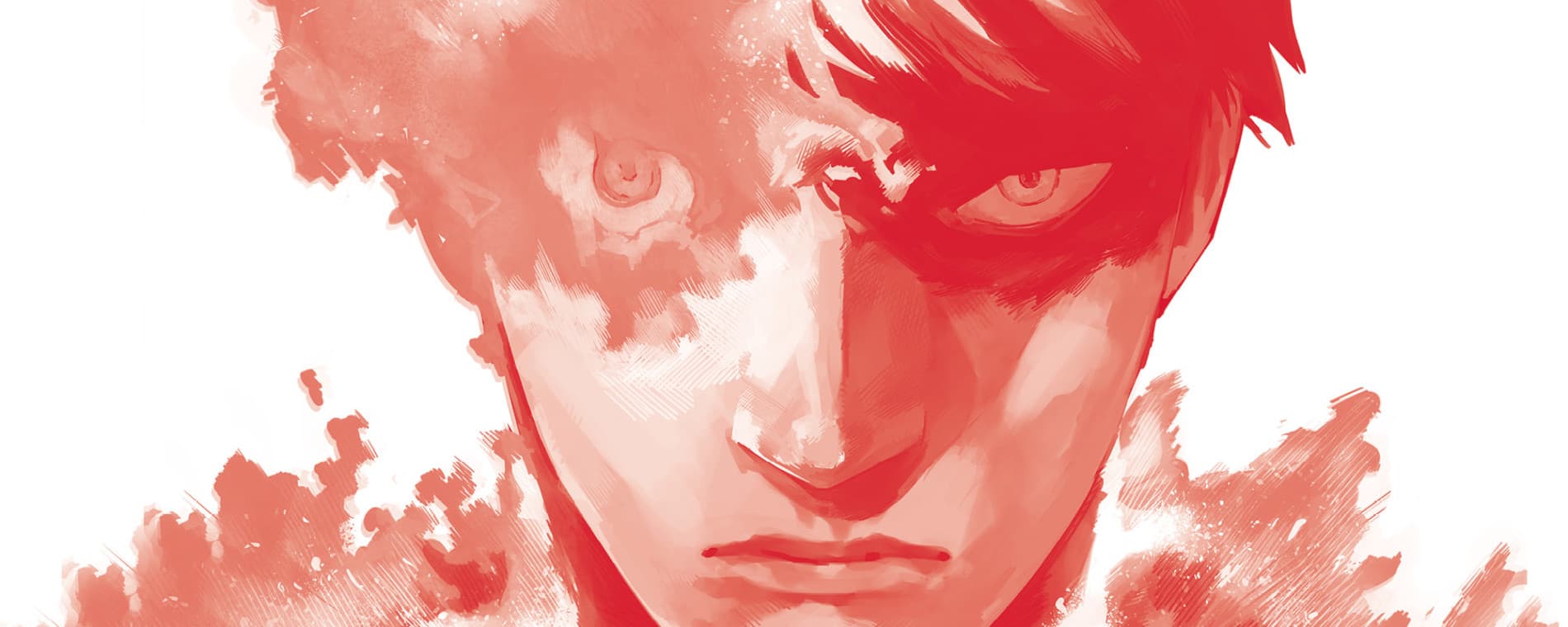
For eight years after his sister's death, Agni did nothing but lie in the snow, burning. He is sustained only by two things: a body which will not let him die, and his sister's last command. Live.
I've seen Agni described as a child in an adult's body, but that's not a complete description, in my view. Agni cannot think the way we think. He cannot analyze a moral quandary and synthesize an ideal, perfect solution. When Agni learns to walk again, he's thrust into a world more complicated than our own. In this world, he's the only one with the power to change things. His body cannot die. He spreads fire which does not go out until the body to which it is attached is burned. He has the power to go anywhere and kill anyone. But he doesn't have the capacity to make the right decision.
In Fire Punch, the world is broken, and humanity is dying. An ice age has fallen over the earth, and humans require fuel to survive. Fuel like firewood, and fuel like people. People are the fuel that holds all of earth's remaining societies aloft. Behemdorg flourishes because of this philosophy. Their fuel is blessed ones, the people gifted with supernatural powers, and women. They extract resources from the blessed ones, keeping them in eternal suffering and misery, allowing them to maintain a real city in the frozen wasteland. To keep their birth rates high enough, they repeatedly rape and impregnate female slaves to keep their population from declining.
Every society we see in Fire Punch is one either in decline, or upheld by the suffering of others. At times voluntarily, like when Agni offers his own flesh to be eaten, or at times forced, like when his limbs are burned for fuel for slavers' warmth. We can call these acts reprehensible, but everyone who does not perform them dies.
Whether the Behemdorgians are wrong is a complicated question. Anyone reasonable, raised by our society, would want to say yes, but, if you take humanity’s survival as an objective moral good, then they cannot be faulted, because they are the most successful, until Agni begins to change the world.
Agni cannot ponder these moral quandaries, nor can he change things with a light fist. On his search for Doma, the man who killed his sister, he did his best to do as much good as he could along the way. He freed slaves, and fought those who enslaved them. All those he fought died. He couldn’t so much as touch them without killing them. He still did his best to save who he could.
With his mental capacity limited by eternal agony, he’s susceptible to being manipulated and controlled. The one who does this to him most is Togata, who, in the detached state of a three hundred year old regenerative blessed one, wants to film his life as a movie.
She pushes him to gain his revenge, while at the same time preparing Behemdorg to fight him off, to up the stakes and improve her film. When Agni reaches Behemdorg’s capital, in front of the slaves he’s freed, he is forced to confront an army, and three powerful blessed ones, all terrible criminals. Armed with armor from Togata which lets them resist his flame, he cannot defeat them easily. One punches him through blocks and blocks of skyscrapers. His flame burns an entire city to the ground. He can change the world, but not with a gentle touch. A single mistake can take lives in an instant.
Everyone in Fire Punch who claims to know of a better way of life, a strong moral system, is corrupted and their society fails. Doma believes that people must follow a strong code. He burns down Agni’s village because they practice cannibalism. It doesn’t matter to him that it’s Agni’s flesh. He believes that cannibalism is a wrong action, and that if Agni died they’d resort to eating each other.
But in the eight years Agni burned, Doma realized that Behemdorg’s religion was false, and he’d been following false ideals. He gathers up his many children (presumably mothered by Behemdorgian slaves he raped), and teaches them his way of life, which while much different from his Behemdorgian beliefs, is still founded on the idea that there are certain actions which are wrong and must not be taken regardless of context.
Ultimately, Doma is killed by Agni, who after choosing to forgive Doma, snaps and returns to murder him in an enraged state. The demon who killed Doma is the result of his own actions, a consequence of applying his beliefs without considering context.
Agni cannot die. He’s commanded by multiple people he loves to live. He’s constantly searching for some purpose for his life, to let him live through the pain.
When Agni is finally released from the fire, after destroying Judah, who was turned into a tree to serve as the fuel to destroy the old earth and make it habitable once more, now, finally, he is a child. Almost on reflex, he calls Judah, who resembles his sister, Luna, and he maintains the lie for ten years. During that time, he suffers under the weight of all the pain he caused. Pain caused by decisions he made while impaired in ways none of us can comprehend.
Ultimately, revenge comes for him like it came for Doma, coming from the degenerated Against religion. But Agni cannot die. One of Doma’s children sets him back alight, and he goes after Judah, who has seen through his lies, and who he loves, to get her back.
San’s Agnist religion becomes a mixture of truth and fantasy, and he kills those who disagree with him. By this point his followers are fanatics, and his society is heading towards extinction. It’s only a matter of time before they become as bad, or worse than the Behemdorgians. When he’s confronted by a version of Agni who doesn’t align with his fantasy, he tries to kill it, only to ultimately himself die.
Judah becomes the final piece of fuel for humanity, willingly becoming the tree once more on the condition that Neneto brings happiness to the amnesiac Agni. Things are peaceful for eighty years. We watch Neneto die of old age. At least one generation got to be happy.
One of Agni’s pupils offers him a pill that can kill him. Nuclear war will soon be upon their fledgling society. Even the tree is not enough to protect the fledgelings of their society from the specters of the past. The last we see of Agni on earth is him in a movie theatre. He is the first to watch the only film they have, which is found on Neneto’s recovered camcorder. A monochrome, silent chronicle of Agni’s own life. Whether he learns that it’s him is a matter of interpretation.
Presumably, the society is destroyed, but Agni lives on. Far above, the tree has spread out to other planets and stars to steal their energy. Judah, at the heart of the tree, begins to lose herself. But she remembers she’s doing this all so at least one person, Agni, could be happy.
Even once the earth is destroyed, and Judah forgets who Agni is, the tree continues to expand, gathering more and more fuel from the universe. She contemplates suicide many times. Finally, Agni, who survived earth’s destruction, and never took the pill, finds her. They talk for a while, before fading off into the night.
As I’ve found I have a tendency to do, I took the long way around to reach a point.
Fire Punch is a dark work. It pulls few punches, and crosses lines most manga, including Fujimoto’s next work, won’t. But it’s not a mindless spectacle. It’s deeply tragic and thematic. If I had to do my best to gather it into a concise statement, it would be as follows:
Human beings are creatures that destroy in order to live. The universe we live in is a place which is hostile to life. In order to survive, humans often do terrible things. The more hostile our environment, the worse we become in order to survive.
Many people think they know the way to improve our society, and reduce harm, but most of those people do not have that power. But perhaps it’s for the best that they don’t. If you shift your perspective, all of us are like Agni. None of us can comprehend and solve these problems, and if we tried, we’d cause unspeakable harm. Even those we help and save might be twisted into terrible people, and those we harm along the way will come back to harm us in turn.
But there is a way to try to improve the lives of those around us. If we need to destroy in order to live, there’s a better way of doing it than causing harm to others. Instead of taking what we need from those separate from us, we should give of ourselves, the way Agni gave his arm time after time for his sister and his town. The way Judah transformed herself to protect the happiness of a single person.
Ultimately, even through this, civilization will be doomed to end. Nothing can prevent entropy. But we can find periods of peace, happiness, and satisfaction, and when they come, we should value them, no matter how fleeting.
When I give something a perfect score, that doesn’t mean I think the work is perfect. I don’t think fire punch is perfect. The art is certainly less polished than Chainsaw Man, and like the later work, it can often be difficult to understand what’s happening in a frame. But I’m usually less concerned about these aspects than I am about storytelling, especially in manga. Neither, of course, do I think the story is perfect. That’s a weird standard to compare anything to.
Rather, a perfect score from me is a sign of respect, of acknowledgement of the value of something as a work of art. I’ve read three manga by Fujimoto now, and all three of them are sitting at a 10/10 on my list. It’s my belief that this man is a genius writer in a dozen ways, who’s work transcends beyond his medium.
It’s worth noting that our own mindset influences how much we enjoy a work. I went into Fire Punch having read Chainsaw Man and Look Back, and having loved the stories told by both. That made me receptive to view Fire Punch as a work of art, and not just a pulpy manga to consume, (a mindset I had entered Chainsaw Man with not in the least because of the meme culture around it). If you entered this with expectations of a more normal manga, I could see perceiving it as disjointed and strange. Instead, though, I see it as an incredible work worth thinking about, and maybe shedding a few tears. I did.
95.5 out of 114 users liked this review
