Real
a review by InspectorJKB
a review by InspectorJKB

At first, it is almost an alien word to us. A definition of the lowest points a person has seems inflexible on paper.
You now go back a bit in time and point out the significant moments in your life. Your achievements, victories, downfalls, breakdowns, and pauses. You begin to witness again records of your struggles from past to present. All those done deeds appear small compared to the obstacles you are about to face anew. All those opportunities, taken and lost, have brought you to this point, still breathing, still standing.
Despair is a word REAL expounds into the fore and pounds into a central force, like gravity. Its ever-changing weight on our shoulders pushes us down, but, unlike gravity, it’s not spread even. Some people have already sunk into the soil, but some were already born sunken deep in the ground. Life becomes an everyday chore of pushing up this exasperating weight, and when you get strong, you either close yourself to this individualistic pursuit, or you give a hand to others who cannot raise the weight themselves. Or, you climb up from the seemingly endless ground all your life.
It’s a word that disperses itself into a rainbow of many synonymous parallelisms. Inoue masterfully weaves these discordant elements into the focus of REAL, and with it, he presents a message with all its glories and disgraces. A central theme readers could easily mention would be “living the hard life”, but that statement doesn’t fully cover all of what REAL strives to be. A hard life is different for everybody, and it's not that easy to measure and show to people who have not experienced it for themselves, and I am pretty sure everyone wishes to be replete with a good health and a good life.
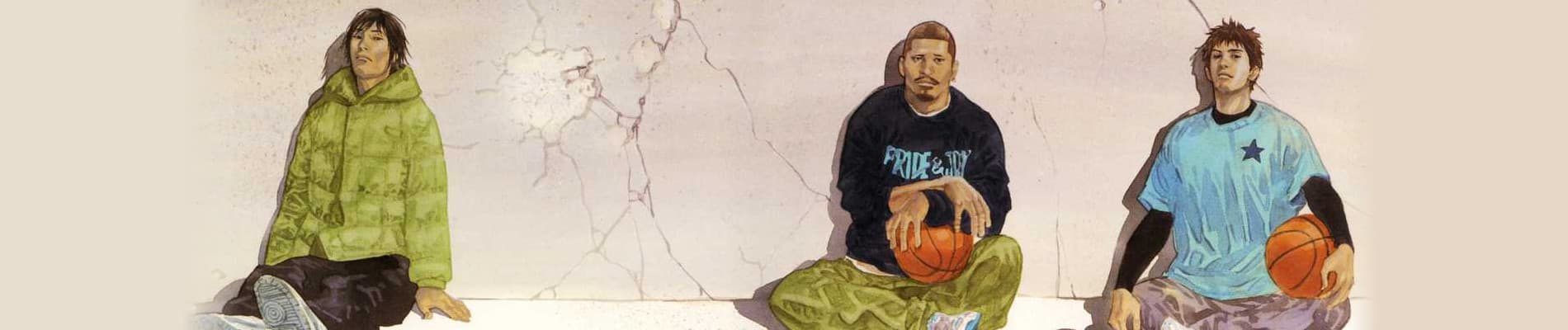
Yet, in REAL, the main characters that we meet at first are already put in this spotlight of “a hard life”. Togawa, a disabled wheelchair basketball player, has dreams of putting his team into the championships. Nomiya slips and falls repeatedly throughout the story, but in each comeback he remains steadfast in his pursuit of purpose. Takahashi is met with a terrible and injurious fate, and in his wretched state is an untying of invisible gaps that stretch from his past.

Each of these individuals undergo an ever-changing metamorphosis of character and identity throughout REAL, and through their eyes, their every struggle, their every second of loneliness, we find them breaking, shattering, morphing, and changing under every realization of their manifesting hopes and fears. It’s awe-inspiring, it’s enthralling, and it’s riveting to be completely engrossed by the way they, written as human as we are, are given immense capacity to be paragons of the way we can break past our very limits, or give us an honest eye-opener of how our very lives can be snuffed out in any second. But the body and the mind that has tasted the verge of death is never far away from the reach of hope, and you will see this theme echoed in Inoue’s writing every time.

I am quite sure that in REAL, Inoue has confidently achieved all the quintessential tool sets to make a compelling chef d’oeuvre surrounding a difficult subject of disabilities. He presents it as it is, showing how disheartening it is to the affected person and it’s inevitable emotional damage to the person’s close ones; how inescapable are the countless stigma almost inherent in it and the huge negative influence it has on the disabled; how helpless we are most of the times to assist them with all our strength.
In REAL, this inopportune situation and its weight upon almost all affairs of human nature is relayed truthfully in the story. This is mostly the gravity in the story for two of our main characters, and in different perspectives we see how they dealt and reacted to it. Both of Takahashi and Nomiya’s lives are filled with melancholy and exasperation that is almost hard not to relate to. To be reading and seeing them in their lowest points in their lives, and knowing out there in the real world, someone is in the same, difficult situation as them, is a powerful synchronicity to keep in mind. This aspect of Inoue’s depth of storytelling is sharpened by embracing a push-and-pull with pathos; for the three main characters have their human flaws, but their flaws and shortcomings transcend them above their disabilities, above the entirety of who they are. They become motivations themselves that enrich the REAL story and experience. Through how they defeat their old selves, we inch ever closer to defeating ours. Through how they come to accept themselves, we inch ever closer to accepting ourselves.

The characters aside from the main ones are written excellently as the three. They all have their own unique share of purpose and presence that ties immaculately within REAL. Like with the patient Azumi, we see her touching perseverance to understand and accommodate Nomiya’s disability and his cold and often rash attitude. From childhood to growing up, she’s been the only one who knows how intense Nomiya’s mentality towards pursuing a goal can be. The broken relationship between Takahashi, his mother, and his father, cascades into an sudden outpour of unsaid words that has been repressed by years of fond memories and the absence of a loving father. Thus, before his disastrous fate, he was already swirling into a directionless teenage life, leaping here and there, fitting into molds which he had no intention of doing so. The bottled Takahashi metaphor shows his rigid plasticity very well, and it was only when he was released by meeting various people in his life that he arrived at a liberating revelation of his own. The unbottled Takahashi now has the drive to find his own purpose, and learns to open himself up to others.

Nomiya is my favorite main character in the series. My connection with him only grows stronger each chapter. What separates him from the two is his solitude; Togawa and Takahashi are surrounded by characters that deal with and influence them, while most of the time, Nomiya has to bear all the burden by himself. Even with his relationship between the two, they have a little impact on his path overall. He is passionate and determined, a man with well-versed knowledge and attention to things around him, except within himself.

He acts on his emotions too much; he gets angry, he is pulverized by jealousy, and he is easily pulled back into his lowest by the slightest inconvenience. And this is where Inoue’s trademark storytelling really shines, and like I said, a push-and-pull with pathos allows us to embrace the pathetic Nomiya, and in return, with our faith in him, we get to see Nomiya work hard to achieve great things even within himself.
Basketball is a huge theme in REAL, and it's a unifying sport that ties all of our main characters lives. It's a sport that has saved them, bestowed them meaning, or it was their whole life. We see this in Nomiya being spurred by the sight of the sport, or Togawa reflexively assuming a shooting position out of muscle memory, or Togawa's fiery sportsmanship being either the bane or spirit of the team. Inoue really loves basketball and he'll make sure you acknowledge how significant it is in the manga with little moments like this:

These are all poetically entwined with Inoue’s art. It’s full of visual metaphors and wonderful implicit storytelling. His art has a start, a middle, and an impact; you can see how this complements the pacing of the story. In one panel, Inoue will set up the purpose, and in the end he will have you deeply moved by the resulting impact. Moments of tears, moments of defeat, and moments of resolve are all given a sentiment of power and triumph. Inoue's unique panelling ties all these up to finalize a lasting impression. He could show an emotional breakdown through a series of "glass-shard" panels, or wide, urban shots to emphasize a transcendent emotion. Being a mangaka that has authored the monumental Slam Dunk, he never fails to deliver that rush of adrenaline and sweat whenever he draws sport sequences. You can feel the speed, the hot air, the collision of bodies and gears in his majestic art.
Perhaps the strongest message REAL tells us is our mishaps do not determine our ends. We see these main characters all have their share of suffering, and in their shoes, we might not even survive a day. Yet, REAL constantly assures we are not alone, and our stories do not end until we run out of breath. Through the main characters, even the most discouraged of us might find the will to get back on their feet, and start walking, even if they're small steps. Inoue really encourages us to celebrate our small improvements and our small victories, and to never stop finding our own path.
There will never be a manga like REAL. It is a work that I will forever adore and share its glory to others. Nomiya, Togawa, and Takahashi will always inspire me in my life, and I hope you find them as inspirations too.

123.5 out of 125 users liked this review
