Bleach
a review by saulgoodman
a review by saulgoodman

True to any other action shounen, fights serve as the zeniths of characterization and development in Bleach. Taking Ichigo's fights with Ulquiorra and Grimmjow, for instance, both are executed well, in serving as staple development stages in his glaring, persistent flaw of hesitance and confliction with his inner hollow and being hype fucking fights with good build-up. However, on other occasions, Kubo's attempts at prescribing subtleties through fights fall flat, rendering them almost ostentatious.
Not that the fights themselves are fundamentally bad, but Kubo has an overambitious habit of doing too many things at once, ultimately devaluing them . For instance, the teeming character introduction in the Hueco Mundo/Karakura arc. The congestion of Arrancar/Espada, Vizard and reintroduction of the Gotei 13 resulted in the fights being far too cluttered, feeling like Kubo's desperate scramble to characterize all the members of the aforementioned parties. As a result, most of them leave behind little memorable presence, though a few like Ulquiorra and Szayel shine through with their thematic backdrops despite their limiting characterization. Certainly, some of the fights were entertaining and memorable, but the lackluster ones dulled my appetite for the action in these arcs.
However, Kubo does succeed on other occasions, such as in the 1000-Year Blood War arc. Whereas the Hueco Mundo arc acted as a dull reintroduction of the Gotei 13 allying with Ichigo and boasting their abilities, the 1YBW arc saturates their characters and principles in their respective fights, in addition to being stupendously more thrilling. Additionally, Kubo pulls off his "show 'n throw" characterization method stupendously well in this arc. Though Kubo stuffs even more new characters here than the Hueco Mundo arc, it disproves to be a hindrance to characterizing the members of the Vandenreich. A key point existing in their two invasions. Whereas the Espada; barring Yammy, Ulquiorra and Grimmjow; were limited to one battle characterizations, the double invasions of the Vandenreich allocates much more generous screen-time and appeal to its members. That said, their plot and thematic relevance greatly differed from one another. However, with their luxurious quantity, Kubo makes many of them entertaining in respective manners. Whereas Kubo fumbled with the quantity of new cast in the Hueco Mundo arc, he makes better utilization of an even greater numbered cast in the 1YBW arc. Of course, this doesn't imply writing issues are nonexistent in the arc. Well, enough hate echo-chambers about Bleach's ending exists, so I don't find it worthwhile to discuss it beyond Kubo's health deterioration a pity.
Thematic aside, the writing behind the fights are laughable at times. Embarrassing power inconsistencies and jumps pop up; Espada #1 axed off the quickest, Nanao's Holy Sword, Kenpachi's God-like power after switching from a one-hand to two-hand sword stance and, of course, Yammy's "Who said Espada were numbered 1 to 10?"; refusing to kill off popular characters, especially prominent in the 1YBW arc, and the action simply hit-or-miss from chapter to chapter.

Though, I maintain a much more positive outlook on the other areas of Kubo's writing. While characterization and development through fights were rather hit-or-miss, overarching themes through story arcs boast much more.
As strikingly black-and-white the art is, the underlying morality in Bleach is all but. So far, I've rained on Kubo's parade but here's where I'll laud his writing, beginning with the Soul Society arc. The memorable fights and exciting conspiracies aside, the Soul Society arc was a golden first step in illustrating the series' morality. Contrary to the heroic image shinigami held, though darkly elucidated through the Quincy and Modified Soul expositions prior to the arc, Kubo depicts them as the antagonists in their initial appearance. Social disparity between the rural rukongai citizens and inner-city shinigami, abuse of authority through Captain Mayuri, the bureaucratic Central 46; institutional corruption and injustice plagues the supposed side of justice. More than that, however, the arc illustrates a theme heavily comprising Ichigo's character; responsibility and personal beliefs. Numerous internal conflicts in the arc revolve around sense of personal duty and lawful duty, giving significance to both Ichigo and his enemies regarding their motives for fighting. This helps to supplement the idea that Soul Society the entity is the antagonist of the arc, not the individual shinigami who act out of consequence. Further on beyond the arc, Kubo continues to subtly solidify the lack of moral boundaries in Bleach, yet never explicitly rears its head in lieu of Ichigo's character.

A key attribute helping to define, the opposite rather, the morality is Ichigo's character. The Substitute Shinigami arc at the very start of the series firmly establishes such, crumbling Ichigo's tough delinquent exterior with the bleakness of shinigami and hollows, explicating his desire to protect those dear to him and his lonesome ability to see ghosts and the duty to protect them consequentially. Rather than a frame of good and evil, the series possesses an outlook of Ichigo's friends and enemies. It can be interpreted that Soul Society, Aizen and the Wandenreich aren't intended to be seen within an objective moral frame. Of course, Ichigo and Soul Society's friendly relationship, and Aizen and the Wandenreich's villainy present morality in a boringly black-and-white, but regarding Soul Society's injustices and the somewhat empathetic motives of their enemies, it subtly pokes the audience into contemplating what justice and evil are in Bleach. Though, it's understandable to interpret this all as adroit, subtle writing or lazy, vague fumbling. All this morality contemplation stems as personal afterthoughts, since Kubo doesn't go anywhere with jabbing his own characters' morals. Soul Society prospers by the end, yet no signs of reformation are shown that will guarantee that the institutional issues shown in the Soul Society arc will also prosper. However, this passiveness can be observed as Kubo conveying the lack of heroes and villains, rather only friends and those who threaten your peace.
While writing and potential behind Ichigo's character is praise-worthy in some respects, the execution was dull on occasions. Speaking mostly of Ichigo's inner hollow battles. Certainly, there's different nuances behind these fights indicative of Ichigo's current internal conflict and state-of-mind, but the fights themselves became too redundant and dull for my liking. The inner hollow fights are best representative of my opinion towards Kubo's writing; vivid potential overshadowed by its own execution through intense fights.
Though, these fights aren't the sole manifestations of Ichigo's character, circling back to my point of story arcs elucidating themes. The Lost Substitute Shinigami arc is a prime example, stripping Ichigo's character, shining new light on his same conflicts. Whereas the previous arcs observe and flesh out Ichigo's glaring sense of doubt and hesitance born out of wedlock between him and his inner hollow's long-lasting conflict, ultimately coming to understand the entities within himself at the conclusion of the Hueco Mundo arc, the LSS arc sadistically clocks back his conflict to observe it in a different manner.
Devoid of his shinigami powers, the arc is reminiscent of the very start of Bleach, but with a sharp pang of somberness given Ichigo's presence on the sidelines, stuck watching his friends protect him rather than conversely. Ichigo's savior complex has always struck one as courageous, admirable, albeit hardheaded, but the LSS arc paints it in a grimmer hue of pity and blind self-sacrifice, seeing how desperate and pitiful he becomes at the prospect of new power to protect his loved ones once again and instantaneous loss of both at the hands of Ginjo. Of course, there's no denying how disjoint the arc is, its perplexing Xcution and Fullbring plot points awkwardly sandwiched in-between the Karakura Town and 1YBW arc, making it out almost as a filler arc. In terms of plot alone, that is. With its refreshing character craft of the protagonist, the LSS arc still suffers debt of praise to where it's due.

I've a generally favorable opinion of how Ichigo's character is constructed, explored and developed throughout the story, but hesitate to hold the same for the other main characters.
The beginning Substitute Shinigami arc acted not only as great characterization for Ichigo, but the rest of the would-be main cast. Chad's fear of inflicting pain on others, Uryuu's unrelenting hatred of shinigami and Orihime's fear of others' deaths. Though, the ball was dropped in the Hueco Mundo arc. Chad's resolve to protect his friends using the strength he once feared manifests in a new power upgrade, then is immediately shafted from the rest of the arc, serves as the middleman between Ichigo and Xcution in the Fullbring arc and I don't even recall what he does afterwards. Kubo shows his fear of permanently depowering his characters through Uryuu's recovery of Quincy powers, also becomes shafted in Hueco Mundo after one fight and serves as a red-herring antagonist in the 1YBW arc with little presence.
Whereas the ball was dropped on Chad and Uryuu's characters, though, Kubo unapologetically leaves Orihime's to starve, die, rot and be feasted upon by maggots. Orihime isn't as terrible of a character as some make her out to be. Her presence is geared as a support character, defined by her disdain for violence. It's crystal-clear from the start that she doesn't use power to retain her role in the main cast. The Hueco Mundo arc does characterize her pacifism well, but at the cost of her depiction as being frustratingly passive. What she does exceed at it, is being a catalyst for Ichigo's development. Serving as the plot device for the arc and the damsel-in-distress, Orihime parallels Rukia in the Soul Society arc in arousing Ichigo's instinct to protect his friends. So much, in fact, that it further provokes Ichigo's conflict with his inner hollow, such as in his fights with Grimmjow and Ulquiorra. In said fights, Orihime's character is given more depth, but merely through her extension of "Kurosaki-kun". There's several plot-points in the arc and afterwards that further reduce Orihime's potential, as well. While showing moments of spotlight, great character potential and a broken ability, Orihime was disappointingly retired to the sidelines, kept arms-width away from her beloved Kurosaki-kun to serve as a device for his development, while showing little for her own.
Apart from the main cast, my opinions towards the massive remainder of the series' cast is scant. Villains and allies alike, there were memorable and entertaining characters and characters whose names I couldn't recall for the life of me. Kubo cranked out as many cool characters and designs as he could, ultimately unable to allocate sufficient characterization and/or development for many.

Expanding more on the mention of it earlier, Kubo is exceedingly meticulous with tone and pathos. His ominous poems at the start of chapters, the motif of rain, the central themes of death and humanity, the somber monologues, among other aspects of his writing; Kubo crafted a palette of vividly monotone pathos that never failed to immerse the audience in the melancholic worlds of Bleach. Melancholic, not sad, mind you. Kubo's writing never felt as if it was an attempt to garner an emotional response, but rather to shroud the audience in a certain pensive air.
Writing aside, the art greatly contributes in carrying this pensiveness. As redundant at the statement is, Kubo draws strikingly black-and-white. The black-robed shinigami and the white-masked Hollows designs are capitalized on to depict the overarching cyclic bleaching of souls and nature of life and death. As with any long-running series, Kubo's art-style revamps itself over time. Some complained about Kubo's lack of background art, but it's such an unwarranted critique. While the quality of Kubo's paneling in action sequences were very hit-or-miss, his general scenic and character paneling was often great. The minimalist, naked white background would immortalize a new character's introduction and indicate a distressing, important turning-point in the plot.

Kubo also carries an eclectic sense to his aesthetic, as well. Namely, his genuine cultural-incorporation. Kubo plainly takes his cap off to Latin American culture in the Hueco Mundo arc and German culture in the 1YBW arc. The naming scheme of abilities and moves rooted in the cultures' mother tongues, which to my knowledge have been generally tightly accurate in translation, the names of the villains rooted in the cultures, and the anime OST borrowing Spanish instruments and music in the Hueco Mundo arc OST. Of course, the character designs are most evident of Kubo's worldliness, with many memorable POC characters born out of Bleach.
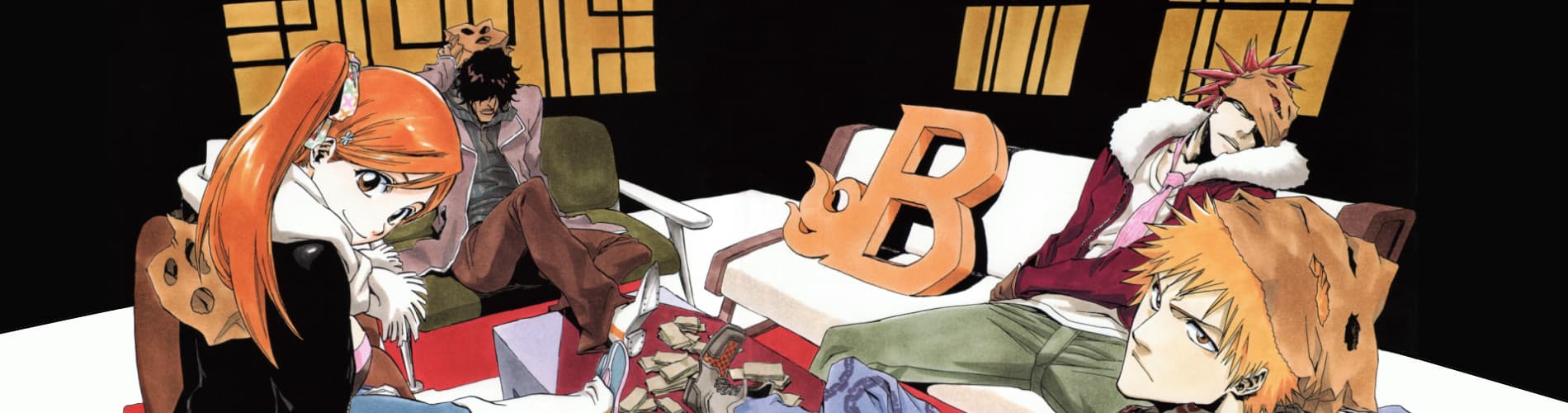
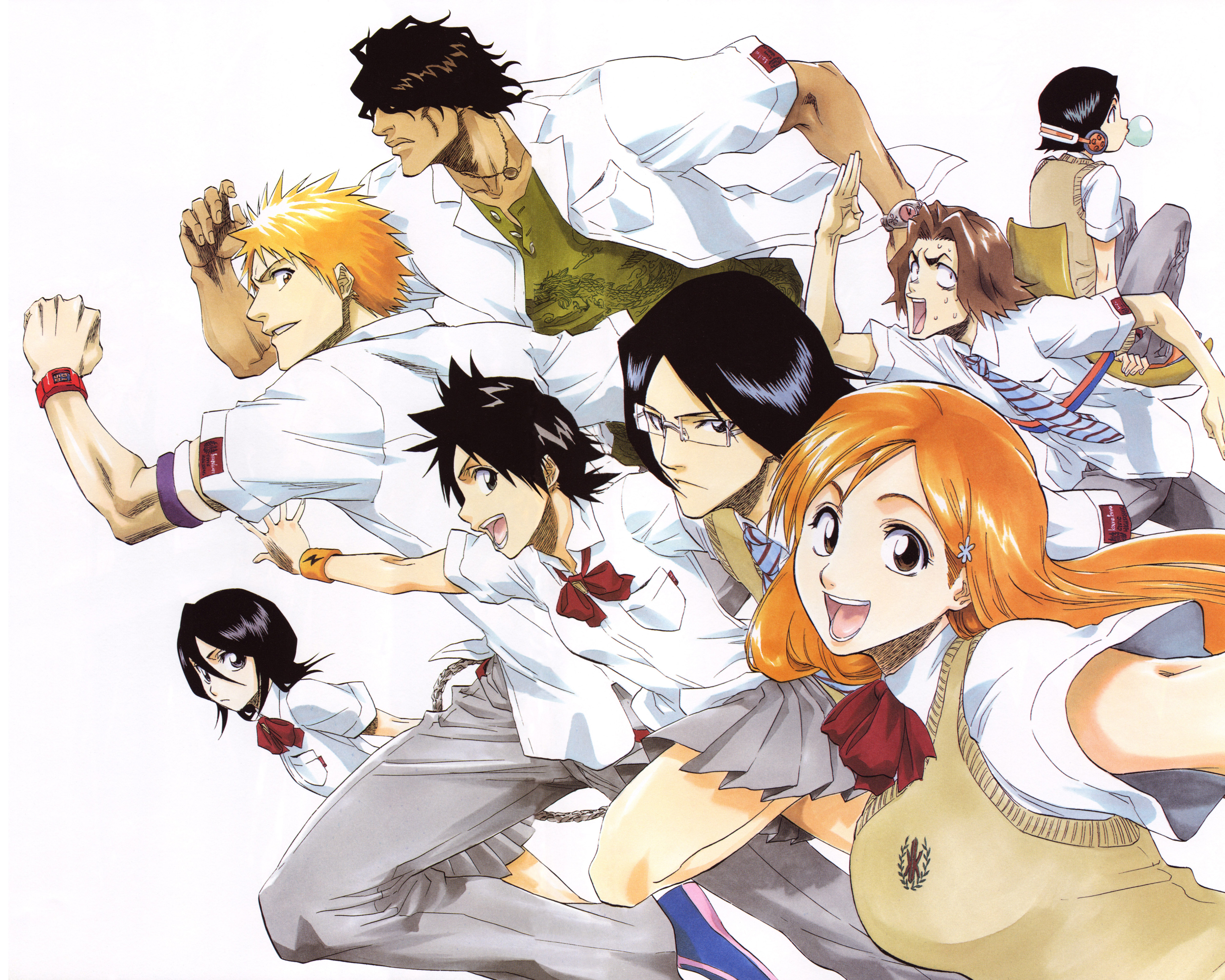
Stylistically, no other mangaka I've known has ever come close to touching Kubo, other than Eiichirou Oda and Akira Toriyama. A glance at his array of color page spreads is more than enough to spell out why Bleach remains so fresh after twenty years. Despite the strong Y2K musk on it, Kubo's fashion aesthetic transcends both time and fashion interest boundaries to continue to awe fans and outsiders alike. The fashion ranges from playfully uncoordinated outfits of faux-fur coats, aviator sunglasses, ski goggles, slouch beanies, soccer cleats, to chic formal attire, vastly creating various atmospheres in these color pages. Kubo also loved playing around with angling and poses, giving further character to these spreads.
(If you're willing to spend several hundreds, then check out the Bleach Jet art book! The official manga color spreads pale in comparison to what's stashed away in it.)

Superficial as it may sound, Bleach prioritizes style and aesthetic above all else. Peerless to this day, Kubo's color page spreads, fashion conscientiousness and memorable character designs are what keeps the series fresh after two decades. Though, going above visuals, Kubo meticulously produced a deepfelt aesthetic. Death at its core and a melancholic pathos enveloping it, Bleach possessed a pensive charm separating itself from the comparatively jocose action manga I read at the time. Kubo heftily reinforces the somber tone with motifs, delicate poems, melancholic monologues and contemplative themes. Though, the action aspect of the series derailed these things from fully flourishing on occasions.
Just as any action mangaka, Kubo favors fights as a primary characterization and development device. Unfortunately, his writing behind the action isn't as subtle nor smooth as the series' delicate tone. Kubo often barrages fights-after-fights, desensitizing me to the clashing and banka'ing quickly and felt repetitive in their use to develop a character. Not to mention, Kubo writing in far too many side characters that compromise sufficient characterization as a result. He makes a habit of writing side characters as devices to further a greater character's development and/or theme, which succeeds in some cases despite the aforementioned flaw. Some characters make their memorable mark in the audience's mind despite their limited characterization, others not. Nevertheless, it was often disappointing when many a character with interesting potential were unapologetically shown-and-thrown in the name of cultivating another.
Spanning over 700 chapters, it's no surprise that plot quality isn't consistent. Circular as the story arcs may be, they all pose unique thematic backdrops and character arcs for the protagonist. Though, again, the bombastic action sometimes proves a hinder.
Bleach may be seen as Kubo's glitzy fashion show, boasting his timeless designs and thrilling character abilities, on a flimsy foundation of a circular plot and ludicrous ending. By no means, is Bleach a series I'd recommend someone to undertake. Its flaws are evident as the story progresses, the ending left a sour taste in many hearts and the appalling 700 total chapters isn't exactly consistent in quality. Today, Bleach is still seen as the black sheep of The Big 3 and there are other recent action shounen titles like Jujutsu Kaisen that have proven to be stronger successors.
And regardless, Bleach is one of my favorite series of all time. There's no denying its glaring blemishes, but no other series I've read since then has ever come close to emulating the timeless strengths that Bleach fosters. The somber pathos, the immaculate character aesthetic, Yoruichi, and the strenuous journey to protect one's peace. As I still reminisce over swiping peeks at my older brother's Shonen Jump monthly issues, believing that I'd get arrested for reading the online scans, and floor-reading new volumes at Barnes & Nobles, Bleach has never left my heart all these years. And today, despite reaching 20 years, it still remains fresh in hearts a many.
Thank you, Kubo.
29.5 out of 36 users liked this review
