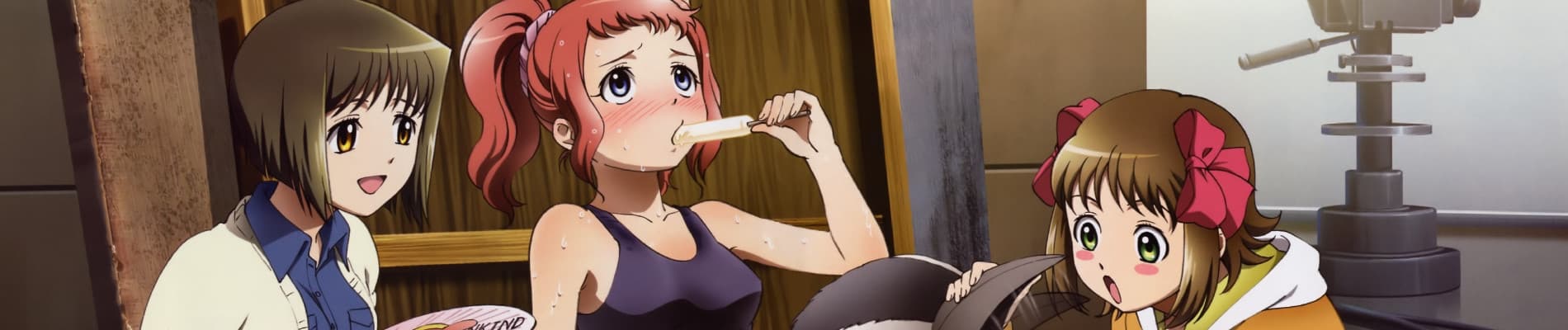

Background plot details for this anime as well as elements of The Idol Master (2011) follow.
You're probably here because the premise of this anime was too absurd not to check out: a mecha spinoff of an otherwise grounded idol franchise. The execution that follows is a hard sell even to the most dedicated IDOLM@STER fans.
Characters
107 years prior to the story, the moon broke into three asteroid belts ("Konpeito") that now orbit the Earth. The asteroids themselves are referred to as Drops, classified by size with names like Lemon. The Drops that fall to earth are so frequent and deadly that the nations of the world have formed an organization called Mondenkind to destroy them before they make impact. Japan is forbidden from arming themselves with missiles to destroy the asteroids like the other countries, so they instead rely on giant mecha known as iDOLs to break the Drops into harmless fragments by punching them.
 Immortal Defender of Legortee(?)
The main character is Haruka Amami, a teenager who attends what she thinks is an idol audition and is soon introduced to the iDOLs, becoming an... iDOL Master.
The supporting cast includes Haruka's best friend Yayoi who works as an actual idol and is oblivious of Haruka's new job, fellow Masters Iori, Makoto, and Yukiho, iDOL technician Ritsuko, and the vice-director Azusa. Meanwhile, another organization known as Turiavita works in the shadows towards some unknown end.
The iDOLs have minds of their own, and the Masters are selected based on their potential to resonate well with them. They don't speak, communicating by playing back recordings on their pilot interface or even moving on their own or refusing to move. This usually just means their eyes light up as a positive response. Regardless, a large focus is put on the characters' relationships with iDOLs, with Haruka and her partner iDOL Imber taking centre stage.
If you're wondering if this is a good place to jump into the Idolmaster franchise, it's probably the worst way to start. Xenoglossia came out as the very first IM@S anime four years before The Idol Master and only two years after the franchise began, so the cast of 765 Production hadn't yet come into their own in terms of personality or design. Three characters from 765 Pro (Miki, Hibiki, and Takane) didn't exist at production time, so you won't be seeing them at all.
As a result, the anime develops the cast in its own way with characterization that diverges both from what the source material was at the time and what it's grown to become today. Yukiho's quirk is falling asleep mid-conversation, while Makoto is an aloof prodigy with no concerns over her tomboyish appearance. Chihaya and Azusa are both markedly older and taller than the rest of the cast. On the other hand, Haruka is as clumsy as ever and jokes about Iori's forehead are rampant. It's easy to imagine this is another of the in-universe movies they show trailers for on their variety show.
 A maybe callback from the 2011 anime
Xenoglossia also began production without Namco's oversight, so the voice cast is completely distinct from the cast that voices these characters in every other IM@S property from the later anime to the many, many albums.
Plot
The first half of Xenoglossia has the other characters slowly warm up to Haruka and find their place in the team. The anime ends up somewhat repetitive towards this, with certain elements of each character surfacing over and over without any developments. A large portion of that time is spent on Haruka getting closer to her iDOL Imber, even taking him on dates. And unlike the 2011 anime or similar light-hearted shows, there's an overarching plot that's being sidelined for this. Turiavita shows up in the first episode, indicating something is going on behind the scenes, but they only appear again twice in the first half which puts a bit of a damper on the character interactions and asteroid destruction going on in the meantime. All in all, asteroids being positioned as the primary threat leaves the stakes incredibly low for a mecha anime.
That said, the anime picks up markedly just after the second half, and it's even marked by a late switch in the opening theme. The focus shifts to Turiavita and intrigue within Mondenkind, and it all comes to a head with engaging character moments and plot developments.
Caring about these characters relies on your interaction with the source material at first, while the effectiveness of the climax depends on how invested you are the versions of the characters you've seen up to that point. Unfortunately, both the beginning and the end fall short more than a few times. Xenoglossia's original characters and even some of the source characters get much less screen time than those with ties to Haruka, which left me wanting much more for the secondary antagonists in particular.
Other
For the animation, mecha action and launch sequences suffer from their close shots and subdued spectacle as they only use their fists on their missions to destroy Drops. While this changes in the latter half and even sprinkles in a few CG animated scenes, the initial impression of the mecha is incredibly subdued. The many close-ups don't do justice to the already not-particularly-striking designs.

Ultimately, it's hard to recommend this anime no matter what you're looking for. It stands on its own by the end - and even then there's a lot to be desired - but what precedes that leaves viewers wanting something more, something different. Watch for the novelty, stay for the penguins.
