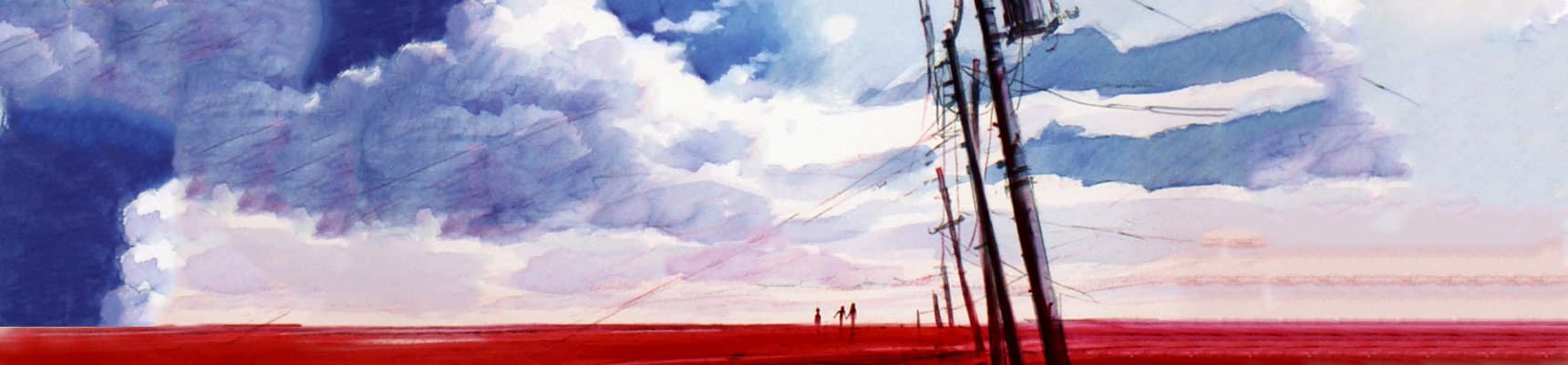
Part Zero: My Relationship with Evangelion
Before I begin, I want to illustrate my relationship to evangelion. I only watched it for the first time about 2 years ago now. I enjoyed watching it then, and rated it highly, though as time went on, I began to doubt that rating. Had I only put it so high because of its legendary reputation?
Then, by chance, maybe 6 months ago, I somehow ended up reading an Evangelion fanfiction. I don’t feel great about it either guys, but it’s what happened. That fanfiction portrayed a happier version of the timeline, where the characters began to communicate, rely on each other, and find their own happiness in the later half of Evangelion, instead of drifting apart and suffering like they do in the show.
This helped me understand Evangelion’s nature as a tragedy, and many of its core themes. The clearer explanations of events in the fanfiction combined with the many wiki-dives I had to make allowed me to get a firm understanding of what was actually going on.
Equipped with that information, I watched the show again, and End of Evangelion again, and this time, I understood what was going on, and the themes being portrayed, as well as I think they could be understood. This cast any doubt I had about the show’s quality out of my life, and its status as a 10/10 alongside EoE was restored.
I only had a short time to wait for 3.0 + 1.0, as I was only a true, fully realized Evangelion fan from a little before those last months between Japanese and English releases. Today, I saw the film, and today, I’m writing this review. It might be a “preliminary review”, as there are certainly elements of the film I don’t completely understand, perhaps in the way that I didn’t originally understand Evangelion or EoE, but more likely, just technobabble (biblebabble?) bullshit, so I feel comfortable writing it now.
Part One: Thrice Upon a Time
I only realized today that the title refers to the fact this is the third time the series has ended, and the third version of the tale, because I am an idiot.
The first ending is that presented in the show’s last two episodes. What exactly is happening in these episodes is very unclear, especially without having seen EoE, but even after, it is up to interpretation.
Shinji is either embracing or rejecting instrumentality, and it’s difficult to say which is happening. The main argument towards rejecting is the fact that the characters are presented in individual form, rather than as a sentient mass. I reject this argument, however. As the show tells us, this is just a representation of what is happening in instrumentality, as our minds cannot comprehend billions of souls connecting. We witness the events of entering instrumentality as individual humans talking, albeit with access to each other's memories, because this is how we can understand human interaction.
My belief is that what is happening here is that Shinji is learning to accept himself as he merges with all of humanity, entering and embracing instrumentality. In the omedetou scene, Shinji has found self acceptance, and joined with the whole. However, to achieve this, he and humanity have sacrificed human form and human nature.
I think you could call this the bad ending. While the characters achieve happiness, the moral becomes that humans cannot achieve happiness, cannot understand each other without forsaking human form.
This is an oversimplification, as Evangelion is a complex series, and my take on EoE will be even more so, because this is not a review of EoE, but discussing its ending is also important.
In EoE, instrumentality begins. We are given the context of how Shinji is given the choice to accept or reject instrumentality: Rei, treated like a human for the first time by Shinji, chooses to take away Gendou’s ability to be the focal point of instrumentality and bestow it on Shinji. Based on a few shots from the last two episodes of the show, we can assume that the context is the same in the show.
Shinji, also, is not prepared to choose, but when he asks Asuka (or his own mental construct of Asuka, unclear) for help, she rejects giving any, and Shinji, in anger and frustration, begins instrumentality.
In instrumentality, however, as he comes to understand everybody, and encounters his mother, he comes to a conclusion that he’d rather continue to live as a human, even if it involves suffering, than reject humanity for happiness. It is stated that anybody with a will to live can return to human form, and the “one more final” scene takes place on the beach. I’m not even going to unpack that can of worms here.
This, to me, is the “true ending” of Evangelion. I’m not prepared to call it the “good ending”, because there is much that isn’t good. Not everybody returned from instrumentality, and most character relationships ended unresolved. A “good ending” for evangelion would have averted the events of this movie altogether.
I believe thrice upon a time is an attempt at writing this good ending.
Rebuild
But what is the rebuild quadrology? Why does it exist? I haven’t done too much research into the behind the scenes of why, but I’m a little doubtful about the claims that it is because ‘Anno was happy to finally recreate Eva "as he wanted it to be" in the beginning and that he was no longer constrained by technological and budget limitations”’ as phrased by wikipedia. Firstly, the story throughout the four films is a mess, and if there ever was a four-movie plan it went seriously off rails. Secondly, while budget limitations did exist, Anno had a large amount of creative freedom, and there is nothing in these films which could not have been depicted with technology in the 90s.
I’m not flat-out saying that the rebuild quadrology is a cash grab, but I’m also not saying it isn’t. More likely, though, I think it’s an attempt at a retelling that got derailed by various factors, and ended up going in a completely new direction.
To briefly summarize/review the three movies before 3.0 + 1.0, 1.0 is essentially a prettier version of some of the first arcs of Evangelion. It might as well be a remaster. However, to fit the movie runtime, a lot of the important small moments are lost.
2.0 is, for much of its runtime, in the same boat as 1.0, until the very end, where shinji begins the third impact early, before being stopped by Kaworu in the post credits. This is the moment where the timeline begins to seriously diverge. Mari is also there, and we’ll talk about her later.
Part of me wonders if this is the original plan. Perhaps the rest of the movies were meant to play out as a remaster, but box office, or critical response, or Anno’s own doubt caused him to stray from the path. There’s no way to know.
Finally, with the timeline diverged, we get 3.0. I’m not going to water down my take here: 3.0 fucking sucks. It begins after a 14 year time skip. Firstly, the CGI usage, which was fine if too noticeable in the first two, becomes more frequent, and significantly worse, in my view. We spend most of this film staring at CGI objects, and some of them, like the navigation bridge set of the Wunder, are absurdly bad.
The plot can be very briefly summarized as “nobody tells shinji what’s going on, he does some gay piano stuff with kaworu, then they start a fourth impact, and then it stops, having no discernable consequences.”
I severely doubt this timeskip was originally planned, although I haven’t researched whether it was. But it’s a fucking mess. There’s nothing to ground us in this world, and we have no way of understanding what’s going on, or why. If anyone had explained anything to Shinji, the plot wouldn’t have even happened. We, the audience, are not given any tools to understand what any of the impact things mean, what’s happening in the plot, or what goes wrong with Kaworu’s plan, or even whether Kaworu is trustworthy, as he is a villain in the original and the audience is likely to be suspicious of him.
So, at the conclusion of the fourth impact, Shinji walks off with an Asuka and a Rei, and we’re left wondering what the fuck is going on, for 9 years. This is the stage that has been set for 3.0 + 1.0. It cannot be a great follow up to 3.0, but rather, if it is to be great, must be great in spite of 3.0. I had, previously, believed that this was not the case, and that 3.0 + 1.0 could recontextualize 3.0 to make it good, but that hasn’t happened, and I think I was silly for ever believing it.
Part Two: The Technical Aspects: Letting Me Down
Most of my review of this movie is going to be in relation to the story being told, because that is what is most important, but more than ever, the technical aspects are worth discussing. The art in this movie is incredibly hit or miss. Most of act one is pretty incredible. The landscapes of the post impact world, and of the village, are incredible, and it is a perfect stage for the story it is to tell. Some of the floating 3d objects are too noticeable as 3d, but they’re acceptable. The fight scene is also done well.
Act two is more CGI heavy than act one, but overall, they’ve gotten a lot better at modelling, animation, texturing, and compositing, and it doesn’t look awful… until act three. Act three is even worse than 3.0 was.
The first of the two big offenders here is this movie’s rendition of Giant Naked Rei, which is the worst looking CGI I’ve seen in any anime, and I’ve seen the asteroids in Cowboy Bebop. Part of me thinks she’s supposed to look bad, but if that’s the case, it was a Very Bad Call. EoE’s GNR was an unsettling masterpiece of art, looming over the environment. This looks worse than CGI from youtube shitposts. If they were trying to achieve an uncanny valley, they didn’t really succeed, because it was too laughable. If they were trying to make it hyperrealistic in the anime world, a la the town at the end, they really fucking failed. Regardless of what they were trying, though, it is unmistakably bad.
The second is the CGI section of the fight between Shinji and Gendo, while they knock around buildings. This looks like baby’s first blender, with the background and props being laughably bad, lacking in detail, looking absurd being knocked around, textured poorly. The terrible cherry on top is the mechs themselves. Other sections of the movie have CGI mechs, I believe, and normally it looks fine, even if I prefer hand-drawn, but here it’s laughably, laughably, laughably bad.
There are other examples of bad CGI, but also some examples of good, but I’ll refrain from listing them off. I don’t know if the things in question were rushed, or meant to be bad to drive home a point, or whatever, but they were a mistake.
I also want to point out this film’s relationship to fight scenes, then contrast it to the original show and EoE’s. In this film, and 3.0, they are mostly there to hold viewer attention, and show off shiny CGI toys. This is how lots of bad action movies in modern day treat fight scenes. Some of them, like the paris fight in the beginning, are actually executed pretty well, and I’m not going to claim I wasn’t laughing in joy at an Eva being speared with the Eiffel Tower, but this does not redeem how the fight is being used.
In the original, and EoE, mech fights are mainly there not to entertain the audience. Many do the exact opposite by being excruciatingly slow and having the characters make frustrating, but in character decisions. They are often used to highlight a character’s current mental state, or to force them to make difficult decisions, or otherwise progress or develop their character.
The flashiest fight in the non-rebuild continuity is probably Asuka vs. the Eva Series. The fight is incredibly entertaining and wonderfully animated, but its main purpose isn’t to hold your attention or fire your dopamine receptors, but rather to highlight how Asuka, after coming into contact with her mother in the Eva, and understanding the true nature of AT Fields, has managed to become a fulfilled version of herself, her confidence no longer an arrogant display driven by trauma, but rather a realized and healthy competence and belief in oneself. Ultimately, though, all that fails, because the Eva Series can regenerate, and the odds were never even, and Asuka is subjected to pain, and killed, regressing her, and spurring Shinji into action. I could write ten more paragraphs about the importance and brilliance of this fight without running out of things to say.
There is not a single fight in 3.0 or 3.0 + 1.0 which serves a role a tenth as important as this single fight, or many others throughout the original show. They are pure CGI and animation spectacle, lacking in further depth or importance.
This concludes this section of my review.
Part Three: The Plot
I don’t love summary as review, but sometimes, laying groundwork is important, so I will do some brief analysis of structure and recap of events.
Following a fun but ultimately pointless action-packed prologue, this movie consists of three acts.
Act One follows the three Eva pilots into a village, where humans are surviving despite the effects of previous impacts. Here, Shinji struggles with overcoming guilt and grief, while Rei, possibly the most sheltered Rei we’ve seen in the franchise thus far, is taught how to be a human. Asuka tries to push Shinji out of his grief, but isn’t very successful, and mostly mopes. Force feeding scene is pretty hot though.
This is the strongest act of the movie. The art is consistent and excellent, the characterization is strong. The village, and the aged-up characters within provide the grounding the film needs. I also get a Hikari old enough to be my waifu. We finally get to see what effect the end of 2.0 had on the world. The landscape is haunting, but inspiring, as hope grows from the ruins of an old world.
Here, Rei is constantly being played against ideas of life, growth, and motherhood. She’s taught very basic things about human behaviour, and takes them to heart, developing into a fine version of herself. We’ll talk more about her later.
Eventually, though, it comes to an end. Rei pulls from his depression, the Rei dies of LCL withdrawal, and Wille comes to pick up the pilots, concluding this act.
The second act, as I define it, begins aboard the Wunder, and ends when Shinji enters the negative zone, or whatever you want to call it. This act has a few good character moments, but most of it is a regression to the flashy style over substance of 3.0. I exited the first act believing that this movie could, despite all odds, be a ten out of ten, comparable to EoE. Here, the hopes of that faded. While there was more, and better characterization than 3.0, most of it was pointless fight scenes, and an excuse to flaunt more 3d models.
Here, we get more technobabble, and while I’m sure some of it is comprehensible, I think the majority of it is invented on the spot and serves no greater purpose.
Finally, we enter the third act, amidst even more technobabble. Wille has failed to stop NERV’s plans for instrumentality, and has in fact played directly into them, as unlikely as it seems. As an aside, most of the scheming in the original show seems fairly believable, but here it feels very absurd. Your scenario always included two failed impacts, and the exact actions of dozens of people? Mmmkay.
Gendou departs for the negative zone, and Shinji declares he will pilot unit 01 to stop him. Misato and him have a well-written moment, and a cheesy but effective standoff between him and the crew, who blame him for the dead during the partial third impact, before he departs.
Here, Gendou tries to defeat Shinji. He intends to, and succeeds at destroying all spears which could be used to avert instrumentality. While he does this, he finally opens up to his son. More on this later. Misato sacrifices herself and the Wunder to create another spear, which is received by shinji. This spear is representative of humankind’s willpower and knowledge to succeed in the absence of gods. At the same time, Gendou realizes that he can’t find his wife in instrumanality, and that he has failed to grow as a person after his wife’s death.
With the spear, Shinji now has the ability to do basically anything with this impact. He’s not restrained by a binary like in the original series. First, he takes the souls of Rei, Kaworu, and Asuka, resolves their character conflicts, and casts them back to the real world. Then, he intends to rewrite time so that there are no Evas, using himself as a sacrifice. Instead, Gendou and Yui do so together, and Shinji is returned to the real world, where he is shipped with Mari.
This act is largely successful, and has some interesting ideas, but it is held back by some very embarrassing CGI.
Part Four: Character Dynamics
In the last part, I avoided diving too deeply into characters and dynamics, and I will do so now.
The reason why this movie works, despite some stumbles, is because it has powerful character dynamics. If the production and writing of this series was ever cynical or lackluster, here it is restored, and done largely very, very well. However, others are not as strong, which hold this movie back from true greatness.
Rei and Motherhood:
One of the first things our Rei in this movie sees is a pregnant cat under a train car. She doesn’t know what it is, and she stares at it with her Rei eyes. Rei is constantly being shown scenes of growth, rebuilding, and motherhood in the first act. She lives with Hikari, where she regularly interacts with Hikari’s child. She works the fields, and helps them to grow and rebuild the town. The members of the village help her become a more complete person, despite her odd ignorance about the world.
The reasons for Rei’s comparison to motherhood are fairly obvious. The exact nature of Rei in this film is not as clear to me as it is in the original series. Is she still the vessel of lilith? I’m not entirely sure. But she is still a clone of Shinji’s mother, and she has a role to play in that part. In act two, Asuka says to Mari that Shinji didn’t need a lover, but a mother.
Rei is the one who coaxes Shinji from his grief, and she does it gently, using the tools of human interaction she’s learned from the townspeople. She briefly acts as his mother in this regard. The line is still blurred between that and lover, as Rei and Shinji’s dynamic often is, but with all the visual representations of motherhood present here, I think it’s fair to say she takes the former role.
The completion of her growth is represented by when she is coaxed out of her black plugsuit, a representation of Gendou’s control over her, and into the old school uniform that is so iconic for her character. This represents her once again becoming one of the Reis we know. Soon after, however, she dies of LCL withdrawal, her plugsuit becoming white, again symbolizing her return to a realized Rei we know.
A part of this story I didn’t quite know how to weave in is Asuka’s assertion that Rei is programmed to like Shinji. This is either intentional by NERV, as Asuka implies, or an effect of her being a clone of Shinji’s mother. Rei simply says she doesn't care, as it makes her happy. I thought that was a pretty powerful moment.
We don’t get more Rei until Shinji enters the Negative Zone (I will not call it anything else) and this time it’s the Rei from 1.0 and 2.0, soul still in unit 01’s entry plug. Our only real interaction with her is at the end of the movie, when Shinji tells her to find happiness without orders or Evas, and that there is a version of her that did so once. This interaction isn’t particularly deep, sadly.
Asuka and ???:
Frankly, I don’t think Asuka had much character in this movie. Maybe rewatching will change that, but she was mostly utilized during fight scenes, and didn’t often play a central role. She made it clear her feelings for Shinji had lapsed.
When Shinji recovers her from the negative zone, her resolution seems almost more forced than any of the others.
There were aspects of her I didn’t fully understand. The movie seems to be saying that in this timeline the Asuka’s were also clones like Rei, but it doesn’t dive too deep into it, and she’s mainly following the same old motivation of proving herself as a pilot. Perhaps on subsequent viewings I’ll see more in her character, but I really don’t think there was much there.
Shinji and Responsibility, Misato and Motherhood:
Shinji’s character has always been about responsibility. In the original show, he struggles to shoulder the responsibility of piloting Unit 01. He wants to make his father happy, but he also resents that his father only wants him for piloting the Eva, only uses him because he is the only tool which can be used. He ultimately pilots to protect Rei, Asuka, and the rest of his friends, but when that help hurts others, he runs away. He constantly wants to run away from his responsibilities. He gets caught in a loop of forming resolve, piloting, people getting hurt, and running away. Near the end of the show, he seems to become fully realized, but killing Kaworu breaks him. He’s basically just pulled along for the ride by Misato and then Unit 01/Rei for most of EoE, trying to avoid responsibility and hurting more people.
In rebuild, Shinji must deal with the same things again, but on a greater scale. This time, Shinji has caused the partial third impact, killing billions, in his attempt to save Rei. The grief of this action causes him to become rash in 3.0’s end, causing yet another impact.
But he overcomes this grief early in this movie, at the end of the first act. This is unusual for Shinji: in both other endings, he only manages to become a complete person during instrumentality. Here, though, he seems to finish his character development before Rei’s death, and, as someone who is now already accustomed to loss, takes that death very well. He is prepared to take his responsibility, and decides to rejoin Wille.
Shinji is absent for most of act two, as he is being held in an explosive-rigged room to keep him out of trouble, but he arrives at the end. He’s already confident, and ready to pilot Unit 01 to try to save humanity.
But the ship’s crew isn’t ready to accept that, and they threaten him with guns, as Misato ordered, despite Misato’s own approval of Shinji going, to the point where Sakura tries to shoot Shinji, with Misato taking the bullet for him.
Misato defuses the situation by accepting her own responsibility. She says that as Shinji’s guardian, and surrogate mother, that Shinji’s actions were her responsibility. His successes were her successes, but even more, his failures were her failures. Her characterization in 3.0 appeared to be that she was angry at and distrustful of Shinji for causing the partial third impact. Here, it is revealed, perhaps as a retcon, perhaps not, she simply wanted to protect him, to stop him from having to harm others to help: she believes that if he had not done what he did, NERV would have caused a full third impact long ago leading to their destruction. But she knows that hurting others hurts Shinji, and she doesn’t want him to hurt anymore.
But she knows that Shinji is now the only one that can stop Gendou, so she gives him leave to go.
Misato also has a son in this movie. Her son, and her relationship to that son, are not given much screentime, but it’s revealed that she has virtually no relationship to him. It seems to be that she believed she was a failure as a parent to Shinji, and did not believe she could parent another. Although she doesn’t live to see her son again, her willingness to accept responsibility for Shinji is likely a willingness to also accept responsibility for her son.
Gendou and Loneliness:
Until the third act, I would have said that Gendou’s characterization was significantly worse in rebuild than it was in the original. The original Gendou is always grounded in his motivation to reunite with Yui, no matter the cost.
This movie, and 3.0 both seem to neglect Gendou as a character for most of their runtimes, with the audience left to assume his motivation is the same. But suddenly, in the film’s third act, Gendou is catapulted from one of the worse portrayals to one of the best.
We get to see Gendou as a human person in a way we don’t in the original. Gendou possesses a tragic motivation in the original, but we mostly get to view him through Shinji’s eyes, as a cruel, neglectful, manipulative, and abusive father. All of this is true of Gendou, in both continuities and all three endings.
But during 3.0 + 1.0’s last act, we are given time, at last, to view Gendou through his own eyes. We knew Yui was everything to Gendou, but we’ve never before seen Gendou’s life before Yui. He was, as you might guess, a person devoid of almost any other human interaction. The way they talked about his childhood: his lust for knowledge, his dislike of others, in some ways reminded me of my own. I think you could read him as autistic, a person not cut out to exist in our social society, and craving one without barriers, or as a stereotypical Japanese man, unwilling to open up, keeping his emotions inside.
Meeting Yui changes that. Yui accepts him for who he is, and she brings him happiness through human companionship. This is the brief period of his life where he is truly complete and healthy as a person.
I think we understand a little more why Gendou is willing to remove humanity’s humanity for his wife, after this sequence of a film. Before Yui, he was always alone, but he didn’t know what he was missing, and was happy in that loneliness. After Yui, he was once again alone, but this time, he knew what he was missing. The healthy thing to do would have been to grow, and change. Seek out new connections with his friends, with his son. Instead, he decided to do anything he could to bring Yui back, especially as her soul was still trapped within an Eva. He was willing to do anything: to kill others, to sacrifice his son, to destroy humanity’s humanity, to become complete once again.
I think the original show’s characterization of Gendou is very strong, and certainly more consistent throughout, but I always viewed him as not just tragic, but also as a little humerous, as the wife guy willing to kill humanity is a bit absurd. But given this additional lens, and insight into Gendou’s childhood, it’s not quite as funny anymore.
Atonement with the Father
In the original continuity, Shinji never truly confronts Gendou. Instead, his plans are foiled by Rei, who, after being given a greater degree of autonomy through Shinji’s treatment of her, decides to reject Gendou, and steals from him Adam, and gives the decision of whether to complete instrumentality to Shinji instead. It’s possible, up to interpretation, that Gendou doesn’t even get to enter instrumentality with the rest of humanity.
Shinji is never given the opportunity to atone with the father.
Atonement with the Father is a stage of the Hero’s Journey where the protagonist encounters a strong, masculine figure, carrying a strong and brutal ideal. It is sometimes literally a father, sometimes not. Here, the protagonist must overcome or reconcile with the father, sometimes both.
Shinji, ultimately, in this film is given the chance to atone. I think there’s something of value to this: it feels a little more mature. Not just viewing the father, even the abusive one, as a villain, but as a person. Shinji knows that he cannot defeat his father in combat, but rather must converse with him. Gendou realizes his own failure to grow and change. Yui is supporting and protecting Shinji in a way he never did, instead of doing whatever it takes to return to him.
Gendou is ultimately given a heroic role: alongside Yui, he sacrifices himself to help create Shinji’s better role. I believe that the strongest part of this movie, of this quadrology, is the way Gendou has been treated. I don’t like constantly comparing Evangelion to Anno, but it seems like he wanted to be a little more mature. Gendou isn’t as pathetic, but instead is more sympathetic. The role of the father is not just manipulator, abuser, mistreater, but instead, of a human being who made mistakes, and learned to move on.
Mari: The Piece that Doesn’t Fit
Not all is right in the characterization of Thrice Upon a Time, however. Mainly, it’s that 3 movies after her introduction, Mari is still flat, and has zero depth. Her role in this movie is twofold: participate in fight scenes, and get shipped with Shinji.
The reason I say “shipped” is because this is exactly as forced as this phrasing implies. They have very little time together on screen, no chemistry. I think Anno wanted to avoid getting Rei together with Shinji, because she’s his mommy, and Asuka together with Shinji, because she’s 28 in this film, despite never acting like it. For whatever reason, though, he felt the need to include a love interest, and that would be Mari. Perhaps to serve his happy ending.
I don’t really know why this character was introduced in 2.0, and if she ever had a different role to play in an earlier draft, but ultimately, she really doesn’t do anything important, and is used in one of the worst elements of this film, her relationship with Shinji.
Part Five: A Happy Ending
I didn’t discuss Kaworu in the last part, because I’m going to here. There have been hints before to Evangelion as a cyclical narrative, or a interlinked multiverse, and it seems to be finally confirmed by this movie. There are many Evangelion worlds, and Kaworu remembers a little bit of being in the other ones.
Kaworu initially views his role in this multiverse as to make Shinji happy. Their names are written next to each other in the Book of Fate, whatever the flying fuck that means. In his sequence with Shinji near the end, however, he accepts that he was trying to bring himself happiness by trying to make Shinji happy. The implications of this distinction aren’t particularly important. He states, also, that this Shinji has changed, and is not acting the way he usually does. Kaworu even loves him a little less, or a little differently for it.
Kaworu ultimately isn’t even in this film much, and he doesn’t end up together with Shinji, although it would make much more sense than Mari. But his presence serves to tell us that this time, things ended a little differently. Shinji’s new world without Evas seems to be a break from the cycle of Evangelion, one where all the children can be happy.
The show ends with a shot of the characters at a photorealistic train station, living normal lives, before the camera pulls back and out, revealing the city they live in is a fully photorealistic one. This seems to represent that they’ve returned to a more normal world. One where, at last, the children of evangelion get to be normal children.
This is why I believe this is meant to be the good ending. Not everybody made it here: most notably absent is Misato, but the children, once forced to be soldiers, some bred for the tasks, get to live normal lives. I'm happy that this ending gets to exist, so that at least one version of these characters, in our collective minds, finds peace and happiness.
Conclusion:
To me, though, it still cannot be the true ending. The movie has too many flaws, and it's predecessor even more so. While there are a few things it does very well, even at times better, it cannot match the sheer consistency. quality, depth, and excellency of the original show and EoE.
3.0 + 1.0 is a film of contradictions. It is both the most beautiful and worst looking movie I've seen in a long time. It contains genius character arcs and very lackluster ones. Given its predecessor, perhaps that was the most that was possible.
I'm glad, though, despite rebuild's flaws, and its now cemented status as the inferior Evangelion version, that this film was able to give it some redemption. I'm not convinced this is the story Anno originally set out to tell, but it's one I'm glad he did, in the end. I'm not going to pretend I like this movie nearly as much as End of Evangelion as an ending, but that's not to say I didn't like it a lot. The first act in particular is an absolute triumph of anime.
I've said most of what I set out to say, and now only one thing remains: the score. My scores for 1.0, 2.0, and 3.0 were all provisional, because they are all hard to judge without knowing what they are building up to.
Now, I can finally give those films final scores. 1.0 and 2.0 are receiving scores of 8.6. This is, to me, the rating of "solid, very worth your time, but not excellent".
3.0 will not be receiving the same love. It's getting a 7.0, a fairly low score in my system. I don't think it's actively bad, and it's very watchable, but it fails holistically as an Evangelion movie, and its sequel succeeded in spite of it, not because. The only reason to watch this movie is so that you can see the sequel.
I think Thrice Upon A Time is the best movie in Rebuild, and the first to bring something new to the table. It earns a score of 8.9 If it weren't for the technical flaws, shoehorned relationship, and neglect for a few main characters in the end, it could have landed as high as 9.5, even with a second act I don't like as much as the ones before or after it.
I'm sure as I stew on it more, it will move up and down, and it will do the same on subsequent viewings, especially if it turns out there are elements I was missing beneath the surface.
For now, though, I'm happy placing it at that score. I'm glad that the troubled quadrology has been put to rest, and Evangelion, at least for now, comes to an end once more. Hopefully the talent trap that is Studio Khara will make some new, original works with their talented staff. And maybe lay off the CGI for a little while.
36 out of 41 users liked this review
