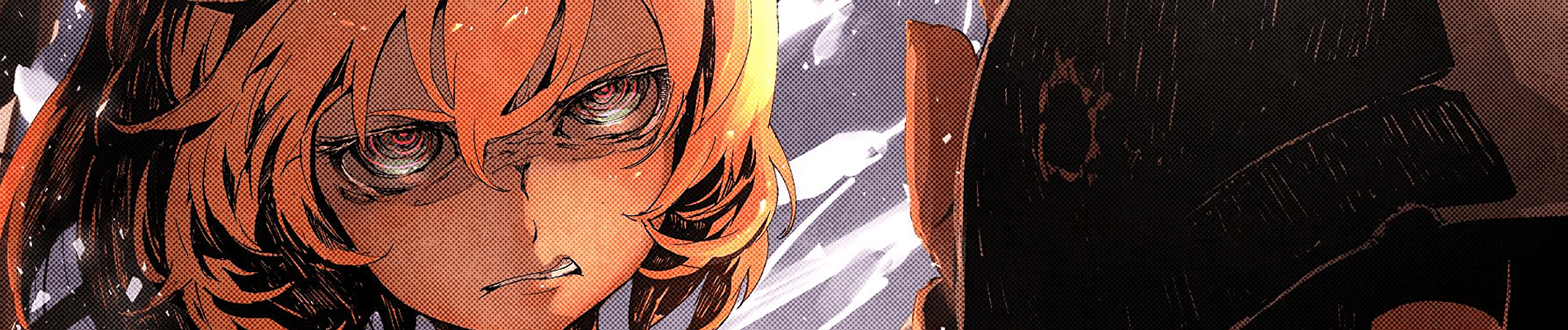
Once upon a time, there was a a man who died.
A staunchly pragmatic Japanese business man, he had just fired one of his lesser coworkers... A common duty for him, as he held no sympathy in his heart for anyone who didn’t have the fortitude to climb the ladder as he had. On his way home, however, the man he had just terminated decided to return the favor, in the ultimate act of vengeance, by shoving him in front of a subway train. The man’s story should have ended there, but his imminent death was paused by a being calling himself God, who chided the man for his lack of faith... A trait the man was NOT ready to give up, claiming that faith was foolish, and anyone living in a comfortable society had no need for it. He even denied the being’s identity, labeling it “Being X” rather than God.
As for what happened next, well... You know that old cliche where you insult someone’s manhood by calling him a little girl? God just sort of does that. The man is reborn, with all of his memories intact, as a female infant in a war torn fantasy version of Germany in the early 1910’s. His goal was to show the man what true suffering felt like, but that goal quickly backfired as that girl, now known as Tanya, signed up to join the war, combining her encyclopedic knowledge of real world military history with her surprising magical aptitude to become the most significant and consequential soldier in the entire Empire. Driven by unquenchable ambition and pure spite, she set her sights on a new goal. God would pay for meddling in her affairs, and the whole world would tremble as they witnessed the Saga of Tanya the Evil.
At first glance, the names involved with this show do not look promising. Director Yutaka Uemura only had one anime attributed to his resume before this, and while I can’t speculate on Punchline’s quality as I haven’t seen it, he still comes off as a rookie. The same can be said for Nut, an animation studio that’s only been around for about five years, and who’s first production was, in fact, this one. It’s also worth noting that they’ve suffered endless mocking over the internet for their name, and it’s hard not to understand why. I will repeat, they’re called Studio Nut.
The final product, however, would turn them from a laughing stock to one of the most promising and highly acclaimed rookie studios in the industry, the 2017 answer to Studio Trigger. For a debut effort, this anime is absolutely gorgeous. It’s not the first anime to incorporate soldiers using magic to fly around the battlefield in intense aerial combat, but it had to have taken some cues from the first season of Strike Witches, because those battles are fast paced and exciting, blending traditional animation techniques with sparse CGI to deliver some absolutely breathtaking combat sequences.
Admittedly, the CGI does look a bit clunky when it’s being used on the ground to showcase soldiers marching in formation, but it’s easy to ignore when juxtaposed against the beautifully gritty backdrops of a wartorn civilization. It’s weird to use that word when talking about dirt and debris, buildings that have been blasted to ruins and skies full of dust and smoke, but it’s all so intricately designed in every harsh detail that you can’t call it anything else. On some level, it reminds me of Barefoot Gen in it’s ability to showcase the horrors of war, the destruction of both property and humanity on a visceral level, never holding back while at the same time captivating you with it’s artistry. The visual direction and cinematography of the series are immaculate, regardless of Uemura’s apparent lack of experience.
The character designs tend to lean towards realism for the most part, with characters sporting believable facial structures, proportionally accurate frames and lips... It feels really weird to me that they all have lips, anime characters do not usually have lips... But unfortunately, the exception to this is the female characters, who have all the same realistic proportions as their male counterparts, apart from the fact that they have giant anime eyes that look really off-putting when paired with lips. It can work at times, of course... Tanya’s close confidant Viktoriya Serebryakov looks adorable most of the time regardless, and Tanya herself is an absolute roller coaster of facial expressions, but a lot of the time it feels awkward to the point of being downright memeable. Still, she looks absolutely terrifying at all the right moments, so I’ll take it.
The high production values don’t stop with the visuals, however. The music is equally appealing, as Shuji Katayama... A composer who actually does have a decent resume behind him... has put together an amazing soudtrack that not only perfectly matches the tone of the series, but even adds depth to several of it’s characters, like how the songs The Realist and The Individualist both explore two warring side of the title character. There are suspenseful tracks that put a chill up my spine even when I know what’s about to happen, as well battle music that’s both intense and adrenaline-fueled in a way that I haven’t heard since Bastard!
Also, I don’t know, maybe I’m the only person who’s noticed this, but even though Tanya is the main character and driving force of the story, some of the music that plays when she gains the upper hand over a foe or clinches a significant victory is downirght villainous in it’s orchestration, and yet it still feels entirely triumphant... A decision that had to have been deliberate. I also appreciated just how on point the sound design was, with each explosion, bullet and flying effect sounded authentic amd impactful, even when mixed with the more futuristic sounding magic effects.
For the English dub, it sounds largely similar to the sub, especially in the case of certain characters like Jeannie Tirado’s Viktoriya, who sounds unsettlingly similar to the seiyuu. There are two noticeable stand-outs, however. The first is J Michael Tatum, ever the smooth talker, playing Erich Von Rerugen, the officer who can’t shake his apprehension over Tanya’s success after witnessing her ruthless methods first-hand, and his delivery sells his character’s trepidation way better than the seiyuu did, as he sounds calm and cool most of the time, adding a subtle shudder to his voice when faced with evidence of Tanya’s cut-throat true nature.
The other difference is Monica Rial, an actor who sort of has a reputation for being over-saturated in the industry, getting type cast in a ton of similar sounding roles, but the work she can do when she plays against type is the stuff of legend. Thankfully, Tanya Degurechaff fits firmly into the latter category. Much like Aoi Yuuki, Monica sounds totally believable as an adult in a child’s body, but she tweaked the character ever so slightly, taking the bar of eccentricity that Aoi set and lowering it just enough to add a level of world-weariness and long suffering frustration that you’d expect from a middle-aged business man dealing with unexpected inconveniences and only truly letting loose in the character’s more intense moments, making Tanya feel both more in control AND more insane at the same time.
Both audio tracks are brilliant, and while it’s possible that I’m just leaning towards the English track because of my monolingual ignorance, the characters just sound more natural to me, both individually and in their dynamics with each other. Aoi Yuuki is famous for voicing the Pokemon Eevee, however, and that’s an endless source of joy for me. I’ve also heard good things about the German dub, so do with that what you will.
I’ve been watching anime for a long time. A long, long time. If you’re counting my exposure to televised anime of the nineties like Pokemon and DBZ before I started going deeper down the rabbit hole, I’ve been watching this stuff for almost 25 years. In that time, life has obviously changed. I’ve accrued more responsibilities over the years, as well as less free time, but nothing put as much of a damper on my ability to watch anime for fun like, ironically, my decision to start writing reviews. No matter how good an anime is, it’s become extremely rare for me to rewatch anything, which has led to me selling quite a few beloved DVDs on Ebay, a lot of which were not easy decisions to make when the need to pay my bills outweighed my need to have a five star classic on my shelf just to look at.
There are a few anime series I’m able to watch over and over again without getting tired of them, however, and Saga of Tanya he Evil is definitely one of them.
If you were to tell someone who’s never heard of this show what it’s about, well, you’d start with a brief summary of the plot, because this is an isekai anime, and when you consider just how many of those there are these days, it’s important to mention just what sets it apart from other titles in it’s genre. Like Konosuba, the circumstances surrounding the main character’s death and rebirth are engaging, unique and immediately make you want to see more. Much like That Time I Got Reincarnated as a Slime, it involves actual reincarnation, a surprising rarity of the genre. I personally really like Slime and Konosuba, so these are attractive comparisons to make.
You could also call it Strike Witches without the fanservice... Honestly, the style of combat both shows feature is so similar I’m surprised more people don’t make that observation... But considering the fact that Strike Witches without fanservice is just Brave Witches, I’d take it a bit farther by saying it’s like Strike Witches, but they’re fighting actual people. Actually, you know what? Let’s drop the Strike Witches comparison right there, because the fact that they’re fighting real people is by far and away the most unique thing about this series.
I want you to think back to the last Marvel movie that you watched, and tell me who the main characters were fighting. They fight terrorists, people so removed from humanity that their entire personality is Death to America. They fight and kill scores of generic nameless bodyguards, who HAVE to be evil because of who they’re working for, right? They fight hordes of aliens, they fight hordes of robots, but with the exception of a few specific arch-enemies that rose above convention to become the most beloved thing about their movies, the heroes never fight anyone that you’re allowed to feel sympathy or understanding for. Even when the humanity of a minion IS acknowledged, it’s usually played as a joke.
In Saga of Tanya the Evil, the story is explicitly set in the middle of a war that’s threatening to turn global, and I’m not exaggerating when I say that every single character is portrayed as a human being. Nobody is othered. There are no attempts at pulling punches, and the only way they try to justify the main characters keeping their hands clean is by the logic of ‘we were just following orders.’ This could have turned out to be a very bad move if either side of the conflict were stated to be especially in the wrong... Humanizing a nazi is an incredibly dangerous road to walk... But the war itself is kept as generic as possible, to the point that unless you took the time to sit down and analyze it, there really isn’t a clear consensus on how the conflict even started.
Soldiers on both sides have familiars, they have diverse relationships and dynamics, they talk to each other like brothers in arms. Higher ranking officers on both sides talk about strategy, the losses they’ve taken, and the pride they have for their countries, with no attempts made in the dialogue to quantify either as more just or unjust than the other. When Tanya kills an enemy soldier, you cheer for her. When you see that soldier’s grieving family right in the beginning of the next episode, you feel bad for them, and you don’t feel conflicted over it, or even the slightest bit manipulated. The only reason you root for The Empire is because that’s the side that Tanya was reincarnated into, which leads me to the main reason her series is able to walk that tight rope so well.
The main conflict of this series isn’t the war. It’s Tanya’s ongoing battle with Being X that takes center stage, and it feels just as important as it wants to feel.
Let’s be honest, we’ve all dealt with someone like Being X before. Someone who didn’t approve of the way we live our lives, and had the authority to do something about it. Maybe they were an asshole boss, or unsupportive parents, judgemental faith figures... Maybe it was something intangible, like God, karma, Murphy, or some vast conspiracy that we swore was happening all around us. Unlike the rest of us, though, Tanya gets to meet her meddler, and while he mostly pulls the strings behind the scenes, he is not shy about showing up every once in a while to brow beat her and chide her for not yet developing the kind of faith he demands from her.
But what about Tanya, you ask? How are we supposed to root for her? Is she not evil? Well, yes, but context is important. She’s certainly no humanitarian... Honestly, I’d go as far as calling her a full blown sociopath. She never hesitates to commit atrocities in the line of duty, both to the enemy and sometimes to her own subordinates, but she never does so without some kind of wartime justification. She never disobeys orders or breaks the rules of engagement, even if she has to occasionally stretch their definitions and exploit some downright egregious loopholes. She is, therefore, a lawful evil. From some perspectives, she is the perfect soldier, but more importantly, she’s also the perfect survivor.
It’s this survivability, this cut throat methodology that she very amusngly developed through years of Japanese social-climbing, that makes her war of attrition against Being X so engaging. Every time Being X meddles in her life, she has to find ways to overcome his influence without bowing to his will. Even after she suffers some small losses, such as having to pray to use magic, she still has every intention of taking the dreams she had in her old life and realizing them here, on her own terms, even if it means fighting a never ending war, even if it means living as a woman in a fantasy version of the early 1900’s, even if it means giving into the base desire for blood that she’s always lived in denial of and climbing a pile of bodies to her destiny, because at it’s core, her character arc... and the story at large... Is about adaptability.
It’s about the indomitable human spirit, and it explores this concept in the most cynical and misanthropic way you can possibly imagine. Not even a political cartoon depicting Jeffrey Dahmer finding inspiration in a “Just be yourself” poster would be this darkly satirical. Is that why the series works so well? Honestly, it’s hard to say. As it is, there was never any guarantee it would have been successful. This show took a lot of risks, and just because it never pulled any punches on any of it, doesn’t mean anything was certain. Hell, it white-washes Nazi Germany to a level that feels disturbingly like how some southern history books handle the subject of slavery. That alone should have been a massive stumbling block, but because they were so careful to avoid any references to Germany other than the word ‘fatherland,” it was really easy to ignore.
On a similar side of the coin, because Tanya is almost always portrayed as the smartest person in the room, and someone who knows more about war and human psychology than literally anyone around her, she should be easily identifiable as a Mary Sue, but because her silver tongue tends to get her into more trouble than it helps her avoid, that doesn’t happen either. There are also several nagging plot and lore questions that never get answered, like, if Being X wanted Tanya to know hardship, why give her so much magic potential? If the Empire is a non-patriarchal meritocracy where someone like Tanya can flourish, why are there no other children volunteering, if for no other reason than guaranteed rations? Why are the no women in the military other than Tanya, Viktoriya and one other lady who failed to make Tanya’s Battallion? They’re allowed to join, right? That’s a thing, right?
In spite of all of this, I feel like the biggest factors to this anime’s success boil down to execution, production values and personality. Saga of Tanya the Evil is tightly paced, moving elegantly between fast, exciting action scenes and heart pounding suspense, between intriguing dialogue and just enough beaurocratic deliberation to to inform of you of where the plot is moving without ever becoming boring, and they still have just enough time left over to flesh out the cast. Even Tanya, in all her evil glory, is both relatable because of her struggle against an outside force trying to control her life, and likeable through sheer force of personality, making this a series that’s way more fun to watch than it has any right to be.
Saga of Tanya the Evil is available from Funimation. The original light novels and manga are available from Yen Press. There’s a sequel movie that hasn’t been dubbed yet, but I’ll be seeking it out after this review goes live, and an upcoming second season has been greenlit. I’d also like to recommend Isekai Quartet, a chibi comedy show featuring several characters from this title, and Tanya has a nice little starring role in it. It’s also available from Funimation.
This show is lightning in a bottle. I had some issues with the worldbuilding and character design choices, and there are a few plot points that don’t add up, and it doesn’t feature much depth outside of Tanya as a character and some pointed social commentary regarding capitalism and society’s tendency to reward ruthlessness over compassion, but it’s a blast to watch, and it’s just as exciting every single time. The isekai genre may be a bit of an over-saturated market at this point, but there are unique titles in every genre, and there is no other anime quite like this one. I could see the gritty depiction of war-time violence being too explicit for some viewers, but the production values are top notch, the action is electrifying, the comedy is gallows black, and you will find yourself unexpectedly rooting for a person you wouldn’t want to meet in a dark alley.
I give Saga of Tanya the Evil a 9/10.
96.5 out of 105 users liked this review