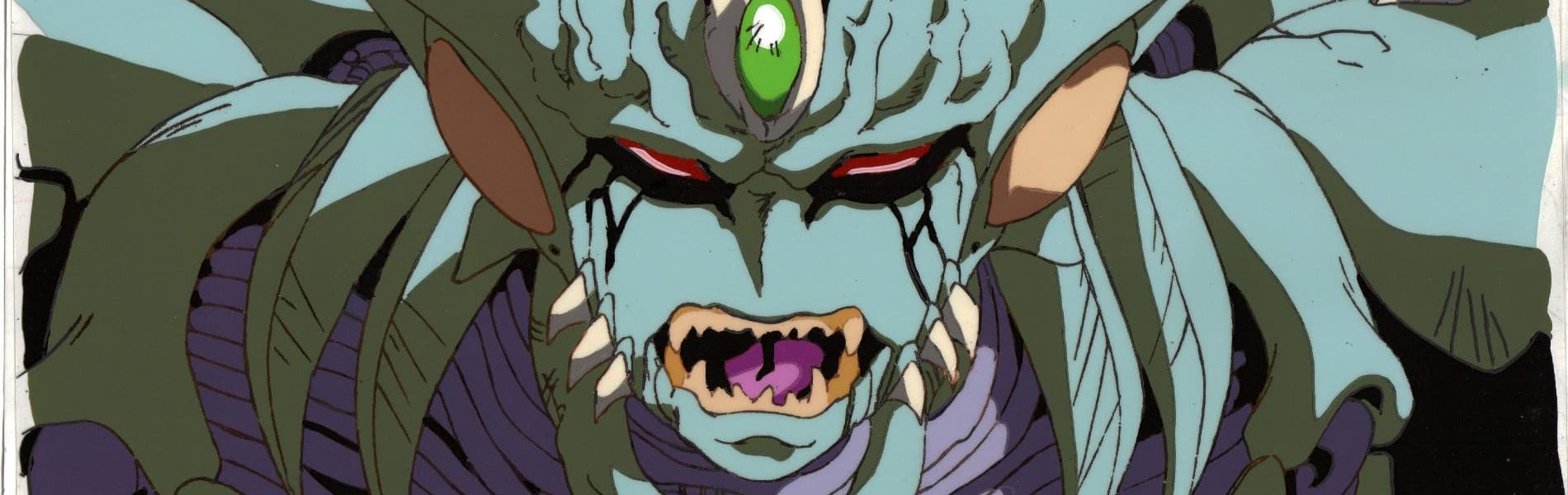
Genocyber
a review by ohohohohohoho

ohohohohohoho
4 years ago·Aug 17, 2021
75
/ 100
a review by ohohohohohoho
4 years ago·Aug 17, 2021
Genocyber is old, and it's grindhouse gory. You're probably watching it in 480p. When I sit down to watch it on my laptop, I feel like I'm watching a video I rented from Blockbuster; although now that I think of it, when I was a kid, we rented from a store called Family Video. It was around the corner from my house, owned and run by a Chinese family. It closed down over a decade ago. As far as I can tell, this store had no affiliation with the chain of video stores with the same name that recently closed all of their physical locations. The Family Video on the corner of Beach Street has long been swallowed up by time. Without some foresight, some money, and some luck, no one can anticipate and keep up with progress. Humanity's technological advancement, a quest that has no end and offers profit without end, is the focus, and humanity itself is in the periphery. Grab onto whatever hunk of metal is drifting nearby and hope it keeps you afloat while the chemical contaminated water rises. Destroying ourselves means nothing if we learn how to make new, better selves in the process.
Perhaps this melancholic, grainy nostalgia which watching a "dated" anime like Genocyber conjures has only added to the experience of watching it, like it's only 30 years later, after sitting around in a state of neglect that the anime is really finished. Hopefully it'll never be a candidate for digital restoration.
Genocyber is anti-capitalist revenge porn. It is actually thematically quite similar to Patlabor 2, but whereas Patlabor 2 is quiet and refined, with a staid, thoughtful, melancholic beauty, Genocyber is furious and vital, and kind of a piece of shit sometimes.
It is a story in three parts, a triptych of anguish and violence. The middle story is the weakest, a somewhat typical anti-war diatribe with a big monster. The last story, which is clearly intended to be the redemptive arc, where we're shown a path forward, feels a little truncated, ultimately not tying together too neatly after an admirable start. Much of the visual experimentation peters out after the first, extended episode, which suggests that time and money constraints impacted the latter parts of production. It was, of course, cancelled after episode 5.
Part one introduces us into a world not too much unlike our own (other than the psychic powers and advanced, weaponized prosthetics, but who knows what the future holds 10 or 20 years from now), except that we are unable to avert our eyes from the violence at the heart of progress. Creative energy is converted into destructive energy. There's an obsession with "upgrading," maximizing the potential of the brain through scientific intervention, destroying and replacing the flesh with machine. Once one person becomes upgraded, that becomes the standard to which everyone else has to rise, or else become ripped apart by time's march forward.
Transhumanism is compulsory. You HAVE to upgrade if you want to keep living, to be seen as productive, whether you're happy about it or not. It's like trying to live without a smart phone, except the cybernetic upgrades in Genocyber are not only contained in artifacts we carry around, they must be applied to our own bodies. Is it really so different, though? Everyone is in a constant state hyper-competition, both to invent the new human, and to avoid obsolescence.
This hubristic desire to shatter the limitations of the human body goes awry when it comes into contact with the equally delimited empathic, spiritual dimension of Elaine's consciousness. Her mind's potential is unlocked, but she is still a child, with an "animalistic" nature. She's innocent, uncorrupted by the perverse impulses of capitalism and progress which place their own goals over the wellbeing of individuals and communities. She values life, and feels for people, which are the natural impulses of human consciousness.
The opposition between the spiritual, naïve, empathic human and the selfish, power-hungry, "progressive" technocapitalist is set up in the first episode, and is returned to in episodes 4 and 5. The "progressive" aspires toward God-like power, and the empath is inherently more God-like because she retains the capacity to love. This capacity is seen as endemic to the enlightened mind in Buddhist traditions, and it's no coincidence that Elaine's conscious potential, her "Vajra," is unlocked via the use of a technological "Mandala." The Kuryu group hoped to create an unparalleled weapon, which they termed a Vajra to symbolize the ascent of humanity to god-like status, but what they created was a weapon that, like the actual Vajra of myth, was turned against the sinners and the ignorant, the enemies of love; in other words, adherents of this unforgiving, inhumane system of capital, progress, and destruction such as the Kuryu group itself.
In episodes 4 and 5, the focus becomes sight as a metaphor. Blindness is another form of naivety, but it is one that is counterintuitively liberating. Mel is incapable of seeing the physical world, which allows her to see things others can't. She has insight, and empathy, and comes to be fetishized as a prophet by desperate cultists. Blindness is also a source of levity. It provides Mel with the space to resist "the Spectacle," the illusory world of the capitalist monolith Grand Ark city, wherein happiness is something bought and sold. Meanwhile people who have no money either suffer or kill one another to attain it. Misery is hidden away, poverty is an indication of personal weakness and depravity, of failure. Mel cannot see the illusion, so she isn't distracted by it, while Ryu cannot help but be tempted. He voluntarily, temporarily blinds himself when he commits his selfish act of violence for money. The city of the Grand Ark is like Tokyo in Patlabor 2, or Macross Fortress in Macross Plus. Many of the promises of capitalism and technological progress aren't real, but their costs to human life are. However, all we focus on is the illusion, the promise. The story ends suddenly with the destruction of the Ark, hopefully destroying the illusion and giving humanity a chance to start over from a state of innocence.
While a little roughshod and uneven in its presentation, I think the story of Genocyber is actually far more intelligent than it's given credit for. The hyper violent veneer is a distraction for some viewers, or even all that some viewers seem to see, but for me, it is essential for representing the diffuse violence of the systems Genocyber is criticizing. This critical narrative is both vital and at times, gripping. If you think you've got the stomach for it, give it a chance.
18.5 out of 20 users liked this review