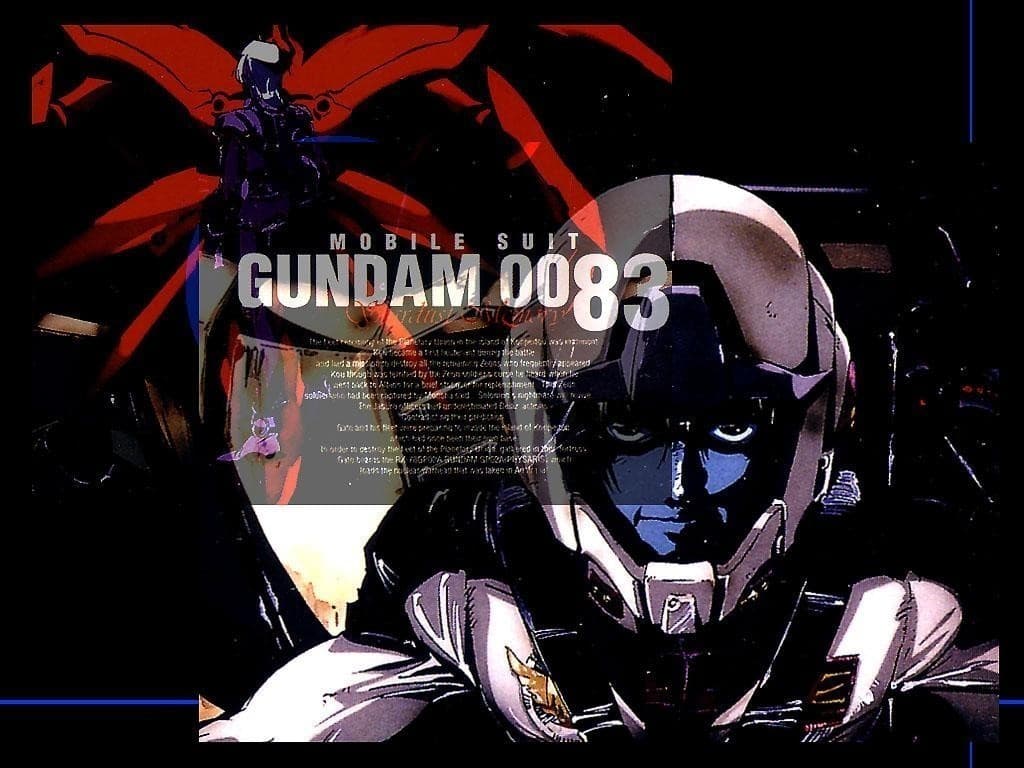
Mobile Suit Gundam 0083: Stardust Memory
a review by ohohohohohoho

ohohohohohoho
4 years ago·Aug 17, 2021
85
/ 100
a review by ohohohohohoho
4 years ago·Aug 17, 2021
Stardust Memory is a Gundam OVA that takes place between the One Year War of Mobile Suit Gundam and the events of Zeta, taking place 3 years after War in the Pocket.
Operation Stardust is a plan spearheaded by Anavel Gato, a notorious spectre of the One Year War known as The Nightmare of Solomon, alongside the head of the Delaz fleet, Aiguille Delaz. These are ostensibly the antagonists of the series, but they are also the reason that there's a series at all, the engineers behind the events unfolding, and the necromancers behind the resurrection of warfare in Universal Century 0083.
Resurrection, rebirth, memory. The meaning of these words is probed throughout this series as they echo in the vacuum of space. Other than the protagonist Kou and his closest friend Keith, essentially every other character in the series is a veteran of the One Year War, or at least has experienced the repercussions of it firsthand. Whereas Kou and Keith are only indirectly familiar with the nature of war, which one could say is as good as not being familiar at all. Their fear is palpable as they're first thrown into combat. When Anavel Gato attacks the Albion and seizes a Gundam and a nuke at the beginning of the series, there's a shot of Nina Purpleton shaking as missiles rain down on the base. Mora Boscht asks if its her first time seeing a battle firsthand, and Nina continues to shake in silence, her eyes wide, as we get a great cut to Kou shaking in fear in his cockpit. With this wordless exposition we realize, though he may be a mobile suit pilot, this is his first overwhelming taste of battle. All Kou and Keith know of the One Year War are the spectres and legends that continue to haunt, like that of the Nightmare of Solomon, whom they initially conceive of as a foe whose legendary powers they couldn't possibly contend with.
So far on my journey across the Universal Century, I've seen Mobile Suit Gundam, 08th MS Team, and War in the pocket. Stardust Memory is the series that takes us back into space, and it's got a bit more action up its sleeve than those other two OVAs. While I preferred the look and feel of War in the Pocket, where the style and direction all feels a bit more purposeful, Stardust Memory certainly looks great, and takes the combat up a notch.
Scars and spectres are everywhere in Stardust Memory. Yet rebirth and resurrection are as much about rewriting history, trying to ignore the parts we'd rather forget, as they are reestablishing its continuity with the future. Kelly Layzner sees the resurrection of the war as a chance to redeem himself, and he intends to fight as if he never lost his arm in the first place, ignoring the scars wrought by battle. It costs him his life, when he could've taken the opportunity to live a peaceful life with Lateura. Dazel is bent on making up for Zeon's humiliating loss at A Baoa Qu. On the Feddie side, Monsha can't accept that he's not the hero who wins the war and gets the girl in his narrative as he may have been during the One Year War, and relentlessly takes out his insecurity and frustration on Kou.
Stardust Memory is an inspection of the ways the past haunts the present, the way our scars, legends and memories linger, and even seem to control our fates as we struggle against them. Gato harps on the value of his/Zeon's ideals, and the fight for independence for all Spacenoids; Delaz delivers a televised speech about the totalitarian rule of the Federation, echoing some of the Zabi propaganda from 0079, and the need for Zeon's fight to carry on; but are they not blatantly overlooking the self interest, racism, greed, and internal rot which caused the collapse of Zeon in the first place? How easy it is for one's ideals to get lost and drift by the wayside in the heat of war, as others within your own faction vie to seize control of the armed forces and the narrative. As one character says in Gasaraki (another amazing mech anime), it's much easier to start a war than to stop one. Will the ills of Zeon's past not haunt its rebirth, once the plot is set in motion and it's too late to turn back? Does success in the present ever pay for the past sacrifices and missteps? Does it transform a failure into an act of heroism?
The other side of this, the haunting of the past, is the far more trying task of learning from experience. The older characters in Stardust Memory, for the most part, live in, or try to reenact the events of their past, perhaps trying to get them right the second time. Yet inevitably, they fail again. Rather than learning from one's own experience, experience is something passed on to the next generation, as with Lieutenant Burning and Kou. Burning is a sort of mentor and father figure for Kou as Kou acclimates himself to becoming a soldier, and a man.
(Spoilers to follow)
The event that the series is leading up to is a return to the Sea of Solomon, a sector of space drenched with history, for another battle. This is where the blood was shed and metal was rent and torn that earned Gato his nickname, the Nightmare of Solomon, and the legendary status that looms over him along with it. The Nightmare of Solomon is more than just his nickname though, it's a nightmare which continues to pervade the lives of all the characters involved in the series. It's Gato's nightmare as well. In the episode where the combatants rush back into the sea, we see Gato staring out the window of his spacecraft, second guessing whether he should really return, anticipating the potential repeat of history, and the loss of more of his Zeon comrades' lives. A Sea of stars washes over his reflection in the window. Elsewhere, gazing out the window of another ship into oblivion, Haman Karn asks herself how long they'll be trapped in the cold of space fighting for the sake of "ideals."
Shortly after, Kou returns from a sortie, having just lost Lieutenant Burning, and says to himself "The sea [of Solomon] is hell" through gritted teeth. He doesn't even have time to mourn before the combat picks back up. There's a feeling that the continuation of war is compulsive, inevitable, unstoppable. Once the Gundam is stolen, there's no turning back. Once the nuke is deployed, there's no turning back. Because people died for what they believed in years ago, because people continue to die, the surviving characters must put their lives on the line and fight, too. Gato must continue to test the righteousness of his beliefs until he's stopped, and Kou must stop him. That's the only way, Kou tells himself, for the hell to end. It's time to put everything Lieutenant Burning taught him on the line. And yet, does it ever really end? How will the memory of operation Stardust haunt the future?
As they prepare to battle, the lingering debris and bodies, zombified mechs and soldiers from the first battle in the Sea of Solomon, obscure the Zeon troops. The scars, spectres and memories of a past clash; yet even beyond the grave they are in a sense involved in the combat. Perhaps Lieutenant Burning has become a piece of floating debris just the same. With no burial, no memorial, he's become a fact of the terrain of space. Anonymous but material. The man forgotten, his corpse and mobile suit preserved frozen in place. What threshold separates the dead and destroyed from the living? "We'll use them for cover, and that's why we'll win" Gato explains.
Gato's nuking of the Federation's Naval Review is, it turns out, just the beginning of operation Stardust, and more of a symbolic victory. The reenactment of the One Year War doesn't end here, as after smashing two space colonies into each other, Cima and Dezal intend to smash a third colony into Earth itself, repeating the "most terrible tragedy of the One Year War." This isn't a mere matter of history repeating itself, it's an almost pathological compulsion to repeat history on purpose. As this war disease starts to take hold of Nina and Kou, Nina warns Kou that she wants them both to back out while they have the chance, now that the two Gundam units have been destroyed. But it's too late, there's a third unit, and Kou is the only one who can use it, with Nina's technical support, to stop the colony from barreling into Earth.
And this is where the series really tips its hand.
Up until now we've seen Kou go through a typical coming of age arc, embroiled in this world haunted by its past, full of soldiers with codes of honor, allegiance to ideals, thirsts for vengeance and glory. Unfortunately, while Kou does become a man, everything he learns about being a man comes from these haunted soldiers, so he's trapped in the same exact mindset as them. By the end of the anime, Kou doesn't accomplish anything. He doesn't retrieve Unit 02. He doesn't kill Gato. He doesn't stop the colony from crashing into Earth. If everything he's learned isn't enough to save the day, to protect humanity, to stop the endless war, then how DO we get out of this mess?
Well, the answer WOULD be Cima and Nina.
At this point in the story, Cima reveals that she's been colluding with the Federation to stop Dezal. Nina reveals she had a romance with Gato between the One Year War and operation Stardust. These women have no sense of allegiance, and that's the key that allows them to step outside of the narrow viewpoint shared by the soldiers and see that the bloodshed is leading nowhere. Just like Haman Karn and Lateura, Nina and Cima are skeptical of the male soldiers' obsessions with their ideals. At what point does the violence bring their vision into reality? Will it be when the colony strikes Earth? Is that when the Spacenoids will be free? Kou is utterly unable to grasp why Nina won't let him kill Gato, and thinks it is simply a matter of her having stronger feelings for Gato than for him. But she simply is brave enough to ask: what is actually gained by killing Gato, if the mission is already over?
However, Nina fails to protect Gato because he won't allow himself to be protected. He sacrifices himself by ramming his mobile suit into a Federation Ship. Like Kelley, he insists on dying an "honorable" death in combat, while trying to reach Earth to pass on the legend of their battle to the future generation. Cima is similarly foiled by Gato and Delaz, and she's brutally murdered by Kou, right after she asks him "Who's side are you really on?" Ironic, coming from her, but it goes to show that this battle is not really between Zeon and the Federation, it's between those in allegiance to senseless murder in the guise of heroism, and those in allegiance to protecting innocent lives. The tragedy is that the few individuals (all women, mind you) who are capable of examining things from outside the soldier's perspective, are incapable of doing anything about it because they're horrendously outnumbered by haunted soldiers on all sides.
13.5 out of 15 users liked this review