“The most merciful thing in the world, I think, is the inability of the human mind to correlate all its contents... some day the piecing together of dissociated knowledge will open up such terrifying vistas of reality, and of our frightful position therein, that we shall either go mad from the revelation or flee from the light into the peace and safety of a new Dark Age.”
When the legendary author HP Lovecraft spoke those words, he couldn’t have had any idea just how far the art of horror media would evolve in the century that followed. Some of the most creative people in history have been inspired by his works to probe the deepest, darkest depths of the human imagination to send chills up the spines of their readers, but perhaps none have probed quite as deeply as manga author Junji Ito. Gifted with the ability to take deceptively mundane ideas and explore them in the most twisted and disturbing ways possible, there really is no way of telling what nightmare awaits you on the other side of the page.
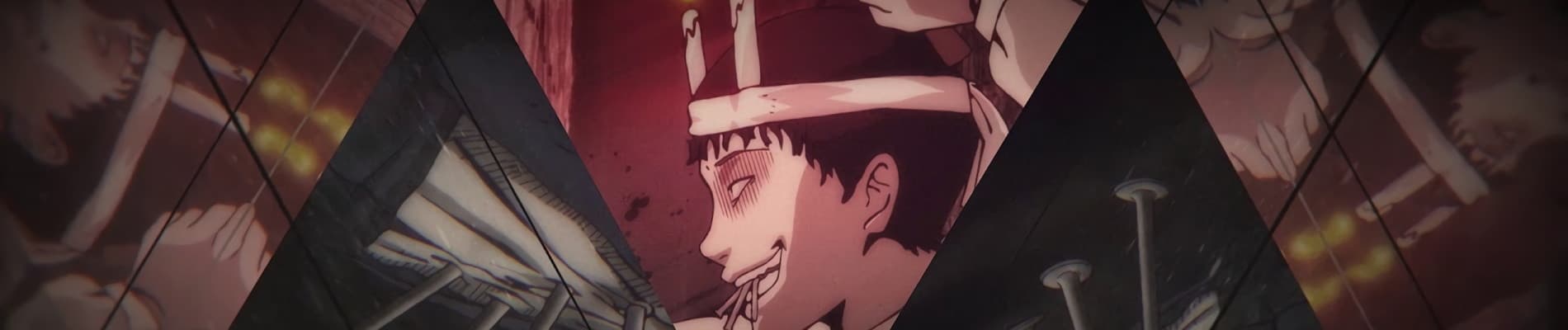
Junji Ito collection was produced by Studio Deen, and if that information alone doesn’t terrify you, then you don’t know much about Junji Ito OR Studio Deen. Deen has a reputation of producing the cheapest, stiffest looking anime in the history of the medium, an honor it shares with Studio Xebec. They’ve released a few titles that looked all right, but in nearly every case they were either a serious outlier like Konosuba, an old show that looked good for it’s time like Irresponsible Captain Tylor, or something that weirdly looked better with cheap animation, like Higurashi. Regardless, titles like these are the exception, not the rule.
It’s fair to say that producing an animated adaptation of the various works of Junji Ito wouldn’t have been an enviable task for any studio... I’ll get into why later... Studio Deen was the absolute last company that should have ever touched it. Technically speaking, this collection looks like absolute garbage. Characters look fine in close-up shots, but they’re frequently off model at any sort of distance. Movement is stiff, with still images of characters just barely swapping between two cells while being dragged across the screen. Even the background, which looks decent enough at first, becomes repetitive and bland before long even when they’re showcasing new settings.
This is the kind of animation that can, as a fluke, make scary characters look even more effective through the uncanny valley effect, and I can’t say it doesn’t work for a few of them. The Fashion model, for example, looks just as scary animated as she does drawn, for entirely different reasons. The music blends well with the story, it does it’s job without drawing too much attention to itself.
I don’t have a whole lot to say about the English dub, either. It’s a Funimation effort, and because there’s no real main character, the cast is a revolving door of Funimation regulars. Pretty much everybody on their payroll gets a part somewhere, and they do as well as can be expected. I feel like they could have picked someone better for Tomie, but Monica Rial still does a good job with what she was given. Austin Tindle loses himself in the role of the socially awkward narcissist with no sense of self awareness, Souichi, one of the only recurring characters outside of the OVA. The adaptive script was fine, there really wasn’t much they could do with a series that already featured dumbed down and compressed dialogue from the source material. You should be fine in either language.
Okay, so, this is new territory for me. I’ve never actually reviewed an anthology before. The closest I’ve come was Otaku no Video, and that did not turn out well. I knew if I was going after this title I’d have to do things a little differently, and if you couldn’t tell from my so-called ‘plot synopsis’ at the top, I made my decision. My personal philosophy right now is that you should pick your reviews based on which titles you you have a lot to say about, rather than titles that are safe for your reviewing structure or guaranteed to please the masses, because even if your words fall flat, and even if you get bombarded by downvotes by people who TLDR’d and just didn’t agree with your rating, at least your voice was heard.
I feel like the best way to discuss what works or doesn’t work about this anime is to compare Ito himself to an author I believe to be his American contemporary, Stephen King. Yes, I know some purists will scoff at me for that, but while they do vary quite a bit in content, they also have some noteworthy similarities. Both of them are highly prolific, having penned title after title for a period of decades with only intermittent break periods here or there. Both have constructed their own interconnected universes with characters that occasionally cross over, even at the expense of their own in-universe lore. Both were inspired greatly by the works of Lovecraft. Bot have gone to some unforgettably dark and disturbing places, and most importantly of all, they both use their chosen medium to it’s greatest advantage, making them notoriously hard to adapt.
Starting with Stephen King, he’s an expert at manipulating your imagination. He doesn’t go into excessive detail about his creepy monsters and settings, he tells you just as much as you need to know in order for your own psyche to fill in the blanks. This is how he gets away with using such cliches like vampires and werewolves, and it’s also how he manages to sell more bizarre concepts like a possessed laundry machine, a set of living army toys, and a gorram demonic finger poking out of someone’s drain. These concepts only really work in your imagination, so when people try to recreate them on screen, the results can be awkward at best. This is why the best adaptations usually wind up being the ones that changed a lot from the novel, swapping out cerebral scares with more visually oriented scares... Kubrick’s The Shining, 2017 It, and Doctor Sleep to name a few.
Where this applies to Junji Ito is that he utilizes both the strengths and weaknesses of manga to his ultimate advantage. He draws with grotesquely explicit detail, creating horrors that feel almost alive despite their other-worldliness. When drawing gore, he pays attention to every little piece of the anatomy, from shards of bone to the messy edges of torn flesh. Even in panels where there’s nothing particularly gritty to see, his simple placement of characters in relation to their eyeline and distance from the reader can establish the tone of a story before it even takes off, and he especially loves to use the last panel on a page to create suspense before a dramatic, full-page reveal that’s about to follow.
There’s so much of his artwork that practically forces you to stop dead in your tracks and just stare at it, letting your eyes trace every outline of his illustration, and that just obviously does not translate to animation. The use of color also doesn’t help, as any fan of classic horror will tell you just how much fear you can inspire with the use of shadows on a monochromatic pallet. I said before that animating the work of Junji Ito was never going to be an easy task for anyone, but that doesn’t make it impossible. I actually really liked the Gyo anime, as not only do I like Kaori way more as a protagonist than Tadashi, but I feel like the uncanny CGI in the OVA is every bit as unsettling as Junji’s original artwork, just on a scale that works better in motion than as a still image.
It was never going to be easy to produce a successful anthology anime based on Ito’s works... Considering just how many different stories they compiled, there was never going to be a one-size-fits-all solution to that problem, either... but there are companies I would have trusted with the concept. Studio Shaft comes to mind. Maybe Studio Trigger, although the product would have been hit-or-miss at best. What Studio Deen gave us is a flat, dull adaptation that often feels like a trace job that someone just colored with MS paint and a few select photoshop filters. The stories are compressed, simplified for time moreso than anything else, and thanks to a very random story selection with no real rhyme or reason to their order other than the end goal of reaching a proper episode length making the series feel kind of disjointed and incoherent.
So, is there anything good about this series? Well, honestly, I wouldn’t be reviewing it otherwise. It has a reputation for being one of the most disappointing and mediocre adaptations in anime history, and it’s a reputation it very much deserves, despite how much it was doomed to fail from the start. I wouldn’t be approaching it like this if I didn’t have something to say about it that I felt needed to be said.
Going into this collection, which I picked up on a massive discount from last year’s Rightstuf holiday sale, my experience with Junji Ito was slim to none. I was a big fan of Gyo, both the OVA and the manga, and thanks to it’s inclusion in said manga, I was also familiar with Amigara Fault. Thanks to my limited experience, I was enchanted the first time I watched this anime, I loved the imagination and originality of all the different concept, but I didn’t start to slip deeper down the rabbit hole until I met the character Tomie. In her one and only segment on the series proper, I found it so deep that an immortal would be trying to permanently capture a her own beauty, when the real problem with both the artwork and her own despicable self is that beauty cannot be captured... The best thing about beauty is that it’s elusive and fleeting. A painting or a photograph cannot capture it, and a person who lives forever will not retain it, at least not on the inside.
The first Junji Ito manga I bought was the Tomie collection, followed by Fragments of Horror, and it snowballed from there. I just finished Smashed, and I’m waiting on a copy of Uzumaki that I just ordered on Amazon, and as much as I’m loving this new treasure trove of horror masterpieces, I wouldn’t be here if it wasn’t for the anime that so many people have called disappointing garbage. Although, watching it a second time, I agree. It doesn’t hold up to the source material, but it’s hard to imagine Junji Ito’s work would be getting the western media exposure that it currently is if it weren’t for the Collection. Cartoon Network is interested in Uzumaki, Loot Crate is doing it’s own Ito themed anime crate, there’s a handful of pretty cool looking Funko Pops available(and those things looked creepy BEFORE they started sporting extra heads and slugs popping out of their mouths) and the future is generally looking bright. I guess this worthless series had some value after all.
Junji Ito Collection is available from Funimation. The official release comes with a short Tomie OVA... It’s two extra episodes of Ito’s immortal succubus, can’t complain about that... And the original manga for pretty much every short in the series is available stateside through Viz Media.
For long time fans of Junji Ito’s work, the Collection anime is at best a missed opportunity, and at worst a slap in the face. This was always going to be a high-risk high-reward concept, and Studio Deen was nowhere near qualified to handle it. To newcomers like me, though, it was the gateway to a world of macabre wonders I’m still exploring. Of course this means I don’t like it nearly as much upon a second watch... There are a few Ito creations that hold up pretty well in my opinion, the Fashion Model being one of them... But I can’t pretend I’m not grateful to it for leading me here. This series may not be a worthy representation of one of the most important mangaka of all time, but it’s a pretty damn good introduction to his catalogue.
I give Junji Ito Collection a 5/10.
6.5 out of 8 users liked this review