Part One: An Introduction
If there’s anyone that still doubts Masaaki Yuasa’s skill and competency as a creator of anime, they’re either tasteless or a contrarian. Not all of Yuasa’s shows are everyone’s cup of tea, however. I find Tatami Galaxy frustrating to watch, and I’ve met others who feel the same way about Kaiba, which I myself found a little slow at times. Despite that, I respect both those works, and still love Kaiba regardless.
His other works range from very fun to incredible, with Devilman Crybaby standing out to me as nearly perfect, and his sheer output of content is impressive. But the one which to me stands above the rest is Keep Your Hands Off Eizouken. I’ve seen it twice now, and I enjoy every frame, every motion, and every sound.
I’m not going to say that disagreeing with me makes you wrong, despite my temptation to treat my own taste as objective, even despite the presence of many tasteless people on this site, although not you, dear reader. Never you. But, I’m a fan of arguments, and I’m going to present the case that it is, and that you should believe it to be too.
And so we begin.
Part Two: A love letter to...
These are the words that first came into my mind when I conceptualized writing an Eizouken review. I discarded them immediately as trite and generic. I don’t know if there’s a more overused set of words for describing a certain category of art. Indeed, many reviews of this show on this very site seem to include “a love letter to anime” in their summary or body. Because I fear being generic, I feel the need to lampshade these words, as I am here.
However, I can’t deny these word’s truth. Eizouken is a love letter to Anime. This is a factual statement. It’s made by someone who loves the medium to be consumed by people who love the medium. If you don’t love anime, go watch some more shows, then come back and love this once you do, and I think you’ll understand it more.
But Eizouken being a love letter to anime is secondary to its true purpose: as a love letter to creating anime. Or, to perhaps interject a bit of my own interpretation, the act of creating any sort of art at all. It highlights a philosophy, a mindset, and a spirit which should be embodied in all creation, presented in idealized form to remind us why we create, and what we should be striving for.
For some of you, those who see the show as I do, this is probably self-evident. For others, it may take some convincing. But first, I’m going to take a few detours to discuss the groundwork the show lays to create this environment.
Part Three: The world of Eizouken
It’s easy to miss the fact that Eizouken takes place in the future: the 2050s to be exact. This is not immediately evident because the technology level of the world is largely the same as our own, even lower tech at times. It could simply be an alternate world, or a stylized and aestheticized version. But we see dates in background objects confirming the time period, and this gives us the tools to understand Eizouken’s world.
Eizouken highlights an outcome of economic decline. Japan’s falling birthrate has failed to allow them to grow the economy year after year, and this has changed the economic and social systems that dominate their country. For one, it seems immegration policies have been loosened, based on the presence of spanish text on signs and the racial diversity present in the show.
Shibahama, the city the show takes place in, is made of old buildings and full of disused and mysterious areas. Concrete crumbles, wood decays, and metal rusts. Despite this decay, Shibahama is distinctly more human than any of today’s cities. It’s distinctly new urbanist, with excellent ability to travel on foot. If you pay attention, a plurality, maybe even a majority of exterior shots show the ability to traverse the city on foot on multiple levels, with walkways connecting buildings and crossing streets. It also contains based and basedpilled water features, which make me happy.
I think this serves to highlight that current capitalist values of growth are not sustainable or compatible with human living, and we need to cut back on focusing purely on efficiency and profit. That’s not to say the show is anti-capitalist, as highlighted by Kanamori’s character, but we’ll return to that later. I digress.
I think the purpose of this world is twofold. The first is to lure us in, and create a sense of comfort. It wants to make this world, one of creativity, friendship, work ethic, and inspiration, one which we want to inhabit more than our own. Secondly, it’s a tonesetter for a tone the show takes often. A calm and relaxation to contrast the moments of excitement.
If this show took place just in a normal japanese high school, with identical layout and look (as exist in real life, if you take a saunter through the schools of Tokyo on google earth), I think it would already be significantly worse. If it wasn’t rendered in beautiful form by the talent at Science SARU, it would already be significantly worse. The world is an important foundation upon which the show is built.
But it’s not just the worldbuilding that builds this foundation, but also the artistic styles which are used to present it. So let’s talk about
Part Four: The Art of Eizouken
There are four primary styles to talk about here. The first is the character style, which is pretty quintessentially yuasa. Simple, low detail forms combined with minimal shading make it easy to animate in dynamic motion, and a willingness to stray off model fills them with expression and personality. This anime wants us to notice motion the way an animator does, and so takes time to focus on making that motion wonderful in every scene. You could easily arrange every Yuasa show on a spectrum between cartonyness and non-cartoonyness, with perhaps Kaiba on one end and Ping-Pong on the other, but this manages to embrace both spectacularly. If you take a quick gander at the eizouken gifs on discord, you can see this evidently.
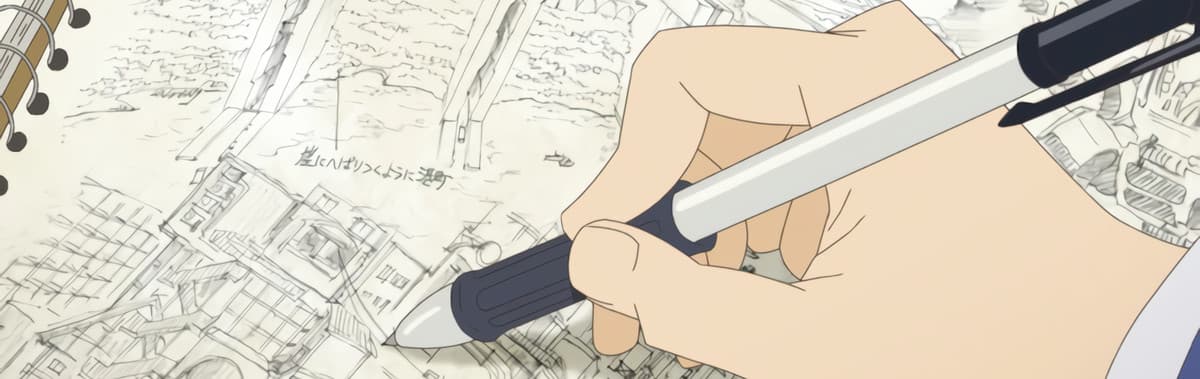
The second to discuss is the background style, which is one of the stars of the show. These backgrounds are wonderfully conceived.. The city exteriors are imaginative, and the interior shots contain the type of detailed clutter you normally only get to see in Ghibli films. The outlines are at times sketchy, but at the same time the amount of detail present in the painting, especially when depicting the wear and decay on buildings and materials, combined with the previously mentioned clutter make the world feel deep and believable at a glance. These backgrounds put nearly every other show in anime to shame.
Third is the world of imagination, into which we often dive during Asakasa-san’s collaborative ideation sessions. Here, the girls remain mostly the same as their real-life forms, but the backgrounds and objects are seen as loose and sketchy, with wobbling lines and color straying from outlines. Anyone who’s ever been a bad artist knows that making “bad” or “sketchy” art that looks this good is as much a challenge as any other kind of good art. Using this loose style lets them quickly switch between a variety of complex settings without much effort, allowing them to take a few shortcuts in these sequences in ways which feel exceedingly natural. This style is an excellent tonesetter for these sequences, and a wonderful part of the show.
Fourth and finally is the in-universe animation style. Cleverly, this style lacks outlines on characters, objects, and backgrounds, instead working with solid chunks of color. Our reality lacks them, their “reality” does, and their animation lacks it once again, making for a neat even-odd pattern. The style is even simpler than our own anime style, but I don’t think it makes it any less. In another world, this would be what anime looks like, and it would be no lesser for it. I want to see an entire show willing to take this bold departure from the present style.
Most shows don’t have this many distinct styles going on, and most shows can’t match even one of them. Science SARU and Yuasa are masters of their craft, and this might be their finest showing yet. But it’s only in combination with the music that the aesthetic begins to achieve perfection.
Part Five: The Music
Fuck, the music is good. The intro, Easy Breezy, serves to ease us into the funky attitude (I can’t believe I just said funky attitude) of Eizouken, and does a great job. The outro, Namae no nai Ao, translating to based title “a blue with no name” is a little more traditional for anime, is what is referred to in the music industry as “a hard slap” or “boppin”, and is incredibly wistful, and a good wind down from the more intense aspects of the show. Both are on my main playlist, which is a good compliment.
The background music is great too. Saikyo no Sekai, or as I know it, “the one with the weird synth” (or at least I think it’s a synth, I have no idea how music works), is a particularly goated tonesetter. I’m not knowledgeable enough about this craft to say more, but suffice to say, it’s really fucking good. It’s the glue that holds the aesthetics together, and does its job perfectly.
Part Six: Creation and Characters
Each of the three main girls in the show highlight different parts of the creative process. The first is Midori Asakusa, who is what you might call the main character. She’s a pretty quintessential creative youth, with ideas she wants to tell, but lacking in the confidence and cohorts to tell them. The difference is that unlike me she’s incredibly talented, but I’ll ignore that for a minute.
If there’s an ultimate theme of this show, it’s that you should go and make something. Gather your friends, and create something good. It’s not necessarily an immediate masterpiece, but you should just fucking do it. Asakusa-san is the bearer of that torch in this show, and while we don’t spend much time with the pre-creating-something version of her, she still serves to highlight that theme.
But if Asakasa-san (who I will call by no other name, fuck I love alliteration) represents the need to overcome resistance from within the self, Tsubame Mizusaki represents the need to overcome resistance from others, namely her parents. Mizusaki has for her a set path, established by her parents who are both successful actors. She is to be an actor or model too, and, like many children of successful people, is essentially groomed for the role, taking classes from a young age, and already modeling for ads by the time of the show.
But her passion is animation. During dance lessons as a child she becomes obsessed with the motion of others, and draws to understand it. She does the same in her daily life, as shown with her grandmother’s tea flick thing. Being an animator is much less lucrative than a model, and not what her parents expect of her, but she wants to chase it anyway. As many of us are held back from chasing our dreams by others, especially parents and their expectations, as by ourselves.
The strangest member of the main cast is Sayaka Kanamori. Kanemoney-chan is an unapologetic capitalist with a love for cold hard cash, who I wish I could pay to step on my face. She serves the role of the producer. In most media, the producer is typically portrayed as evil, as the enemy of art, and often as cruel or sadistic people who destroy art for the sake of money.
But Kanamori fits into my neat little lens too. Where Asakasa-san represents the need to overcome resistance from the self, and Mizusaki resistance and expectations from others, Kanamori is the warrior who fights resistance from the world. Even the less aggressively capitalistic world of Eizouken is still not one naturally built to support art. Like our own world, it resists art which cannot be profitable. Eizouken depicts the role of the producer as necessary. Someone willing to force the creative types to face the facts and aggressively scope. One who demands they only take on projects they can afford, that will generate the income they need to continue, and that they can finish with their limited staff and time. Anime is ridiculously hard to make. It is among the hardest artforms, due to the sheer number of frames required. For two high schools students to make one themselves is frankly absurd, especially of the quality that is made in this show. But it is only through Kanamori’s efforts that it can be done.
Because while the show espouses creation as a virtue above all others, it’s not afraid to show nuance in that theme. They face constant roadblocks and setbacks, ranging from a school unwilling to support them, their own inability to restrain themselves, or having to redo work at the last minute because of a miscommunication with a musician. Eizouken is telling you to go create something, not because it will be easy, but to create something even though it can be hard. It tells you that if you want to create something, you need to be willing to give that thing your all, despite adversity, despite people who won’t believe in you, and despite your own doubt in yourself.
When I watch this show, I become enveloped totally in this message, enthralled by its beautiful world. The way Asakasa-san sees totally-not-castle-in-the-sky/nausicaa and begins to want to make anime, I see this show and begin to want to make anything.
Part Seven: Sticking the landing
As I said before, a few missed things and this show wouldn’t be nearly as good, but it consistently delivers time after time. The way a music anime lives or dies on its musical numbers, if the anime they made was Not Good, I don’t think the show would work at all. They serve the same purpose a fight scene does in an action show, or a song does in music anime, or a kiss does in a romance show. They draw your attention, and reward you for watching. They build and release tension, they serve as the fulfillment to implicit promises.
And fuck do these three shorts land. My single complaint is that I don’t enjoy cutaways to audience reaction, even when they’re cool, because I want to be able to enjoy them as works in isolation. But I digress.
These are probably better than high school students could reasonably achieve, but I don’t really care. I love all three of these. The first is simply a very cool action scene, the second a more sponsored, but fun mech anime, and the third an imaginative conflict with a bit of moral/tragic character.
One of the highlights of them is the way they illustrate points made to us earlier in the show. We see concepts they discussed earlier, or shots they showed in progress, finished and executed. It’s easy to forget when they talk about how to portray the spinning blades of a windmill realistically in animation, that the “real” windmill itself isn’t real, but once you force yourself out of the intense immersion Eizouken’s world demands, you can observe the lessons they’re teaching you about animation and anime production in both the level of their “real world” and their “anime”.
Part Eight: Conclusion
I’m going to be brief here. I meant for this to be a shorter review, but it got out of hand quickly. I guess brevity isn’t in my nature.
I don’t think I’m a talented enough writer to convince someone to change their mind about a show, and it’s not in human nature to change one’s mind at all. So really, all I'm doing here is preaching to the choir. I know that those who like the show will upvote me, and those who don’t (mostly skeptics and contrarians, in my view), will slam the downvote, the way I did to that one guy who doesn’t like Mob Psycho. But you know, I’m content with that. I’m not really writing this for you, I’m writing it for me. I want to shout into the world about how great every individual aspect of this show is, and I've run out of friends to do it to. So thank you, friends, for listening.
If the final score isn’t clear, I’ll state it once more here. One hundred anime points out of one hundred. The greatest show, about the greatest world. See you all next time.
39 out of 42 users liked this review