 Likewise, I would like to explicitly state that I am a fan of Evangelion as a whole. I genuinely think the manga adaptation, to some extent the original TV anime series, and undoubtedly the sequel film End of Evangelion is excellent. However, I am not a fart sniffing elitist snob that will lecture you in attempt to proselytize into the Cult of Evangelion. The Evangelion Franchise is not the zenith of the medium nor peak fiction. But, it is special. Regardless of how you personally feel about Evangelion, the Franchise has cemented itself firmly into the otaku consciousness & even seeped into general popular culture as well. Fundamentally, it is a revolutionary franchise that has changed the landscape of the medium as a whole. I say all this just to give you some idea as to where I am coming from with my personal feelings on the Franchise as well as present my level of experience and knowledge of Evangelion as a whole, which will inevitably affect my perception. Nevertheless, let’s get into the review!
- - -
The First Rebuild Film
- - -
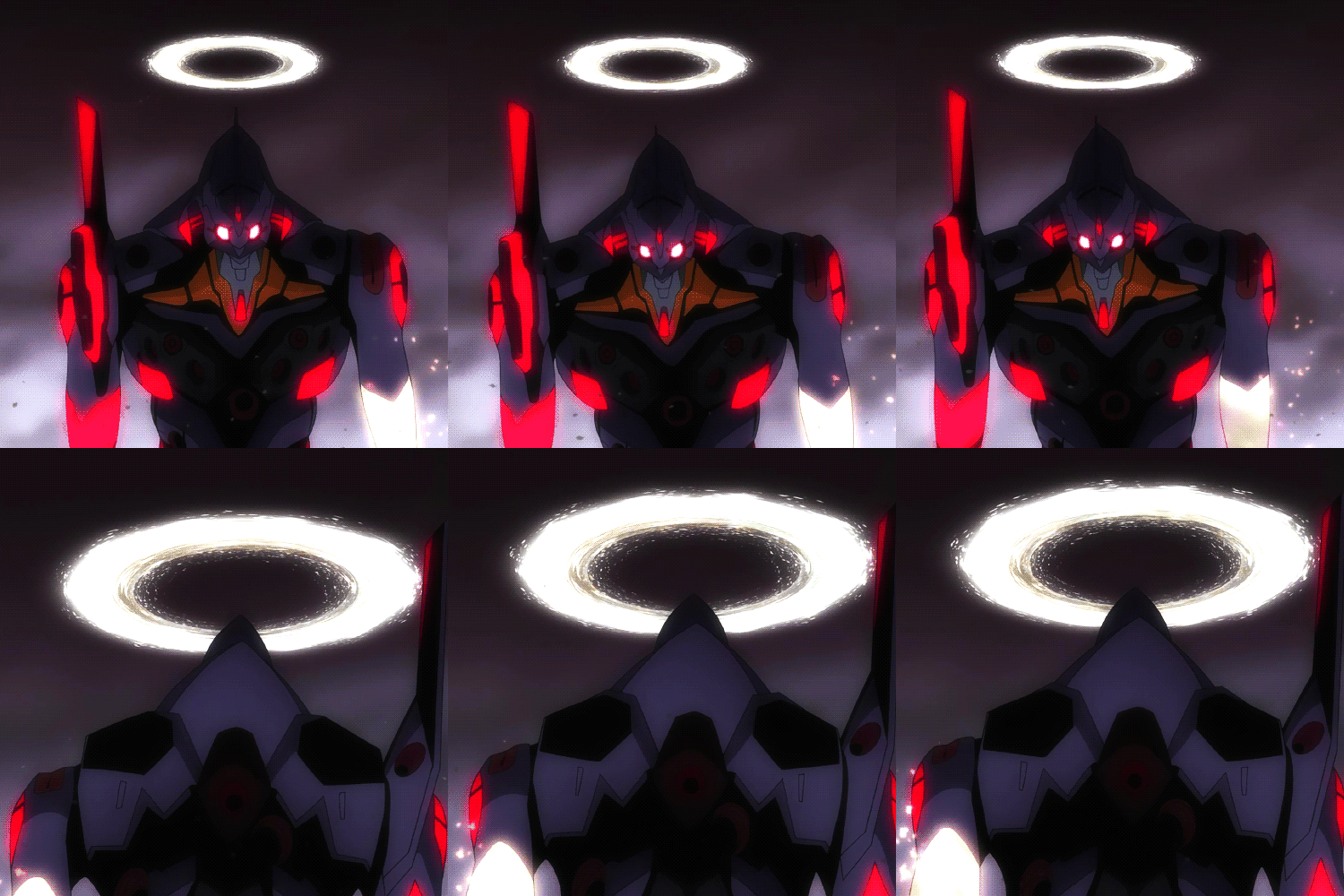
This film plays it remarkably safe. In fact, it is nearly a shot-for-shot remake from some of the core concepts and scenes in the original TV anime series. However, some of the new 3DCG animation tends to look like shit (which will be a trend in the movies that follow this one as well). I am honestly unsure if I would call this film a visual upgrade. Sure, it looks more aesthetically contemporary; however, it often over-relies on shitty CG, whereas the original run was very faithful to traditional hand-drawn animation techniques, which added a lot of visual flare and style. As an illustration, the hand-drawn frames I have added below are infinitely more emotional and energetic than something that can be produced with standard 3DCG techniques.
Likewise, I would like to explicitly state that I am a fan of Evangelion as a whole. I genuinely think the manga adaptation, to some extent the original TV anime series, and undoubtedly the sequel film End of Evangelion is excellent. However, I am not a fart sniffing elitist snob that will lecture you in attempt to proselytize into the Cult of Evangelion. The Evangelion Franchise is not the zenith of the medium nor peak fiction. But, it is special. Regardless of how you personally feel about Evangelion, the Franchise has cemented itself firmly into the otaku consciousness & even seeped into general popular culture as well. Fundamentally, it is a revolutionary franchise that has changed the landscape of the medium as a whole. I say all this just to give you some idea as to where I am coming from with my personal feelings on the Franchise as well as present my level of experience and knowledge of Evangelion as a whole, which will inevitably affect my perception. Nevertheless, let’s get into the review!
- - -
The First Rebuild Film
- - -
This film plays it remarkably safe. In fact, it is nearly a shot-for-shot remake from some of the core concepts and scenes in the original TV anime series. However, some of the new 3DCG animation tends to look like shit (which will be a trend in the movies that follow this one as well). I am honestly unsure if I would call this film a visual upgrade. Sure, it looks more aesthetically contemporary; however, it often over-relies on shitty CG, whereas the original run was very faithful to traditional hand-drawn animation techniques, which added a lot of visual flare and style. As an illustration, the hand-drawn frames I have added below are infinitely more emotional and energetic than something that can be produced with standard 3DCG techniques.

 Though, I’ll concede the new remake did make improvements in some areas, such as making the movement of the Evangelion units significantly more fluent relative to the clumsiness of the original. I actually really like this change because it further reinforces the theme that these robots are, in fact, essentially alive and sentient metal rather than just something that requires control.
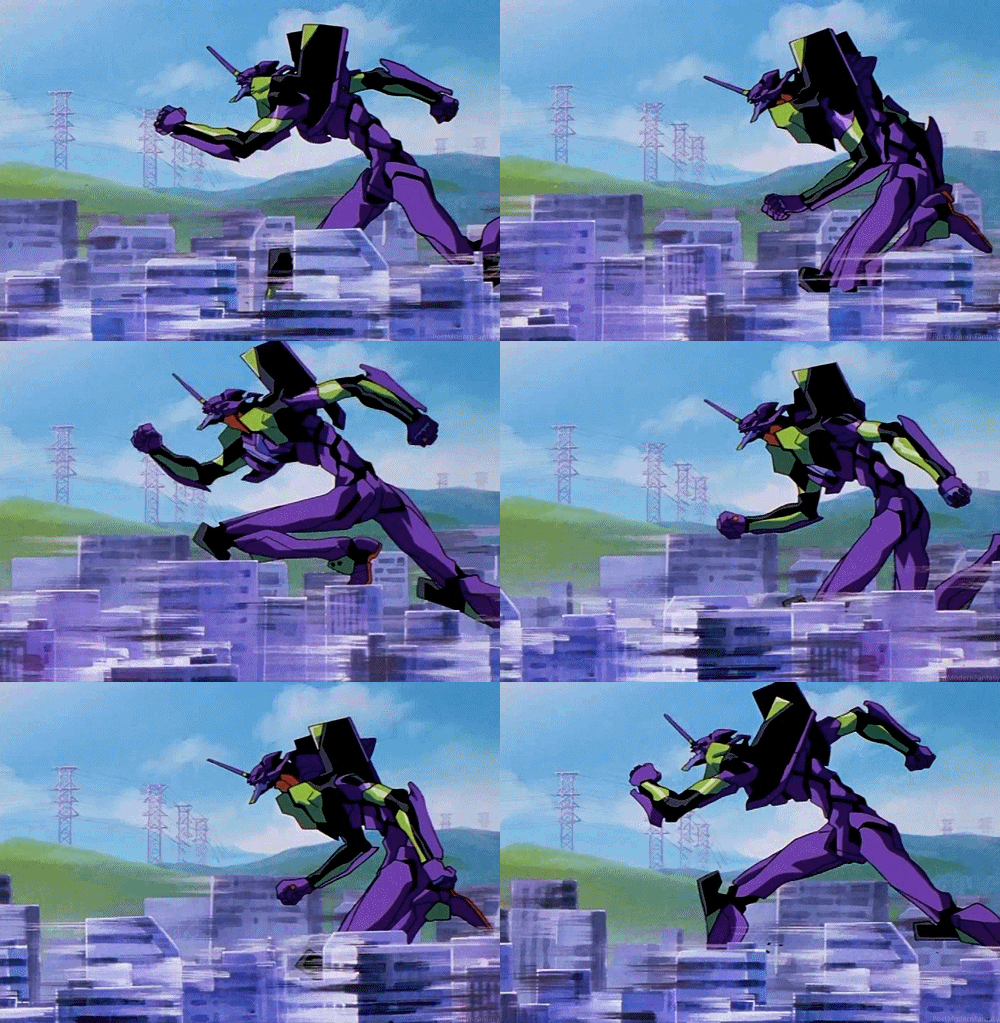
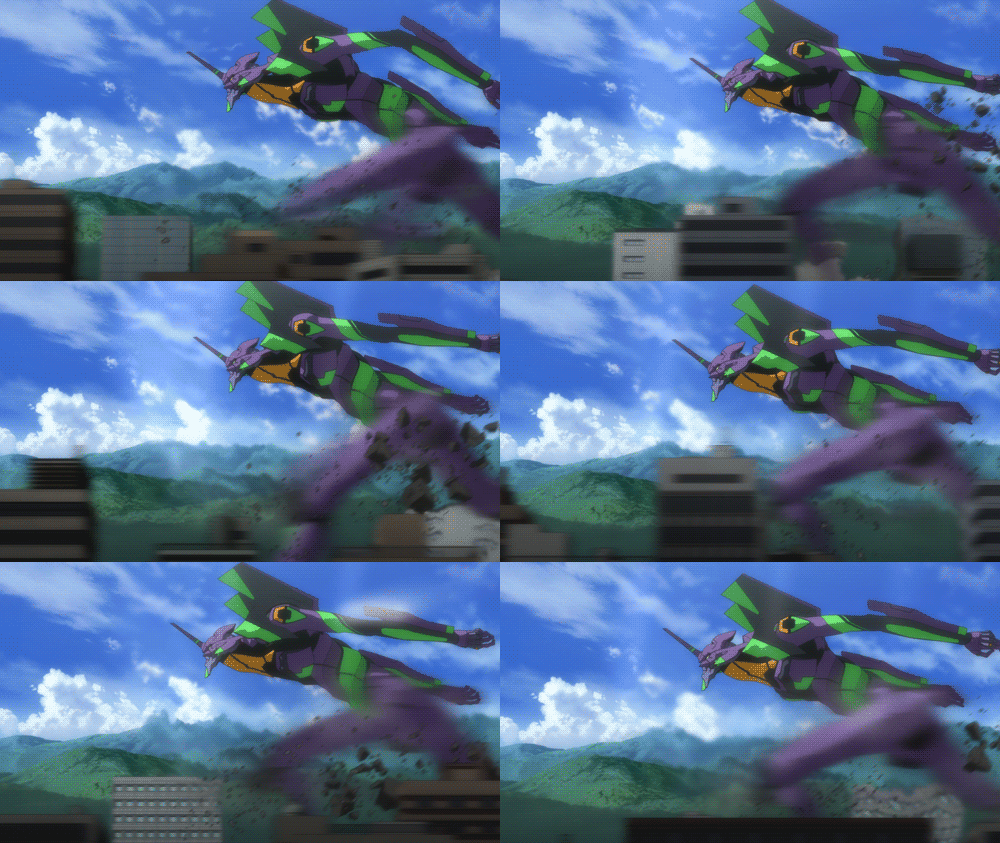 Perhaps, this is a nitpick, but, I think, in general, I just prefer the aesthetic of original run, which felt more tonally and thematically appropriate. But, you be the judge; I am rather indifferent either way!

 Nevertheless, aside from the aesthetic rabbit hole, this film was extremely serviceable as a re-introduction into the franchise and had a kickass final scene, setting up for the next film in the tetralogy. It is hard to pinpoint anything that particularly stands out here as it is so faithful to the original TV series. Also, there are no big changes to the continuity presented in this film, so I have little to say about it altogether. Overall, this movie was more or less 7/10 material for me.
- - -
The Second Rebuild Film
- - -
This is where the continuity of the Rebuild films really becomes completely divorced from the original TV anime run as well as the End of Evangelion to some extent. After the safe start to the Rebuild film tetralogy, this second movie offered a refreshing new take on the Franchise as a whole, while still retaining some of the core elements that made the original so great. For instance, this film has a perfect balance of the more slice-of-lifey scenes coupled with high impact action scenes as well as some occasional moments of brevity, which was a formula that made the original run so endearing as well as entertaining. I particularly like one of the opening scenes where Kaji takes our famed trio on a little field trip, portraying some of the aquatic life which had went extinct due to the Second Impact. During this scene, there were clever dialogue exchanges that mirrored the visual metaphor of the aquarium being shown. For instance, below is a scene where Rei and Shinji are gathered around one of the exhibits on display. Shinji remarks that he wishes “the fish had more space to swim in” as a little gest; however, Rei takes this remark super seriously, remarking “impossible, these little ones cant live outside this tank.” In relation, just like the fish, Rei is practically restricted to spending most of her life at NERV HQ within the confines of an entry tube. Similarly, Rei, like the fish, knows nothing outside her metaphorical tiny tube of NERV HQ, her respective orders, and the Evangelion units.
Nevertheless, aside from the aesthetic rabbit hole, this film was extremely serviceable as a re-introduction into the franchise and had a kickass final scene, setting up for the next film in the tetralogy. It is hard to pinpoint anything that particularly stands out here as it is so faithful to the original TV series. Also, there are no big changes to the continuity presented in this film, so I have little to say about it altogether. Overall, this movie was more or less 7/10 material for me.
- - -
The Second Rebuild Film
- - -
This is where the continuity of the Rebuild films really becomes completely divorced from the original TV anime run as well as the End of Evangelion to some extent. After the safe start to the Rebuild film tetralogy, this second movie offered a refreshing new take on the Franchise as a whole, while still retaining some of the core elements that made the original so great. For instance, this film has a perfect balance of the more slice-of-lifey scenes coupled with high impact action scenes as well as some occasional moments of brevity, which was a formula that made the original run so endearing as well as entertaining. I particularly like one of the opening scenes where Kaji takes our famed trio on a little field trip, portraying some of the aquatic life which had went extinct due to the Second Impact. During this scene, there were clever dialogue exchanges that mirrored the visual metaphor of the aquarium being shown. For instance, below is a scene where Rei and Shinji are gathered around one of the exhibits on display. Shinji remarks that he wishes “the fish had more space to swim in” as a little gest; however, Rei takes this remark super seriously, remarking “impossible, these little ones cant live outside this tank.” In relation, just like the fish, Rei is practically restricted to spending most of her life at NERV HQ within the confines of an entry tube. Similarly, Rei, like the fish, knows nothing outside her metaphorical tiny tube of NERV HQ, her respective orders, and the Evangelion units.
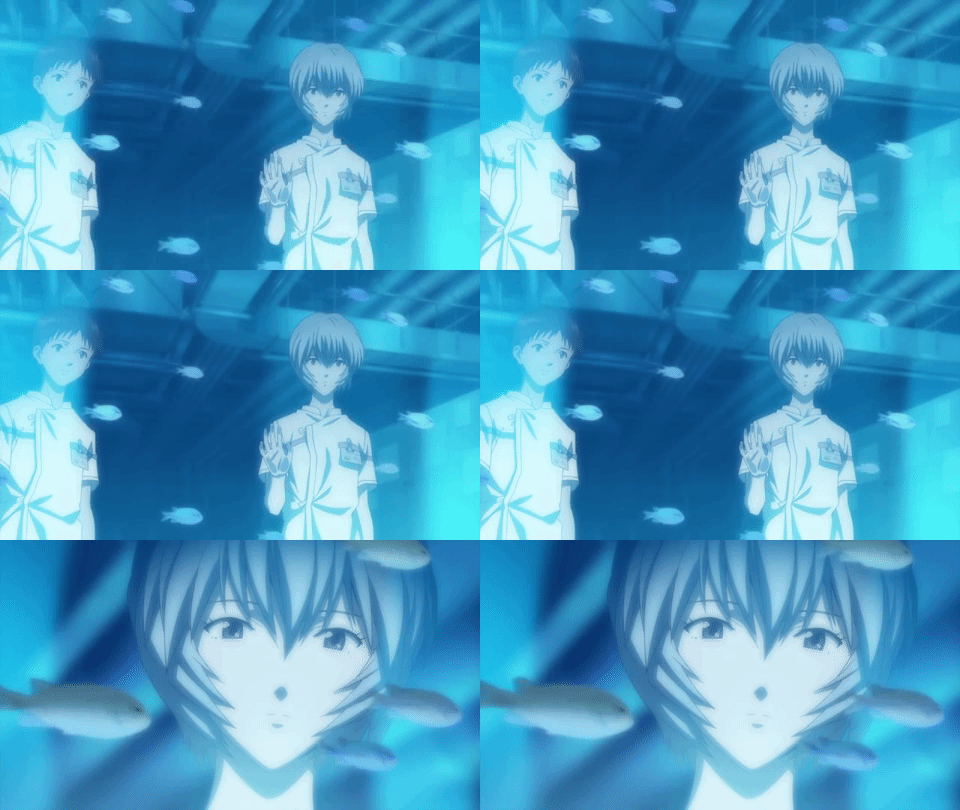 Moments like these as well as others added emotional weight to the film, which further contrasted with the gore & carnage being shown on-screen during the action set pieces. Also, these seamless dialogue exchanges helped not only explain some of the exposition of the new timeline but also add some insight to the inter-personal relationships among the characters. Moreover, this movie had some other subtle character moments too that added a lot of depth to the film, notably the planned dinner party to reunite Shinji with his father Gendo.
 On a technical level, the animation was mostly great here other than a few moments a shitty CG, which plague the Rebuild franchise. In addition, the soundtrack offers enhances classic tracks from the franchise as well as some new bangers entirely. It was genuinely stellar. Other than that, the climax of the film in the final action set piece offers the most destruction and shock & awe factor we have seen from the franchise up to this point, featuring Shinji Awakening his Evangelion unit in an attempt to defeat the immediate Angel threat as well as save his newfound friend and potential love interest in Rei. Overall, I was very engaged the entire way through the runtime of this second film, and I think it was excellent as a whole.
 However, this film does run into some hiccups. Notably, the introduction of the New Asuka as well as Mari. I call her New Asuka because this Asuka is not the same Asuka seasoned Evangelion fans are used to – both in spirit and quite literally in name.
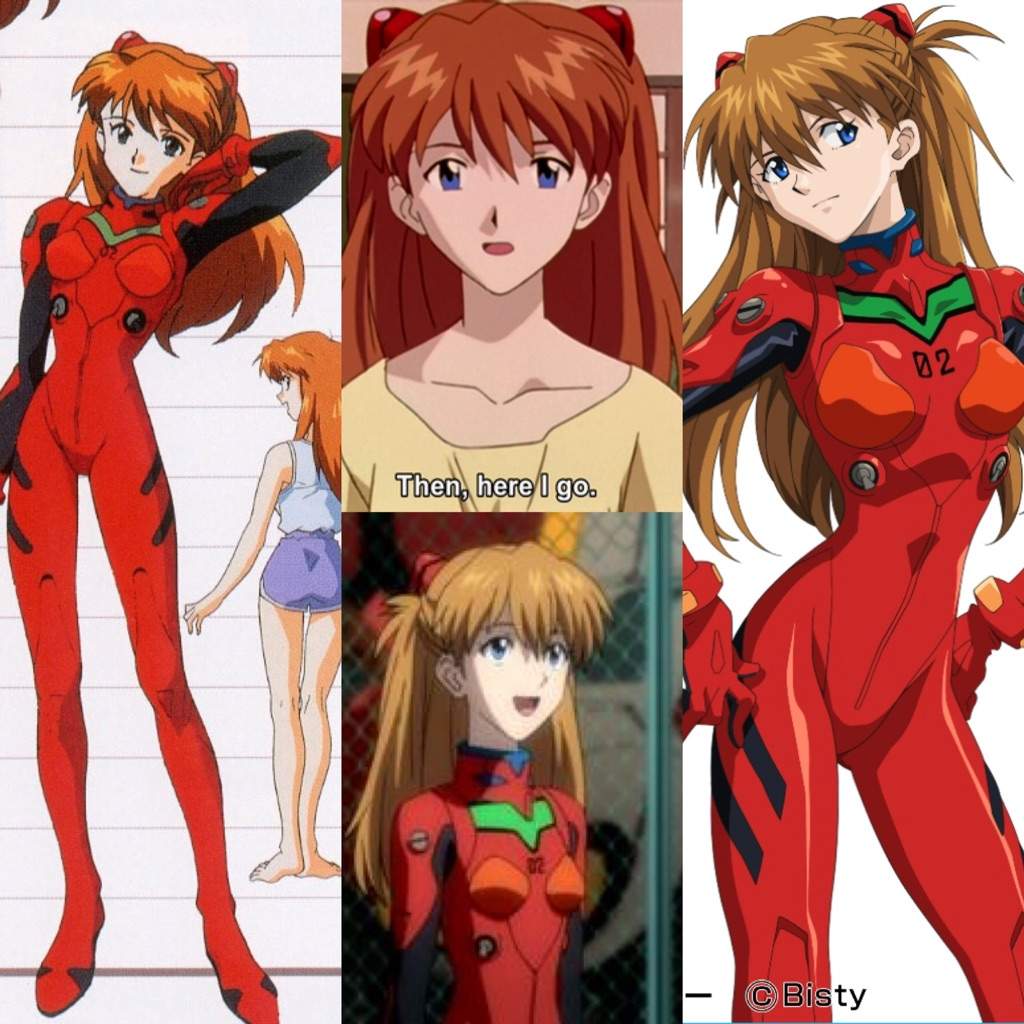 In fact, her character is almost entirely different aside from some shared surface level tsundere traits. For instance, before piloting the new Evangelion Unit 3, Asuka calls Misato and tells her about how happy she is with life and how it is nice to have friends. What?!? Would the original prideful loner Asuka ever say such a thing? Certainly not.
 Moreover, the original Asuka shows up in episode 8 of the TV run and affectively foils Shinji, brimming with confidence and self-assurance in her own ability to pilot her Evangelion unit. Throughout the original TV anime series, she actively seeks to work by herself in order to impress others and reassure herself of her own prodigal capabilities. In fact, she is extremely reluctant to work with Shinji and especially Rei to defeat an Angel threat, even if the fate of the world itself lies on their shoulders. However, ironically, she takes many L’s by various threats throughout the original run, showing us that she actually works best in a team in spite of the fact that she wants to work by herself. This complex later induces her into severe inner-turmoil, ultimately resulting in her sync rate with her beloved Evangelion unit to plummet into nothingness.
 Conversely, the Rebuild Asuka immediately takes up Rei’s offer to help Shinji and Gendo get together with the planned dinner party. Likewise, the famed elevator scene, which originally lasted 50 seconds in the TV anime, is now reduced to 10 seconds. In my opinion, this is a huge blunder because the awkward elevator ride was meant to parallel and further reinforce how uncomfortable the relationship was between Rei and Asuka. Now, reduced to 10 seconds, it practically signals that, while their relationship is precarious, they seem to put aside their differences to work together to reach the same destination (exactly what they later do). Asuka’s willingness to help Rei also makes little sense from a canonical perspective too as Asuka’s tsundere jealousness would never permit her to submit to not only a love rival but also a rival, and perhaps superior, Evangelion pilot. Beyond that, the Rebuild movies hardly touch upon and, in fact, never even mention Asuka’s trauma regarding her mother, which actually adds a lot of depth to her character and helps explain some of her motivations and tendencies. There is so much more to say here, but, TLDR New Asuka and old Asuka are not remotely the same character.
 This film also adds a new character named Mari into the mix, and she is yet another Evangelion pilot. However, this film is essentially just a vessel of introduction for her, so I have little to say about her here (I will touch upon her more later).
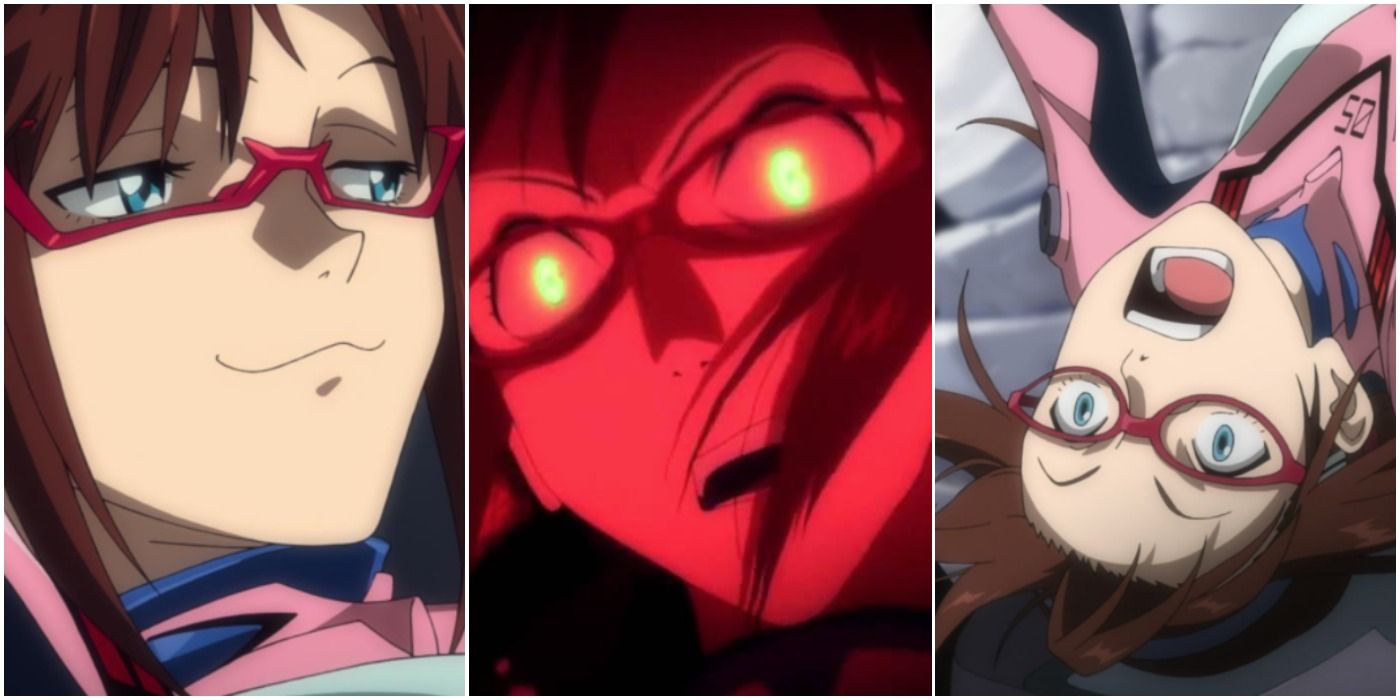 Overall, this movie did, indeed, have some hiccups; however, as a package altogether, I thought it was great. So, I would rate this movie within the realm of 9/10. The little teaser for the next film at the end of the movie also adds a lot of anticipation for 3.0. At this point, I am thinking I cannot wait to see where this franchise is going next!
- - -
The Third Rebuild Film
- - -
Whereas Rebuild film 2.0 had a few mistakes, it contained so many changes I enjoyed that my overall perception of it was very high. Unfortunately, I am unable to say the same about 3.0. In my opinion, this is the moment where the Rebuild franchise nosedives in quality.
As aforementioned, at the end of 2.0, Shinji awakens his Evangelion unit in order to defeat the Angel threat and rescue Rei. He is even actively cheered on to do so by Misato alongside his other contemporaries in order to save the day! But, 3.0 entirely retcons this moment. In fact, 3.0 even retcons the entirety of the preview for the next film presented at the end of 2.0!
Overall, this movie did, indeed, have some hiccups; however, as a package altogether, I thought it was great. So, I would rate this movie within the realm of 9/10. The little teaser for the next film at the end of the movie also adds a lot of anticipation for 3.0. At this point, I am thinking I cannot wait to see where this franchise is going next!
- - -
The Third Rebuild Film
- - -
Whereas Rebuild film 2.0 had a few mistakes, it contained so many changes I enjoyed that my overall perception of it was very high. Unfortunately, I am unable to say the same about 3.0. In my opinion, this is the moment where the Rebuild franchise nosedives in quality.
As aforementioned, at the end of 2.0, Shinji awakens his Evangelion unit in order to defeat the Angel threat and rescue Rei. He is even actively cheered on to do so by Misato alongside his other contemporaries in order to save the day! But, 3.0 entirely retcons this moment. In fact, 3.0 even retcons the entirety of the preview for the next film presented at the end of 2.0!
 Here, Shinji is lamented, not only by his former champion in Misato, but also by all of his contemporaries. They actively despise him for invoking the Near Third Impact in spite of the fact that humanity wouldn’t even exist without his actions. In the opening of the film, Shinji awakens in the same near-comatose state reminiscent of Asuka in the End of Evangelion. Likewise, it is stated that 14 years have passed since the end of the second film. So, from an audience perspective, we are all wondering what the hell happened during this timeskip alongside Shinji. In essence, we are effectively just as lost of Shinji. Shinji, as well as us as the audience, shortly later discover that Shinji is not even on a NERV battleship (where he awakens from a coma), but actually he is on a WILLE ship commanded by Misato. Furthermore, we discover that the newly introduced WILLE faction actively opposes NERV and aims to defeat their mission to bring about the Fourth Impact and Human Instrumentality as a whole. This is a lot for both Shinji and the viewers to take in!
 During this section of the film, Shinji is also greeted by Asuka & Mari as well, who further torment Shinji for invoking the Near Third Impact despite being the only pilot able to defeat the Angel threat at the time. Nevertheless, it is here where yet another narrative disconnect from 2.0 rears its ugly head. During this rather morbid re-introduction, Shinji questions why Asuka & Mari have remained the same age even though 14 years have passed. To answer his inquiry, Asuka cryptically responds that it is merely the “Curse of Evangelion.” I absolutely despise this reply for a myriad of reasons. Firstly, here, Anno is prioritizing meta-narrative commentary on the Evangelion franchise over in-canon logic. The Curse of Evangelion is (probably) referring to the fact that these characters are unable to age merely due to merchandising reasons and how the rather toxic fanbase will not permit these characters to age either. For one reason or another, Anno seems to actively despise his progeny in Evangelion and frequently adds in little easter eggs to purposefully insult his own fans. In fact, he famously did this by showing hate mail he had received in End of Evangelion. Beyond that, there are numerous fan theories on how Anno hates his fans and Evangelion as a whole – some of which I will provide below.
 Regardless, another reason why I hate Asuka’s response is that it is never once touched upon later on the story. Shinji never inquires about what this supposed Curse is or how it functions – he merely accepts it like a good little boy because the plot commands it. In fact, this Curse is never even remotely explained or mentioned throughout the rest of the tetralogy, which presents a possible plot hole or at the very least an unanswered plot thread.
After this exchange, eventually, Rei as a tool of NERV raids the WILLE’s airship base to rescue Shinji. This occurs after everyone explicitly states that Shinji never actually rescued Rei at the end of 2.0 and remark that Rei doesn’t even exist. At this moment, upon seeing Rei, Shinji understandably accepts her hand to return to the comfort and familiarity of NERV alongside the loving embrace of Rei. I mean, what reason does he have to stay at WILLE? His previously most trusted allies are actively being untruthful with him, not explaining anything to him, and treating him like a prisoner. To further reinforce the prisoner metaphor, Shinji is branded with a literal death collar that can be activated remotely at any time by Misato, his former champion.
 Upon returning to NERV, we gain a little more insight as to the state of the world. Whereas NERV was once prominent, it is now reduced to practically nothing. The organization now only has the support of SEELE, Gendo, Fuyutsuki, Rei, and Kaworu, who had previously stopped the Third Impact from reaching fruition in the final moments of 2.0. Ultimately, once again, Shinji is accosted into piloting a newly-manufactured Evangelion Unit 13, which is actually commanded by two pilots. As such, Kaworu and Shinji are commanded by Gendo to pilot the new Unit.
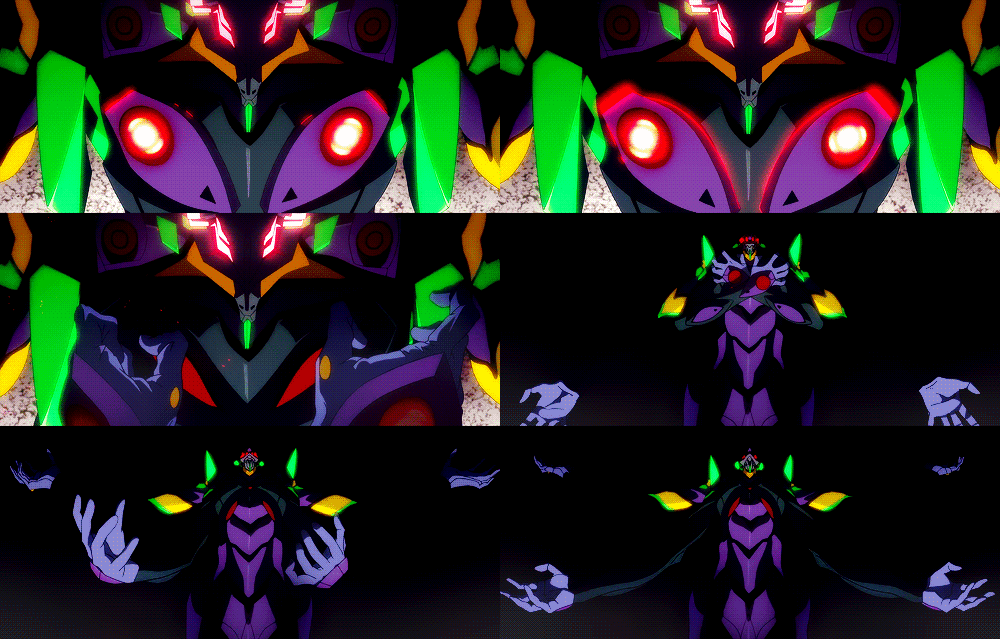 Following this moment, a vast majority of the runtime is dedicated to developing the relationship between the two and wrapping up some plot threads with Rei. It turns out that the Rei at NERV, which had previously rescued Shinji on the WILLE ship, is not the same Rei he attempted to rescue at the end of 2.0. This, understandably, angers and traumatizes him, further encouraging him to right his wrongs from 2.0. In order to repent, Shinji aims to develop a relationship with Kaworu, pilot Evangelion Unit 13, free Lilith from the two Spears binding the entity, and save the day (once more)!
As a side note, some of the scenes with Kaworu and Shinji bonding were visually interesting, especially the piano scenes.
 I also rather liked the scene of Kaworu adopting Shinji’s death dog collar (for lack of a better term) in an act of trust. Kaworu, who Shinji is practically just getting to know, is being more honest and trustworthy than Shinji’s previous foremost ally in Asuka, which helps to explain a lot of his motivations throughout the film.
 However, the production staff really go out of their way in this movie to affirm Shinji’s theorized bisexuality. I mean, every interaction between the two just radiates Boys Love energy to the nth degree. I don’t necessarily mind this at all, but the sentiment is so in your face in this film that it is borderline insulting my intelligence as a viewer. Overall, I much prefer the more subtle take on Shinji’s probable bisexuality presented in the original TV run.
After developing their (gay?) relationship, the two Children enter Evangelion Unit 13 and descend into the depths of NERV HQ in order to remove the two Spears aforementioned. But, they are unable to do so without the opposition of WILLE, explicitly Mari and Asuka. During this struggle, Kaworu vaguely mentions that something is wrong, yet Shinji ignores his ominous warning anyways, determined to make amends for the Near Third Impact and accomplish his task this time around. Unfortunately, this moment presents yet another flash of frustration from both the viewer’s as well as Shinji’s perspective.
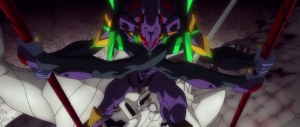 Earlier, I lamented Misato’s unwillingness to the explain the current state of the world, and I bemoaned Asuka’s unwillingness to explain the Curse of Evangelion. Now, I cannot help but to ironically laugh of Kaworu’s unwillingness to explain the basic issue at hand in the movie’s (and perhaps the world’s) most crucial moments. Even worse, during this scene, Kaworu doesn’t prevent Shinji from pulling the spears out, even though he presumably had the power to do so since Evangelion Unit 13 utilizes a duel entry plug system. So, not only does Kaworu be exceedingly cryptic at this critical moment, but he also suffers from inaction. For me, this makes zero sense from a character or a plot perspective, and this instance is a rather blatant display of events happening merely because the plot commands it.
Ultimately, Shinji as well as the audience discovers Gendo had tricked the two Children to pull out the Spears to trigger the Fourth Impact. In addition, Kaworu transforms into an Angel to much of his surprise. After these events take place, in order to prevent the Fourth Impact from occurring, Misato alongside the WILLE vanguard remotely activates the death collar, blasting Kaworu into goo right next to Shinji. Yet again, Shinji had failed while simultaneously nearly invoking yet another Impact event. Upon seeing practically his best friend die, unable to rescue another person close to him similar to the situation with Rei, Shinji is left in a state of utter despair, reverting back to a severe PTSD state. The film concludes with Asuka and Mari rescuing Shinji’s “pathetic” ass, walking into the sunset and returning back to the embrace of WILLE.
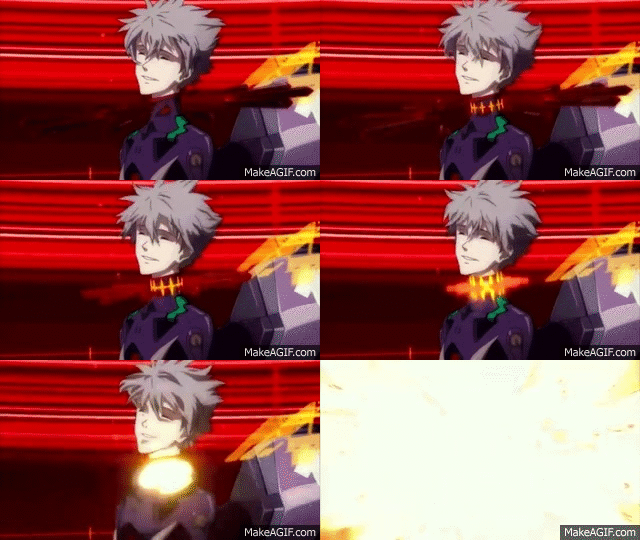 As a whole, I cannot help but to feel severely disappointed by this film. While being the shortest film in the tetralogy in terms of runtime, it certainly felt like the longest. Between the lack of notable action scenes, muddy and mixed character motivations, and severe retconning, I was just thoroughly underwhelmed with 3.0 as a cinematic experience. Ultimately, we end the movie just as lost as we were at the beginning of it all from a viewer’s perspective. Practically, nothing happens. Nothing was explained. Worse yet, Mari is still a shallow character relegated to being Asuka’s side kick and spouting a few one-liners. Ultimately, the Rebuild franchise has forsaken the characters seasoned Evangelion fans have come to know and love to pivot towards a more plot-driven perspective. But, the plot makes as little sense as the characters’ actions. This film fundamentally does not work as a standalone film nor as a piece in a larger story. It is clear that it went through a myriad of re-writes, which failed to add any value and presumably made the underlying plot muddy altogether.
My sentiments on 3.0 cannot be summarized by any other word other than letdown. After how great and optimistic 2.0 was, THIS is the follow up. I feel like I am on an episode of PUNK’D. Most of the plot-threads set up in 2.0 were discarded in the follow up film, which makes little sense from a plot perspective. Even the climax of the film and the final action set piece is rather lame. As a package, I would rate 3.0 exactly that – a 3/10. At this point, I am left to pin my hopes with the final film in the tertralogy to recuperate what little faith I have left in the Rebuild franchise.
The Final Rebuild Film
This film serves as a direct continuation of the events from 3.0, which is ironic considering 3.0 completely trashed the events in 2.0. Nevertheless, Asuka and Mari take PTSD-ridden Shinji to a little village supported by WILLE, representing the remnants of humanity. Here, Shinji is re-introduced to his old pals Toji and Kensuke, however, Shinji’s old friends are now full-grown adults with responsibilities, jobs, and even families. Ultimately, Kensuke and Toji are living fulfilling lives in a broken world, whereas Shinji remains completely lost without purpose. Furthermore, Shinji, in his state of despair, is unable to accept nor return the hospitality and love of his former pals, further depicting his hopelessness. Likewise, Shinji encounters Kaji Jr., the progeny of Kaji and Misato, which further reinforces the theme that life must go on even in this fractured world.
 But, the introduction of Kaji Jr. brings little substance to film as a whole. In fact, Kaji Jr. is only shown once, doesn’t do anything meaningful, and merely serves as a vessel to retcon prior events (a sentiment which seemingly plagues the rebuild franchise as whole). Turns out, Kaji, not Kaworu, is the hero who stopped the Third Impact from reaching fruition! This makes absolutely zero narrative sense. We are explicitly shown that it was Kaworu who stopped the Third Impact by throwing the Spear through Shinji’s awakened Evangelion Unit 1 at the end of 2.0. But, this movie wants us to somehow believe Kaji abandoned Misato during this event, flew up into a helicopter, and did something to stop the Third Impact. What this something is is ironically never explained throughout the runtime of the film. I even took the liberty of going through a myriad of forums, praying someone could explain how in the world a normal human like Kaji in a helicopter could prevent this remarkable supernatural event from occurring. But, no one can coherently explain this disconnect, which certainly presents a massive plot hole. My best guess as to why Anno and the production staff included this change is simply because Kaji is a fan-favorite, lacking a lot of screentime in the Rebuild franchise as a whole.
Enough of this rant however, let us move on! Throughout this long-winded village sequence, which accounts for nearly half of the film’s total runtime, blank-state Rei is able to connect with the villagers, adopt her own personality traits, and even take up some communal responsibilities like gardening and looking after Toji’s young daughter. Conversely, Shinji essentially wallows in self-pity during the same period. Nevertheless, Rei later serves as a catalyst for Shinji to change and return to a more optimistic view on life. Ultimately, Rei visits Shinji in his lonesome despair on the remnants of NERV, presenting Shinji with his famed cassette player and attempts to connect with him. In doing so, Shinji, in due time, renounces his own self-hatred, accepts the new Rei and current state of the world, and becomes determined to make amends, yet again, for his actions.
 But, since this Evangelion, happy and simpler times cannot last for long! Unable to live from NERV or her respective tube for long, Rei is marked for death. In her dying moments, she visits Shinji one last time in an effort to breakthrough and reach Shinji with her final remarks and, like Kaworu, subsequently explodes into goo right next to Shinji. For context, this is right around the time Shinji has finally recovered from his severe depression and PTSD, resulting from the events of 3.0. Rei, who is the embodiment of motherly love and unwavering affection to Shinji, dies in front of a recovering PTSD patient, depression ridden, borderline on the verge of suicide Shinji. This moment of shock must surely trigger a relapse. But, no! Because the plot demands it, this somber yet remarkable event gives Shinji newfound determination to pilot an Evangelion unit with Mari, Asuka, and WILLE to confront his father one final time and stop Instrumentality.
 Truly, I cannot put into words how little this makes sense, from both a plot perspective as well as character perspective. At this point, unable to save Rei for a SECOND time, Shinji should be completely shut down, rendered to a vegetative state permanently. He should also thoroughly lament his situation and life and become catatonic altogether in essence. But, nevertheless, 3.0+1.0 demands that the show must go on (even though, by all metrics, Shinji’s response makes no narrative sense)!
After Rei’s goo explosion, as aforementioned, Shinji gears up alongside Mari and Asuka to confront NERV and more specifically his own father in the final battle. It is here where the movie pivots to a more slice-of-lifey feel to straight up action! Although I rather enjoyed the subtle and quiet moments of the village setting, I am definitely ready to see some robot fights in my mecha anime!
But, WAIT, 3.0+1.0 subverts my expectations yet again! Rather than showing fights between Evangelion units, you know, the staple of the franchise, Rebuild dedicates the destined confrontation between NERV and WILLE via a ship battle. I’m sorry, what?!? Am I watching Last Exile or Evangelion? Perhaps the most iconic image in the entirety of the Franchise is Asuka breaking the battleship in half with her Evangelion unit in End of Evangelion. This is a perfect opportunity for Anno and the production staff to portray a throwback to this moment, pay homage to the series roots, and provide excellent fanservice! But, they completely miss this opportunity! Beyond that, the ship battle sequence completely looks like shit. One would think a high budget legendary production would be better animated in its climax, but I suppose not.
 Regardless, after this brief exchange of blows, Gendo relieves himself of piloting the NERV ship, leaving Fuyutsuki in charge. Gendo then descends onto an adjacent platform and confronts Misato, but this scene presents yet another opportunity of narrative disconnect. Misato, the commander of WILLE, finally apprehends and corners her foremost nemesis. In this moment, Misato and all of WILLE should literally unload nearly all their weaponry on Gendo. At the end of the day, the death of Gendo is the death of Instrumentality – Mission Accomplished! But, what do they do? They slowly essentially park the ship down, get out of it, and confront Gendo in a rather laughable exchange.
Rather than Misato taking action, Ritsuko, Second-in-Command, is the one who actually capitalizes on this golden opportunity. In a parallel to End of Evangelion, Ritsuko shoots Gendo without wavering, unlike her previous iteration. Yet, Gendo is unaffected by this exchange of fire as, at this point, Gendo transcends humanity practically. In essence, Gendo is literally Superman. As laughable as it sounds, it is the most direct and apt comparison I can make. The dude has laser vision, the ability to float, and a myriad of superhuman and supernatural capabilities. Ultimately, Gendo, not threatened by the morally defeated WILLE faction, operates Evangelion Unit 13 and subsequently awakens it, invoking the Fourth Impact to serve as a catalyst for Instrumentality.
 With the chips down, WILLE must now reluctantly rely on Shinji Ikari, the protagonist of our story, to confront his father in Evangelion Unit 1 in the final final battle much to their own hesitation. Now, we commence the shittiest action sequence of the entire Rebuild franchise in the franchise’s most critical moments. Due to lack of available footage since 3.0+1.0 is still recent, I have included some highlights (or more aptly named lowlights) below in some YouTube videos.
youtube(https://www.youtube.com/watch?v=hDLEfBfhJy4&ab_channel=Pilemia )youtube(https://www.youtube.com/watch?v=_WWWrRtFlGc&ab_channel=PattawutWin )
Although the confrontation between the two in an action set piece was rather cathartic and memorable (albeit shitty looking), the main issue with the CG is that the Evangelion units have zero weight to them. Conversely, in End of Evangelion, when Asuka fights the mass production units, the fights have a real sense of weight, momentum, and violence. In fact, you can physically see the units kick up the earth and struggle to balance in the fights. However, in the Rebuilds, everything just kind of … floats. In the Rebuilds, the action sequences between the Evangelion units feel more reminiscent of a little boy smacking his action figures together than meaty mecha units clashing.
youtube(https://www.youtube.com/watch?v=kBhbZMHgDqg&ab_channel=Zeruel84 )
It is hard to exactly put into words, but those who have seen the films can understand the gest of what I am trying to get across. As a whole, this sentiment plagues the final movie altogether. There are essentially four major battles throughout the runtime of the film; however, I can hardly remember a single thing that happened in them. Likewise, you could remove all of these action set pieces from the movie entirely, and everything would ultimately end up the same. Rather than having memorable and emotion-packed spouts, the Rebuild franchise seems to focus on a Dynasty Warriors-esque approach, having the famed units fight thousands of enemy grunts as opposed to actual major threats.
With the chips down, WILLE must now reluctantly rely on Shinji Ikari, the protagonist of our story, to confront his father in Evangelion Unit 1 in the final final battle much to their own hesitation. Now, we commence the shittiest action sequence of the entire Rebuild franchise in the franchise’s most critical moments. Due to lack of available footage since 3.0+1.0 is still recent, I have included some highlights (or more aptly named lowlights) below in some YouTube videos.
youtube(https://www.youtube.com/watch?v=hDLEfBfhJy4&ab_channel=Pilemia )youtube(https://www.youtube.com/watch?v=_WWWrRtFlGc&ab_channel=PattawutWin )
Although the confrontation between the two in an action set piece was rather cathartic and memorable (albeit shitty looking), the main issue with the CG is that the Evangelion units have zero weight to them. Conversely, in End of Evangelion, when Asuka fights the mass production units, the fights have a real sense of weight, momentum, and violence. In fact, you can physically see the units kick up the earth and struggle to balance in the fights. However, in the Rebuilds, everything just kind of … floats. In the Rebuilds, the action sequences between the Evangelion units feel more reminiscent of a little boy smacking his action figures together than meaty mecha units clashing.
youtube(https://www.youtube.com/watch?v=kBhbZMHgDqg&ab_channel=Zeruel84 )
It is hard to exactly put into words, but those who have seen the films can understand the gest of what I am trying to get across. As a whole, this sentiment plagues the final movie altogether. There are essentially four major battles throughout the runtime of the film; however, I can hardly remember a single thing that happened in them. Likewise, you could remove all of these action set pieces from the movie entirely, and everything would ultimately end up the same. Rather than having memorable and emotion-packed spouts, the Rebuild franchise seems to focus on a Dynasty Warriors-esque approach, having the famed units fight thousands of enemy grunts as opposed to actual major threats.
 On top of looking shitty, the conflict between Gendo and Shinji is rendered meaningless as a Deus-Ex Machina plot device rears its ugly head to level the playing field. Shinji basically pulls out a supernatural Spear of Cassius or Spear of Hope out of his ass. It is this very Spear which enables him to fight on par with Gendo. Regardless, ultimately, since this is Evangelion, the conflict between Shinji and Gendo could never be resolved merely by some fisticuffs. In a surreal sequence reminiscent of End of Evangelion, Shinji does the one thing that scares him more than fighting the Angel threats themselves – confront his father. During this scene, Gendo and Shinji finally come to understand one another and their respective POVs in a long therapy session.
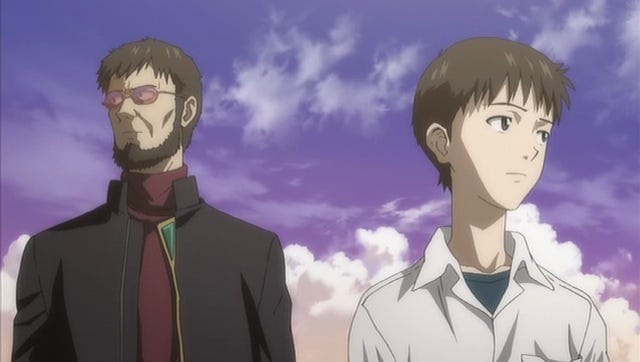 The Hedgehog’s Dilemma is perhaps the most central theme in the Franchise as a whole. Essentially, the Hedgehog’s Dilemma states that the closer we get to people, the more we risk of getting hurt. In relation, this Dilemma seems to be what plagues the Father-Son relationship between the two. To circumvent this Dilemma, Gendo, alongside SEELE, aim to institute Human Instrumentality to merge humanity into a single entity. As a result, Gendo will finally be reunited with his beloved Yui, the one person who was able to breakthrough Gendo’s unemotional shell and love him unconditionally. However, the irony of all this is, in doing so, Gendo neglected the love Shinji felt for his father in turn. For both Ikari’s, one lacking romantic love and the other lacking paternal love, they were forced to seek external validation to soothe their own respective self-pity. In this sense, Shinji and Gendo poetically parallel one another.
 After the exchange among the two Ikari’s, Gendo finally comes to understand Shinji as well as the error of his ways. While this moment was very cathartic and finally provided some resolution between the two, I am rather indifferent about how it was executed. It seems awkward to me that Gendo would sacrifice so much – his own humanity and to some extent his own progeny – to just give up after the first real challenge to his ideals. Moreover, Gendo is fundamentally not a nice man. The dude’s actions resulted in an untold amount of carnage and deaths, actively endangered children, and aimed to, in essence, destroy the entire world. At the end of the day, it is my belief that Gendo is beyond redemption. Worse yet, Gendo is defeated by Talk no Jutsu, which, while predictable and narratively coherent, is a bit underwhelming. Nevertheless, the movie adopts a more forgiving outlook on his character, granting him the opportunity to redeem himself. In fact, Gendo gets the ultimate form of redemption – the martyr treatment – sacrificing himself to put an end to his ideal Instrumentality, leaving Shinji to deal with the remnants of Instrumentality altogether.
 From there, with Shinji in charge, he subsequently enacts his ideal form of Instrumentality. But, Anno spices up the finale of the film with his ideal topping – retconning. After Asuka’s run in with an Angel during 2.0, it turns out that she was just one person among a myriad of clones, further downplaying her character and autonomy. Likewise, it is revealed that Kaworu and Shinji’s relationship was rather superficial the entire time as opposed to genuine. As it turns out, their relationship was destined via the Book of Life, and Kaworu’s ultimate goal was to prioritize Shinji’s happiness over his own. In fact, Kaworu explicitly states during this sequence that their relationship was a “pre-destined circular narrative” ordered by the Book of Life essentially.
Unlike the other Children, Rei actually gets the best outcome through Shinji’s Instrumentality in my opinion. Although it was short, Rei and Shinji briefly exchange some words, and Shinji decides that Rei should be able to live a life without Evangelion units and just be a normal girl. Finally, Rei can be her own person rather than just merely a tool in a grander scheme. In this final act, Shinji attempts to stab himself with the asspull Spear and reset the world, but his act of martyrdom is circumvented by the spirit of Yui taking Shinji’s place, which was also a nice moment for the film. Consequently, Yui’s sacrifice allows our protagonist to live on in his newly envisioned ideal world.
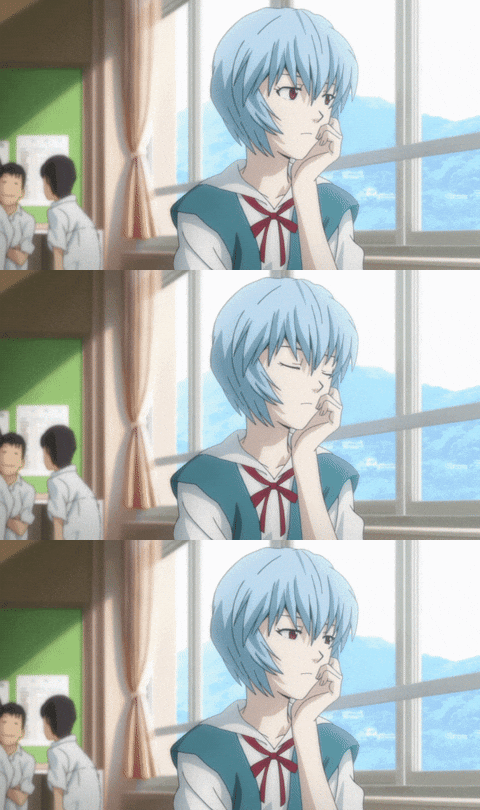 Once more, like Gendo’s redemption, I am left with a feeling of indifference regarding Shinji’s resolution. Personally, I always held the notion that Shinji would rebuild the world – a sentiment that came from the Rebuild franchise being named exactly that. However, Shinji, rather than rebuild the world, effectively abandons it, adopting a brand new world entirely. While this decision is narratively coherent, I do not feel it is thematically appropriate, especially after the village sequence. The village sequence constantly reinforced the theme that life must go on in a broken world. Conversely, Shinji’s answer is to just “rewrite the world, a world where new people will live – Neon Genesis.”
Nevertheless, the ending of the film was visually interesting, reminiscent of End of Evangelion, and provided a nice sense of closure to the Franchise altogether. Similarly, the end of the Rebuild franchise offers a much more optimistic tone as opposed to End of Evangelion. In a direct parallel, the original Evangelion timeline begins with clear blue waters and ends with poisoned red waters. Conversely, in the Rebuild timeline, the story begins with poisoned red waters yet ends in clear blue waters. As a whole, I think this visually reinforces the more positive tone the Rebuild timeline was trying to get across. Similarly, in End of Evangelion, Shinji gets help from everyone else to push him along his wary path; however, here, Shinji is the one who helps everyone else instead through Instrumentality.
 As a package, the ending of the 3.0+1.0 was both cathartic and frustrating. For the best viewing experience, evaluate this final film in the tetralogy emotionally rather than intellectually. At the end of the day, the themes of Evangelion have always been at the forefront of the series rather than its complex plot or ever-expanding lore. Thus, for my final sentiments on the film, I would rate 3.0+1.0 a 6/10, slightly above average. Personally, I believe the 2nd movie in the tetralogy is the best, then the first movie, then the final film, then lastly 3.0.
- - -
Closing Remarks
- - -
Probably the most pervasive issue with the Rebuild franchise is Anno’s tendency to shamelessly self-insert himself into the narrative. It is no secret that Shinji is somewhat of a representation of Anno himself, especially during his depressive episodes. To the same extent, Mari is a self-insert character of Anno’s own wife rather than an actual autonomous character in the Rebuild franchise. Ultimately, the point I am trying to get across is Anno, fundamentally, cannot control himself.
As a package, the ending of the 3.0+1.0 was both cathartic and frustrating. For the best viewing experience, evaluate this final film in the tetralogy emotionally rather than intellectually. At the end of the day, the themes of Evangelion have always been at the forefront of the series rather than its complex plot or ever-expanding lore. Thus, for my final sentiments on the film, I would rate 3.0+1.0 a 6/10, slightly above average. Personally, I believe the 2nd movie in the tetralogy is the best, then the first movie, then the final film, then lastly 3.0.
- - -
Closing Remarks
- - -
Probably the most pervasive issue with the Rebuild franchise is Anno’s tendency to shamelessly self-insert himself into the narrative. It is no secret that Shinji is somewhat of a representation of Anno himself, especially during his depressive episodes. To the same extent, Mari is a self-insert character of Anno’s own wife rather than an actual autonomous character in the Rebuild franchise. Ultimately, the point I am trying to get across is Anno, fundamentally, cannot control himself.Between a myriad of re-writes, ever-expanding lore, unnecessary fanservice, wasted runtime, and retconning prior events, Anno consistency illustrates a lack of control in his own progeny with Evangelion. For instance, the world is ending throughout the carnage of eminent Instrumentality, but I can hardly become invested in this event as female plugsuit cooch is shown every ten seconds on screen as a distraction. Worse yet, Asuka spends 90% of the movie half naked.
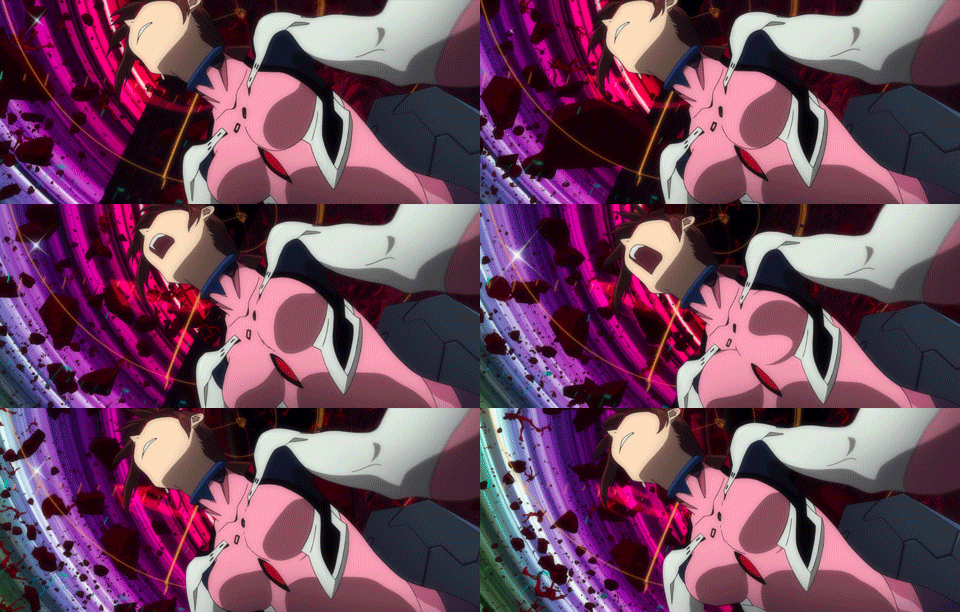
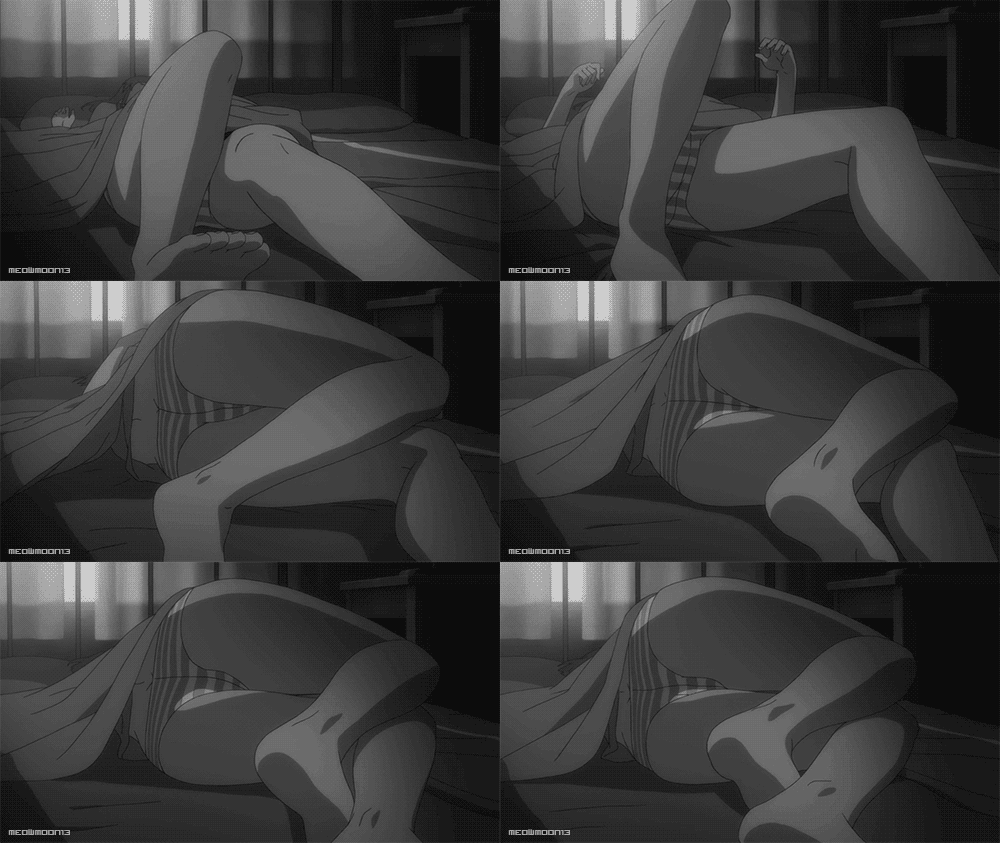
 Now, the Franchise has always had fanservice between the famous plugsuits and the babe known as Misato. But, it was always utilized to a more narratively appropriate extent. For instance, the plugsuits were a necessary form of equipment to help the Children better synchronize with and pilot the Evangelion units. Likewise, Rei’s famous nude scene in the original run was to further illustrate the point that Rei is fundamentally different than Shinji and Asuka, devoid of human emotion. In a direct parallel, compare Rei’s lack of reaction to Shinji discovering her naked to Asuka’s hyper-emotional reaction of Shinji discovering her naked.

 The main point I am trying to get across is the fact that fanservice is okay, even great, if used correctly. But, the Rebuild franchise does not use fanservice in a subtle or coherent manner. Fanservice in the Rebuild timeline is just showing some titties for the sake of it. The over-indulgence of fanservice is especially ironic considering how Anno is historically known for hating how the Evangelion fanbase portrays Asuka and Rei in the waifu wars.
 On another note entirely however, the lore of Evangelion expanded a ton in this final film and all throughout the Rebuild tetralogy. Anno introduces new bits such as Black Lilith, the anti-universe, the Book of Life, the Gogotha Object, and the Wanderers among many other new concepts. But, does any of this lore actually contribute anything meaningful to the story at hand? I would argue that it does not.
The expansion of the lore does not inherently result in the expansion of the world of Evangelion. As an illustration, we are only shown Village 3 in the village sequence aforementioned. But, it is stated there are many other villages that exist with the support of WILLE as well. How do these villages function? Are they worse off or better off than Village 3? If Village 3 has Asuka and Mari, does that mean the other villages have no protection? Are the Wanderers outside the other villages as well? What is the population of these villages and the world at large? All of these questions seemingly basic questions are left unanswered.
 Worse yet, there are even more major questions left unanswered as well. I mentioned some of these earlier like the Curse of Evangelion or how Kaji stopped the Third Impact. But, let us discuss some other ones that could present potential plot holes. In 3.0, Shinji is given Toji’s shirt at NERV HQ. How did his shirt end up there? How did NERV function at all with effectively zero staff? Who built the mass production Evangelion units? What was the Angel threat portrayed at the beginning of 3.0? What are the Wanderers? What happened after the Third Impact between movie 2 and movie 3? Who funds WILLE? Who is Mari? What is Mari’s ultimate plan or goal? What is Mari’s relationship with Gendo and Yui? How is her last name Iscariot relevant to the underlying plot? Is Asuka even human? Why didn’t Rei leave Evangelion Unit 1? How are Shinji and Kaworu connected in the Book of Life? Who wrote the Book of Life? In all honesty, I could go on for days revolving around unanswered questions.
Now, I will finally move on to Anno’s most blatant display of self-insertion throughout the entire Rebuild franchise – the epilogue. Earlier, I alluded to the fact that Shinji is a representation of Anno himself, and Mari is a representation of Anno’s wife. Well, the epilogue ends with showing the fandom of myriad of ships – Asuka with Kensuke, Kaworu with Rei, and, lastly, Shinji with Mari. This is yet another moment of absurdity that makes zero narrative sense from both a plot and character perspective.
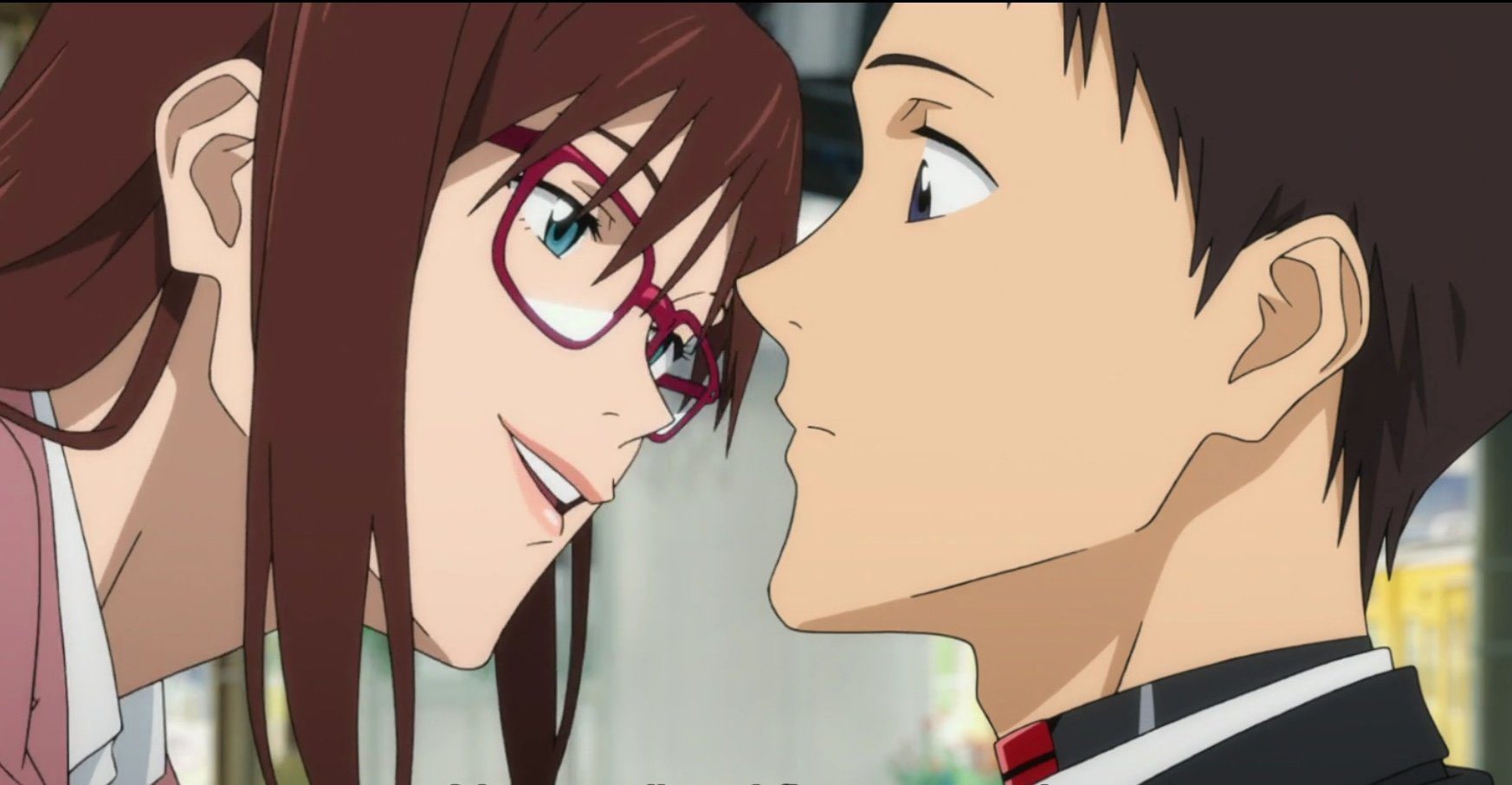 Firstly, the connection between Mari and Shinji is practically non-existent. Mari calls him “doggy” a few times, and that is practically the extent of their entire relationship. In essence, Mari is just the new girl with big tits who just moved to town.
Compare this to the nuanced relationship between Asuka and Shinji. During Shinji’s darkest time, Asuka forces Shinji to eat, albeit forcefully, to ensure Shinji’s continued survival. Likewise, after Shinji succumbs to a PTSD flashback of Asuka wearing the DSS choker (previously referred to as the death dog collar), Asuka makes an effort to cover it up around Shinji by wearing a scarf. Similarly, as Shinji wallows in self-pity all by himself, she secretly checks up on him to see how he is doing. Moreover, Asuka actively attempts to cook a meal for Shinji and helps to see the planned dinner party come to fruition during the events of 2.0. Furthermore, Asuka is the foremost love interest of Shinji throughout the entirety of the rest of the Franchise. Ultimately, it is very clear that Asuka has a crush on Shinji, and this notion is consistently supported with evidence throughout the Rebuild tetralogy. Altogether, the most narratively coherent love interest for Shinji is Asuka.
Waifu wars aside, my previous points still remain extremely pertinent to Anno’s lack of self-control. As a package, the tetralogy of Rebuild films are horrifically incoherent and inconsistent with one another. In fact, it is clear Anno has a completely different goal in mind and tone for each and every movie in the tetralogy. Consequently, the four films viewed as one story simply does not work well at all. As a result, none of the resolutions depicted in the final film feel properly earned.
As a whole, I would be hard pressed to call Anno a good director. For context, Anno conceived the original TV anime series in a shorter time period than it took him to create two Rebuild films. In my opinion, this speaks volumes as to how Anno is simply all over the place creatively. A good director knows when to make compromises to get the production finished in a timely fashion with their respective vision. Conversely, Anno seems like the type of guy to have a vision in mind, write an entire script, then abandoned it at the last second because it no longer feels right to him. In fact, this sentiment is further supported by his infatuation with retconning and the rumors swirling around a myriad of re-writes.
At the end of the day, I love this franchise. But, I cannot say with authority that the Rebuild franchise provided anything of value to Evangelion as a whole. Perhaps, none of this was ever worth it.
 - - -
Epilogue
- - -
If you read this entire review, I wanted to thank you in advance. I wanted to make sure that this review would be the most definitive analysis I could make on the Rebuild franchise. If you agree or disagree, feel free to let me know with a comment on my profile! Also, feel free to drop a follow as well; I generally follow back!
- - -
Epilogue
- - -
If you read this entire review, I wanted to thank you in advance. I wanted to make sure that this review would be the most definitive analysis I could make on the Rebuild franchise. If you agree or disagree, feel free to let me know with a comment on my profile! Also, feel free to drop a follow as well; I generally follow back!I know it was long, but Evangelion is a piece of fiction truly deserving of discussion and certainly criticism.
If you want to see my thoughts on other series, I have some other reviews up on this site as well Demon Slayer Mugen Train , Record of Raganrock, and, so far, So I'm A Spider, So What . Similarly, I provide detailed notes for each title I consume on my lists! I also plan on doing more reviews in the future!
With all that being said, Cheers! Here is to finally an End to Evangelion!

135.5 out of 185 users liked this review
