This review contains lots of spoilers for the first season of One Punch Man
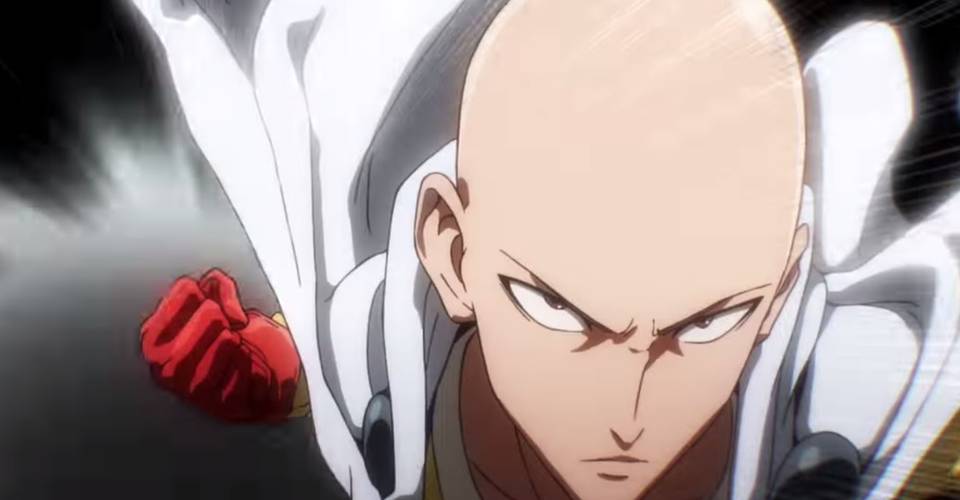
Summary: I’m generally not a fan of the standard shounen formula, so a show like One Punch Man (henceforth OPM) that is premised on parodying that formula and being more fresh and honest seems like the type of show I would enjoy in theory. However, the writing by and large shows a distinct lack of imagination about the struggles it poses for the main character, Saitama, while at the same time ignoring the potential problems that might arise due to Saitama’s personality and weaknesses. The humor, in my opinion, also generally falls flat, either feeling exactly like some of the blander jokes in standard shounens or further demonstrating the lack of imagination in the writing. The animation is excellent and the battle sequences are well thought out, but those alone aren’t enough to carry a show. This is especially true with the central premise of an overpowered main character removing most of the tension by design, although here again I think there’s missed potential to create tension in ways that would be different from your typical shounen. In short, a solid premise that could have been much better fleshed out while still keeping a distinct tone and direction compared to the author’s other work, namely Mob Psycho 100.
Saitama’s Boredom: Early on, the show establishes one of the core struggles facing Saitama as a character: boredom. He yearns for an opponent that he has to go all out against in order to defeat, which is established in his dream fight against the Subterraneans. The length of the dream, the fact that the show hides the fact that it’s a dream until it ends, and Saitama’s disappointment all drive this point home. And certainly on its face that seems like a very valid point; always crushing your opponents in any competition gets boring quickly. However, the show fails to consider any number of counterpoints to this problem; there’s much more to a superhero’s life than just beating up bad guys. The show explicitly points out that Saitama is not particularly studious with his low score on the written hero exam, so anything requiring thoughtfulness or strategy could potentially provide a good challenge for Saitama. Coordination is another potential area of struggle, so tasks that involve fine motor work like knitting or crafts. Even physical sports, which generally require both control and strength, might potentially pose some difficulty for Saitama.
Of course, one might object by saying that facing strong competition in your area of expertise is more fulfilling than competition in other fields, but the show doesn’t make that point because it doesn’t even consider any alternative areas of competition for Saitama. Another possible work around that the show doesn’t consider is Saitama trying to lose his powers. He certainly seems to believe that doing his special workout everyday is important for building his super strength, so having Saitama stop working out could have been an interesting way to see Saitama attempt to counter his boredom. Whether or not doing so had any impact, the exercise (or I guess in this case the lack thereof) would allow the author to explore Saitama’s character more in depth.
Or maybe he could try being an agent of chaos to cure his boredom. I’m not advocating for the evil Superman trope that’s been done to death or a copy of the bored queen of evil from Danganronpa, but rather something that stays true to Saitama’s personality. Imagine Saitama starting to cause mayhem in the city, the other heroes desperately trying to stop him to no avail. Just when it seems like it might start to get really bad, Saitama abruptly stops and decides he has to go and do his laundry or something, being satisfied with the fun (or lack thereof) that he had causing chaos.
None of these ideas or any similar ones are considered though. In the end, all we’re really given is that Saitama is bored because he accepts being bored. The best explanation we get is that Saitama seems to be clinging to the belief that one day a worthy opponent will find him, but even then he never tries to actively seek out a strong opponent. All of this really just makes Saitama on par with the worst generic anime MC’s in terms of likeability and personality.
The Meteorite Incident: In order to protect the city from a meteorite that would annihilate everyone, Saitama is forced to destroy the meteor and inadvertently creates a meteorite shower. The people’s lives are saved, but people’s possessions and homes suffer significant damage. The arc ends with the villain successfully convincing the public that Saitama should be blamed for the destruction to the city, and Saitama angrily countering that he doesn’t care about his reputation because being a superhero is just a hobby for him. Here the show is trying to jab at a few tropes seen in various superhero shounens: the unrealistic expectations foisted on heroes, the appalling ingratitude the public sometimes has for heroes, and the excessive focus heroes have on protecting their public reputations.
The last point doesn’t really stick because it’s undoubtedly important for heroes to be trusted and liked by the public. There are far too many real life examples of the consequences of an organization tasked with protecting the public having a poor reputation to dispute this point. The other two points are more interesting, but the setup of this scene is simply too poor for them to work in this case. Like you have to choose between siding with the hero who just saved you from Armageddon or someone who that hero is treating as an adversary, and you choose to side with the adversary? I use “you” here to illustrate just how much of a stretch the setup is; even if the public didn’t know that the dude was responsible for the meteor in the first place, it’s simply too unbelievable to think that they would be angry at Saitama. I get that this is a parody and that it’s supposed to be absurd, but there’s a redline somewhere between absurd and entirely unbelievable that this setup crosses.
Crossing that line kills any impact this moment could have had. Saitama lashing out at the public also hurts this scene. In Voltaire’s Candide for example, the characters don’t angrily challenge Pangloss’s world view. Rather they tacitly accept or ignore what he says, as the insanity of Pangloss’s ideology is already plenty obvious to the reader. Likewise, Saitama doesn’t need to point out how absurd the crowd is being to get the point across, especially if he cares as little about his reputation as he claims. Perhaps Saitama cares more about his public standing than he claims, but that’s just speculative because the show doesn’t ever try to distinguish his actual thoughts on the matter from what he says publicly. The meteor arc is a neat idea, but the poor execution completely destroys the moment
The Sea King Incident: Arguably the highlight moment of the season is the end of the fight with the Sea King. All of the other heroes have been unable to beat the Sea King despite their best efforts, but then Saitama finally shows up and easily defeats the villain. The public then starts to question the value of the other heroes who weren’t going to be able to protect the public, but Saitama stops that by claiming that the other heroes weakened the Sea King, allowing him to steal all the glory. Thus, the public keeps a favorable view of the other heroes, particularly underdog Mumen Rider, while Saitama is labeled as an arrogant cheat.
It certainly seems like a great moment if you don’t look too closely, and I’ll give it credit where due; it touches on the tendency for an audience to fetishize an underdog even when the ability to get results, in the case of being a superhero, is clearly more valuable. But even that point could have been much more developed. There’s no criticism of the fact that there are so many people watching the fight in the first place, engaged in idle bystanding rather than evacuating like they should be. Especially considering that treating hero battles as a spectator sport is found in many other superhero shounens, this is an obvious missed opportunity for OPM to function as an effective parody.
Another weakness in this scene’s execution is that Saitama doesn’t try too hard to sell his performance. A lot of the public might still buy what he said anyways, but you would figure that a sizable minority might see through it given the half-hearted attempt at deceit. What would be the long run results of such a division in public opinion? Or if Saitama did use the necessary acting to sell his story (think Lelouch or Hachiman), would we, the audience, feel differently about Saitama as a person or about his decision? Also, does he plan on continuing to pretend that he’s arrogant and unskilled whenever he does hero work in front of the public? Probably not, and maybe the short attention span and forgetfulness of the public means that this contradiction would go unnoticed, but there’s no guarantee that it would play out that way.
The gesture also isn’t particularly costly for Saitama. Sure, he loses points in the eyes of the public, but he has plenty of opportunity to turn that around, like by saving the city from aliens at the end of the season. Even if his reputation became too tattered to repair somehow, which apparently wouldn’t bother him too much anyways, he has Genos, his very powerful cyborg boyfriend who is unlikely to be taken from him and seems willing to stick by Saitama’s side pretty much no matter what (although the exact limits of Genos’ loyalty are unclear because the author doesn’t bother testing them).
Yet another unasked question: why does Saitama even decide to bail out the other heroes? Does concealing the deficiencies of the other heroes really benefit them, or does it primarily just protect Saitama’s conscience from feeling guilty about how gifted he is compared to the other heroes? Hiding the weakness of the hero establishment helps to protect order in the short run, but does little to improve the security of the city in the long run. Maybe Saitama thinks he’ll always be able to keep everyone safe, but would he really accept such responsibility in practice when being a superhero is just a hobby to him?
The point here isn’t to decide whether or not what Saitama did here was right or not. Rather, it’s to say that although this scene is a cool idea, there is so much about it that’s left unexplored that, like the rest of the show, it just feels hollow and thoughtless. It certainly doesn’t help that I have little interest in the characters or world since the writing refuses to ever take them seriously in a thoughtful way. We’re supposed to look on and think, “Wow, Saitama is so strong, but he’s still such a considerate, humble guy” and leave it at that. The minimal consideration of the full range of circumstances and possible outcomes is the type of shallowness one expects of an average level superhero shounen. That, in my opinion, reflects poorly on OPM; a parody that’s too much like what it’s satirizing is just a weak entry in that genre.
Saitama Being an Unnaturally Perfect Hero: This may seem like a bit of an odd point at first, but it’s a bit surprising just how great at being a hero Saitama is even just given the few flaws that the show touches on. For one, his abject failure at the written part of the hero licensing exam would seem to suggest that Saitama doesn’t know about some of the more nuanced parts of being a hero. Here we can create a few hypothetical scenarios of how this could reduce his effectiveness at being a hero:
Scenario 1: Saitama defeats a bad guy and secures them to be arrested by the police. However, because he fails to follow proper procedures, the arrest is illegal and so the criminal gets to walk free. The criminal proceeds to leave to an area outside of Saitama’s protection and causes trouble elsewhere.
Scenario 2: Saitama decides to patrol through an area where a set number of other heroes were assigned for a special event. The presence of a hero who wasn’t expected to be there causes a panic amongst the guests, who mistakenly believe that they’re in danger, and creates unnecessary chaos.
Scenario 3: Saitama encounters a couple of suspicious people, but after a quick questioning he decides to let them go. He plans to monitor them with his super hearing for a bit, but then remembers that he had something else to take care of, and so runs off, neglecting the suspicious people and failing to prevent the crime they proceed to commit.
Maybe the author simply wanted to ridicule licensing tests and bureaucratic systems like hero organizations. Yet if that was the author’s intention, having Saitama get more questions right on the exam while still getting just enough wrong to make him a low rank hero would be a much clearer way to show that. Focusing on the point as more than just a passing joke would also make that excuse more believable. As it is actually written, there’s ambiguity over whether the licensing test is pointless or if it’s just that Saitama is ignorant about proper hero procedure, but the latter seems more likely to me.
Another potential weakness as a hero is that Saitama is sometimes forgetful (i.e forgetting about the all important supermarket sale). Combine that with his perpetual boredom and his detached nature, and even more scenarios involving negligence, apathy, and irresponsibility open up. Delegation of superhero tasks that Saitama is better suited for would alleviate some of these problems, but not all of them, and such specialization and Saitama’s thoughts on it are never explored since the show simply treats him as an all-star hero. Certainly, the show is free to just ignore potential contradictions to his effectiveness as a hero, and some shows could get away with such simplicity. But when there’s no real substance to the show for such simplicity to streamline, it leaves us with not simply a shallow experience, but rather an entirely empty one.
Why I Find the Show’s Humor Lackluster: Being a parody, the humor relies mainly on poking fun at the standard beats in a battle shounen. Examples include Saitama starting as a rank C hero despite already being the most powerful, villains’ special moves that would normally turn the tide of battle having no effect, Saitama’s powers coming from an ordinary training regimen, and Saitama panicking about a supermarket sale in the middle of battle rather than about the actual fight.
The humor is entirely predictable, which by itself wouldn’t necessarily be a problem. However, this being a parody of a superhero shounen, all of the jokes are drawn out in order to appropriately mimic the style the show is parodying. Drawn out pacing and predictability are not a great combination, but the humor still could have been saved if the show made any attempt to expand upon its jokes after being initially laid out. But no, generally the predictable joke is unveiled, and then the characters all react to it as if it were an unexpected twist in a normal superhero shounen story. The resulting moments are clearly ridiculous, and such moments of absurdity work well in most parodies. However, expecting jokes ridiculing the absurdity of a situation in a genre where absurdity and wackiness are not just the norm, but a huge part of its appeal, just doesn’t work.
The jokes needed to either be more unpredictable, leverage abrupt changes in pace (i.e slapstick), or really just find some way to be less static. People may think that being predictable in this case is inevitable, but anyone who’s seen The Great Pretender knows that a show can still make its central gimmick feel unexpected.
Conclusion: Perhaps you’re wondering why I’ve spent most of the review being so finely critical of all the missed opportunities, ideas not explored, and arguably trivial details about world building and characters. After all, OPM is just supposed to be a relatively light hearted action series parody about a chill, overpowered superhero who’s basically perfect. But therein lies the crux of the problem. OPM tries to create a parody by taking the standard superhero shounen template and combining it with a force completely antagonistic to that template: an overpowered hero who faces no real opposition. The end result of such a combination is a boring show, unless other elements or ideas are used to compensate for that. And as I’ve tried to make clear in this review, OPM uses a few very paper-thin ideas and jokes as its counterweight and calls it a day. Furthermore, the show fails to reconcile the image of perfection that OPM wants us to see Saitama as and the blatant weaknesses that the show attributes to Saitama.
There are so many unconsidered possibilities and ideas surrounding the show’s writing, and it would be unrealistic to expect the show to explore them all without destroying its flow. But if there was just a bit more thoughtfulness in the writing, it would have gone a long way in improving the experience. Really, all we’re left with is a shounen superhero story that is uninspired, contradictory, and very boring.
And to clarify why I barely mentioned any of the other characters besides Saitama, it’s because, in a literal sense, they’re all basically just treated like action figures: flashy and perhaps somewhat memorable, but utterly lifeless. That’s probably by design; having basic characters built around standard superhero story tropes creates plenty of parody opportunities, but for OPM it’s just another weakness because the parody element does not deliver.
Maybe some of these complaints of mine are addressed in the manga or even in the second season of the anime. However, this first impression is just so underwhelming that I have little interest in finding out.