
Please note
Introduction
#
Presentation wise the plot is fairly simple at first glance, but how it makes you think is something else entirely. This novel will certainly get you thinking, posing the reader with a lot of philosophical questions that cannot be answered easily. Not only do the characters ask this themselves, you do too. In doing so, I became much more immersed in reading the novel. Perhaps I was just continuing to read to find the answers that were being asked. Some of the questions asked in the novel include (courtesy of isyatup's review):
- “How much does my life cost?”
- “What does it take to have a meaningful life?”
- “How should I spend the remaining time I have left?”
- “What brings happiness?”
As you can see, it is hard to answer these questions. Only by progressing through the story, we can see what answers the characters discover, a key drawing point of the novel. And just maybe, we will find an answer ourselves.
What happens in the plot is fairly mundane at first glance, but coupled with the characters and the philosophical aspect of the novel it can become quite engrossing to read.
Pacing is a key part of the novel to discuss here. As I stated earlier, the first few chapters serve has foundation building for the novel. As such, it can seem to be slow at the beginning. I would say the novel does not really take off until the second half, in which it got really good or me. You could describe this novel as a slow burn, with the beginning being fuel to the flame and then in the later parts it bursts into something much more. Overall, it all flowed nicely. That said, the slow beginning can be a turnoff to some readers. It takes some time for the novel to get really interesting, so I would suggest trying to stick through it. The novel is not too long either.
Plot development is another important part to discuss. For the most part, the development was well thought out and paced. I really liked how things played out in the later parts of the novel, how things changed. There were times where the development was more subtle, and other times where it was more obvious. Most of the time I was not able to correctly predict what was going to follow, so I was satisfied in being mildly surprised as to what would happen next. I cannot really go into too much detail about the development with spoilers in mind, but it was one aspect of the novel I enjoyed.
#
The characters presented in this novel are vital parts of the story, and there are not many characters to speak of. In the AniList entry of Three Days of Happiness there are only three characters and really, there are not much more. Most of the other characters that appear are either unnamed and insignificant or only play a part in the late parts of the story.

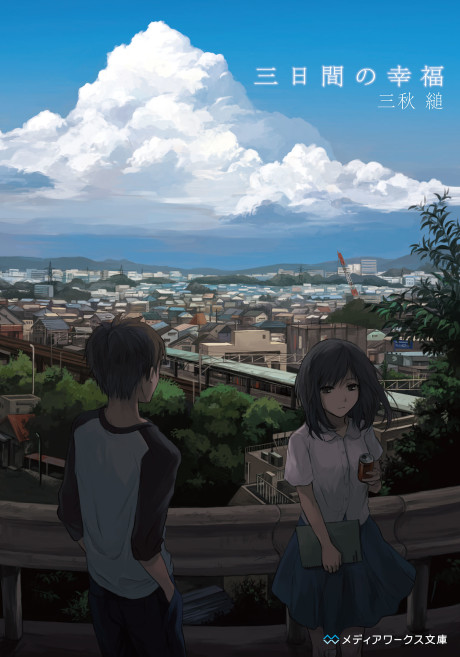
Kusunoki is presented as a pretty miserable and hopeless character. He is different from the hopeful and cheerful leads that appear in a lot of what I read these days. This in turn made him a more fascinating character to read. His perspective on the world was quite pessimistic, which I suppose was something fresh to me. With this in mind, he can be an unlikable character, but keep a close eye on how he changes.

Another notable character in the story is Himeno. She does not have an illustration in the novel so I have no image to show of her here, but you can easily find some art of her on her character page. She is perhaps the only childhood friend Kusunoki had, and she played a vital role as to who Kusunoki came to be in his twenties. She has some similarities with Kusunoki, with them both being unable to fit in with others. I do not want to say much else as she plays a vital role in one of the later chapters, and to discuss her further may be some spoilers. But overall, she was an intriguing character, and seeing how both Kusunoki and Himeno heavily effected each other was engaging. Himeno often appears in Kusunoki's internal dialogue, so it is quite apparent as to how significant she is to him.
Other than the characters I have mentioned above, there is almost no one else to speak of. In the later parts of the story some other minor characters play a role, but for the most part it is just the main two. That said, the roles the minor characters play in the later parts of the story were written and implemented well. They did not feel like meaningless background characters, and added more to the story. By having only a few characters in the spotlight, the development and relationships of those characters are focused on and it is easier to craft better development with them. It also helps in focusing the reader's attention to them only. Whilst the main two may be unlikable at first, this only emphasises the changes they go through.
#
Not only did this novel get a manga adaptation, but the novel itself is a rewrite of a web novel the author Miaki Sugaru posted on the website 2ch.
The manga adaptation may be the more favourable option for many people to experience this story. It is understandable, as reading manga takes less effort than novels, it is faster to read, and it also provides art. There are some things only manga can do, but the same thing can be said about novels too. One difference I found when reading the manga was the pacing. This was probably something due to the form of media, but it was much faster to read as compared to the novel. The events between the manga and novel are mostly the same, but the manga plays out faster as there are less words to go through. I personally preferred the slower pace the novel had, allowing things to develop with more time, but the swifter pace of the manga may be more appealing to others.
Of course, there is also the visual aid of the art provided by the manga. The art adapted scenes from the novel accurately and faithfully. After reading the novel, it was nice to see the images that I conjured up in my head manifested. The novel did quite well to illicit vivid imagery of both the settings and characters presented, but I also liked seeing it showcased through art too. Both media formats were able to build a stimulating world and characters, so in the end it really comes down to preference.
Although most of the plot stays the same, there are some changes. Most are not significant and I could not really remember much, but one I recall was
Spoiler, click to viewclick to hide
after Kusunoki meets Himeno he decides to do something with the money he planned to give her. In the novel, he gives it out to random passers-by, whereas in the manga he throws it all off a bridge into the ocean. Whilst the manga's depiction of that event is more symbolic, Kusunoki's act in the novel better links to Miyagi's comment on their "altruistic" acts.Moreover, the manga has two extra chapters. The first extra chapter seems to be something new, or at least something that was in the novel. I could not recall anything in the novel that was similar to what happened in the first extra chapter, but I could be wrong. The second extra chapter adapts a short story the author wrote called 'I Say a Little Prayer'. It is a pretty faithful adaptation but the web novel version has some more detail in it.
The original web novel is essentially a shorter version of the published novel with some plot differences. One notable difference in the story is that
Spoiler, click to viewclick to hide
Kusunoki's family makes an appearance in the original, whereas in the novel Kusunoki only mentions them in passing. This was an interesting change, but ultimately both formats show the disdain he has against his family, but perhaps more so in the web version.You might be faced with the question as to whether you should read the manga or the light novel of Three Days of Happiness. In the end, it comes down to your preferences. Whilst I personally preferred the novel (partly because I read that first), the manga was still a good read, and a pretty faithful adaptation. If you like reading novels and prefer a slower paced story then by all means read the novel. If you do not like reading novels and prefer manga, then perhaps the manga is the better option for you. You would still get to experience a great story either way. For those who enjoyed the manga adaptation, you might be interested in reading the novel too. Seeing the same story but in a different way can be enthralling. The web novel is not a must read if you read either the manga or novel, but it is nice to see how it all originated.
#
I recall the scores I was giving the novel as I read. The beginning parts were a 70 or so, not too bad but things were not too interesting at that point. But as I continued to read on, the score kept getting higher and higher. The ending is what really raised the score for me, I found it to be wonderful. It was quite touching and emotional, not many forms of media can make me feel that way. You could say that the whole novel was just build up for the ending. I am glad that I read this novel, and it easily became one of my favourites. I cannot recommend this to everyone, but for those who want a thought provoking philosophical tale with some romance then this should be up your alley. My review cannot properly put this novel into words, it is an experience that in the end you would need to experience yourself to understand. I may be overpraising this work, but at the end of the day what matters is I enjoyed Three Days of Happiness. In summary:
- The novel has a slow burn to it, taking its time before it kicks off. From there, it becomes highly engaging and immersive.
- It poses deep questions to both the characters and the reader to ponder on which makes it all the more engaging.
- The main characters may be unlikable at first, but their development makes up for it.
- Both the characters and the relationships they hold are a fascinating read.
- The development of the plot and characters were both well thought out.
- Both the novel and manga are good ways to experience the story.
If you are still here at the end of review and made it through my ramblings, I thank you. I would also recommend reading isyatup43's review on Three Days of Happiness, they go into better detail on the philosophical elements of this novel. If you want to send me feedback on my reviews, please post a comment on this thread. Hopefully you were able to get something out of this review. If you did not like this review, then I apologise for wasting your time.