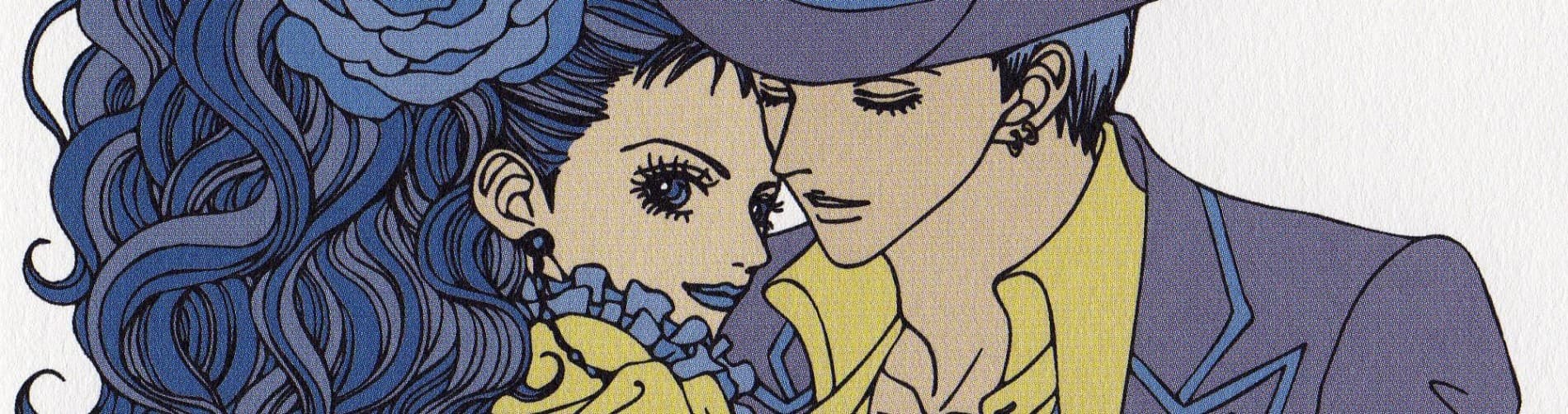
Paradise Kiss
a review by SEGURIDA
a review by SEGURIDA
At a first glance, Yukari is your run-of-the-mill high school student that knows nothing else than the boring routine of an exam-taking, cram school attendee. And she makes sure everyone is aware of that by constantly complaining internally while storming down the street with a sour face. But what would annoy a lot of readers from the get-go, Yazawa takes and turns into a kind of blue, but also inspiring tale about growing comfortable in one's own skin and finding a path for oneself. Having a lot of fun but with a heavy load of sadness on the side is how Yukari spent her last high school days, resulting in a heartwarming story with a sad aftertaste.

There is no romance just for the sake of romance; each scene and dialogue is written with direction and a strong intent, and that is what elevates it and sets it apart from other manga of the same genre. Yukari learns that romance is another aspect of life, which can’t be unwoven or separated from the rest: her career aspirations, her relationship with her mom and her so difficult to grasp feelings for George, are all different sides of the same coin. They cannot be taken into account separately, because they act as a whole. For instance, the height of her relationship with George has her reevaluate her situation at home, when she decides she isn't happy with the way of life her mother is imposing on her, and finally decides to run from home. But this also has her realise that she has to think about having a stable career if she is to live away from home, so is modelling truly what she wants to do? But much in a full-circle manner, all this swaying back and forth, and indecisiveness, and getting tugged by others' feelings has George disappointed in a Yukari that does not have a strong will, determination or passion for any decision she makes. He is disapproving of that, in his view, every road Yukari takes is to please or influenced by other people’s feelings that affect her so deeply. In the end, one thing in her life impacts the other in a way that they cannot be separated, much how it is in real life.
Reading this story is very heart-wrenching, as it is filled with funny moments, usually sparked by bubbly Miwako, but also coming right out of George’s mouth with a strong stench of french cologne and heavy cynicism. But then, all of a sudden, there is a really deep nudge; a single comment that ruins a nice picnic with a gloomy, grey atmoshpere, and takes Yukari’s heart for a ride. I bet you have had one of those times where everything is merry and happy until someone blurts out something which sparks a really depressing conversation, that leaves you thinking for the whole week. Or you are having a good couple of days but cannot fully devote yourself to enjoying the moment because everything you do has you doubting yourself over. This quest Yukari embarks on in search of content, even with its highs and lows, is mostly characterized by a weird feeling of happiness with a bitter aftertaste. Deep down she feels uneasy about her life situation, so even in the moments where she is feeling joy, it is always accompanied by a sad feeling.
I really liked the way in which Yazawa brought polyamorous relationships into discussion. Miwako and her childhood friends, Hiro and Arashi, were always close to each other, but as Hiro moved away, they grew distant. Miwako and Arashi finally ended up in a romantic relationship, somewhat by inertia. However, even after years of barely talking to Hiro, Miwako confesses she still loves both of them equally, but has a hard time conveying her feelings because she realises that isn’t the normative romantic relationship. This aspect is perfectly incorporated into the story too: Miwako, a loving and caring girl, seems like the type to have these feelings of actually liking everyone! Even in a romantic way. I also believe the fact that Arashi and Miwako became boyfriend and girlfriend just because they were there, and they were together all the time, because they were neighbours, and then classmates, is also worth talking about. Romance is not a platonic state in which circumstances don’t matter, because love is strong enough to bring two people together. No, romance totally is about the specific circumstances and time each part of a relationship is going through. And I hate to repeat this over and over again, but I’m trying to make a point here, this is much like real relationships. No relationship is black or white, perfect or terrible. Love works in strange and funny ways, and whether it be with Mikako loving two people in the exact same way, or her and Arashi being together because “it just sorta happened” (her words exactly), Ai Yazawa beautifully explores all these weird things that make a relationship.
This brings me back to Yukari and George briefly living together. In the morning, waiting for her boyfriend to come home, Yukari thinks about their relationship, and realizes how fragile it is, as she knows that the only thing keeping them together is the fact that they are cohabiting and having a physical relationship (something similar as to what Arashi and Miwako go through, and finally resolve). But love isn’t glue, sticking two people together. If things aren’t working out, they will inevitably, sooner or later, drift apart. After realizing this, and taking into account Hiro’s advice, and the fact that she needs parental permission to enter a modelling agency, she decides to go back home to her mother. This little distance between her and George, and a new ambition to finish high school, strengthens her, and as a result, strengthens their relationship.
_“ -All I can think of is that she was born into this world with that personality and body just to trifle with me.
-You’re terribly mistaken if you think anyone was born just for your sake. ”_
The quote above is from a conversation between George and his friend Kaori, who came to visit Tokyo after moving to London to study. This might not be a memorable quote, but after reading it again, I found it quite interesting, as it can be used to exemplify some aspects of his and Yukari’s relationship. George, from the beginning, manipulates Yukari (not necessarily ill-intendedly, but still), into becoming his ideal woman. But the problem is, he wants her to make her own decisions, act independently and be strong and passionate, but if she were that, then she wouldn’t be taking George’s words so seriously. This contradiction is why they lastly reach the conclusion that they’re no good for each other, despite all the good moments they shared, and would probably continue to. At the heart of the relationship, they have too different a view. This line is funny also in context, as they are both laughing, but when I read it I can’t seem to separate from it a very deep and subtle tinge of sadness and realization. Maybe it’s just me, but why does it feel like every line is bittersweet?
Yukari’s evolution can be clearly see throughout, and is at the core of the whole story, but I especially enjoyed reading the last third of the book (especially from Stage 31 onwards). Everything starts to become clear in her eyes, and even though nothing is set in stone just yet, this helps her build a stronger, more patient and understanding character, while also maintaining a (somewhat) firm sense of individuality by the end of the manga. On the last couple of scenes, everyone seems to be settling into their adulthood smoothly and George has one last decision to make: study to become a hairstylist or continue on a design career. He thinks, as his designs are only created to please himself and not others, that he would suffer a lot if he had to turn his passion into a business and make a livelihood from it. I absolutely loved this, because it illustrates the passion he has for clothing clearly, but it is also totally in character for George to refuse to please anybody with his clothing but himself, in a peak egotistical manner. When he finally decides to go to Paris and study design, he asks Yukari if she will come with him. Her response is no, because she wants to give her modelling career her all, and she needs to start in Japan, to which George responds: “That’s the right choice”. This is not the first time in George asks Yukari something expecting a totally different answer, and then proceeds to get upset and scold her about it, but this is the first time Yukari does not fall for that, and that shows her evolution as a person. In the end, Yukari complaining about how she will have nothing to remember him back in Japan proves unnecessary, as George leaves her a storage unit with all the dresses he made, including the one she modelled.

Final notes and afterthought
Paradise Kiss, for me, is a story that brought to surface everything I knew I really loved about romance, but couldn’t remember.
I finally finished my first reread of Paradise Kiss. Only reading it twice might not seem much, and it really isn't, especially for a short manga, but since I first finished it I have had it always floating in the back of my mind. As it is a story so close to my heart, I decided to write up something that is not really a formal review, but more like my personal analysis and takeaway from the series. I decided to start with “All that’s right with ParaKiss” like in my Nana one, because rather than a review, this text is a list of the things I liked the most about the manga. Of course I left out some, and if I gave it some more thought I could probably find double the amount of points I mentioned here to talk about. I just love everything about Paradise Kiss, and I might be biased, but I really cannot find anything wrong with it. George is an ass that’s treats everyone badly? Character flaws. Yukari is annoying as hell? It’s just to show her evolution later on.
As of this moment, out of Ai Yazawa’s works, I have only read Paradise Kiss, Gokinjo Monogatari and NANA in that order, and as much as I love the three of them Paradise Kiss still has a very special and exclusive place in my heart. If you read Nana and are debating on whether to read Paradise Kiss or not, please give it a chance. It is not as edgy but it has as much substance as Nana, even when much shorter.
As for the anime, I haven’t watched it through, but I have seen bits and pieces of it and the animation looks absolutely amazing! It’s not quite Ai Yazawa’s art style, with the long skinny limbs, but it looks really good. I love the subdued colours, the look of the faces and the kind of photographic backgrounds and close up shots there are at times (see, for instance, a screenshot of joji’s car down below). The opening is very nice too, and I listen to it quite often, but what I absolutely adore is the ending! First of all, Franz Ferdinand’s “Do You Want To” is such a funky and amazing song. Really makes you wanna dance. Secondly, the lyrics actually match the story! The singer talks about how friend makes some famous acquaintances, so they both go to a trendy party full of stuck up and snobby people. Some lines are quite funny: “Well, here we are at the Transmission party. I love your friends, they’re all so arty, oh yeah” and “Well, he’s a friend and we’re so proud of you. Your famous friend, well, I blew him before you, oh yeah” which has that homoerotic reference in a mocking tone that really reminds me of George. Lastly, the art style of the ending and the animation is just sublime. It features amazing scenes containing: George’s car coming alive and attacking him and Arashi, Yukari dancing smugly, Miwako twerking her ass off and Isabella dancing disco-style, and a bunch of neatly drawn magazine covers featuring each of the characters.

Revised on: June 6th, 2023
61.5 out of 63 users liked this review
