
In The Eternal Night
"The legend ends, and history begins"
I had heard of Legend Of The Galactic Heroes (LOGH) for almost as long as I had been watching anime and been involved in the community. The acclaim astonished me as it just seemed so untouchable, so massive, so hard to wrap my head around. This soon turned to disdain after hearing fans gush so much, what was so great about it anyways? The reason I describe my experience is because I am sure people have felt the same. I could never shake that curiosity though, so I went for it. LOGH quickly drew me in like few series have before. The curiosity soon turned to intrigue, investment, and then astonishment. I was stunned at what I had missed out on all this time. With all of that being said, LOGH is easily one of the greatest series I have ever watched. It is a pillar of the medium, that has stood the test of time and most likely will for decades to come. It tackles heavy themes of authoritarianism, democracy, corruption and more while still creating a memorable story. __This is my last spoiler warning, because I will once again highly recommend you watch this series.
__ Now, onto my thoughts.

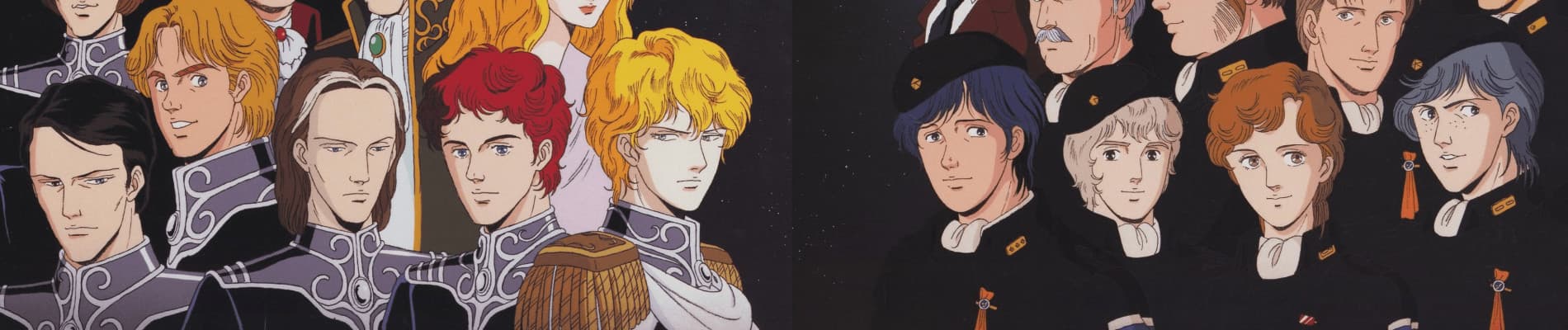
Of course, the show has a vast amount of characters beyond just those two. I wish Frederica had been fleshed out a little more, but she still is a great counterpart to Yang, and their relationship was really feel good. Her reaction to his death was easily one of the hardest hitting moments in the show and overall I felt it was a great portrayal of the emotions of a young death. Schönkopf is not a character that warrants too much deep analysis but he still ended up being one of my favorites. He is easily the most capable of Yang's allies in a practical sense, and I felt it was a good choice to have him be the one who is willing to criticize Yang for his lack of ambition. If there was any character who deserved to go down fighting it was him. Poplin, Cazerne, and Attenborough bring a lot of the levity without being annoying or unlikable, and they all prove themselves in various ways. Admirals Lutz, Bittenfeld, Fahrenheit, all show different traits which make them unique and memorable. Going in, I thought the scale of this series would make me quickly forget names but by the end I felt a very deep connection to even the more minor side characters, which is no small feat.
The narrative is also an aspect I expected to have trouble with, but I never did. The pacing is perfectly balanced, and altering between Yang and Reinhard's sides never felt confusing or lost me. The build-up towards episodes with both was perfectly executed and these episodes always came at the right time. The first series is largely set-up to begin with, but deftly starts to weave in the main plot and the rebellions on both side of the galaxy. And of course, Kircheis' death is a great inciting event. The second series however, is where I feel the show really began to prove its greatness to me. It was a great decision to have the alliance fall, however early it may seem at first it's a very logical conclusion that is built up to masterfully. The ill-advised actions of the alliance in the first series serve as fuel to this flame, and set up the debate between corrupt democracy and benevolent dictatorship. Reinhard also finally triumphs, but a major twist comes with how hollow this triumph really is to him. As mentioned before, Yang defeats him tactically once again and only spares him due to the ceasefire orders. The crown means little to him at that point.
Series 3 is the biggest triumph of the show for me. It not only begins contrasting the democracy and dictatorship, but comparing them. Lennenkampf's incompetence as a leader leads to his death and Yang rising up against him while the alliance, ever desperate to save the nation, imprisons Yang. Bewcock's last battle against the invading imperial forces is one of the highlights of the series, his committal to his values is inspiring and the scene of his wife handing him his uniform for the last time was moving. The Terraists are largely revealed this season to be the main antagonist of the show. They are a little too boogeyman-y but I like how they connect back to the Earth, and the history elaborated on in documentary episodes as a remnant of violent social institutions, and religion. Along with Fezzan and Rubinsky they divide instead of heal, and move back instead of forward. Of course, this all builds up to Yang's tragic conclusion. This was one of the most moving deaths I have ever experienced in a story in general. It was perfectly executed, did not feel shoehorned in, and ends up serving a greater purpose in the story. Frederica describing how she wished Yang SHOULD have died brought me to tears which few series do. The galaxy is broken, and it feels unreasonable for the war to even go on. Needless to say, but the show does an excellent job of making his death feel truly monumental. At the end, the funeral and then founding of the republic shows Iserlohn singing the alliance anthem. It takes on a new meaning as an upholding of the ideals that Yang died for.
In the final series, every plotline is tied together excellently. First, there is Reinhard finally finding something to live for by marrying Hilda and having a child together. Then there is Mittermeyer and Reuenthal. Reuenthal is easily one of the best characters in the show. His background as someone who wasn't even meant to be born leads to his surging ambiton, an amplification of one of Reinhard's greatest traits, which shows how it can also be a downfall. Mittermeyer, his ever loyal friend tries his hardest but at the end it is Reuenthal's pride that leads him to not back down. He lives by the sword, and dies by the sword as the episode titles spell out. But at the end he still held Reinhard in high regard. At the end, with him passing his son on to Mittermeyer and killing Trunicht, it was a very fitting end to his character arc and a very touching moment. The type of tragic character that Reuenthal is can be very hard to get right but it is done perfectly. His actions perfectly fit with his character, and at the end he dies with honor. The church of terra stages their final attacks after this. This is probably my biggest gripe with the plot. The terraists, who were this insanely powerful organization who have succeeded almost all series with plots, completely stumble over themselves and fail to even touch Hilda or Annerose. I'm not saying I wanted them to die, but it is far from believable when this group that couldn't be stopped by armies was stopped by Kesler shooting them through a window. I get they were weakened but they seem like an afterthought towards the end, similar to Rubinsky although he is more believable. Despite this, the show still crafts a perfect conclusion. Oberstein, the morally grey and hated person he is, ends up being true to his characterization in every way, and dies for his Kaiser whether intentionally or not. I like that it was left up to interpretation and not just explained away. I think it was a major risk to have Reinhard get the disease that would kill him, but it paid off well and fits with his character. He had conquered all he needed to, achieved his dream, and passed on his knowledge to the next generation. You can also see the direct impact Julian has on him. Julian fought to reach him and proved to him that beyond the empire and democratic republics, that it was about the leaders. Julian did not just carry the institution Yang built, but grew into his own as a leader. This changes Reinhard's attitude and he ends up deciding to relieve his son of the pressure to be the best ruler. And Julian succeeds in planting just the seed of democracy that Yang passed on to him. Finally, Mittermeyer watches his adopted son reach to the stars and realizes that the spirit of discovering the world lives on from Reinhard, which was one of my favorite scenes in any series. I'd say it gives Reinhard meaning past his death the same as Yang, immortalizing both of them as heroes not just in battle, but to their loved ones and comrades. Overall, minus the mentioned issues. It is hard to call the narrative anything but a success. None of the deaths or twists miss and they all are perfectly paced. The story engages throughout and I never got lost. Despite the scale, the plot executes.
"Will you someday journey to those stars too?"

Of course the last elements of the plot that tie all the themes together that I must mention is the contrast between democracy and dictatorship, and wars and violence in history. This is one of the elements that the series does so much better than most that it is unfair. The themes are perfectly represented, both in dialogue and visually. The failings of the alliance are set up early with the secret police, failings at Amritsar and the coup and it's effects. The politicians are corrupt, and fail the citizens. In contrast Reinhard is extremely competent, and benevolent. This is why he is a perfect foil to Yang. As said, the worst enemy to a democratic republic is one good dictator. Reinhard is not by the people, but he is for them. However, who can say that the next ruler will be as competent as Reinhard? These are the cruxes of Yang and Reinhard's debate. As said for a series to execute so well on this front is almost unparalleled. It all comes together in a very satisfying manner as well since Julian influences Reinhard enough to know that at minimum the guidelines must be set for the future to have the best leader. When it comes to wars, violence and the mark they leave on history, the series does a great job exploring this as well. Yang frequently describes to Julian, using his studies as a basis, the use of righteousness as a cause for war and how this perpetuates this. This is proven by the characters deaths in the show as well and how they influence the landscape. I felt personally that the show got me thinking about how leaders are truly perceived in history, and whether we always know the full context of their actions. Whether you agree or not with any of the philosophy, it is a nice way to wrap up the major theme, as well as provide cause to the characters actions.
"In other words, the life of the Alliance is at an end! Its politicians toy with power. Its opportunistic soldiers are absorbed in military adventurism just like at Amritsar. And its citizens have turned over leadership to politicians instead of participating in it! The people have democratic principles on their lips but cannot spare the effort to safeguard it! The collapse of an autocracy is the sin of its rulers and leaders. But the collapse of a democracy is the sin of every citizen!"
"For example, while it is true that Duke Lohengramm might have that talent, what about his descendants? His successor? Rulers are not necessarily wise through generations... I do not think that the entire human race should be ruled by a system where everything depends on one person's character."

I will briefly go over how I feel about the more fundamental/technical aspects. The art is clearly dated but actually looks good and enjoyable. It's helped by really unique character designs, ships, uniforms, etc. The characters looks really portray them well- Bittenfeld looks fiery, Mittermeyer noble, Schonkopf is rough and battle-hardened etc. I would be lying to say the show has great animation or uses the medium to the fullest but it looks good for the time and hasn't aged too badly, it works. Considering how hard space battles are to create it probably makes it more admirable that it just works. The music is all amazing, only some could probably be accredited to the actual staff because a lot of it is classical but also using the music they did for the show was a great idea. I thought most of the OPs and EDs were good but some a lot more memorable (OP 1, ED 3). All of the voice acting was great.
I won't go on more since this is very long already, but to conclude I can say this: I am very glad this series proved me wrong. I went in expected a bit of a mess, and now it is one of my favorite series ever. I felt huge emotional impact, it lead me to think a lot about the themes it presented, and overall was just very engrossing, dramatic, and exciting throughout. It is hard to put in the words the beauty of the ending and the idea of passing on that reach towards the stars to the next generation. It can only be summed up with my favorite quote from the show.
"In every age, in every place, perhaps it is an action repeated innumerable times.. people continue to pursue something forever out of their reach. Has that aspiration not appeared in all of us?"
Beauty.