There’s an old Chinese proverb that says if you save someone’s life, you’re responsible for that life, and that’s exactly what happened to seventeen year old Haru. An otherwise normal high school girl, she spent her days being passionate about sports, having to skip breakfast because her alarm clock didn’t wake her up for school, worrying about a boy she liked, and wondering if she’d ever truly be able to find her place in the world. One day, on her way to school, she saw a stray tomcat in the middle of the road, about to be run over by a truck, so she rushed out to save the poor creature.
A familiar set up to say the least, but instead of the truck sending her into a fantasy world, it’s the cat who would ultimately turn her life upside down when he stood up, thanked her for her help, and scurried off back to the cat kingdom. In return for her act of heroism, the cat king began sending her gifts that only a cat would enjoy, culminating in her engagement to the prince she saved! With her human life slipping away from her, and her only hope lying in the hands of a mysterious Baron working with the Cat Business Bureau, will she ever return to the human world, or will she be trapped forever in the bonds of holy meow-trimony?
The Cat Returns was directed by Hiroyuki Morita, a one time director for Studio Ghibli, for whom this would be his only project. It was originally conceived as a twenty minute animation commissioned by a theme park who wanted Ghibli to make them a short film about cats, which is PROBABLY why it landed in front of one of the studio’s story-board artists rather than one of their more prominent names. It was ultimately a producer who was so impressed by what Morita was doing that he convinced Hayao Miyazaki to green light The Cat Returns as a full length cinematic feature, and while a backstory like that MIGHT give the impression that this movie probably has an uneven tone and a ton of filler, that isn’t the case at all.
The animation is very smooth and fluid, and while there are some exceptions to that... maybe one or two scenes that feel a bit stiff... it’s very deliberate. At any given time, the animation matches the tone of the scene, and for such a fast paced story, the slower moments are few and for between, mostly concentrated in the human world, such as when Haru’s sneaking into her classroom. Basically, corners are cut in moments that are important for a character’s identity and development, moments you’re not likely to remember by the end. This is a level of sensibility you’d expect from a director who cut their teeth on storyboards, and it works perfectly with the pacing and comedic timing of the film. Each setting is full of life and history, and drawn with such a high level of detail that even a field of grass can look breathtaking in some shots.
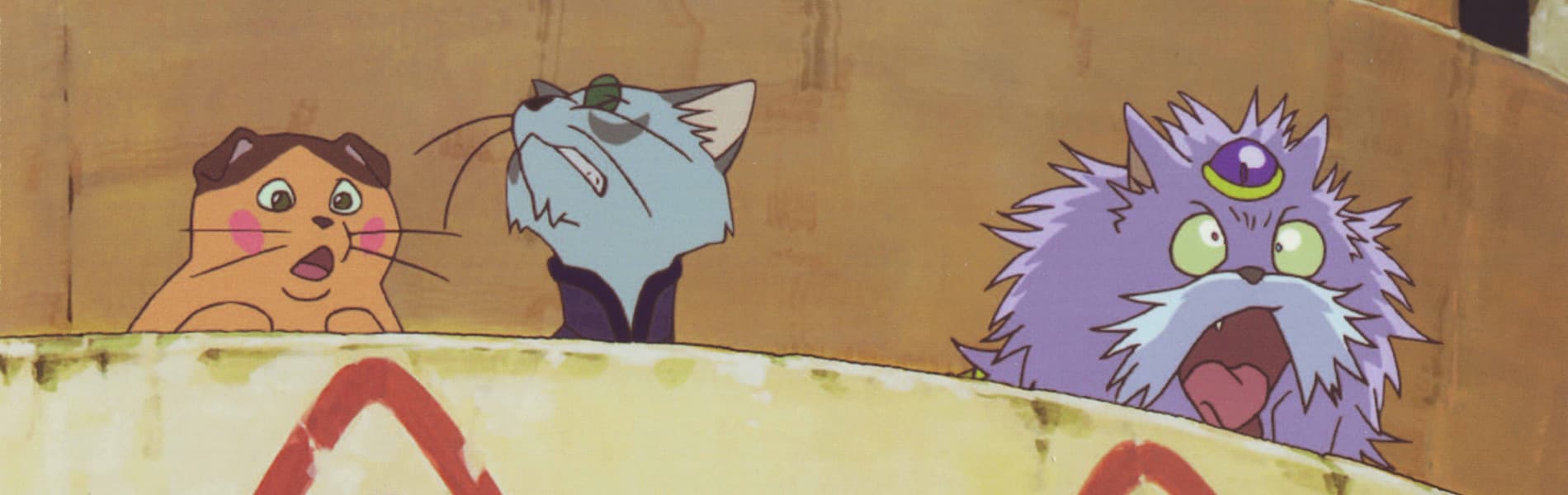
With pretty much any female protagonist in a Ghibli film, they’re going to be a bit on the generic side, but also fairly pretty or fairly cute, depending on their age. The main character Haru does fall into the former camp, but she’s also one of the more interesting leads that the studio has featured, at least in terms of design. It’s hard to say any anime character looks realistic, but she probably looks the most believable in a modern day Japanese setting, somewhat awkward, but still growing into her looks, as we can see the huge difference a simple haircut can make later on in the film. The cats also look believable, which is high praise coming from a cat lover in regard to a movie that was directed by an alleged cat hater. This is how cats should be animated... No CGI, no human faces imposed on fursuits, no digitally removed buttholes.
The music has a folksy quality to it, very easy on the ears, but nothing you’d really seek out afterwards, unless you got a tune like Mutta wo Otte or Neko to Ohanashi stuck in your head. The English dub, as is usally the case with Studio Ghibli films, is almost entirely a celebrity affair, but for the most part, I feel like it works really well here. Unlike a lot of the young starlets that usually get cast as the protagonist of a Ghibli film, Anne Hathaway was both old enough and trained well enough to slot directly into her character. She ranks right up there for me with Kirsten Dunst in Kiki's Delivery Service and Claire Danes in Princess Mononoke as one of the best Ghibli leading ladies, even though her film isn’t anywhere near as grand or dramatically intense as theirs were. Elsewhere in the cast is Carey Elwes, reprising his role as The Baron from Whisper of the Heart, further proving he’s far more suited to playing a smooth-talking, debonair gentleman than whatever the hell he was doing in Porco Rosso.
Kristin Bell plays a small supporting role that I wouldn’t even mention if it wasn’t for the fact that I swear to God I mistook her for Cherami Leigh at first(which is definitely praise). Andy Richter does a great job playing an upbeat middleman for the King, despite the fact that his character was clearly intended to be female, Peter Boyle is a lot of fun in his only ever anime role, and then you have Tim Curry, playing a role so unlike any other Tim Curry performance I can’t help but imagine him muting his mic between each take so they won’t catch him giggling. English Ghibli dubs are usually a mixed bag, and it is true that some of the actors attached to this project are far bigger than the part they played(I’m so sorry Judy Greer) I still really like the way this one turned out. They found some clever workarounds for Japanese wordplay jokes, but it’s otherwise pretty faithful, and I highly recommend checking it out.
When you hear the name Studio Ghibli, what’s the first thing you expect to see? It depends on the director, frankly. From the legendary Hayao Miyazaki himself, you expect magic, artistry, a film that focuses more on visuals and music than story, but still manages to immerse you in another world anyway. From the late Isao Takahata, you expect something a bit more grounded, as his films usually contain some degree of realism, along with a thoughtful message about culture and the environment. From Goro Miyazaki... Well, let’s just not go there. In the hands of Hiroyuki Morita, The Cat Returns doesn’t really deliver on any of this. The visuals are high quality, but they’re not quite as magical as the studio’s other projects. It kind of has a message to it, but it feels like an afterthought. There is an element of the coming-of-age narrative that’s become a hallmark for the studio, but it’s very subtle.
The Cat Returns came out one year after Spirited Away, a film that’s adored by millions(You know exactly how I felt about it) and carried a level of sensation and spectacle that earned it the only Oscar for Best Animated Feature that an anime has ever received, although later Ghibli films would also be nominated. The Cat Returns looks almost quaint in comparison, and it joins films like The Secret World of Arrietty in a very weird spot... It’s not regarded as one of the bad films, like Earthsea and Pom Poko, but it’ s also not considered a hidden gem like Only Yesterday or it’s sister film Whisper of the Heart. The Cat Returns is to Ghibli what A Bug’s Life is for Pixar... It’s a fun, decent movie that a lot of people like, but that you wouldn’t hold up as an example of the studio. As far as critical and commercial success, and cultural relevance, it does feel like one of the lesser Studio Ghibli films.
I know that this is going to sound weird, but in my opinion, all of that works entirely to this film’s advantage.
There is a quality to this film that sets it apart from the rest of the Studio Ghibli catalogue. There’s something it does that makes it work on an entirely different level from the rest of their output, and that spins it’s diminutive status into a selling point. I might be wrong about this, and correct me if I am, but The Cat Returns is quite possibly the only straight up comedy that the studio has ever released. This movie may not thrill you, it might not give you chills, or goosebumps, or the feels, or any of that other media goodness that we all love injecting into our veins, but it will make you laugh from start to finish with it’s surreal imagery, it’s brilliantly casual weirdness and laid back atmosphere that allows you to take it all in without being overwhelmed.
The Cat Returns never takes itself seriously, and it never asks YOU to take it seriously. Rather, it encourages you to approach it the same way Haru does... Bewilderment at first, followed quickly by an understanding that things are the way are, and an eventual willingness to embrace the weirdness around you. Haru’s not the most deep or developed character, but the film is very efficient at letting you know who she is and why you should like her very early on, and the details given during that time tie in flawlessly with her acceptance of the shifting reality around her. She’s quite similar to the unnamed protagonist in Humanity has Declined in her ability to guide you through a bizarre civilization without ever giving the impression that a bunch of sharks are being jumped.
The comic timing is spot on. Certain shifts in environment are delivered with just as much uncanny surrealism as necessary to make the viewer ever so slightly disoriented, just enough to keep us receptive to the journey we’re being taken on. The further we go into the Cat Kingdom, the more sight gags there are on display, to the point that you sometimes have to keep your finger on the pause button to catch them all. There’s always something entrancing, to me at least, about a story that puts animals in the place of humans, but still manages to include animal like behavior in them, so that they’re not entirely anthropomorphized. The story is full of cliches, not only from high school based anime but also medieval fantasy stories, but almost none of it is played straight, rather as an excuse for more feline imagery and cat puns.
It even goes as far as including small plot elements from previous Ghibli films on a very specific level, but never over-relying on them so they stay just below the radar. The two films it borrows the most from are Spirited Away and Whisper of the Heart, both of which are amusing nods for very different reasons, and there’s even a little Kiki’s Delivery Service thrown in there. There is a flying scene, as you’ll find in most Ghibli films, but because this movie can’t play anything straight to save it's life, the characters are literally walking on a flock of birds. Again, this isn’t the film you’re looking for if you want to experience the prestige and grandeur of Studio Ghibli, but if you’re just looking for something fun, unique and creative, you could do a lot worse.
The Cat Returns is available from Gkids, both in DVD, Bluray and steel case forms. The license originally belonged to Disney, which is why there are so many different versions on the market, and also probably the reason that video reviews have been so difficult to come by on any site that takes the copyright goblins seriously. The same is true, on every point, for it’s sister film Whisper of the Heart. There’s also a picture book and manga, but I can’t find much information on either.
I can’t exactly call this one of the great Studio Ghibli movies. Objectively speaking, if I were to rank the top ten best films from their catalogue this one probably wouldn’t make the cut, mostly due to stiff competition on all sides, but what I can say is that I’m glad Ghibli has something like this in their library. With every other Ghibli film either offering an emotional roller coaster or a boring disappointment, The Cat Returns is somewhere in the middle... A chill, laid back, light-hearted comedy that follows it’s own whims, explores it’s own creative vision and just has fun throwing around all possible varieties of cat jokes. It may not be one of the best Ghibli films ever made, but for me, personally? It’s on my top ten.
I give The Cat Returns a 7/10.
26.5 out of 28 users liked this review