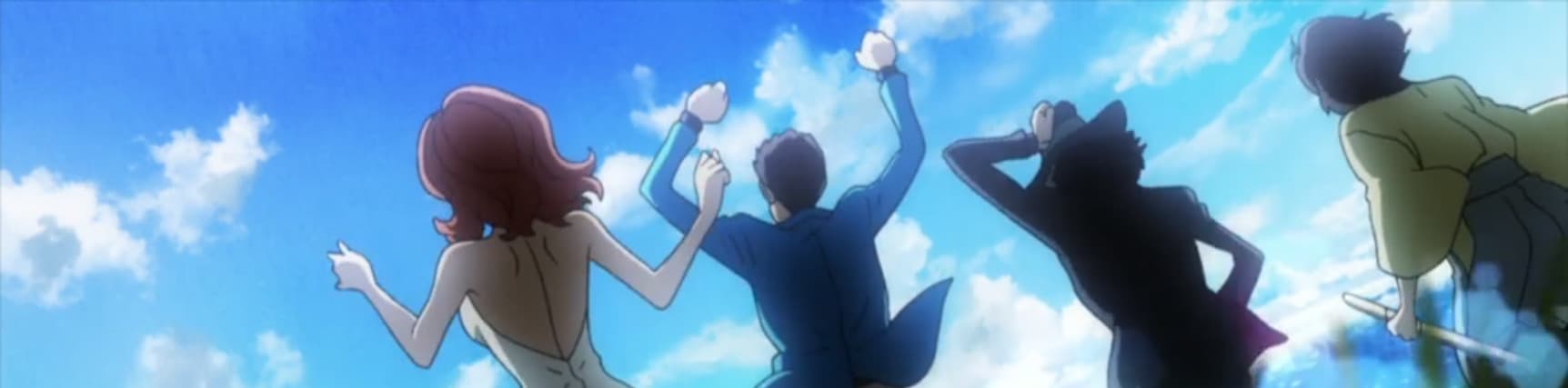

This review is spoiler free.


Have you ever had your opinion of an anime change upon a revisit? That’s the situation I find myself in with “Lupin III: Part V”. This most recent viewing was my third time watching it and I was surprised by how different it felt this time around. Previously I felt that, while it was good, it spent too much time focusing on its narrative it was trying to build at the expense of the character dynamics that drew me in. This was the first Lupin anime that brought me on board to explore the franchise. Not my first Lupin anime, that was “The Castle of Cagliostro”, but it really left me wishing I had more time to spend with the Lupin gang. The second time I watched it my opinion didn’t change, but this most recent time I really found myself appreciating it more than I previously had. There were some aspects of the anime I still wasn’t sold on, but they weren’t as disruptive to the things I did like. And the elements that did work ended up being far more enjoyable than I remembered. If you asked me just a few months ago what I thought about this anime I would have provided a very different response. It’s fascinating how that happens.
Part V aired from April to September of 2018 and was directed by one of the men behind Part IV, Yuichiro Yano. The series composition was provided by Ichiro Okouchi, one of the creators of “Code Geass” with writing credits on anime like “Turn A Gundam”, “Devilman Crybaby”, and one of the best episodes of “Space Dandy”. The setting this time is in France bringing the franchise full circle as Monkey Punch based our Lupin off of Maurice Leblanc’s Arsene Lupin, who is also his grandfather in canon. The structure for this series is different this time around. Here we have four mini arcs, as I describe them, which eventually tie into each other leading to a consistent narrative. However, in between these mini arcs are multiple episodes that don’t actually tie into those stories. I enjoy this about Part V, the episodic nature is something I don’t want the franchise to abandon. The first mini arc is what I call the Lupin Game arc. This is about Lupin stealing money off of the deep web and rescuing a young, captive hacker named Ami Enan while the people he stole from create the viral Lupin Game to bring him down. The rules of the game are simple, photograph and document Lupin and his friends and post your findings to social media. This leads to Lupin being in a situation where anyone with a smart phone has become a photo journalist and can leak his whereabouts to Zenigata and anyone out for his head. Our second mini arc is about a man from Lupin’s past named Albert d’Andresy and a political conspiracy concerning a book with information on various crimes and scandals covered up by the French government. The third mini arc is about Ami and her schoolmate, Princess Dolma of the Padar kingdom. The girls are kidnapped and caught up in a political conflict concerning Padar traditionalists and reformists while Fujiko and Lupin are in pursuit of Dolma’s family heirloom, a necklace called The Bloody Teardrop. The final mini arc is about a new app called PeopleLog created by Enzo Bron, the president of the multimedia conglomerate Shake Hanz. Through various AI and facial recognition the app can determine and post a vast and invasive amount of information on a person and make it all public. With just the snap of Lupin’s picture he is once again incapable of hiding.

One of the first things that allows Part V to stand out is how it embraces technology. Considering how old the franchise is many were surprised to see them go this route. The first episode of this anime sets it up that you’re going to see the internet and technology play a role and it’s honestly the best opening episode to any Lupin anime we’ve had so far. There’s so much energy within it and it establishes the tone and nature of this anime perfectly. Not only is Lupin using a smartphone and advanced tech like his monocle, but various aspects of the anime are derived from this modern social media culture. In the Lupin Game arc we see Ami discuss how growing up secluded and consumed by technology and coding led to her possessing different values. Within the same arc we see Lupin use his wits to take advantage of social media and outsmart the people who think they’re in control of the situation. The PeopleLog arc asks questions about privacy in the internet age and how much damage that could bring to society. And on a more lighthearted note there was a running gag where Goemon struggles with basic technology and it consistently made me smile. The man who once boasted he was “the only normal Japanese person” because he rejected modernity and westernization, brought to his knees because he couldn’t open Lupin’s text message. A small, but very appreciated touch, was the user name Lupin adopts. He goes by Monkey Python, what a great twit. I like that you can see things like this all throughout the anime and that it wasn’t mere window dressing. While the anime isn’t trying to tell the most realistic or even nuanced stories on this subject, it does have very interesting and engaging stories built around it. And it isn’t going to leave you with the same feeling you get when an old person complains about the kids these days.


Something else that really won me over with Part V is how it pays tribute to the franchise’s history. Most notably there are episodes littered throughout the anime where Lupin and his friends wear their color schemes from the previous eras while the writers have fun paying homage to those anime. They even go so far as to have the characters behave the way they did in those versions even if it isn’t how this incarnation of Lupin generally acts. The pink jacket episode is great, it’s hilarious seeing these Showa era gags in something so recent. The premise of a safe that requires Lupin literally dumbing himself down is the epitome of wacky and I applaud that. The red jacket episode about the treasure trove of cars feels right at home with that anime, right down to the strange supernatural element that goes unexplained as if it doesn’t matter. The green jacket episode where an old woman tasks Lupin with determining which dinner guest murdered her husband is a personal favorite of mine. Lupin’s written in this episode in a way that really captures the unique charm Miyazaki and Takahata helped give him and it was refreshing to see him work alone. What’s most impressive to me is that none of this closes the anime off to just the seasoned fans. The anime has so many Easter eggs and references to past installments, even “Mystery of Mamo” got a shout out, but it’s handled in a way where it won’t cripple a newcomer’s experience. This anime does feel designed with preexisting fans in mind, but they understood to play it a certain way so someone unfamiliar can enjoy it too. I wasn’t very acquainted with Lupin when I first saw this and I didn’t feel lost in the slightest. Now that I have gone further into the franchise I find there to be new discoveries in part V. I couldn’t hold back my joy when I saw green jacket Lupin and Goemon sitting on the ground laughing like they did in the first series. I also appreciated seeing Deca Melon again, the callback to the Shiranami Five episode, and the person at the airport holding a sign for Yuji Ohno. I’m rather amazed at how much rewatch value lies within this anime and its partly because of how well they wove these references in.

Like in Part IV this anime brings us some new characters that we see throughout the show. I’ll start with our computer genius Ami, voiced by Inori Minase. I’m going to get to the point, I have never been keen on this character. I don’t find her deadpan personality very appealing and the anime’s attempts at making her seem like a social misfit don’t work. They should have had her years of isolation lead to her lacking the social graces to make many friends, instead it’s that other girls are creeped out by her being a hacker. And like several other female characters in this franchise, she develops feelings for Lupin. The thing about that is she approaches everything with a highly logical eye, something Lupin says you can’t do with emotions like love, and it almost feels like she’s misunderstanding her feelings. She confesses to him in a way that makes it sound more like she admires him or he simply puts her mind at ease, but it’s supposed to be romantic attraction. She even tells him she’ll be a better woman than Fujiko once she’s older and I’ve never found this one sided love triangle well executed, but we’ll get to that. Albert meanwhile was a great addition to the cast. He’s voiced by Kenjiro Tsuda and there’s something to his gravelly voice that loans itself well to the anime. Some modern seiyuu I just can’t see fitting in with this world, but Tsuda does. Albert and Lupin have a history between them where they were once rival thieves until Albert left to go work a government job with the intentions of controlling France. Usually when the franchise tries to dive into Lupin’s personal history it’s hit or miss, this I’d consider among the good ones. I liked the flashbacks to Lupin before he met Jigen and the way he and Albert worked off each other felt right. It didn’t feel forced and it definitely didn’t feel like we kept this character around for no good reason like what happened in Part IV with Nix. We have another new character, Zenigata’s partner Yata voiced by Nobunaga Shimazaki. This character doesn’t actually do much. I feel like I need to acknowledge him because he was a new addition, one that’s being kept around for the upcoming Part VI like Albert, but at the same time I question why he exists. I would say he was created to give Zeniagata someone to talk to, but this wasn’t an issue before. Aside from a scene near the end where he addresses why Zenigata was assigned the Lupin case and the issues it caused him I really don’t think he added much. Hopefully in the future he’s given more to do because right now you could write him out of Part V and little would change.

As far as our main characters go I think this anime improved on my criticisms from Part IV. I feel like the time spent with them is distributed more evenly and Goemon ends up playing a critical role in the climax. I’ve seen people who don’t like the way this anime tries to break down the way Lupin relates to his friends, but I think it works. Because the franchise doesn’t have a strict canon I find myself accepting each version as its own entity. Granted this anime does refer back to events from previous versions, however I don’t see this as a coherent timeline spanning across every anime like how Universal Century “Gundam” is supposed to operate. And as a result of this I can accept that in this version we’re going to see characters like Fujiko and Goemon question where they fit into Lupin’s life. In one of the earlier episodes there’s a scene where Ami mentions how Lupin doesn’t appear to take care of the things he possesses which serves as nice foreshadowing to this conflict. It didn’t swallow the anime up though, we built up to it for when we needed it to matter most. And along the way we still get to see those fun dynamics we know and love. Again, this anime made me pursue the franchise because I really enjoyed the character driven moments. Small things like Jigen stealing Lupin’s venison, Zenigata entering their apartment because he smelled Goemon’s miso soup and wanted some, Lupin giving Goemon a hair ribbon so he can disguise himself as his granddaughter, Fujiko mocking Jigen for always wearing the same suit which leads to him pointing out this is the summer version of it, Fujiko and Jigen smiling at each other in the pink jacket episode, these are the types of scenes that help give the characters their personality and the anime its charm.

So among my issues with this on past viewings was what the anime chooses to do between Lupin and Fujiko. They decided at some point to have the two of them try dating and be broken up in this series. My issue with this is I just found myself wishing we saw their relationship instead. Fujiko is still seen often in the anime, it isn’t an issue of screen time. It’s that instead of seeing Ami admonish Fujiko for breaking up with Lupin for several episodes I’d rather have seen them be an item. That Padar mini arc is one where Ami’s the main focus and she spends a lot of time with Fujiko, but I wish that wasn’t the case as her perspective on Fujiko throughout is colored by jealousy and very unflattering as a result. Considering its obvious Ami was never going to pose a romantic threat it just makes watching her chastise Fujiko and blush over seeing Lupin shirtless quite annoying. Of the four mini arcs this is my least favorite and the frustrating part is there is an easy fix to it. I think I would have enjoyed the arc more if Fujiko served as the main character, I wish they did that even if I still had to endure all of Ami’s awkwardness. However, I understand this anime wanted to keep Fujiko fairly mysterious. In some ways this breakup arc feels like a twist on the questionable loyalty she had towards Lupin in the past, you are left asking what she’s playing at. But then you get moments that show what their relationship was like and it all just feels like a missed opportunity. This doesn’t ruin the anime for me, but I do find myself asking “what if”.

In terms of the audio visual department, this is fantastic. You should know by now I love Yuji Ohno and what he brings to each anime. I strongly recommend listening to the two soundtracks, “Lupin III Part V: Si Bon! Si Bon!” and “The Other Side of Lupin III Part V”, because the music in this series is marvelous. The version of the main series theme that we get here is among my favorites. It’s a beautiful arrangement that, once again, captures the essence of Lupin as a character and an anime. The version of “Magnum Dance” that plays during episode 19 made me light up the second I heard it. It really speaks to the timelessness of his music that it still feels fresh after all this time. I also love these versions of “Love in Sao Paulo”, “Dangerous Zone”, and “Love is Everything”. Tracks like “Crafty Girl” and “Happy Flight Boogie” also deserve mentions. Once again, I am not a musician and don’t understand the complexities of jazz, but I can tell Ohno is a man who delivers every time. Our closing song this time is actually sung by Fujiko’s seiyuu, Miyuki Sawashiro. It’s called “Seine no Kaze ni… (Adieu)” and I never realized what a good singer she is. The song feels very relaxed compared to the bombast of Part IV’s closing number, but in between the sensual visuals animated by our friend Kazuhide Tomonaga and Sawashiro’s voice it makes for one of the most memorable in the franchise. Visually the anime is stunning. It is similar to Part IV’s aesthetic, but instead of that sketchy quality its cleaner. I think both animation styles have merit and suit the stories they were telling. The character designs for the most part are unchanged, except with Fujiko and Goemon. Fujiko has auburn curls, which reminds me of her original 1971 design, and Goemon looks closer to his original counterpart as well. I honestly prefer their designs in this anime to Part IV. I know I praised Fujiko’s design in the last one, and I do love it, but in this anime she has this perfect balance of sex appeal, beauty, and cuteness going on. And this is one of my favorite designs Goemon has had, I want to embrace him. The new characters like Ami, Albert, and Yata look good too. I don’t think they are designed too modern to work with these older characters. TMS doesn’t appear to be a studio known for their visuals, but they really bring the heat with Lupin when they want to.

Every now and then I look back on this franchise and just can’t help but feel a sense of awe. It all started as a manga that Monkey Punch never intended on fully committing to. It was just something he was supposed to make for a few months and then move on. The first TV series was plagued with production issues and low ratings only to be cancelled. And look at it all now. We’re moving towards Part VI and into Lupin’s fifth decade in anime. I can’t help but believe that “Lupin III” beat the odds when everything seemed to be working against it, not unlike the titular character’s own adventures. When it comes to long running franchises people tend to have this idea that they’re only being kept around for a sense of nostalgia or tradition, but I do believe Lupin exists because there is still potential within it. Monkey Punch once spoke of how Lupin and Zenigata could chase each other forever after all. TMS picked it up to make the “Pilot Film” in 1969 for a reason and they’ve continued to keep it alive for a reason. Even with Monkey Punch no longer being with us to provide new stories we are still seeing people create new things with his characters. While I don’t think every Lupin anime is a masterpiece, there are still ones I don’t like and ones I found mediocre, it also doesn’t really matter that those exist. Lupin isn’t defined by his weaker entries when there is so much more that he offers us. Whether it’s the gritty Takeshi Koike films or the sophistication of “Cagliostro” or the TV shows there is plenty to see. My opinion on Part V has evolved through the years, but that’s just part of being a consumer sometimes. What matters to me is I now realize and appreciate all that Part V has done. Not only are experienced fans going to gain something from it, but so are new fans. You don’t even need to see Part IV to enjoy Part V the way it is. Some people did get into the franchise through this anime, myself included, and that alone makes it a success in my eyes. I don’t know where the franchise is heading from here, but I am happy to keep chasing Lupin and see where he takes me.