BELLE
a review by bitchassdarius
a review by bitchassdarius
I’ve been nursing a pet theory for a while now, and after listening to the post-film screening discussions of my fellow moviegoers while walking out of the theatre, I feel a bit more confident in this theory. You see, we Americans are an untrusting breed, skeptical of anything bigger than the Individual. Because, naturally, Americans are Rugged Individuals, for better or for worse, and large, organized groups—be it the government, Big Tech, or Costco—only serve to impede and restrict the Freedom of the Individual™. Don’t tread on me, Big Weed!
This political paranoia has fueled our obsession with dystopias and imagining the worst version of the future in fiction. Hence, our perennial love for cyberpunk. Almost two decades have elapsed since the end of The Matrix trilogy, yet we still crave Keanu Reeves in both a sequel and an entirely separate cyberpunk video game. The criticisms I heard as I walked out of the showing of Belle about the film’s dubious optimism and the squandered opportunity to lambaste the social media age (the phrasing I heard followed along the lines of “I was expecting a dystopia…”) only seem appropriate in this context. At Variety, David Ehrlich describes Mamoru Hosoda’s latest as “‘Beauty and the Beast’ Meets ‘The Matrix’”, and while I disagree with the intent of that “just two things” synthesis, it actually demonstrates precisely my thoughts on the film. In a way. Belle is no The Matrix, and D*sney + cyberpunk seems absurd and oxymoronic in the Western paranoiac environment. Now, just what is my theory? How is that related to all this? Let’s start from the beginning.
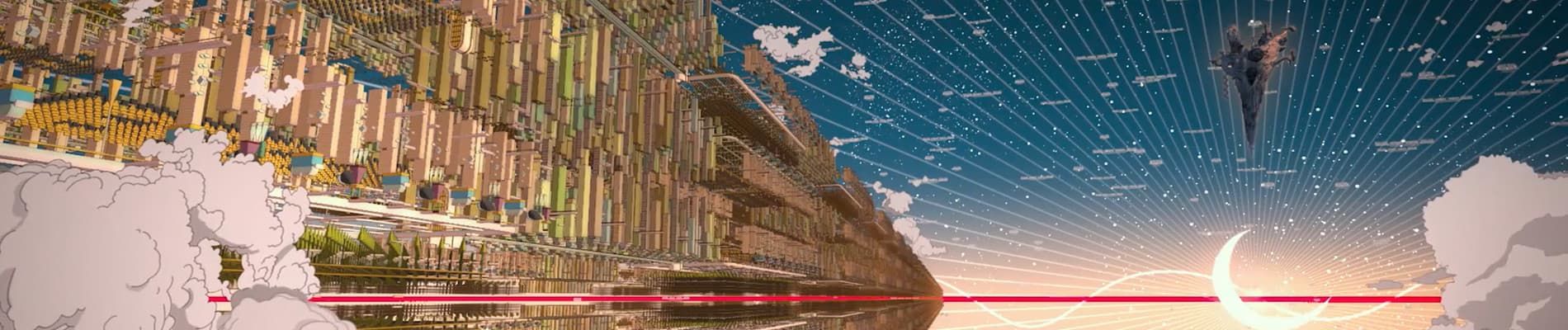
Belle almost feels like the final entry in a film cycle Hosoda has been working on throughout his career about digital dimensions and their effects on/interactions with their real counterparts. The story centers around Suzu, a plain Jane teenager living out in the sticks of Kōchi, and her secret dual life as Belle, the most famous singer of the virtual world known as “U”. U is sort of like a full dive VR Second Life in which player avatars are somehow based on the player’s physical and mental compositions. It also boasts an international user base that's quite sizeable, so much so that the happenings in U are able to make waves in the real world, which we see in the first sequence. The film opens with a parade reminiscent of the parade from Ghost in the Shell 2, except instead of evoking a celestial otherworldliness that prods the boundaries of reality, this scene shows our protagonist as her internet alter ego performing on top of a space whale to an audience that could fill multiple stadiums. No, this isn’t Hannah Montana, nor is it the dystopian critique you might expect from such a setup. In contrast to Digimon and Summer Wars, Belle elects a more positive approach to online social interaction.


The virtual world is animated entirely in (quite good) 3D. 3D was a choice obviously made to emphasize the separation of virtual and real, but there’s an added benefit in having two separate styles of animation. Note how much Belle resembles Disney 3D designs like Rapunzel from Tangled and Elsa from Frozen as opposed to more familiar 3D anime designs. Visually distinguishing the two worlds allows for variance in art, specifically in the character design, and Hosoda goes all the way in pursuing the Disney style in the virtual world.
Earlier, I mentioned David Ehrlich’s description, and with respect to the “Beauty and the Beast” part, he’s not wrong. In fact, large swaths of the story that develops in U (even entire scenes) are cribbed directly from the Disney version of the French fairy tale. From the names of the characters (obviously Belle = Belle; Ryuu is usually referred to simply as Beast; and Justin sounds an awful lot like Gaston…) to the setting (Beast’s grand, decrepit castle is reconstructed in U, replete with a ballroom for the emotional musical scene), the Disney aping is entirely with purpose, as Hosoda does indeed seem to be attempting to fashion his own Disney movie. The question is: Is this a noble pursuit? Enter my theory.
Japan is no stranger to cyberpunk, as anime fans are typically well aware. Ghost in the Shell, Serial Experiments Lain, Akira: this genre flourished in the aftermath of the bubble economy and its hyperconsumerism and reflected sentiments of unease and fear common to Lost Decade. But the year is 2021. We have seen more than a decade of Vocaloid and virtual idols, and now, in the age of the VTuber, it seems Japan has shed much of its cultural distrust of the internet. Yes, Ghost in the Shell and Psycho-Pass are franchises that are still kicking; yes, the story of Rorochan_1999 is one that has perplexed and resonated with people worldwide; yes, the Japanese government considered banning TikTok as a potential international security concern. But this may be indicative of a different, less suspicious understanding of technology. Japanese society has been and continues to be exposed to the horrors that can occur in the Information Age. Yet it had already subsumed some of those cyber anxieties long ago, resulting in a culture in which nearly half a million people livestreamed an anime dragon-girl's graduation from virtual idoldom and harsh noise legends made four different albums with Hatsune Miku.
My fellow moviegoers, you were right to point out that Belle’s resolution is “kinda whack.” From the Crash(2004)-esque hammy and absurd stare down scene to the epitaph of “You can be anything you want to be” scrawled across the final shot, the final act reeks of insincerity and unrealism completely perpendicular to the tenets of cyberpunk. But that thin veneer of positivity is also a hallmark of Disney movies, and like Disney movies, Belle has many moments of grandeur and swelling emotion that can compete with the best of them, even if you walk away with a bit of a shallow aftertaste. Scenes, like when the main characters virtually interview random U users to learn more about the person behind Ryuu's avatar and are met with very little hostility, come off as slightly strange, not quite right. There are also moments of clarity that acknowledge the downsides of online interaction, like when Belle is met with skepticism and accusations of fraud after her first performance in U, or the scene portraying one of the characters using creepy internet stalker methods to track a U user's physical location (albeit for a good cause). When Hosoda reappropriates Disney, he does it to tell a heartfelt story about people making genuine human connections through the internet. It's a kind of story that's rare in the West, one that would probably be slighted with acerbic cynicism on contact. I can see why Belle would turn some people off. Me? I liked it.
90 out of 100 users liked this review
