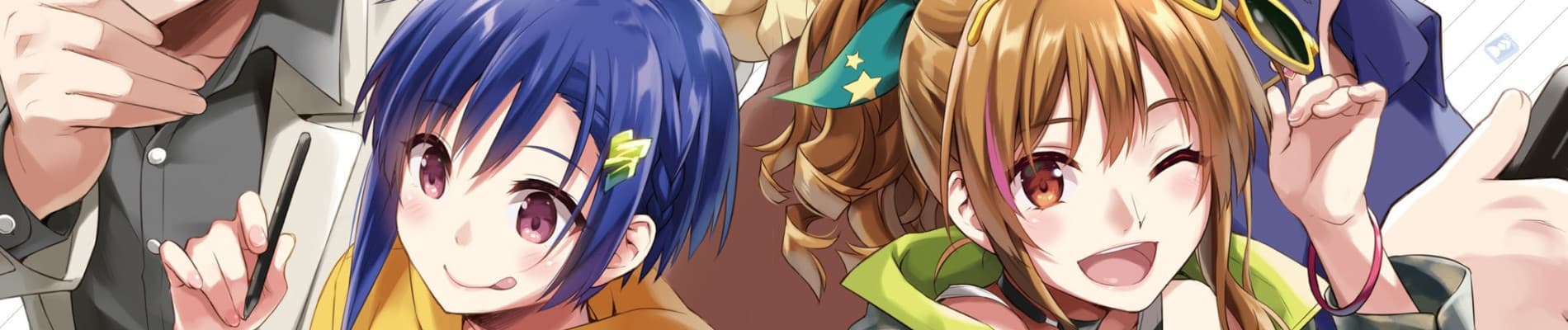
Remake Our Life!
a review by ZNote
a review by ZNote
SPOILER-FREE!
It’s perhaps one for the biggest clichés in all of drama – what if I had done this instead of that? What if I had taken path B rather than path A? Part of the reason why we find this such a compelling device for storytelling is because our own lives are fueled by the numerous decisions we make, both in and outside our control. So, when a narrative presents its characters with the opportunity to go back in time and take a new approach, or try to fix something, it plays upon that nagging question that has lingered in our minds every once in a while when we’ve reflected on something. After all, we cannot rewind the clock in reality, so fiction affords us the chance to see the possibility exercised for dramatic purposes.
Remake Our Life! was the summer 2021 anime season’s newest take on the do-over story. Considering that it relies on the old cliché I spoke of, it already has a lot that it needs to accomplish. The time travel needs to feel justified, and the ensuing drama that happens from the resulting changes needs to come across the same way. But the overall setting and premise caught my attention more than anything else; especially as someone who teaches in the arts, I wanted to see what the series could potentially bring as far as working in the arts was concerned.
Hashiba Kyouya is a former salaryman turned video game development worker who thoroughly hates his job, regretful of his decision not to attend an arts college like the so-called Platinum Generation creators he looks up to. He one evening chances upon a woman who also works in game development, Kawasegawa Eiko, and lands himself a new job. Despite getting off to a good start, their project is cancelled and he once again enters a melancholy. He awakens shortly thereafter ten years in the past, taking the opportunity to attend arts college instead of what he did before. While taking his life in this new direction, he becomes classmates and sharehouse mates with Shino Aki, Kogure Nanako, and Rokuonji Tsurayuki, the three Platinum Generation artists he adored. Kawasegawa herself is also a student at the school during this period of time. The artists face an uncertain future, but Kyouya comes armed with the foreknowledge of what each of them is capable of.
While Kyouya may be the main focus of the narrative, the other three members of the house, as well as the group of four as a whole, need to function together well in order to carry the story. Kyouya is unfortunately the most uninteresting of the main characters, in part because there aren’t any particularly-noteworthy aspects to his character, be it through quirks or some other element that gives his personality some kind of spice. As the de facto leader of the four during the college years, he ironically is the one who has least amount of fleshing out. To an extent, this is slightly understandable; since his entire perspective zeroes in on idolizing the Platinum Generation-to-be members, he stands as a kind of everyman in their wake. There’s nothing noteworthy about him, but he’s not intended to be the noteworthy focus of the narrative. That said, the fact that he comes from the future, in essence, IS his trait, but as a quality that makes him stand out on his own, it does not contribute much in the way of endearing himself to us.
But where Kyouya’s characterization falters, the other three manage to develop more effectively. Working on an artistic project is a form of sharing, but as a result, having your work be cut down or told that it’s not good enough because of various constraints can be absolutely brutal to handle. Remake Our Life! shows each of the main characters having their artistic pursuits getting questioned, flat-out rejected, or their moods demoralized, and does so in ways that are believably practical; the entire premise is set up on Kyouya’s ambitions to work in game development getting crushed, and the other three Platinum Generation characters all have moments in the show where they find themselves up against the wall. Whether that wall be their own hang-ups, mistakes, or whatever needs the project they’re working on calls for, it makes for good drama. Seeing them pick themselves back up after getting knocked down is cathartic. And when their endeavors do get completed, there is a satisfaction that comes with it. One such event includes an overt nod to one of the most-famous musical sequences in all of anime, which feels appropriate given that the past segments of the show take place in the mid-2000s.
Kyouya’s knowledge of the future that he brings with him, both who the Platinum Generation members will eventually become and his own expertise in his area, also contributes a fascinating aspect to the group’s dynamic. Since he is working with years of organizational experience, he intuitively is able to think on his feet and evaluate the numerous properties that go into artistic endeavors. So, when problems begin to manifest that the other members of the group aren’t prepared for or anticipate, he often acts as the idea house or lifeboat that keeps whatever it was they were working on afloat. It also gives his interactions with the other group members, along with others at the college, a kind of relentlessness that one could find quite admirable.
But it is because of that relentlessness that makes the show get a little too close to harem territory, which intrudes itself into the show’s strengths. It’s not necessarily because it’s unreasonable; the romance element develops through the characters working and living together, and Kyouya’s seemingly-boundless belief in them acts as a beacon of light in the Platinum Generation’s crisis moments. Getting attracted to someone who has that kind of faith in you is, naturally, something one could expect. The problem rests in the fact that it begins to come at the price of focusing on the art creation aspect of the story. The drama works most effectively when we ourselves see and hear what it is that made Kyouya look up to the Platinum Generation, being given an “as it happened” glimpse into the fruits of their labor. That’s not to say the series cannot have romance, but that given how short the show is, it oversteps itself. By putting too much stock into romance, and especially among the women, it takes away from those creative opportunities. The show is divided between two paths and struggles to unite them.
Those opportunities are only possible thanks to the time jump to the past. While they are one of the primary vehicles for setting up the drama within the show, they’re also part of a weakness with Remake Our Life! Because the time jumps themselves span upwards of ten years or more, it means there’s a lot of history of the characters, events, and dialogues that we are not privy to. It is appropriately disorienting for Kyouya as he tries to get his bearings each time it happens, it unfortunately means that certain events that should have transpired on-screen ultimately don’t, not even in flashback. Even though Kyouya is the main character that the drama follows, allowing the audience to see flashbacks through the eyes of the other characters could have helped tremendously. Especially considering that they are seemingly not aware of any time-travel shenanigans that have taken place, possibly having some gaps filled in, even if Kyouya himself would not be privy to witnessing or remembering them, was certainly possible.
This problem of not showing particular events is also true for one of the show’s final pushes towards the end; the day of release for a product is not shown. At a moment where Kyouya is at his lowest, he witnesses a video from Nanako that ultimately gives him the inner motivation and fire to try and rectify the overarching problem he’s facing. Although this is framed as a moment where the momentum of the drama turns, we don’t actually get to see or listen to the video in full. It didn’t have to be a full-fledged three-minute masterpiece, but even listening to the provided song for, say, 30 seconds could have made the affect of the moment land with more panache. These pacing issues ultimately make Remake Our Life! feel like the latest victim of the single-season curse, of trying to get as much as possible into the twelve episodes that it comes at the cost of dramatic or thematic coherence.
Remake Our Life! has vestiges of being a particularly-good series, but cannot quite capitalize upon what’s there. The exploration of pursuing an artistic endeavor, especially in the wake of business or school, unfortunately gets a little too bogged down by the romantic element with all of the female characters. It’s well-animated and well voice-acted, and the Platinum Generation characters were a lot of fun, even if the pacing tends to move too disjointedly. If it had been perhaps sixteen episodes instead of twelve, I think quite a number of these issues could have been minimized, or happened more organically. For what we actually got, I still somewhat liked it even though it had flaws. The story managed to get the job done – just not as cleanly as it aspired to. If it ever does get a second season, and there has been no announcement about that at the time of this recording, I’ll give it a consideration.
25 out of 29 users liked this review
