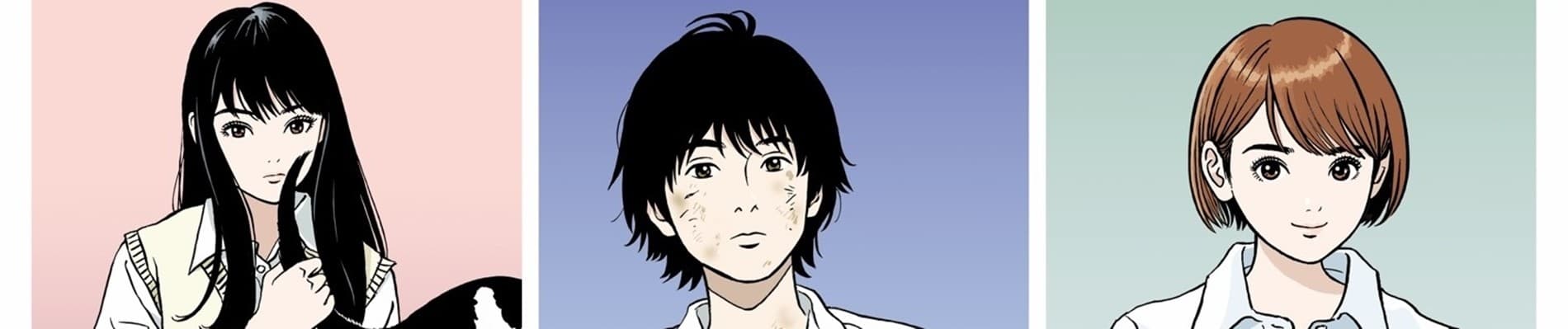
Sonny Boy
a review by BeatleJews
a review by BeatleJews

Trying to make sense out this show is quite frankly one of the most intense challenges to my intellect I have ever received from any anime, movie or whatever work of art. However, there’s a certain charm to this show that keeps dragging me in like an angler fish luring its next prey into the depths of the ocean. Sonny Boy is a show that ever since it started airing has been compared to other works of literature, namely The Lord of the Flies, taking in consideration how the apparently simple premise of a group of people in isolation paves the way to a game of survival in which the union of forces seems like the only way out of the predicament. I can see why people would make this assumption and expect the show to develop a certain way until the very end. However, these same people are in for a trip involving deep sociological, philosophical and, hell, even religious themes brushed upon on this 12 episode long show, that, if it had strived for a more mainstream audience maybe wouldn’t have garnered as much interest from me as from many others that keep finding themselves intrigued with Sonny Boy.
I would be lying if I said that I understand every single detail about the logic and rules that are thrown at our faces on almost every episode. To be honest, I find that this constant inclusion of cryptic and dense “lore” in addition to an already intricate train of events can work to the detriment of the show. Being a show so avant-garde, trying to make sense of the singular events and how are interconnected to make it a cohesive whole in the mind of the audience is a task that can be next to impossible. But then again, maybe the whole point of the show is not to try and make sense of this world of chaos our characters find themselves adrift in. All this said, I’d like to maybe point out the larger themes that stick out to me and the ones that drive the whole narrative of the show in my opinion. Please note that all of these statements I’m about to make are nothing but opinions and conjectures aimed at making sense of this absolute mindfuck. I do not pretend to make a review stating what this show is trying to convey objectively speaking, these are only my opinions and you are free to agree with them or not.
Moving on in the events of the show (or during the rest of the first half for that matter) we keep observing the development of the theme of social hierarchy and how to the rule of the majority tends to treat all the outcasts, and people that decide to go against the current. Sonny Boy doesn’t even shy away from treating this whole dynamic of social order and adapt it to the world of religion. You may remember that I said Hoshi has the power to listen to the voice of god; and gives foundation to his leadership almost exclusively on this fact, assuring the rest of the students that as long as they follow his lead, they will be kept safe. It would be safe to say that Hoshi is playing the role of a Messiah that is working towards the salvation of his people.
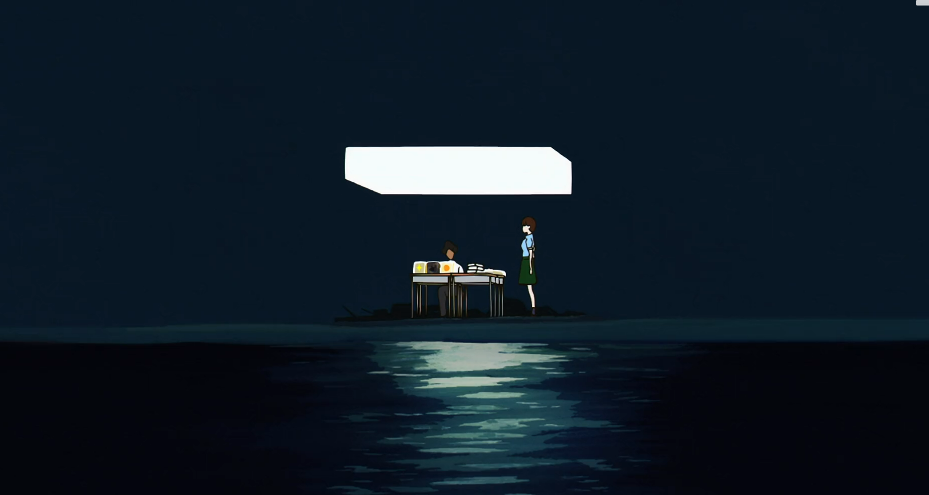
Sonny Boy more or less keeps this thematic train going during most of the first half of the show. We can see how with some differences among them, they are trying their best to get out of their situation and finally return to their home, reality, their world. However, we can also see the deepening gap between the real objectives of this two factions. As in: basically all of the students versus Nagara, Mizuho, Nozomi and Rajdani. Episode 6 brings this entire situation to a head when Nagara and company finally “find” a feasible way to return to their world much to the amusement of the rest of the students led by Hoshi. Hoshi, playing the role of messiah that he is, tries to convince Nagara and the rest, that resisting what has already being written was futile and it was a better to just let themselves be guided by their fate. Nagara, with the support of his friends defends his plan by saying that passively playing along just because the future is already set in stone was no reason to stop trying to make a change; that is, to appeal to the roll of the dice that is the concept of fate/destiny. This mid-season finale brings to the table some major plot twists about the true nature of our cast being sent adrift, lest we forget, with the accustomed metaphorical screenwriting.
The second of half of this show is where most of the audience, including myself, start scratching our heads bald; and with good reason. This second half can only be described as more artistically personal, with many self-condensed vignettes, through the use of religious references like the Tower of Babel, the philosophical concept of the duality of human consciousness and lastly the chaotic nature of life. I am aware that all these big words can even pass off as pretentious or “too deep for you”, and, to a certain extent; they are. However, this is the part where the subjective tastes of the viewer come into play. I personally find the narrative of these entire show to be a breath of fresh air to the anime industry, even though I can understand why people will find this anime to be a senseless mashup of avant-garde trash. But I digress.
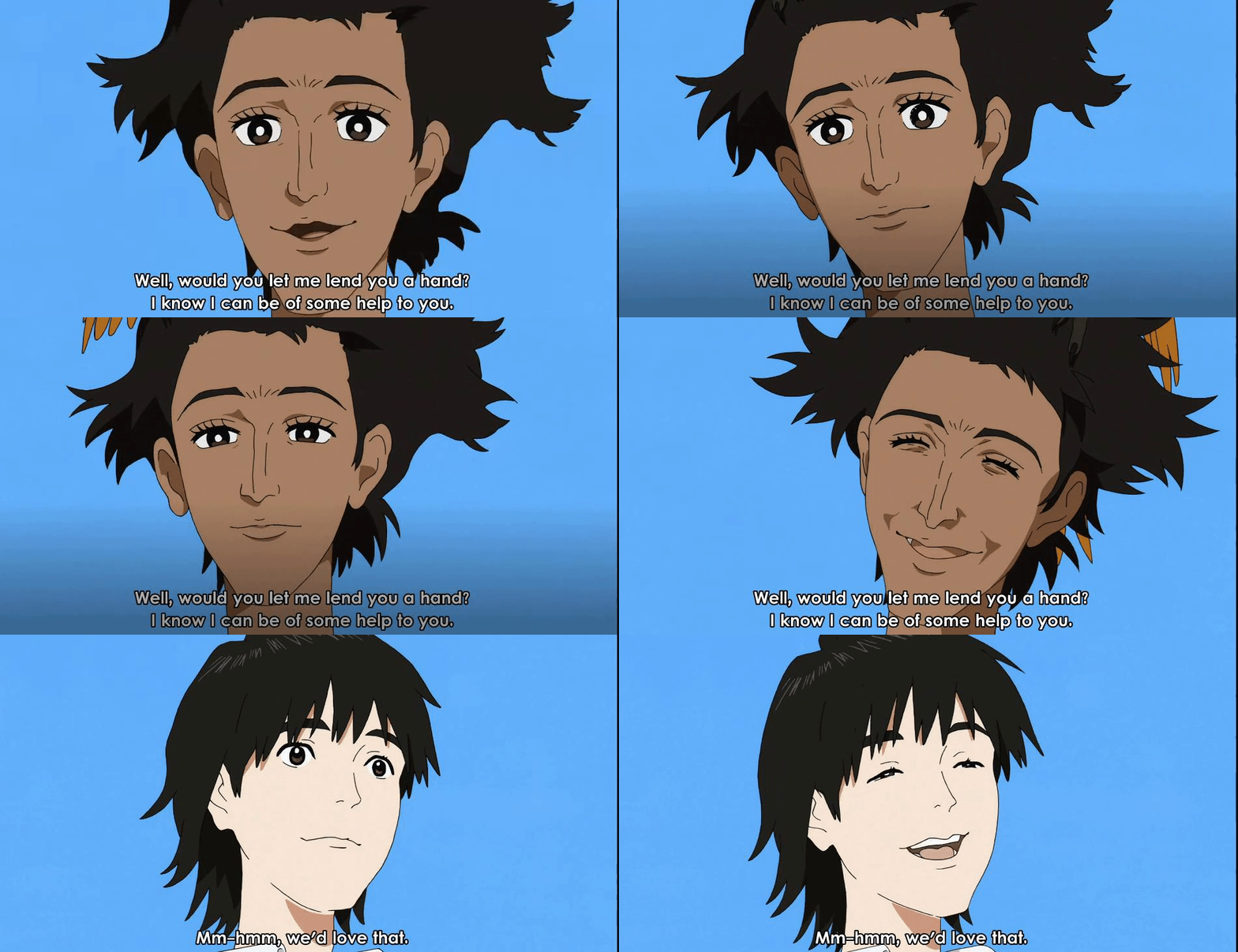
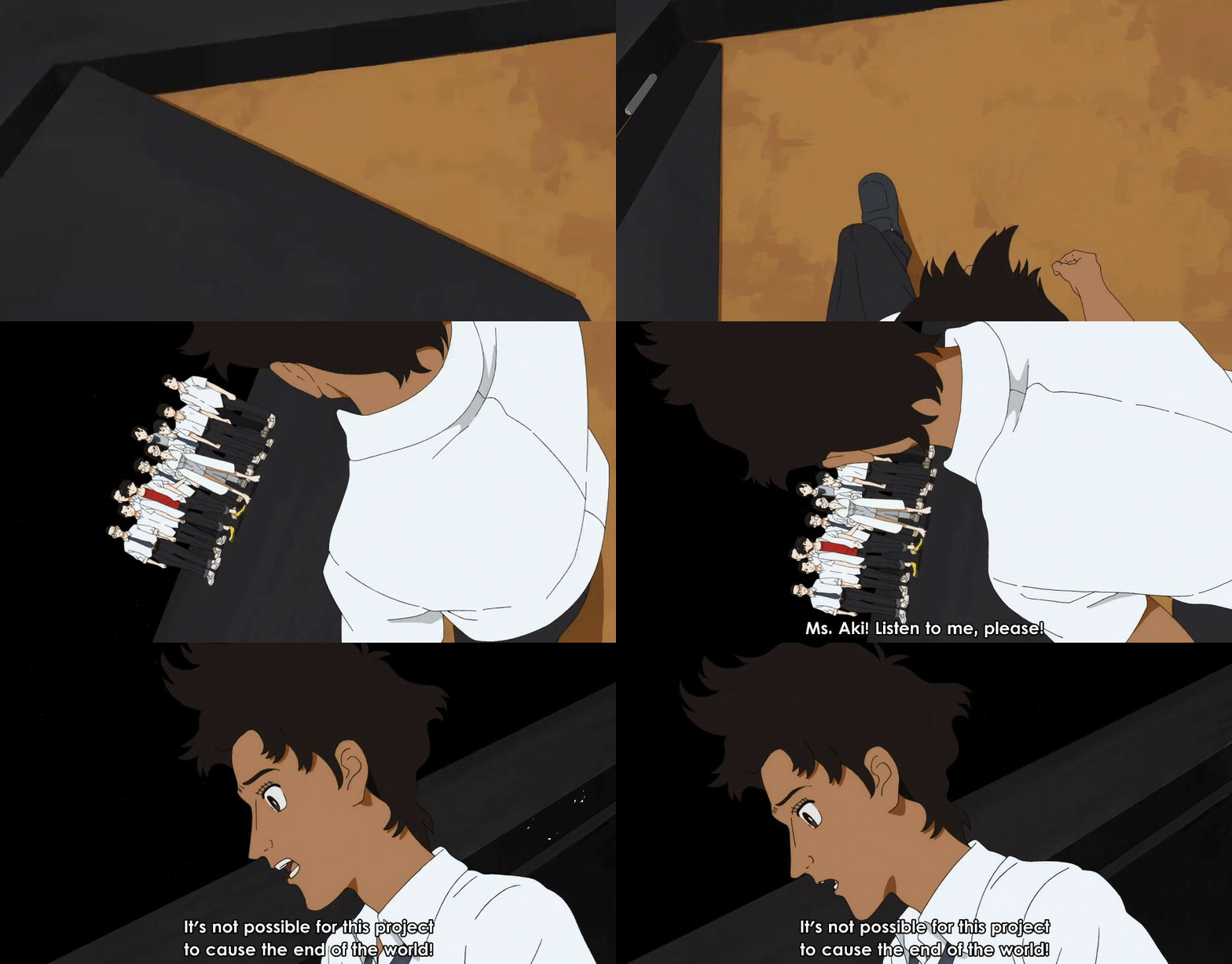
Skipping a little ahead to the final episodes of the show, I think I could make up what could perhaps be one of the core messages of the show: The concept of life never has and never will have an implicit meaning or value to it, the role of giving it a meaning, a purpose to our lives, and, by extension, our chaotic world; depends exclusively on the individual. Rajdani as the MVP and class-A chad that he is puts this very succinctly on episode 11 just before Nagara along with Mizuho are about to return to their world. The way I came to this conclusion and the reason I think this major theme ties in nicely to the rest of the show goes as follows: Nagara is the focal point to this, as he clearly is a character that lacks a “north” in his life, walking along lacking a purpose, a road to follow. We can see how deep down he feels anxiety about this fact, but at the same time not doing a single thing to break through. This feeling of despair and apathy is what metaphorically speaking sets him adrift, in a world ruled by the nonsensical. This is the part where the sociological themes of the first half start making sense, at least to me. You see, a major part of how societies work comes from giving each individual member a reason to be, a goal to strife for. Nevertheless, the issue with this, as the show tries to explain, especially in the Tower of Babel episode, is that people who are desperate to have a purpose in life will probably just resign themselves to work for a meaningless cause not caring about this fact, justifying their decisions by saying that its “either this or being completely lost”. I think my point is further proven when after it is revealed through the Principal that the students cannot return to their world. Many of them simply give up on their goal and yield to their so called fate and continue traversing through worlds per sæcula sæculorum. Moreover, leaving Nagara, Nozomi and Mizuho to do as they please.
Before I start talking about more technical aspects of the show (as they deserve an equal amount of praise as everything else mentioned earlier), I’d like lastly bring to the table, one of Rajdani’s conversations with Mizuho in episode 11. I am talking about the one where he describes a world inhabited only by its master, the appearance of that world, Rajdani said; was heavily affected by how the master’s memories interpreted it. This apparently solitary world eventually changes drastically when Rajdani sees the figure of a woman he could only asume was the master’s girlfriend. This girl was depicted with a stunning beauty. Rajdani then proceeds to use one of his mcguffins, to see through the clouded interpretation of the master’s memories and look at the girl for how she was in reality. Turns out, she wasn’t as pretty as the memories would make you believe, the same could be applied to all the world surrounding our storyteller. Rajdani concludes this story by telling Mizuho that the master had let himself be fooled by a faulty interpretation of reality, in fact; he went as far as to say that the master had rejected the reality of his eyes after his girlfriend confronted him on the same issue. This story, in my opinion, goes to prove the end result of people who don’t want to accept the true nature of our world; and instead, prefer to get lost in a world of fantasy that suits our prejudices.
This show is carried by a lot of things, and all the things mentioned in the title above are on top of that list. I loved how Sonny Boy hardly plays into any stereotypes and tropes that we are all but used to at this point in the anime industry.


55.5 out of 58 users liked this review
