SPOILER-FREE!
At the start of my Vision of Escaflowne review, I talked briefly about how ideally, one would not have to worry about constraints upon their work, be it from budgetary issues, an undertrained staff, tight deadlines, or any other reason one could come up with. Especially in the anime industry, where so much content is produced that animators, writers, and others find themselves so frequently pushed to the brink, a show coming along that breaks free of those things is too rare an opportunity. So, when the opportunity DOES present itself, it will, on some level, gain attention.
Sonny Boy was perhaps the most-unique work within the Summer 2021 anime season. The series’ director, Matsume Shingo, was effectively given full creative control over the work. He wrote it, was able to choose his own staff, and was essentially given near-complete creative freedom. Such a privilege comes with its own risks, of course. Falling in love with your own passion project that it runs away with itself, or that it becomes increasingly incoherent as it goes on are classic problems. Unique also does not automatically translate to good. But when an opportunity like Sonny Boy appears, one must hold their breath and pray.
____
A group of students and their school have been transported from their world to another world where there is seemingly nothing there but a black void. Among these students are the quiet and closed-off Nagara, the unusual and spirited Nozomi, and others. Within this new world, the students begin manifesting mysterious powers of all sorts, some of which include the ability to bend reality. As time passes by and tensions build higher and higher, the students begin working to not only figure out what precisely led to them being transported to this bizarre world, but also to hunt for a means to find their way back.
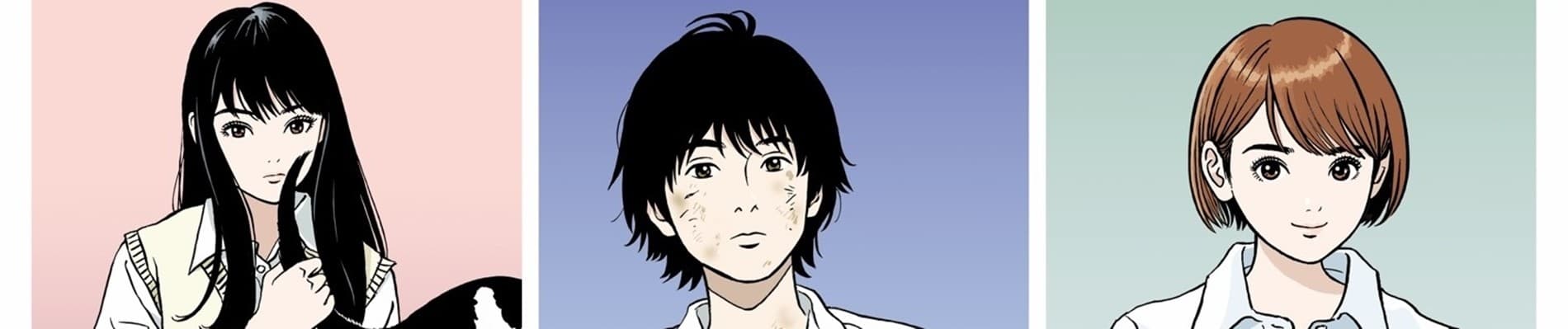
Sonny Boy’s uniqueness becomes apparent right away in regards to its presentation. Usual character models that we have come to recognize over the course of the last several years are replaced. Plain colors both for the skin, hair, and wardrobe would ordinarily be unappealing to the eye, but the entire visual aesthetic works to make the characters appear as fish out of water, both in the world they’ve found themselves in and to us, the audience watching them. Contrasting that are times where the lighting and surrealism come to life. Whether it be with dazzling splashes of color or using a stark black background, one can sense a palpable creativity etched into nearly every frame. The nuance generated from the imagery alone can reach truly arresting levels.
Worth also mentioning is the soundtrack, or what would be more accurate to say is the absence of one. Familiar storytelling devices like background music are left behind. Instead, sound is mostly restricted just to voice actors and actresses delivering their lines, as well as ambient noises. The series loves using silence to portray itself, which is a trait that I honestly wish more shows would use. By doing this, Sonny Boy appears to emphasize not only the unfamiliar territory the characters find themselves in, but also to emphasize just how alone they are. Perfectly-mundane, everyday things like characters walking come across as more intense since the overall sound-palette is so sparse. Therefore, when music does play at those select few moments, it grabs your attention.
What further grabs one’s attention is that Sonny Boy’s physical universe is more expansive than one would initially assume. We do not see only one singular world that the characters find themselves in, but several worlds that they travel through, and each with their own particular set of rules. This further contributes to the expansiveness of the show’s thematic universe as well. While mob mentality is one of the earlier themes in the series, Sonny Boy branches off into numerous other metaphysical and sociological territories. Each episode of the show usually tackles a theme as it pertains to one of the characters or the group as a whole.
For instance, Nagara begins the series as a reserved individual, not really speaking up unless he is given instruction, is pestered, or there is something required of him. Especially since he doesn’t appear to manifest any powers, unlike nearly all of his peers, he becomes an early target of ostracization, with only Nozomi and a few others allowing him in their circle, and even then there’s a question of just how much he wants having them around. As the show progresses onward, Nagara, through the various experiences he and his fellow classmates endure in their world-surfing, gradually begins his process of self-actualization. His growth accompanies the many themes of the series such as leaps of faith, belief in nonsense, and the existential question of growing up and coming into the world, even if Nagara does not embody them specifically.
Those are indeed many themes, but they come with a narrative cost. After spending some time tackling a theme, the conclusion of each episode effectively says, “That theme is over, so let’s move on to the next one.” Though it means that Sonny Boy’s overall reach of material is vast and could pull anything from existentialism to any other philosophical branch you could imagine, it means that the journey from episode to episode is a little confused. Even if one were to argue that the overall plot is not essential to the show’s ultimate substance, it is still a show that is trying to tell a narrative, and I must confess that around the halfway point, my attention started to waver. Ordinarily, a show keeping me guessing would be a point of interest, but the show’s charting of unknown territory came across more as winging it rather than having a stable rudder. That wasn’t always the impression I was getting with each episode, as there are threads that one can follow across all twelve episodes to give a sense of grounding. It does indeed build to something, but the rudderless impression was more-present than I would have liked.
Part of that impression was not only from being perplexed at where the series was going, but also because I wanted more from what the material gave. I’ve had to read a slew of philosophy and sociology for graduate school from Kierkegaard to others like Sartre, Kant, Hegel, and others. As such, the themes Sonny Boy touches upon may serve as a decent introduction to what the idea is presenting, but stops before it can really be explored further. As these ideas make their presence known, the writing is sometimes presented in such a way that it feels more like characters giving speeches rather than conversation, so during the course of an episode, one person is often designated as the “lecturer” and everyone else is listening. There isn’t quite enough give-and-take to make the ideas hit the level of engagement that they’re after, and therefore, they run the risk of going on for far too long or being too dry. It’s not a question of whether I agree with the episode’s dense musing, but rather HOW the dense material is mused. The fourth episode of the series has one character, Cap, telling a story about baseball-playing monkeys (it makes sense in context…kind of). Even though baseball is my favorite sport, the story and the theme it tried exploring went on for so long that it marks one of the few times ever in my anime-watching life that I had to actually stop an episode, gather my energy, and press onward.
This relentless pursuit of explaining the ideas also comes at the price of the side characters being underdeveloped. For all intents and purposes, Sonny Boy mostly revolves around three-to-four characters, but there’s an entire roster of side characters from the school that sadly do not develop too much beyond setting up the first few episodes. Other characters are introduced later on in the series, and even for the characters that do come back later, some of their resolutions are rather hastily handled. Quick explanations as to things that happened off-screen are given rather than taking some time showing us. In a bid to explore as much philosophical space as possible, the show occasionally stumbles in delivering its other storytelling conventions. It’s one case where I think “less is more” might have actually behooved the series from a thematic standpoint. Any one of these themes could be enough for an entire series, but tackling so many, while wildly and admirably ambitious, comes a little close to making the cup runneth over. That said though, the finale that had been built up to did manage to pull it off well, with the show’s best demonstration of its aesthetic and thematic exploration. It ended strongly enough to somewhat justify a languished middle.
______
Sonny Boy touches upon numerous metaphysical and sociological topics unapologetically, using the generous sandbox it has been given. The individual episodes and their topics, unfortunately, cannot quite fully make use of the riches that lie therein, as the show attempts to address so many things that few of them come across as realized to their full potential. Its aesthetic presentation and sheer creativity were dizzyingly-fascinating, but the actual journey to get to the end left me feeling colder and more malnourished than I think the show was going for. If this is your first time being exposed either to this kind of storytelling or thematic ideas, I can easily see this series becoming a favorite for someone. I don’t think I can bring myself to say that I like this series, but it’s too unique to not be given an honest chance. Matsume Shingo and his team made a genuinely-ambitious, full-fledged trip into the unusual, unshackled by the common restrictions a show faces. If nothing else, it should be celebrated for that. Despite my feelings being quite mixed on this series, I’m ultimately going to lean more towards the series’ favor.
22 out of 26 users liked this review
