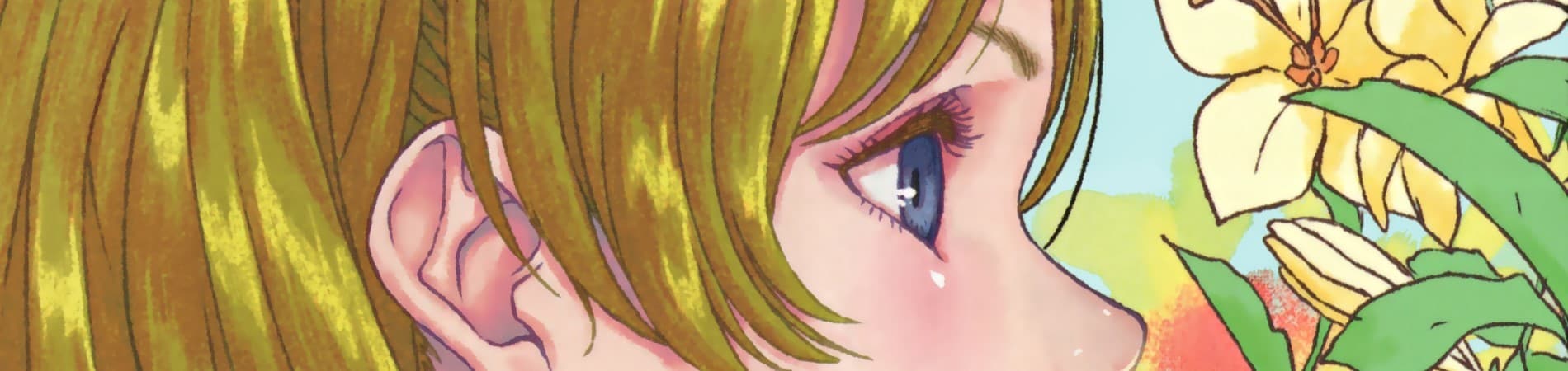
Sorry, couldn't resist the reference. Though I believe it fits the theme well; everything is art, and everyone likes art. But, if everyone and everything is art, then what distinguishes us from one another? It's our own, personal perception of the art around us and the interpretations we draw from it. For example, one man could look at a tree and think it was one of the most beautiful things he's ever seen. Another man could see that same tree and think of it as nothing more than a large, protruding stick. Who would you say was correct in their analysis of the tree? The answer: It doesn't matter. They're both correct from their own perspectives yet wrong according to the other's. There is no point setting absolutes with art, as any number of opinions can be drawn from any one piece of art. This principle is essentially what Le Portrait de Petit Cossette is all about.
Forgive the verbose prelude, now onto the series itself. For all I can say about this series, it has an incredibly simple story. Its premise could be told in a few lines of text, the whole plot itself could be summarised in about five minutes or so. If this is the case, then how does it fit over three thirty-seven minute episodes? This is mainly due to the visual direction and animation.
I can liken the direction to that of the Monogatari Series or FLCL, in the sense that it utilises a lot of bizarre imagery and odd camera angles. Not quite as absurd as Monogatari's visuals and not as bombastic as FLCL's. This sort of direction can be jarring to some and paired with Cossette's indirect way of storytelling, it may not be everyone's cup of tea. You will tell from the first episode if it's not for you. I think it does a great job of pleasing your eyes with pretty art while simultaneously stimulating your mind by questioning your own opinion on art as an idea and concept.
Was considering leaving out characters altogether as there's really not much to say in this department. In situations like this, I ask myself, 'Does this story need great characters? Would they contribute much to what the series was trying to convey?'. In this case, I'd say no. For many series, the characters are the driving force and embody the themes of the story - serving as the catalyst behind the series' effectiveness in projecting its concepts. Cossette is not of this ilk, quite the contrary actually. The characters, to me, act as readers. In short, they are just there to paint the picture through their dialogue and interactions, rather than be of any substantial value individually. If someone was to read you a story, you wouldn’t usually think much of the reader as opposed to the story itself, but the way in which they tell the story can greatly affect the experience – for better or worse. That’s how I look at it. They served this purpose well though I guess that won't be enough to excuse the lack of characterisation for some.
The main element of the story is two men's differing interpretations of art. The art in question: a young lady. One sees her heart; One only sees her external appearance. One sees her beauty as a living, transient being; One only sees her beauty as something to be displayed. One acknowledges the impermanence of her physical looks as a part of her beauty; One can't accept such beauty going to waste and wishes to immortalise her visage. In other words, the primary theme is the relationship between the art and the artist. This relationship is closely explored through the characters to display a connection that is intimate and almost symbiotic. Seeing this portrayed by living humans puts an interesting spin on the concept, as this challenges you to look at it from two standpoints: an artistic one and a human one. What does the artist think of their art? What does the creation think of its creator? This is examined artistically, like a painter and the painting, and humanly, like the one being painted and the one who painted them.
Note the distinction between ‘painter’ and ‘the one who painted’. While some art is very personal, it does not always reflect the artist as a person. Going back to the aforementioned men; one of them is a superior artist, but an evil person. His art is beautiful but barren – it is not fuelled with emotion or passion, nor is it a product of love or creative ambition. It is clinical and cold; created out of compulsion as opposed to artistic whim. The quality can’t be denied, and it is hard not to admire the talent displayed, but it is also hard to stomach knowing who created it, as this, whether we’re aware or not, influences our perception of the art in question. While there is a relationship between the art and the artist, there is also a relationship between the art and the audience. Art is whatever you perceive it to be; while there is usually an intended takeaway, anything that you draw from art (within reason), is valid. As mentioned prior, the artist can affect the audience’s view on the art, even if there is no tangible connection between the two. Cossette shows that art is more than we often give it credit for. Art is diverse and dynamic, recreational and transformative; art is alive. It lives in the minds and hearts of all.
_____
All in all, I love this OVA; I'd go as far as to say it is one of my favourite pieces of visual art ever made.
A question: Who would you say was correct in their analysis of the young lady? The answer: It's up to you. Putting ethics aside and looking at it from a purely artistic standpoint, both interpretations are valid and acceptable. When you stand in awe of a flower, you rarely acknowledge the fact that it's a living organism - yet you doubtless acknowledge its nice colours and pretty shape. So, maybe the second man isn't so wrong, that's the true beauty of art; any interpretation can be considered.
_That's the beauty of art.
That's the beauty of Le Portrait de Petit Cossette._
~~~~~~
42 out of 44 users liked this review