
Life & Death
Revenge & Retribution
Father & Son
Wolf & Cub

Introduction:
The Samurai: history's greatest warriors, or glorified soldiers? Loyal defenders, or self-serving cowards? The samurai have been painted in different ways throughout history, both at the time of their prevalence and long after their day. From a literal standpoint, they were just paid retainers of the Daimyō (大名), but they have somewhat transcended that definition. There are multiple reasons for this, one of which is their way of life, or Bushidō (武士道), which I'll talk more about later. Another is pop culture and the different depictions of samurai in narrative mediums. From the classics in Japanese cinema to modern anime, and even Western takes on the subject; there has been many creators who have tried their hand at a samurai story. Amidst the rest, is a manga series, that I believe to be the greatest samurai story ever told. This manga is Lone Wolf and Cub.
Lone Wolf and Cub was a monumental series - a collaborative project between Kazuo Koike and Goseki Kojima, both of whom are sadly no longer with us. Often lauded as a classic and exemplary work that showcases just how good manga can be. It was a series that along with some Western comics (Maus, Watchmen, The Sandman etc) proved that comics were not a child's medium and could enjoyed by mature audiences as well. There are a lot of aspects of this manga that I wish to talk about so this may end up being a mess, I apologise in advance for that. This review will have a couple minor spoilers but nothing that would affect your experience.
____
Story:
LW&C has a grand narrative - one that will leave you thinking for a while. In addition to the main story, the series has a multitude of short stories due to the episodic structure. Both the overarching plot and the short stories have deceptive levels of complexity -- full of nuance and detail. The writing of the series gets consistently better as it goes on, enrapturing you more and more as you read. The last fifty-chapter stretch in particular is amazing.
The main story is built almost entirely around three characters; some other characters contribute but the focus is always on three in particular. Additionally, one of those three only appears every once in a while. So, as you can probably guess, the story takes a while to be fully realised. It is all worth it though, as the way the plot threads are tied by the end is nothing short of masterful.
The episodic chapters are also a treat. Many feel like the plot of an epic samurai movie while some are a little more heartfelt, all serve their purpose though. Much of the character development is found in these short stories, especially the relationship between the two main characters, Itto and Daigoro - which is a fascinating dynamic. For this reason, these short stories should not be overlooked. I love the variety of them in particular; you go from seeing Itto slaughter a trio of assassin brothers or carrying out the last wish of a legendary gunsmith, to seeing Daigoro being taught how to swindle strangers or getting accidentally caught up in the murder of a noblewoman. Each story is enjoyable and presents its own ideas and themes.
_____
Characters:
As mentioned prior, there aren't many major characters. In accordance with their relevance and screen-time, there are two main characters - Ogami Itto and Ogami Daigoro - and two major characters, Yagyu Retsudou and Tanomo Abe.
__
Ogami Itto__
 The Protagonist of The Story. The Killer Who Walks the Assassin's Road. The Lone Wolf.
A wonderfully layered character - a true samurai living in a decadent samurai society. He was once the Kaishakunin (介錯人) for the Shogun himself, his duty was to behead treacherous daimyō. His important duty and reputable position would not last however, as he was framed for treason as well as having his wife and retainers murdered. I won't tell his life story verbatim but instead of accepting the order for seppuku (切腹), he decides to walk the assassin's road with his recently born son, Daigoro. Itto is a deep and multifaceted character and following his journey is both heart-breaking and eye-opening.
The Protagonist of The Story. The Killer Who Walks the Assassin's Road. The Lone Wolf.
A wonderfully layered character - a true samurai living in a decadent samurai society. He was once the Kaishakunin (介錯人) for the Shogun himself, his duty was to behead treacherous daimyō. His important duty and reputable position would not last however, as he was framed for treason as well as having his wife and retainers murdered. I won't tell his life story verbatim but instead of accepting the order for seppuku (切腹), he decides to walk the assassin's road with his recently born son, Daigoro. Itto is a deep and multifaceted character and following his journey is both heart-breaking and eye-opening.Ogami Daigoro
 The Son of Itto. The Innocent Boy in the Midst of Death. The Lone Wolf's Cub.
Daigoro is difficult for me to talk about, much of his character can only be understood through experiencing it, especially since he rarely speaks any words other than 'Papa'. His development is all through actions and narration. All I'll say is some of his moments are incredibly sad and poignant, as seeing such tragedy through the eyes of a child is an unsettling experience.
The Son of Itto. The Innocent Boy in the Midst of Death. The Lone Wolf's Cub.
Daigoro is difficult for me to talk about, much of his character can only be understood through experiencing it, especially since he rarely speaks any words other than 'Papa'. His development is all through actions and narration. All I'll say is some of his moments are incredibly sad and poignant, as seeing such tragedy through the eyes of a child is an unsettling experience.Yagyu Retsudou
 The Antagonist. The Mind Behind the Slaughter. The Nemesis.
Another nuanced character and a great foil to Itto. Due to his lack of screen-time, it takes a while for his character to get going but even from the start, he had a presence in the story. Whenever he appears, you feel the tension.
The Antagonist. The Mind Behind the Slaughter. The Nemesis.
Another nuanced character and a great foil to Itto. Due to his lack of screen-time, it takes a while for his character to get going but even from the start, he had a presence in the story. Whenever he appears, you feel the tension.__Tanomo Abe
__
 The Thorn. The Glutton. The False Samurai.
Abe acts as a complete opposite to what samurai are usually perceived to be. The idolised image of samurai is completely pissed on by this man, and I love it. You will hate him for every scene he's in, but by the end, you may harbour an odd admiration for him.
_____
The Thorn. The Glutton. The False Samurai.
Abe acts as a complete opposite to what samurai are usually perceived to be. The idolised image of samurai is completely pissed on by this man, and I love it. You will hate him for every scene he's in, but by the end, you may harbour an odd admiration for him.
_____Art:
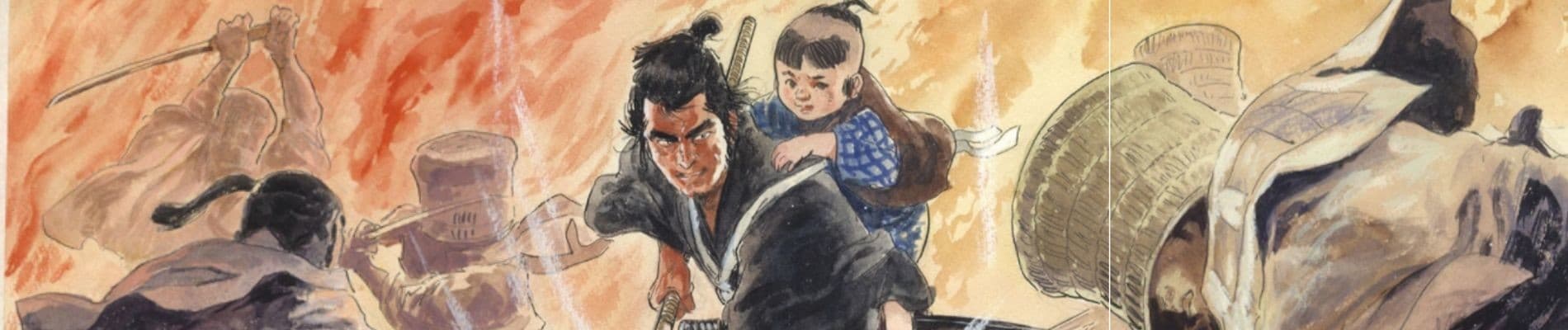
As you've seen from the several pictures in this review, the art is great. Doesn't quite possess the sheer detail of Miura's Berserk, nor does it have the landscapes and flowing beauty of Inoue's Vagabond, but it has its own charm and character.
The art itself is consistently good, but at the beginning of most (if not all) chapters, there is a slightly different art-style that focuses more on shading than lines. These sequences are particularly gorgeous.

One aspect I think Kojima excels at is fight scenes. I believe he captures the nature of a duel to the death very well; the fights all feel raw and visceral as a result.
 ____
____History:
This isn't usually a part of the criteria I'd discuss when reviewing a series but it's so significant and relevant in this manga that I think it deserves a mention. When reading, it's clear to see the time and effort Koike put into recreating Edo-Period Japan. Some series may give you a history lesson, LW&C gives you a whole university lecture. A specific aspect of the historical side of this manga is the terms and words used. A lot of the words used don't have proper English translations and so the original is used. This includes the names for many sword-styles like Suiō-ryū (水鷗流 居合 剣法), which is practised by Ogami Itto. This adds a level of immersion and realism not found in many other samurai series. Most of the time, samurai series are samurai series in name alone; not much is put into giving it the feel of a samurai story. Some are deliberately like this however e.g. the anachronistic Gintama and Samurai Champloo. LW&C really makes you feel like you are in Edo-Period Japan amongst the samurai.
_____
Themes:
The series covers many themes and projects many ideas. Most prominent of these is revenge. The whole plot is centred around Itto's lust for vengeance against the Yagyu, so this obviously takes the forefront in the story. Revenge is presented very uniquely in LW&C, making a simple story and theme very captivating as a result. It goes to show that execution is just as important, if not more so in certain circumstances, as the idea itself.
Another of the themes is the image of samurai. For example, take the 1954 classic 'Seven Samurai' by the legendary Akira Kurosawa. I believe this movie represents the best of the samurai. Seven wandering samurai risk their lives for some poor farmers who offer nothing but a few bowls of rice. They showed bravery, honour, and skill - everything the samurai are idolised to be. On the contrary, Masaki Kobayashi's 1962 film 'Harakiri' did the opposite. It showed the declining state of the samurai, shown by the feudal lord's cruelty and his retainers' unquestioned loyalty despite the remorseless judgment of their lord. Both films show the pros and flaws in the samurai way. LW&C possesses this theme as well. The good of the samurai is shown through Itto's actions. While this may seem contradictory due to his occupation as an assassin, in reading you will see Itto carries the soul of a true samurai despite discarding bushidō. The bad of the samurai is seen through the corrupt government, shadow organisations, and mistreatment of the peasant stratum. Bushidō itself is shown as a paradoxical paradigm, as a lord could give an order that betrays the way of the samurai, yet refusing the order would also betray bushidō, which is very focused on loyalty to one's lord. There are times however when this is reversed, showing that there is still some true samurai left, even in the government.
Lastly for themes, I'd like to briefly talk about a concept unique to LW&C: Meifumado. Meifumado is made up of two existing words. The word 'Meifu' (冥府), which roughly means the underworld, and the word 'Mado' (魔道), which has several meanings - mostly translating to a way of life characterised as evil. This means the combined word roughly translates to 'Road to Hell'. Some of the nuance of the word is lost upon translation but that's the case with a lot of Japanese series unfortunately. I find this concept to be extremely cool, especially how it is a direct counter and renunciation of bushidō, which adds even more depth to Itto as a character and to the series as a whole.
“Though we become the demons of Meifumado! Though we claw flesh and drink blood, reduced to bone we will transcend the six paths and the four lives!” - Ogami Itto
Conclusion:
There's still so much I could talk about, but I don't want to spoil anything major for any potential readers; it is best experienced blind.
This series, especially the final volume, left me mentally and emotionally exhausted, and despite how ground-breaking and iconic it is in the industry, I don't think it has the popularity it deserves in the community.
I implore all of you to read it, it truly is a masterpiece in every sense of the word. If this review convinces just one person to pick it up, I'll be content. Thanks for reading.
 by Artigas on DeviantArt
_'Assassin! Lone Wolf and Cub!
I come for your life!'_