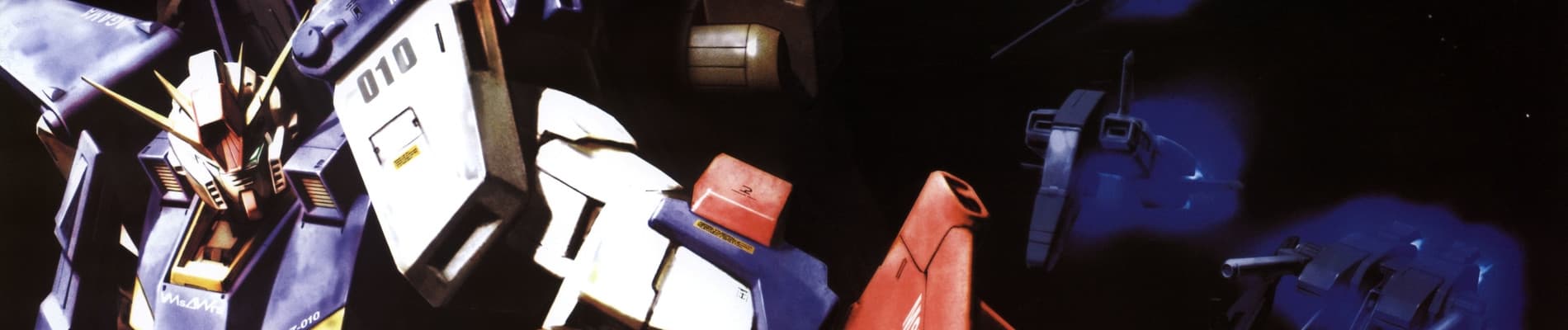

Shattered/Mr. Bigshot's MOBILE SUIT GUNDAM ZZ review!

*
Two months before starting MOBILE SUIT GUNDAM ZZ, I had the esteemed pleasure of starting and finishing the entire 50 episode run of the ZETA GUNDAM series (created in 1985). If you know me personally, run in the circles I’m in or read my previous GUNDAM review, you know where I stand on that show and here I’m going with this. But for those that somehow [and, even, thankfully] don’t, here’s a worthy precursor for my feelings on the subject: “Fuck you Tomino. Go to Hell. Never again. Never. Again.”
A bit of an over exaggeration, obviously. But if there’s anything that better captures the emotions I felt after finishing ZETA, it’s definitely a few profanities lobbed towards the GUNDAM creator for that mixed bag of missed opportunity. (Nowadays, it’s about two curse words less – progress!).
ZETA GUNDAM started off strong with its depiction of fascism, how it can steadily spread throughout the ranks of organization and interesting characters that seemed primed for just as interesting arcs. All of this, coupled with a story that would possibly show the worst humanity can offer while also being a genuinely entertaining series. Unfortunately, the series ends up being the absolute exact opposite of this. Characters go nowhere and remain one-note villainous caricatures of fascists throughout history with nothing of true interest to differentiate them. Women in the cast far and wide are either boring with no worthwhile character moments inserted into their stories beyond their first appearances or dick-starved to the point that they chose to become fascist…for some weird reason. Even characters you think will evolve into something more, like young Kamille Bidan or Katz Kobayashi, end up being just flat out boring, annoying and largely repetitive in their moments.
To cut the chit-chat and the ZETA hatred I have stored within me in half, allow me to put it like this – while MOBILE SUIT GUNDAM offered a nuanced and raw take on PTSD and war on the effect of the planet and the young, MOBILE SUIT ZETA GUNDAM offers a nuanced and raw take on a series becoming messier and murkier by the episode, with no character moments from a Char or an Amuro Ray strong enough to save the entire ensemble.
Needless to say – ZETA GUNDAM almost turned me off of the very idea of a Tomino-Gundam watch. So, going into ZZ after some much needed downtime, my expectations were low. I knew that it was a contentious series for most of the Gundam fan space and, for the most part, I took that into account as I watched the first few episodes and then the rest of the ZZ series. What awaited me was, on all accounts, a welcome surprise – a return to nuance, a maintained standard of sharp animation and art and an eventual respect for Tomino’s writing on the series. MOBILE SUIT GUNDAM ZZ is one of my favorite entries in the GUNDAM franchise and it’s time that I explained why…
I'll be the first to admit that starting this show after coming from Zeta Gundam is probably one of the most jarring experiences I’ve had in anime. Though, why wouldn't it be? Going from nearly every member of the AEUG dying violent, horrible deaths to…Judau and his friends getting into hijinks while stealing from the military is definitely something that was never going to blend the smoothest. That said, I think the tone of ZZ ends up straightening out to be a much more pleasant experience than its predecessor; it makes the world feel much more alive and accessible.
And that’s not all that it does better! From its main character (we’ll get to him a bit later) to guys like Mondo and Beecha and even antagonists like Mashmyre, Chara Soon and Haman Karn, the experience I had with the characters here was much more enjoyable. Here, Tomino employs a varied amount of character depth that was annoyingly absent in Zeta and much more reminiscent of the original GUNDAM run. Gone are the days of a cast full of one-note, static characters or villains that are evil and antagonistic just for the sake of the story. In its stead comes characters that either get very satisfying and fulfilling arcs to experience along the shows run or characters that are still static, but still get cool moments or scenes where I can still appreciate them overall.
To put it in simple terms – everything in ZZ feels much more…natural, well-earned and better written. Rather than characters being in the story simply to fulfill one thematic or story role and having nothing else to do of interest, Tomino offers a cast that is rounded out succinctly.
Unfortunately, even though Tomino’s character writing has gotten better for the large part, he still suffers when it comes to writing most of his women and the interactions they have with each other. Ple fights constantly with Elle or Roux, who in turn constantly fight with each other, while also fighting with Chara Soon when they are magically on screen together. It’s a tiring approach to character interaction, especially through a modern lens.
That said, each of those characters get moments throughout the narrative that at least keep Tomino in my good graces this time around and…hey! Since none of them are characters that start committing genocide for the sake of getting good dk in their lives, we’re already above the bar…right?

So, I’ve talked about ZZ’s ability to make its character cast feel fresh, engaging and (if I could describe them as such) human, but there’s still one elephant in the room that needs to be addressed – Judau Ashta. It’s a bit of a controversy, but I honestly believe that Judau stands tall amongst the main protagonists of Gundam that I’ve currently seen grow.
Amuro is a great take on a boy slowly turning into a man fueled by fighting and war. Mikazuki (from what I’ve seen of the totally-standalone-without-a-season-two Iron Blooded Orphans) has a great arc of learning to stand on his own while also appreciating the presence of the people around him. And, hell, while I have qualms with how boring Kamille was for the majority of Zeta Gundam’s runtime, I can admit that he’s absolutely great as the empathetic and wise senpai. But Judau…Judau’s a dick. I mean, an absolute asshole. And I couldn’t love him more because of it.

Or, uhh…let me rephrase that. Judau starts out with a type of Aladdin archetype: he steals for profit and to provide for his younger sister with his Shangri La friends, he has no respect for the adults that started the wars around him or authority and he’s a dick even to the people that love him sometimes. Although some of that makes Judau seem like an awful person, it makes for an amazing character arc. And that eventually makes him into a great person.
Without getting too deep into the dirty details, there comes a point where Judau, confronted with a way of making money that would keep his little sister fed and secured for a considerable portion of her life, outright rejects the very idea. He then proceeds to slap food out of the hand of his beloved younger sister and run off! To put it bluntly, Judau Ashta is very much a jerk, through and through, who cares more in that point in the story about the thrill and sense of independence that playing the thief gives him, rather than what would be best for his sister.
Another point of Judau being a relative dick is how he often treats Elpeo Ple, sometimes as an annoying fly or as the irresponsible reason that he has lost his true sister. Judau, I think, is a character that is unable to see the bigger picture in the beginning. He is unable to express heavy amounts of empathy for others and often indulges himself in many selfish desires, even though he covers up the selfish with the idea of being the noble and caring older brother.
Judau is an asshole, but he is an asshole that Tomino has constructed brilliantly. I think back to a great scene he has with Elle, where he begins to realize what an awful brother he truly is to Leina…A scene, where, Elle doesn’t clichély tell him that he’s wrong. Judau here has hit rock bottom, both as a man, a protector and a brother. And from then on, it’s a slippery slope to growing and becoming a better person as a result.
Tomino excels at character writing not where his pieces on the board stay their same boring selves, but rather when they grow over time, or they devolve as a result of their time within the narrative. This is true for Amuro and now especially so for Judau.
As the final pin in my case for Judau as not only a great character but the best main pilot in the Tomino-Gundam trilogy, it isn’t lost on me how well written his time with the women in his life are, as well as the character effect they have on him and vice versa. Leina and Elle are part of Judau’s desire to go on and have something to protect, but neither of them cut him any slack and often push him to be a better person.
Although his relationship with Ple starts off rocky, he eventually learns to accept her, empathize with her and ultimately grieve her in a way that feels genuine for the setting. Even near the end of his arc, the lessons Judau has learned through his interactions come a long way into shaping his perspective on the world when he tries to help the late Ple-Two and convince Haman Karn to stand down. This change in Judau not only is the most beautiful aspect of the series in my eyes, but also empowers a moment that I still believe to be the most progressive and powerful scene in this trilogy thus far!

Double Zeta, above all of the Gundam series so far that I’ve covered, highlights a very strong and sturdy theme – humanity, at large, has begun to enter a period of stagnation. That is to say, humanity is stuck in a state of decadence and squalor, rather than progress and enlightenment. It’s something that I’d say has always been a subject that all of the GUNDAM helmed by Tomino has always pushed, but this is the series where it is confronted in the foreground, for all to see. And, in that way and in many others, it’s downright ingenious.
While the Federation and Zeon/the Titans/Neo-Zeon continue to push out more weapons of war and destruction, the infrastructure and ways of life on Earth and the various space colonies are taking noticeable hits. While the Mark 2 Gundam and the Double Zeta Gundam are being launched off of the military assembly lines, people are shown to be hungry and in food lines. While the White Base becomes the Argama and that becomes the Nahel Argama, people are losing their lives caught in the middle of wars that seem never-ending. Hell, even the Newtypes in the series, an evolution of human perception and ability, are immediately used to further the war efforts of various factions and are even disgustingly mass-produced in the form of Cyber-Newtypes.
Humanity is stuck in a perpetual cycle of hatred, abuse and war, which benefits no one in the long run. It’s a subject that isn’t unlike the Gundam series that came before or the type of series that came after (like Attack on Titan and its own take on the material), but why is it that the conclusion in this series about that same cycle feels admittedly much more visceral than even Isayama’s own take?
That, I think, goes towards how bright and well done Tomino’s writing is, but specifically his approach to Judau as a character. It’s Judau, his sister, his friends and the other people that grew up on Shangri La that are caught in the middle of these wars that produce nothing but hardship for their daily lives. He has personally experienced the negative outcomes of the countless wars. So it only makes sense that Judau, after a full series of reflecting on his life and growing as an individual, is set up to face that reality and cycle head on!
It is Judau that confronts Gremy Toto and Haman Karn, in the sheer heat of battle. It is Judau that confronts them in their flawed belief of power being above the needs of people that have made the Earth and the world around them deteriorate at such an alarming rate. It is Judau that has to be the one to examine the ideals of these adults and reject them wholeheartedly. The same Judau who learns the importance of empathy, understanding and moving forward rather than remaining in stagnation. Not only is this moment the best pin in Judau’s character, but it also works for a scene that plainly puts out what the original Gundam trilogy is getting at and what must be overcome in order for humanity to go to a state not yet experienced…

While my experience with MOBILE SUIT GUNDAM ZZ started off a bit rocky, I can honestly say that I had the time of my life watching the series. The animation and music are as great and as sharp as Gundam has been, but what really kept me was how tight a good percentage of the character writing is this time around. Tomino has crafted a universe where he is able to share and express truly profound ideals of both Foucauldian and empathetic value.
Though he might not be the best in the genre when it comes to even the things he’s good at in this series, ultimately I can still appreciate the raw strength that comes from his artistic voice and stance. While (spoiler alert!) I didn’t like Char’s Counterattack very much, my love of Double Zeta is what ultimately, even while writing this review, made me understand what vantage point Tomino is coming from artistically. With ideas that important, in the times we live in, sometimes…maybe that is enough. But some real meat on the bones of a series doesn’t hurt either!
Gundam ZZ is a series with heart, determination and a true sense of understanding of its characters and themes and how to make them work perfectly in tandem. While I know that CCA doesn’t quite carry the torch the way that this series does, I raise my glass to the standard that Judau Ashta and the rest of the cast set here – knowing that this is only the beginning for the great works Tomino can spawn from his mind.
***
