
THE AMAZING ABILITY TO TURN A GAME OF LUCK INTO A WONDERFUL PSYCHOLOGICAL WARFARE
Before reading this review, I advise anyone who has not done so to read the one relating to the first season first. This is because, to avoid repetitions especially in the sections dedicated to animations and music, I will not use my classic scheme to talk separately about plot, characters, etc. (which you can find in the first part) I will limit myself to making a general discourse, trying to reconnect all the elements in the right way and at the right moment.

Kaiji-Against All Rules is the sequel set immediately after the events of the first series that begins by giving an overview of Kaiji's life after the Starside Hotel Arc. To avoid spoilers that reveal the ending of the predecessor, I will call the 2 arcs that distinguish this season with 2 names that give just the idea of the games that our protagonist will face: dice and Pachinko (Japanese game similar to pinball).

Immediately the first 2 episodes of the season are loaded with a heavy burden: that of letting us immediately re-immerse ourselves in the atmosphere to which the first season has accustomed us. In doing so, the anime immediately hits like a boulder, beautifully portraying Kaiji's gambling addiction and the ease with which he falls into any kind of temptation, due to his naivety and mental fragility. The first arc is not particularly elaborate in terms of strategies and psychological games between players, because as mentioned above, the subject is the dice and on the roll of the dice it is not easy to build an efficient narrative from this point of view. But despite starting with a rather evident handicap as regards the depth and peculiarity of the strategies, the risks that Kaiji runs have the direct consequence of "evoking" an atmosphere that is much heavier and more dramatic than in the first season.


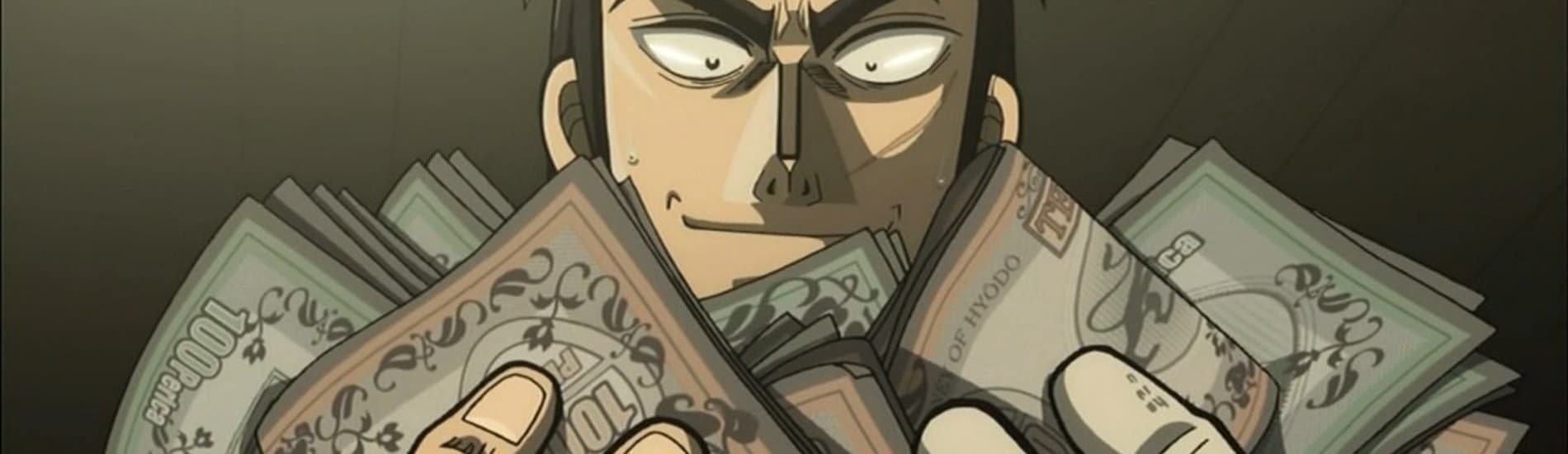
I take advantage of the clarification I just made to underline once again the graphic quality that distinguishes this work, highlighting the character design that has remained very faithful to the prequel. In addition to this, the sequel is even more dense with wonderfully eloquent facial expressions, which reveal all the sensations of anger, despair, joy that the characters feel and transfer them with maximum effectiveness to the viewer.

Having said that, in a whirlwind of emotions and psychological games (because yes, they are fewer than in other games where the skill of the players counts more, but they are still present and equally effective in terms of impact on the game) the first arc comes to an end, opening the doors to the main arc of the season, the Pachinko Arc.
To talk about this arc I start directly from some criticisms that I have heard and read against it. The criticism that takes hold most is that relating to the pacing, judged to be very slow and boring to the point of forcing the viewer to skip episodes to reach the conclusion. At least personally I never, ever thought of doing such a thing for 2 simple reasons: the first is that I particularly love this series and all the tactics that characterize every game, the second is that the arc in question is so full of plot twist that there has not been a single "dead" moment in the whole arc, although 9 episodes for a game of Pachinko are objectively a lot but not necessarily boring or repetitive. The beauty of Kaiji is to witness every counter-attack and actively participate with the characters in every situation they are faced with.

And at this point anyone would ask: but how do you bring a simple game of Pachinko (for the uninitiated, a game in which the player does not have the slightest control over the game, which is completely dictated by chance) on the level of a psychological war between 2 opponents? The answer to this question lies in these "damned" 9 episodes because, to avoid spoilers, you will never imagine the immeasurable amount of things that can be done to influence even a tiny part of the outcome of an "apparently random" game. 9 episodes characterized by literally dozens of twists, some of unthinkable proportions, and by a feeling of anguish the air around the players is full of. 9 episodes in which anxiety, fear, pain, joy, relief, feelings of omnipotence and impotence alternate and, as mentioned before, all this is passed on to the viewer in an excellent way, not only with graphics but also with music and sound effects (to make a spoiler-free example that will understand only those who have seen the season, during the nail scene I was suffering terribly with him and maybe even worse). Finally, I give a further note of merit that I forgot in the first review although it was already present in the first season: I love the fact that metaphors are continually used to describe game situations, it gives a much more poetic air to something that is actually very much simple, I consider it an excellent expedient that contributes to making the whole plot even more profound and psychological. Chapeau.

P.S. I am not a native English speaker so I apologize for any mistakes.