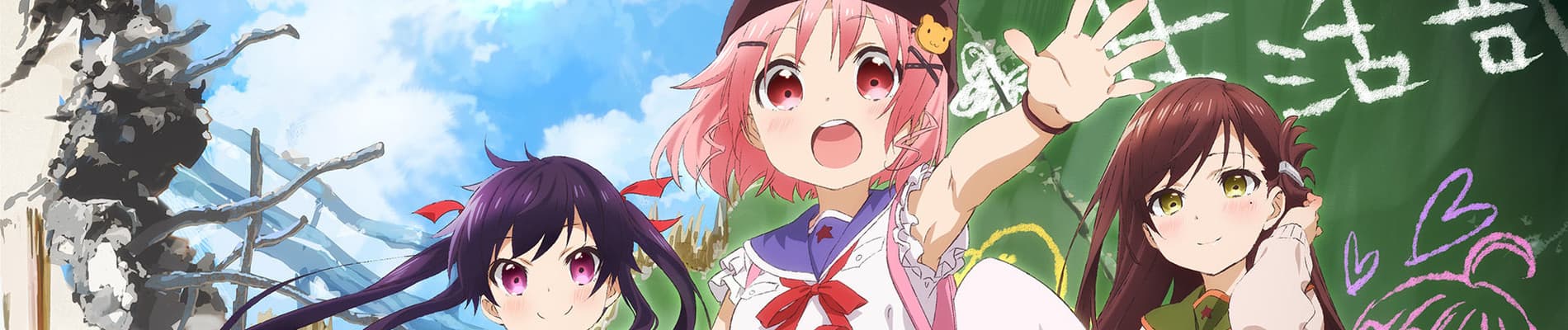
SCHOOL-LIVE!
a review by TheRealKyuubey
a review by TheRealKyuubey
Do you love school? Do you wish your happy, carefree days among your friends and teachers could go on forever? What if I told you there was a club where a small group of students have set up permanent residence on campus, making use of the schools many state-of-the-art amenities to support themselves 24/7 so they never have to deal with their nagging parents again? Welcome to the School Life Club, where the joy of youth never ends! With our sweet and caring faculty adviser Miss Sakura, and our strong willed but kind hearted club president Yuri, it’s our solemn vow to keep the horrors of the outside world far away, so our every day lives can be a never-ending dream!
Okay, we’re going to be doing something a little different with this review. For the first time since I started writing reviews, I am going to put a loud, clear and explicit spoiler warning right at the top. Do not read farther than this paragraph if you haven’t gotten to at least the end of episode 1. I play fast and loose with spoilers at the best of times, but the twists in this show happen early enough, and are substantial enough, that if I were to reveal how the first episode ends, it would drastically alter your viewing experience. If you have any interest in this series, whatsoever, go watch episode 1, or hell, just to be safe, maybe the second episode as well. Pirate it, if you have to, but just those episodes, you can pay for the full series later.
We good? Then let’s continue.
Moe and horror are two very distinct anime genres, and they mix about as well as hip-hop and country... It’s not impossible, but they’re definitely not meant to share the same space. A good example of this is Higurashi no Naku Koroni, a series that delighted in twisting the cutesy color-coded characters into both the sadistic villains and tortured victims of the story, more often than not both in the same character. The inherent clash of style created a tonal dissonance that enhanced the shock factor, but School Live isn’t really going for shock value. It’s also not going for the shameless exploitation that made Highschool of the Dead so impossible to ignore. Rather, School Live seems to be taking the high road, aiming for a seamless blend of two genres that do not blend easily.
I don’t have a whole lot of experience with Studio Lerche, but from what little I’ve seen of them, their work tends to be very visually creative, especially when it involves dealing with production issues like budget shortcuts and content restrictions... The stylized pink blood in Dangan Ranpa, for example. School Live doesn’t use pink blood, thank God, but it’s also a relatively PG-13 zombie story with what appears to be a modest-at-best budget, and it handles these issues with tact and grace. Director Masaomi Ando did a stellar job of covering up the financial shortcomings of his project through clever framing and cinematography, using key frames only where he knew they wouldn’t be noticed and shooting characters from behind and in close-up whenever the artwork needed to be simple.
Part of his budget saving effort also went into his presentation of the ever-present zombies. In close-up, the undead are often shrouded in a black mist effect, which not only looks effectively creepy and ties into Yuki’s delusions in the way they’re obscuring the horrors in front of us, but it also gave Ando a convenient out to not have to design unique forms and stages of decay for each individual zombie. In far off shots, zombies are represented by a few stock CG models, which makes them not only easy to quickly apply to any scene on the cheap, but creates a very powerful uncanny valley effect. Of course, the use of all this CGI meant he’d have to cut corners elsewhere to make it up, but like I said, he’s shown himself to be pretty good at that kind of thing. The characters are distinctive and highly expressive, easy on the eyes and with color palettes that enforce their personalities.
The only part of the direction that felt odd to me was the occasional fanservice, which felt oddly out of place. That’s not to say it ever felt gratuitous or inappropriate, far from it, it all made perfect sense plot-wise, but it felt kind of awkward in terms of presentation. It feels like Ando included it as an afterthought, a reluctant concession under the belief that the show wouldn’t be successful, and wouldn’t sell a good amount of merchandise, if the audience didn’t see each character in the three stages of anime undress... Underwear, bikini and bathing. His framing for these scenes is kind of clumsy, like he didn’t know whether to be conservative or exploitative in the amount of jiggling and cleavage he was showcasing. Like I said though, it never felt forced or gratuitous, which is kind of a first for fanservice in a zombie anime.
As for the OST, this is one of those times where I wish I had a better musical education, because while the soundtrack does pretty much what you’d expect it to... Plinky plink happy school life music leading into far more tense and suspenseful tracks whenever the scary shit’s going down, as well as the occasional sad track, there’s something different about this OST. MOSAIC.WAV, a Japanese musical duo that I would hesitantly call the eastern answer to Daft Punk, have a very eclectic style and they’re known for being really extra with their music, so when I’m listening to the soundtrack that came with my limited edition Blu-Ray set and the stereotypical school background music just sounds a lot more complex than what I’m used to, it’s a hard thing to describe, but it all does it’s job brilliantly in the show.
As much as they fade into the background when you’re watching the series, and then out of memory when you get to the next scene, these tracks are not simple or repetitive like they would be in most other anime. I can listen to them on their own without skipping halfway through, and you have no idea how big a praise that is. What’s a lot easier to talk about, however, is the OP, Friend Shitai, sung by the main cast. This song actually is your stereotypical sugary moe-club song, but the visuals are something else entirely. My favorite OP of all time is the first opening for Higurashi, and one of the things I like about it is all the symbolism it uses to convey information about the story and characters, but in that respect, Friend Shitai has blown it out of the water with the amount of easter eggs and visual clues it contains. It’s probably more famous for the way it changes throughout the course of the series, getting progressively darker and more honest about it’s content, and it does so alongside three separate ending themes that do somewhat the same thing.
The English dub was a Sentai effort, meaning it’s a mix of southern and west-coast US talent. Some of these casting choices might feel a bit weird in the first episode, with only Juliet Simmons as Kurumi and Stephanie Wittels as Megune sounding like natural choices, but you find out pretty quickly how perfect all these assignments were. Brittany Karbowski has a reputation for having an almost supernatural level of control over her voice, so it sounds odd to hear her playing the sweet and innocent genki girl in a light-hearted moe show, but it all comes together when you realize the depth of delusion and sadness hiding behind Yuki’s cheerful demeanor. Karbowski’s not the only actor who could have pulled this off, but she is the most obvious choice. Cynthia Martinez has a very unique voice, and she’s also really easy to miscast, but she excels at conveying vulnerability, making her perfect for the Miki. Luci Christian is probably one of the most prolific voice actors in the field, so you might rolls your eyes at the idea that she’s just playing another character in her normal register, but she proves herself hard when Rii-san’s strong, maternal exterior shatters later in the series. You can’t go wrong with either sub or dub in this case, so it’s up to you.
I mentioned earlier that School Live was attempting to pull off a seamless blend of moe and horror, but how does one exactly go about doing that? How do you bypass the tonal dissonance that should by all means create a series that’s jarring at best? Well, thankfully we have plenty of examples to draw from, and while the obvious examples are all the various zombie anime that have come before, I’m actually going to be taking a look at one of the most famous anime of the last decade, Madoka Magika. Madoka was a show that sought to create a dark subversive tragedy centered around the seminal magical girl genre, and it pulled it off so well that it was immensely successful, a cultural phenomenon that spawned countless rip-offs... None of which were able to recreate the magic of the original. Is this just a case of the first being the best, or was there something special Madoka did that none of it’s successors have tried?
First off, obviously, spoilers for Madoka Magika. Madoka built the horror aspect of it’s plot around a questionable aspect of the genre that already existed... As a staple of the genre, the force that gives a magical girl her power is entirely supernatural, and the heroine has to trust in it entirely to draw from it. Okay, so, what if that force had sinister intentions? Madoka asked this simple question, and in doing so, it turned the entire genre upside down, but it had a few additional tricks up it's sleeves that it’s numerous rip-offs have failed to replicate. First, it gave you scarce information about the entity. I haven’t gotten into all the Madoka spin-offs and sequels, but in the series itself, you never really find out the true mature of Kyuubey or whatever purpose he represents. This makes the threat of the series all the more intriguing, and leads to endless speculation and theorizing, along with the realization that these poor magical girls are suffering and dying for a cause neither they now you understand. More importantly, though, Madoka goes out of it’s way to make you care about it’s cast so that when tragic events unfold, it doesn’t matter what the cause is, you’re that much more invested in them, and you’re firmly on their side.
Put simply, School Live took a massive page out of Madoka’s book. Throughout the series, the focus is almost entirely on the cast and their day to day lives trying to live on campus as a massive threat to their well-being lurks outside. They’re all highly complex and believable characters, even though we only get hints of their backstories, which I believe were a lot more fleshed out in the manga. They all have unique dynamics between them, and they have their own inner turmoil to deal with. In contrast, the zombies themselves are shrouded in mystery. You get very scant details about they operate, vague hints at a lingering consciousness that(if true) makes their situation all the more tragic. This not only leaves the show a golden opportunity to develop them however it wants to in relation to the plot, but by not over-explaining them, there’s little to no risk of contradiction or plot holes.
You want to know how easy it is to create a plot hole when dealing with supernatural monsters? In Highschool of the Dead, they over-explained the zombies. They’re completely blind, they can’t detect changes in temperature even when they’re on fire, and they hunt purely by sound. Taking all this into account, all it takes is one scene of them not attacking humans who are being quiet right in front of them to realize they also don’t have a reliable sense of smell, meaning there’s no logical reason why one clumsy zombie knocking over a stack of plates wouldn’t cause them to gang up into a zombie rat-king situation and start eating each other to death. And no, they didn’t have echolocation powers, ya weirdos.
There’s very little gore in this show. You never see anyone disemboweled, you barely ever see someone get bitten, and while you see old blood stains on the clothes of zombies or splattered across the decimated locations that the cast visits, you honestly don’t see that much bloodshed either. The horror of School Live isn’t what you’re seeing, but what might happen at an given time. I’m not saying shock value and gooey gorey bloody anime can’t be good, but in my opinion, suspense will always be the higher ground of the medium. But more importantly, much like Madoka did with the supernatural nature of a magical girl’s powers, School Live plays up the underlying threat of any school club anime... Or, really any highschool anime in general. Time.
The reason this series was able to blend these two genre so well is because it recognizes just how much the passage of time impacts both situations. In zombie stories, you can only hole up for so long before your resources begin to run out, the threat outside either subsides or exacerbates, and you have to face the inevitability of the situation, and that ven if you do manage to survive for the long haul, the world will never be the same as the one you knew. In a high school anime, you can only enjoy your happy life with your classmates until graduation, when reality sets in, you’re ejected into the cold, dog-eat-dog adult world, and nothing is ever the same. The zombies are the encroaching inevitability of time, dominating the world outside their club, serving as a constant reminder of the reality these girls will one day have to face.
I know I haven’t been talking much about the actual substance of the story, but that’s because School Live is really dense with plot and character development, and it’s not told in a strictly linear fashion. It goes the Tarantino route of starting in the middle of the story, introducing the characters and situation p front before delving into episode-long flashbacks to reveal the intricacies of how we got to this particular point before bringing everything together in the final act, where unexpected twists that occurred earlier in the timeline are still being revealed. There’s a lot to spoil in this show, some of which is brutally blunt, but just as much of which is subtle enough that you might not notice it the first time around. Even the reveals that are predictable... And yes, there are a few... Are executed well enough that they can still leave an impact when they’re finally paid off. With the exception of the fanservice, which I still believe was included with a degree of reluctance, this is a series that had a lot of love and passion poured into it, and it’s a show I’d heartily recommend for the Halloween season.
School Live is available from Sentai Filmworks. There was initial speculation about a second season being produced, but it hasn’t happened yet. With the Blu-Ray’s poor sales and the manga being concluded, it’s not likely to happen in the near future. The manga is available stateside from Yen Press. A live action movie and a four episode mini-series meant to serve as a companion to it are both available from Section 23 Films, and I'd eagerly recommend both. They're pretty solid.
School Live is a series that attempted to merge two very distinct and almost mutually exclusive genres of anime together, and while I don’t think it pulled it off quite as seemlessly as a lot of other people do, it still did a far better job than anyone could have reasonably thought possible. The best zombie movies are the ones that focus more of their attention on creating a likeable and well-developed cast of humans to root for rather than just writing everything as an excuse for excessive gore and carnage, and that’s this series to a T. It’s cleverly directed, well executed and dripping with an honest sense of inspiration, featuring enough mind-blowing twists to keep you compelled and a bittersweet ending that is 100% earned, I can’t recommend this show enough.
I give School Live a 9/10.
48 out of 51 users liked this review
