SPOILER-FREE!
There really is something mystical about the sea, isn’t there? Whether it’s the idea of sailing off to a place that exists only in your imagination, or diving down into the depths to discover something that has yet to be discovered, its very mysteriousness acts as its great attractor for fiction. It’s no wonder why the sea and water are so often employed as dramatic devices in their literal or metaphorical form, or involves the creatures that dwell within it. Anime certainly is no stranger to this, as there’s some pirate-focused franchise that’s rather popular, but I cannot quite put my finger on what it is…
Fena: Pirate Princess was the Summer 2021’s anime season’s new take on the idea of venturing out onto the seas. The last time that I made any sort of commitment to watching a pirate-oriented series was Pirates of the Caribbean, which frankly long-overstayed its welcome and became a tired, rickety old mess of a ship. But perhaps what the genre needed was a new animated venture to inject some life into the concept. No genre is ever truly dead after all, and all it can take is one show or property to demonstrate that there is always a new angle or approach to take moving forward.
____
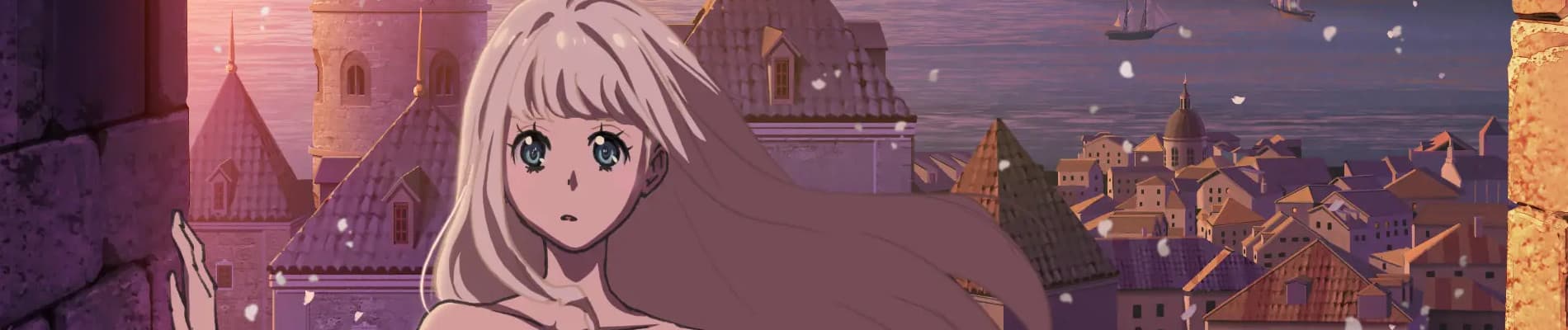
The story takes place in an alternate-universe 18th century. With hazy flashbacks to a ship burning, a boy crying out to her, and sailing away on a small boat, the white-haired Fena Houtman is sold off to be married. Though she plots her own escape, she ends up being rescued by an oddball group of pirates called The Goblin Knights. Among these pirates is Sanada Yukimaru, the young boy whom she remembered from her past. With a new group of friends, she sets out to create a new sense of purpose, but finds that her older memories start coming to the fore. Remembering that her father’s last words to her involved something called “Eden,” Fena feels pulled to discover what or where Eden is, all the while fending off those who also seek the word’s mysterious meaning.
One of the fascinating aspects of a pirate story is the ability to have the tale be either an Errol Flynn-style swashbuckling fantasy or lean more-heavily into sea myth and mysteries of the waters. Fena: Pirate Princess attempts to walk both the comedic and dramatic lines, taking the silliness inherent in its genre and mixing it with the story’s aura-laden mystique. It does however take a few episodes for the series to make the approach work; it tends to swap rather freely between the two methods early on, making the first couple of episodes and transitions a bit clunky. That’s not to say that it isn’t funny, but rather that it doesn’t land the punches as cleanly as it is going for.
Part of the reason for this is that Fena, while definitely a likeable, fun character, is also the driving force behind the drama working. She’s depicted as being wildly out of her element, enjoying the new freedom she has now that she’s no longer in captivity, but is adrift both in terms of ability and her place in the world. While a main character being adrift certainly offers some comedic potential, her character also has to carry the burden of being that which the story focuses on with its pathos. In terms of the show’s overall structure with the adventures and discoveries of what Eden means, Fena seems more-suited for being a drama heroine rather than being a comedic one.
Fena: Pirate Princess ultimately works more effectively when the series figures out which characters are better suited to comedy versus which ones aren’t. Once this balance is realized a few episodes in, with Fena and Yukimaru as the dramatic force while most of the other Goblin Knights are the comedic energy, it manages to make for fun interactions or digressions. The timeouts for merriment and frivolity come across as more wholesome, and the result of this is that it builds camaraderie among the Goblin Knights. The more time is spent with them, the more I could believe that they were an unflinchingly loyal group to one another and, by extension, to Fena. That way, when action scenes take place when they must fight off any other pirates or people that get in their way, it made for a good time even if the characters themselves were not entirely deep or memorable.
And the action scenes themselves are handled well. Since the show takes place in a somewhat-realistic setting, it has to rely heavily on swords, guns, or other objects and things that are less fantasy-oriented. As such, most of the action sequences utilize the characters’ speed rather than brute strength. While they may not have animation quality at the level of sakuga or that of a more-explosive shonen, the effect is one of nice, slicker violence. Watching people get slashed was fun, and the Goblin Knights having a witty remark on standby added an extra dose of pleasure.
And the series as a whole looks great, as though Production I.G. was trying to somehow blend a Disney-esque aesthetic with anime. The result makes for some genuinely-lovely sequences, culminating in one sequence during the tenth episode that made full use of the show’s beauty. The music itself is also another strength of the show; with plenty of appropriately lulling and dramatic numbers, most of the tracks capture that silly sea shanty aesthetic. Coupled with the action segments, Fena: Pirate Princess pulls off the fun of pirate stories solidly.
But as I mentioned, the show struggles with balancing between the seriousness of the drama and the comedic fun. If the first few episodes were the show trying to get a firmer grip, the last third unfortunately undoes some of that. As the dramatic story begins weaving itself and takes its place at the front, there are several other mysteries and characters who are introduced that each have their own motivations about finding Eden or using Fena’s sealed memories for their own ends. Two different threads, one of the benevolent Goblin Knights and the other of a man who seems to have a connection to Fena’s past, begin to come together.
It ultimately ended in a fashion that managed to resolve some of the lingering questions, but also unleashed a whole other box of them at the same time. There are certain aspects of the story that get either re-introduced or re-focused that left me scratching my head as to why they were there in the first place. This is, in part, due to Fena: Pirate Princess’s tonal shift; although there is a battle that takes place in the final hours, the show adopts a more metaphysical setting for its ending. While the change in style makes sense given the surrounding context involved, it feels like it contributed less to a proper ending and more like an attempt to try and get everything finished. The various mysteries introduced, each one peculiar in its own way, feel like they reached too much of an anticlimactic conclusion. They don’t quite coalesce because the dialogue, decisions, and resolutions don’t seem to coincide with what the drama was going for. In a manner of speaking, it’s almost as though the compass got thrown out at the final coordinates. I was left with a feeling of, “That’s what it all came down to?”
Another reason why this matters is that, even though it may have had its bumps in the road getting started, the actual experience of watching the show was mostly nice. Even though it wasn’t anything that I would call “special,” it had energy and life. One impression I always had was that the people involved in the production cared greatly about putting out a good product. Everything in the series felt like attention was given to it, which just makes the several trips at the finish line all the more disheartening in the end. You can have all the passion for your product in the world, but it still has to deliver.
______
Fena: Pirate Princess tries to walk the line between comedy and drama to mixed success, but in a way that feels surprisingly earnest and well-intentioned. It takes the inherent advantages of both the swashbuckling craziness of pirate stories with the mystery of the ocean and tries to make the most of both. With good animation and a good soundtrack, this original story did indeed hold my attention the further it went along. While it may struggle in the beginning, it ultimately settled into its rhythm and keeps mysteries incoming. But the ending is just too weak, leaving it limping in its final minutes as the resolution doesn't feel adequate. I may not have enjoyed it nearly as much as I would have hoped, but it was still an okay show.
29.5 out of 33 users liked this review