Angel's Egg
a review by MattSweatshirT
a review by MattSweatshirT
Having gone through almost every lead-directed work in Mamoru Oshii’s catalog, I have developed an immense appreciation for his massive influence throughout the anime industry, as well as the unique vision he brings to every project he works on. The more I saw from him, the more impressed and captivated I was by what he had to say through his auteur mode of expression. And Angel’s Egg is most likely his most artistically dense work to date–bursting at the seams with things to say. It is also the most distilled embodiment of what I personally like most about him as a director. It is an artistic expression of uncertainty. A creative visual language used to articulate his personal grappling with various issues. The presentation of the issues he grapples with is what I often find uniquely intriguing about Oshii. He crafts a world and atmosphere that the audience is lulled into to simulate the space and emotional-landscape the characters exist in–as well as perhaps the one he himself exists in when confronted by these issues–and then provides brief moments of clarity in which exposition is delivered to better outline the messages and themes at hand. The harsh, candid delivery of this exposition is particularly effective at striking through the priorly built up atmosphere.
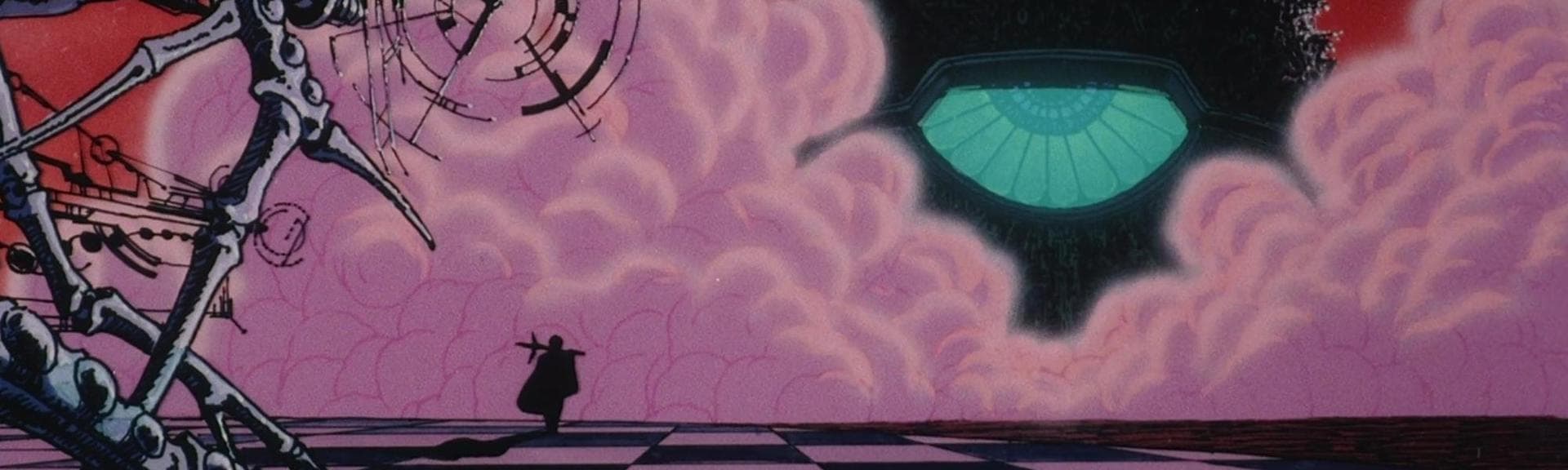
Angel’s Egg, while not the most technically impressive of his works, is still my favorite. The main reason for this probably being my personal affinity for its style and world. It is gorgeous and entrancing in every facet of its form. I find myself craving to take another dive into its bleak and haunting, but equally beautiful and mesmerizing world constantly. With its seeming never-ending night steeped in grays and blues, its abandoned gothic-Victorian architecture, and its gargantuan fossils of sea creatures; Every detail in this film has an alluring fantastical coloring to it.

Something that inevitably has to be touched upon when talking about a story is the actual events that take place in it. Or, in Angel’s Egg’s case since it is essentially the entire focus of the film, the symbolism behind those events. There is a wide array of interpretations you can explore with the symbols in this film. This is undoubtedly another reason I find myself coming back to it so often–there is always a new perspective to consider when analyzing it. You can endlessly think about how different pieces of it connect if… maybe the man was Noah? and the girl the dove? Were the statue fishermen a representation of the unrelenting destructiveness of blind faith—and therefore maybe the man was a Christ-figure, the girl noah, and he was freeing her from her blind faith. Or perhaps the ending is not the man sacrificing himself but really he was too curious for his own good, didn't keep faith, and is now the only one not immortalized into the eye of God. These that I have mentioned are only a few possibilities–there are tons more that seemingly hold just as much weight as the next, and there are plenty of places you can go to see them all in-depth. Some of the other reviews on anilist for Angel’s Egg go into these theories in a lot of detail, so I recommend checking them out if that’s what you’re interested in. While certainly fun to explore and itself a testament to the accomplishment of this film, the endless specific interpretations of its symbolism aren’t what I personally value most about it.

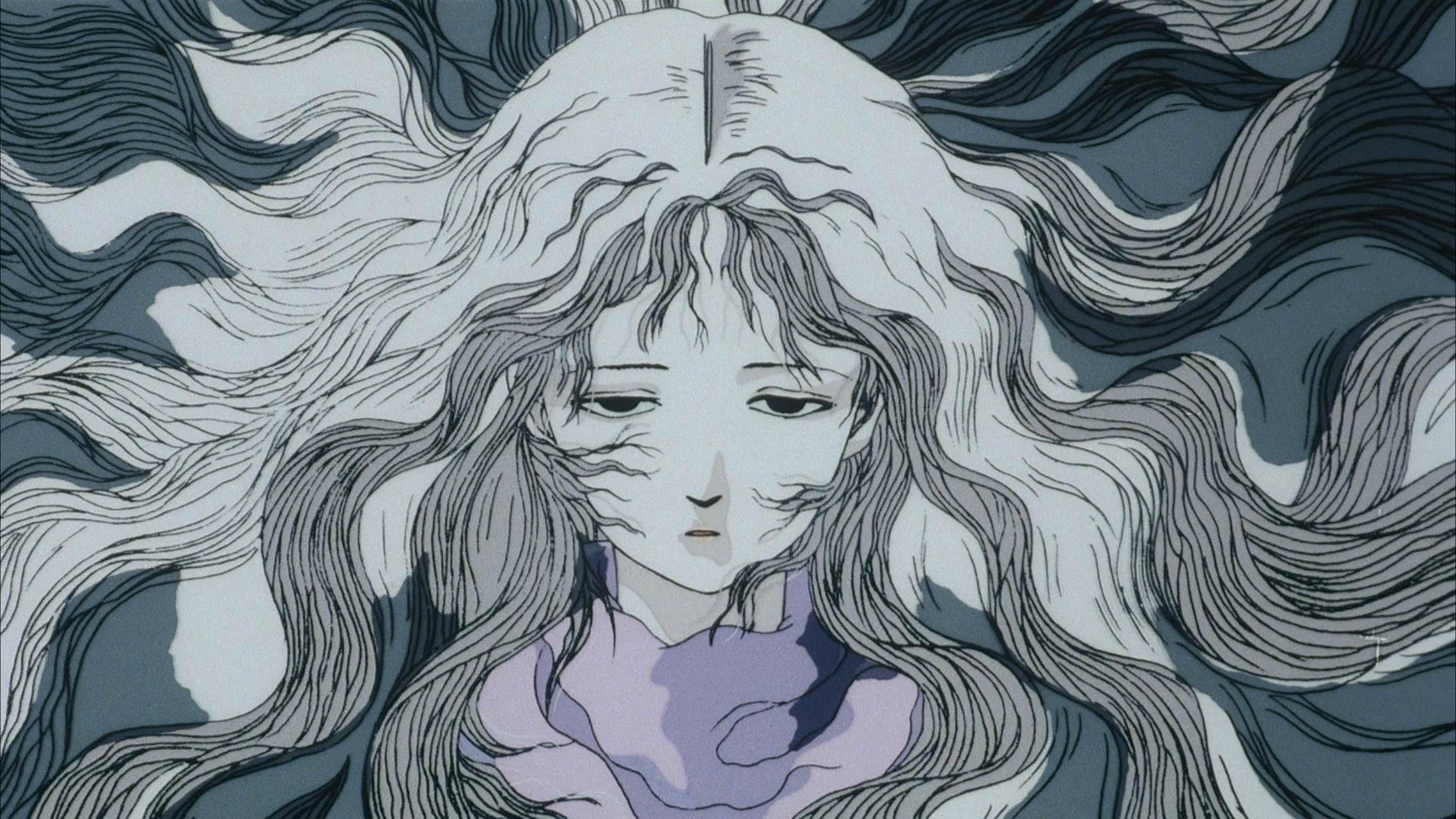
What I find the most personal value in is the more implicit emotional expression this film serves as. It is a personal grappling with various emotions that is incredibly ambiguous. In relation to what Oshii was going through at the time, a loss of a priorly fervent faith in religion, this emotion and ambiguity gains context. This film feels like an expression of the confusion he had in losing his faith and reevaluating his life, and in doing so, being forced to resign himself to the unknown--the meaninglessness that is so brutally apparent to life once you let go of something like religion that gives all of the answers to you. It expresses the emotions conjured by this meaninglessness. It does this through the actual content and form of the film; creating a cascading landscape of somber resignment; a bleak, empty world abandoned by God. And even further, it does this through the jumble of contradicting interpretations one can make about the events of it. There is no rational interpretation that accounts for every scene of this film. There are so many disparate parts that can't fully be explained, but can be felt. You can feel the click in your head when you see the trail of bird feathers on the beach, but it's seemingly meaningless. The image of the girl staring at the camera while under water amidst the seaweed is a powerful, striking scene--but it's seemingly meaningless. You can shift all of these different things around and manipulate their meaning to validate your theory, just as humans can with their beliefs on religion and the meaning of life, but its ultimately meaningless and unknowable. This feels ultimately like only thing this film strives to concretely communicate.
This expression of uncertainty is ever-present in Oshii's catalog, and it is at its most prominent here. This feels the most personal and desperate of his works--wholly committed to its artistic and emotional expression rather than dealing with any pretense of narrative or characters.
At the end of the day, the only conclusion I would like to make about this film, inspired by absurdist theory, is this:
When viewing the prospect of life (and this film) we are confronted with a barrier of understanding, a lack of objective meaning we can glean. Only once accepting this fact can we enter a state of pure existence (or experience of this film).
58 out of 63 users liked this review
