The Heike Story
a review by Dramaddict
a review by Dramaddict
While many people were kindly disheartened by Naoko Yamada’s departure from KyoAni, I see it as a logical step forward in her already auspicious career. Yes, KyoAni is unquestionably an industry leader, pushing the envelope on how visually marvelous anime can be, but at the end of the day, KyoAni still caters to a broad audience—they wouldn’t be as successful as they are if they didn’t. With her latest films being “A Silent Voice” and “Liz to Aoi Tori,” Yamada has been dipping her toes into more experimental media for some time now, and with that requires creative freedom not as easily available at that beloved studio. So her transition to Science SARU—one of the most experimental anime studio to come out in recent years—serves as an exciting foray into the world of arthouse; and adapting a poem as ancient and dense as “The Tale of the Heike” makes this project all the more ambitious.
But alas, that ambition might’ve been too great.
For those who don’t know, Heike Monogatari is basically the Japanese equivalent of the Iliad and Odyssey; it’s a tale as old as time passed down through many generations. To adapt such a story would be a task so gargantuan, even the most talented of screenwriters would cower at its premise. And yet, Reiko Yoshida—who’s pretty much written all of Yamada’s works—stepped up to the challenge. I respect it, but the narrative was...messy, to say the least. The show kind of expects you to fill in the gaps yourself, but as a Westerner who isn’t too familiar with Japanese literature, the plot lost me more often than I’d like to admit. But that isn’t my fault. The job of a show is to tell a story, not to tell a story I’m supposed to already know: it’s just poor adaptation. There are way too many characters sitting around and talking about the plot, things just happen and I have no idea why, and it has the same problem as The Godfather where there’s a bajillion characters I can’t keep track of (it doesn’t help when so many of their names end with “mori”. Yamada just wasn’t set up for success with such a convoluted script adding so much confusion to the whole experience. On top of that, it was bizarre to see a script play so far away from her strengths as a director.
As evident from interviews in the past, Yamada describes herself as a “method” director, taking pride in her ability to get close to her characters’ thoughts and frame of mind. And looking at her filmography, this is her first time directing a story that isn’t set in modern-day Japan, and she seems out of her depth here. Biwa, as an observer-type main character, has next to no presence in the story for most of the runtime, and for a historical-political drama, none of the other characters were all that relatable either; it felt like she was grasping at straws when trying to portray them. Why? There’s too much dialogue. Her characters aren’t allowed enough space to express themselves. Yamada’s style focuses on empathy and all the little emotions we hide in our body language and facial expressions. A common theme among all of Yamada’s works is the deep anxieties the future can hold, and that fear has always been communicated through subtext. I don’t even want to call it subtext, because that implies there are lines of text to read in-between, and her best moments are when there IS no dialogue, conveying emotions purely through audiovisual mastery.
Oftentimes, Yamada’s characters aren’t able to process the emotions they’re dealt with. The beauty of K-on is in the senior's naive ignorance of their transient lifestyle. Tamako Love Story captures the unease of facing others’ feelings, including your own. And if “A Silent Voice” didn’t make this clear, emotions are more than just words; it’s not something that can be described, only felt, and she’s consistently delivered on that delicate intimacy until now. Heike Monogatari falls into that anime trap where everything’s overexplained. Characters that somehow have the self-awareness to psychoanalyze everyone including themselves is a trope I despise in drama. So to have Biwa, a literal child, flat-out say that she’s “frightened of the future” in such a pronounced manner was jarring, to say the least.
To make matters worse, the show feels tonally all over the place because Yamada was trying to get TOO artsy with it. I never thought Yamada would be one to use vapid metaphorical imagery, but alas, I was wrong. The most egregious example is in episode 6 where Kiyomori sees smoke in the shape of skulls to symbolize his guilt and fear of the recently deceased. Wow, how deep. I swear it looked like a parody scene straight out of Adventure Time; it was horrendous. If it was any other director, I would’ve burst out laughing.
And the final nail in the coffin to this bizarre mess of a show is the music. Ushio Kensuke—a composer that previously worked with Yamada on “A Silent Voice” and “Liz to Aoi Tori”—has started to become monotonous. It feels like he’s recycling old ideas in an almost self-plagiarizing way. His music is wonderfully hypnotic and captivating, seducing his audience into a more contemplative headspace to explore the character’s emotions. It was gorgeous, really, but this time felt lackluster and out of place. There were moments with goofy percussion, then 2 seconds later comes the more metronomic pulse of a sentimental piano. Instead of easing the audience into a lull, he’s just telling us how we’re supposed to feel, and that’s annoying. Also, for a period piece, I’m not a fan of him using modern instruments in the soundtrack. Sure, he made sick music in “Devilman:Crybaby” and “Ping Pong the Animation,” but why the hell am I listening to a brisk techno beat in a show set in the Heian Era? And it’s not like it’s a fusion of culture like Samurai Champloo.
I honestly think the biggest crime here is the rushed pre-production. I didn’t think Yamada would resort to the occasional still image. Naoko Yamada is a director that excels with time. Back in KyoAni, she had the liberty to completely redo K-on’s character design (a decision that paid off dearly) and she had the luxury to spend 2 trips to London in preparation for K-on the Movie. From what I can tell, Science SARU seems to be facing overproduction issues to the point that Masaaki Yuasa—a director synonymous with the studio—says he himself is burnt out and needs a break. That’s why Yamada’s here. They’re trying to look for freelance directors to diversify their catalog so Yuasa doesn’t have to do everything himself. A classic tale of too much anime, not enough workers. It’s depressing, really.
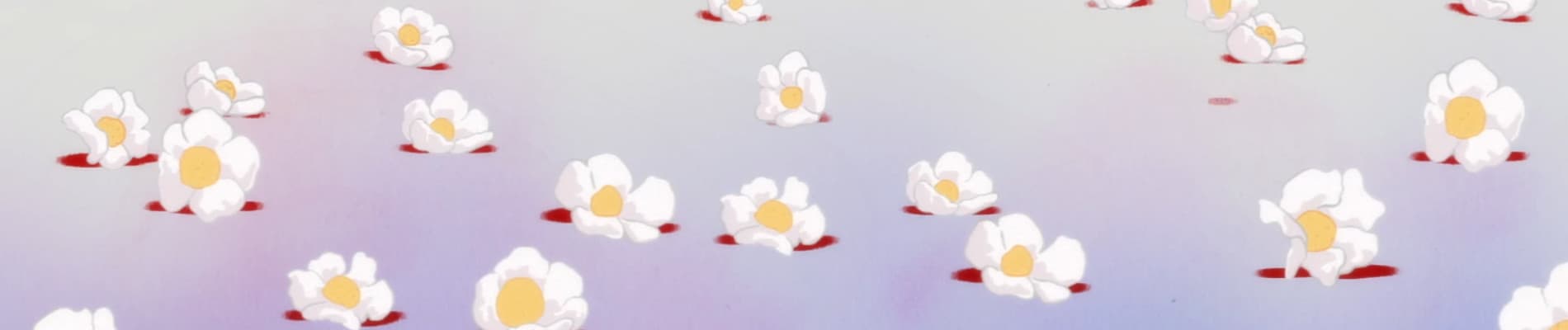
I know I’ve been mostly negative on this review, but that’s only because of my exorbitant expectations for the show. I mean, it’s not all bad. I liked some of the flower imagery. Whenever older Biwa starts hacking away at the biwa (what a dumb idea for a character name) with an intense staccato, it gave me chills. I love the background and how it gives it off the feeling of an old scroll. And I especially love the shots where Biwa is framed with one eye and the other is hidden off-camera. Depending on what eye is shown, it conveys a lot of what she’s thinking.
Everything that could’ve gone wrong went horribly wrong, but Yamada still managed to pull out a show that looks better than the vast majority of anime I’ve seen. It was too artsy, too ambitious, but I’d rather have it be too ambitious than not at all. This shows that Yamada is still a top-tier director, but also a painful reminder that no artist is infallible. Despite all of that, Yamada continues to be my most favorite director—not just in anime, but across all media. Having one disappointing project doesn’t change the fact that she created what I believe to be 4 consecutive masterpieces, nor does it diminish the deep catharsis they brought me at points in life I needed it the most. Sure, it could be that this new direction is actually pretty good and I’m too close-minded to see her vision, so I do look forward to revisiting Heike Monogatari after several months of reflection, but for now, I must give it an agonizing 5/10.
54 out of 75 users liked this review
