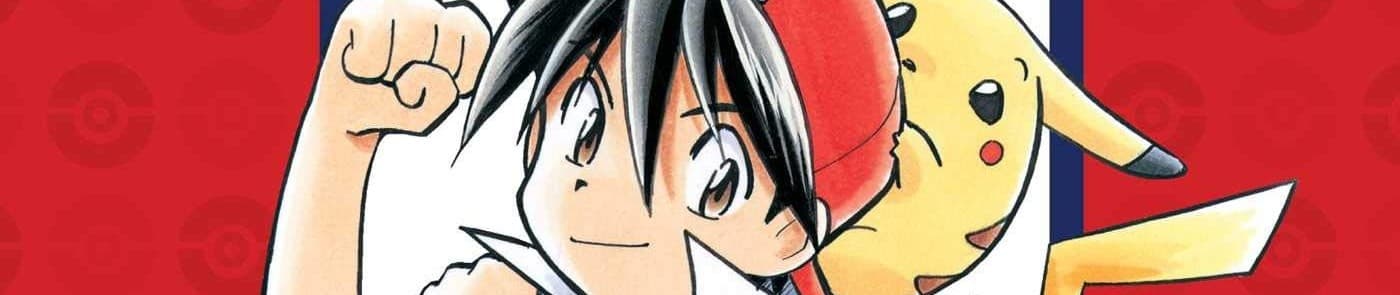
This review will contain no spoilers. Also, I will be calling Green and Blue by their localized names. Therefore the rival is Blue, and the girl is Green.

Pokémon, as a franchise, has always found its stride in miscellaneous and meandering adventures. A charmander lost in the rain, hidden ancient Pokémon buried deep underground, a hamlet full of eerie ghosts, or a mysterious and looming figure beyond the lighthouse over the ocean— so many atmospheric and adventurous moments that have been imprinted into many children's minds, including mine. There’s a certain magic to it that seriously leaves an impression on people; there’s a level of fun and escapism, a whole wonderous world with new things to see awaiting you. So, does the manga capture this magic— well, yes and no, but I’ll get into that. For now, I should clarify I went into this series with one question: is this going to be genuinely good, or is it gonna be a self-masturbatory fan-service circle jerk for nostalgia filled junkies? Fortunately, for the most part, I was pleasantly surprised— so let’s get right into it.
For some background, Pokémon Adventures takes place in the Kanto region— so generation one, for those of you familiar with the franchise. We follow our protagonist, Red, as he adventures across the country, battling and capturing many Pokémon along the way. The A-Plot involves our protagonist and his rival, Blue, battling gym leaders and filling out their Pokédex. Team Rocket— an evil organization— is trying to capture a Pokémon called Mew, which Red has to put a stop to; that’s the B-plot. It’s hard to sum up simply, but I’ve taken the liberty that the readers here at least know what a Pokémon is.

Pokémon Adventure is in no way atypical for a Pokémon installment. You have all of the usual set-ups— a strong and somewhat callous rival, a wacky professor, a naive but good-hearted protagonist, and a goofily evil team of bad guys. Being based off of the first generation of Pokémon, it’s the usual crew of familiar faces as well. Something that doesn’t shoot in the manga’s favor is that along with it they bring cliches as well, which aren’t really evolved from their previous incarnations. There are very few instances where they evolve these tropes past their most archetypal forms, so be prepared to experience some eye-rollingly lazy writing on the plot’s front— this effect is only confounded upon if you’ve played or seen any previous Pokémon work. However, I do think there are real nuggets of gold sprinkled into the crevices of every arc; I can really see this story blooming to be something special in further installments. For one, since it’s a manga aimed toward children, it’s easy to forgive the cliches as long as they do something interesting with them. I’m happy to say there’s some fun stuff here. By the end of the manga, even if Professor Oak points it out in an exposition dump, you can see how both Red and Blue have changed. Rubbing off on eachother, which is a nice dichotomy even if they are the stock and standard rival duo, honestly. Of course, not everything is done incredibly well. Take this for example:

Bad dialogue really perforates the chapters of this manga. Not only do they constantly use trope-y and overused lines, but sometimes it doesn’t even make sense in context of the characters— especially exposition wise. In the example above, not only is “let me show you the cruelty of adults” a cliche, it’s just stupid. He has no reason to be so evil, and it just comes off as corny despite trying to strike a serious tone.
Beyond the occasionally lazy writing, however, Pokémon find it’s stride in being simple. It takes these stock characters and gives them likable dynamics that are fun to see in action, given the dialogue isn’t particularly bad in said scene. You root for our naive protagonist as he adventures towards his dream— and that’s kind of the point. It’s supposed to be a fun-filled adventure about friendship and teamwork, and that’s totally fine. At times it really does this perfectly; I couldn’t be happier with those moments of pure, unadulterated entertainment. So, yeah, it can own it’s cliches. One of the best examples of this would be Red as a character. His one-note naive and kind personality makes him incredibly likable and charming, not to mention captures a childlike innocence most of us have long lost. Even if he does develop to be a bit more cool-headed by the end of the manga’s run, Red is a trope done near perfectly. Sometimes you don’t need to innovate too much, given the setting and context.

Finally, the themes are about as stock and standard as they get. Which in this case, is no way a bad thing. A sense of camaraderie and friendship really works in a story like this. Not only is it good for teaching children the basic moral of compassion for others, but it’s heartwarming as an adult. It’s pleasant, simple, and to the point. Nothing wrong with talking about friendship as the crux of your show depending on what you’re trying to do, or what tone you’re trying to convey. Hell, even the setting contributes to this— it’s literally just about adventuring and making friends. I’d be shocked if they made the main thematic purpose anything else.

Harkening back to the hook statement for this review, Pokémon is a series about adventure first and foremost. In the sense of random, fun, and episodic encounters that are memorable and inspire a feeling of childlike wonder— Pokémon Adventures succeeds. There are plenty of enjoyable one-offs that Red stumbled into, and damn were those chapters good: finding a Pokémon race on the way to the next city, joining Team Rocket to catch a badge thief, stumbling upon a bizarre Pokémon fan club, entering a hollowed city of ghosts— the list goes on and on here. It really captures the appeal of the early Pokémon episodes, and also in early Pokémon’s likeness, it captures very mixed pacing. Chapters constantly flash by, hardly bothering to set up the next event. Hell, never setting up the next event. The manga has no clear direction for most of its run, and it makes the whole adventure feel aimless and meandering. It would have benefited the story to include a map or outline the route Red will be traveling to get his badges at some point. This may seem minor, but it really ruined the whole adventure schtick. Without a baseline for travel, it’s hard to get invested or excited.

What’s this? There’s already an adventure map? Oh… well, uh— it’s still bullshit. I really like the illustrations and route details provided in these maps, but they’re not given in the story, so much as end-of-the-volume extras. The context and timing is completely off here, making the maps more of an insult to injury than anything. This whole thing ties into the nostalgia-based circlejerk, anyway. People who loved these locations and played the games as a kid won’t be near as bothered with the lack of outline, and will just be happy to see these places reimagined in manga format. I really hope the writers didn’t write this with the express intent that most would have pre-knowledge.

The characters in Pokémon Adventures are all cardboard cutouts— but in no way is that a bad thing. As touched upon earlier, Red is an extremely likable protagonist who touts the adventurous themes of the series. His opposing personality to Blue is fun to see in action, and often leads to humorous moments. They’re simple enough for kids to understand, while being charming enough for adults to have fun with. I talked about this earlier, but the way they develop each other is quite apt as well. Red becomes more of a critical thinker; Blue becomes more compassionate for his Pokémon, and generally less self-centered. My favorite from the primary cast is definitely Green, however. She’s a genuinely witty and charming character; her manipulative tendencies play off of Red’s naiveness very well. Don’t expect a lot from any of these characters, and there’s nothing to really analyze, but it’s a fun cast that certainly serves its purpose well.
On the other hand, I cannot say the same about the tertiary cast. Some characters feel like they’re just shoved into importance due to being popular in the anime or games. Brock is the easiest example I can think of. He’s barely in the story at all, and serves his purpose as a gym leader— but then they make a big deal of him and Red being friends, having him travel to a city during the climax to save him. Not only does him knowing Red is in trouble not make sense, but they had a singular Pokémon battle. It’s such a pointless turn of events, and I can’t help but think it was done for fan service.

Know what character also randomly showed up during the penultimate finale? That’s right, Misty— and god damn does she vex me. She’s the perfect example of how the pacing in the manga can screw over both the plot and characters. Her character struggle is introduced and concluded in the span of three chapters, so I can’t help but feel it’s rushed. She somehow starts liking Red in a semi-romantic tsundere type of way, and evolves to genuinely care about him from one battle where she was knocked out for the entire chapter. Then, when Red is ready to rush back into combat, she gets mad and stops him— declaring they’re friends who care about each other so he shouldn’t be reckless, noting that she thought he already understood that. For one, they don’t have a bond. They’ve been together for one day and she acts like they should understand each other perfectly. This sort of plot line is a cliche you see in a lot of stories, but without the proper time to breath and develop it feels anticlimactic and brushed over. It doesn’t help that she randomly shows up twice on later occasions just because it’s convenient for the plot. Hopefully her character will improve in further installments.

Another thing I should mention is that the Pokémon are oddly decentralized here. They don’t have distinctive personalities and hardly get scenes to themselves for the most part. Hell, the manga is oddly selective with the Pokémon it wants to become part of the main cast as well. Red will catch a Pokémon and then it will never show up again, but sometimes he just randomly catches a Krabby and it sticks around. What happened to all of those Pokémon he caught in the forest and the Safari Zone? It’s not a big deal, but it’s a bit weird. Especially when compared to stuff like the Pokémon anime, which creates characters as memorable as Charizard despite Pokémon only being able to say their names.

For Pokémon to work, you have to hold your suspension of disbelief. You have to simply accept the idea that an 11-year-old child can travel across the country and fight evil criminals organizations by himself. It’s part of the fun; I’m not so petty as to nitpick what’s necessary to make the story work. However, there are plenty of issues present outside of this. For example:

On the surface level, stuff like this is fine— but I’m concerned the writers will write themselves into holes sooner or later. In later generations, we get introduced into many more Eevee forms. How does one introduce Umbreon or Leafeon when it’s already been established that there’s only three types of Eevee? The same thing goes for Pokémon count. They’ve already established a set limit in the entire world, so how do they explain future generations? Hopefully they’ll have a way around this, but it’s hard to take the world-building seriously when it’ll just betray itself in the next installment.

On top of this, the manga is filled to the brim with inconsistencies. They had a low-level Pikachu one-shot a high level Onyx, despite their type difference. In Pokémon, an electric type is supposed to be weakened against a rock type. Fucking hell, in the anime, Ash had to put Pikachu on a whole-ass electric power mill to beat Onyx in the first place. Here he just does it. What’s worse is that they establish water attacks don’t work on grass Pokémon the chapter after. Which isn’t how it works exactly, for the grass Pokémon should still take some reduced damage— but that’s besides the point. The authors just bend the rules of the world towards whatever’s convenient for the plot.

Perhaps my biggest issue with the manga, which permeates every single section I’ve talked about so far, is how often they base writing off of pre-contextualized knowledge. They don’t really bother explaining gyms, Pokémon types, the Pokémon league, locations, or legendaries. They just throw you in and assume you know; it’s so incredibly lazy. I’m sure they would have just delivered it in exposition dumps anyways, though. You can really feel this aspect as we travel around unknown locations with no clear direction; as we get into strategic battles with no knowledge as to how types work. Rushing the set-up always muddles the execution, and fuck is it crippling here. Even outside of assuming you have pre-knowledge of some things, they base some character appearances and events off of nostalgia. As previously stated, Brock had absolutely no reason to come back into the story. Misty was rather shoehorned in as well. Fuck it, here’s another example:

No, Pokémon Adventures, I don’t know Articuno— you didn’t bother introducing the concept of legendaries until this very chapter. I don’t know if they simply forgot or didn’t have the foresight, but the introduction of Articuno would be so much more impactful had they established legendary Pokémon before this event. It doesn’t hold any weight or impact the story at all due to this. It feels like it was just aimed at fanboys who would already be hyped to see legendaries.
So, in the end— is it a pure nostalgia trip? No, not really, but it certainly has pandering elements which ultimately bog it down.

Pokémon Adventures was a very flawed, but overall enjoyable ride; I can easily recommend it, and I’m excited for more. Despite its tropes, cliches, and pandering, there are genuine nuggets of gold within the character interactions and exploration elements. If you’re a fan of Pokémon as a franchise, definitely check this out. Otherwise, maybe give it a shot, but it’ll be harder to get into. If you have any criticisms or other thoughts, please leave a message on my profile. I’m always down to discuss series.
Next Review- Pokémon Adventures: Yellow

Disney and Mark Twain are now canon to the Pokémon universe. So cool.

They gave Mewtwo the King Bach comically large spoonful LMFAO.

They really did their best to make Pikachu look SpEd.

This kid is like a 11 lmao, he does not know what ornery means.

This fight was actually rather great. Plenty of fun strategy that isn’t incredibly surface level as opposed to the fights beforehand.
50 out of 56 users liked this review
