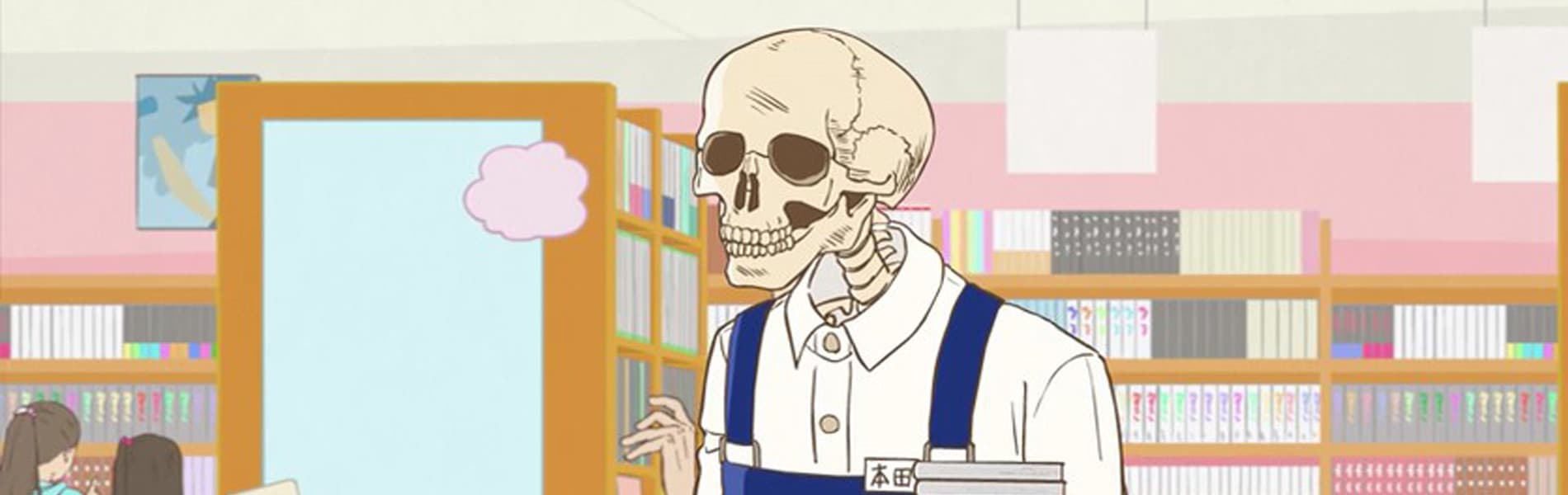

The first thing you notice is that the main character is a skeleton. Just bones and clothes. The second thing you notice is that the skeleton is freaking out because a handsome foreign man is asking for help finding yaoi manga, and the skeleton’s English is very bad.

If we ignore the skeleton and the fact that their coworkers wear things like plague masks and knight’s helmets—we’ll come back to that part—the series is actually a fun, interesting and all-too-relatable look at working in a bookstore.
Lots of parts will be far too familiar to anyone with retail experience, regardless of country or store type: back room conversations, trying to explain supply issues to customers, phone calls, internally freaking out when you feel in over your head, that fantastic feeling when you can get a customer just what they want and it ends well.

Some parts seemed to be specific to Japanese bookstores: specifics of shrinkwrapping books, for example, or their relationships with publisher representatives. But it’s all easily understandable, not in the least because Honda-san takes the time to explain how everything works to the viewer.
Now, back to that obvious tidbit: s k e l e t o n . I thought at first I might be getting into a fantasy slice-of-life: running a bookstore in the demon realm or something.* The answer is more mundane, but by the time you realize it you’re already hooked: the skeleton is how the original manga creator anonymized herself. Similarly, all the other coworkers, bosses and industry contacts also get masks to avoid connecting the characters with their real-life counterparts.
*Anyone who has worked with the public could argue that retail is, by default, in the demon realm, but you know what I mean.

Still, the visual of a full-on skeleton wearing the store uniform and helping enthusiastic boys’ love devotees will never not be funny.

Verdict
English dub? No
Visuals: A limited animation style is used to great effect. It’s stylized and doesn’t feel lazy, and made me feel like the manga (which I read after watching the entire show) had jumped to the screen. Plus, I loved the bright colors and character designs.
Worth watching? Yes. It’s a short 12 episodes that go even quicker because every episode is broken up into two minisodes. It might be Honda helping various manga fans from other countries–apparently the bookstore is near a popular tourist area–or bemoaning backordered titles, commiserating with coworkers in the break room or explaining how inventory is done. It didn’t get old, and I was genuinely surprised (and disappointed) when I found myself sent back to the title screen after finishing the 12th episode.