SPOILER-FREE!
This review was originally written in July 2021, published as a YouTube video on my channel.
The score at the bottom is no longer representative of my feelings on the show. However, I have left it unchanged here as a time capsule of what I once felt. Please see my profile comment entry for Hyouka to see my most-recent thoughts.
There’s an old expression that I’m sure many of you are familiar with – “First impressions mean everything.” Considering the sheer amount of people we meet in life and the media we consume, being able to make quick judgments about the things we see is a means of helping us save time and sparing us potential aggravation or disappointment. But there’s another aspect of the “first impressions mean everything” saying that gets underscored, and that’s your original attitude about a show that you took the time to finish. It’s entirely possible for your opinion to change down the line, with your first impression somehow being an insufficient way of gauging how you feel.
Hyouka is an example of a show that I had a particular impression about, but ultimately had to re-evaluate sometime later. When I first saw it, I liked it, but didn’t love it. Then for whatever reason, it was a show that simply would not leave my mind. I kept darting back to it seemingly at the most random of moments, as images of its characters, setting, and other recollections came to the surface. With the show being such a presence in my thoughts, there was only one decision I could reasonably make – watch the series again and see how my new reaction would treat the material.
______
Oreki Hotaro is a high school boy who wants to get through his life putting in as little effort as possible with his “energy conservationist” outlook, but ends up joining his high school’s classic literature club at the request of his older sister to avoid having it abolished. One of the members is Chitanda Eru, a girl in Oreki’s grade with an insatiable appetite of curiosity. After school at a café one afternoon, she comes to Oreki asking him to help her solve a mystery relating to her uncle. This mystery involves her uncle’s ties to the classic literature club from decades ago and something he said that made her cry, a memory that Chitanda cannot remember. With their two friends Fukube Satoshi and Ibara Mayaka, the group sets out to solve the mystery.
Although the mystery behind Chitanda’s uncle is the primary element that gets the show in motion, it does not stick around for the entirety of the run. Hyouka is peppered with mysteries throughout, some lasting for several episodes at a time, while others are quick one-offs. The mysteries are not those of the supernatural, some grand governmental conspiracy, or the characters getting in way over their heads. Rather, the mysteries tend to be closer to those of the everyday, the small, seemingly incidental things where we wouldn’t notice any mystery or care to notice unless pressed. The characters themselves don’t have any particular stakes in the mysteries either, with little-to-nothing to gain or lose by leaving them solved or unsolved. The show is fueled by Chitanda’s curiosity instead of a more-pressing urgency.
It's for this reason why Oreki works so well as the show’s main character. His blunt, sarcastic attitude and general outlook on life makes him, in many ways, a completely unsuitable character for being the center of a mystery show. He has some great abilities for putting clues together and reaching solid conclusions, but he attributes it mostly to luck as opposed to any innate ability. The show’s framing makes Oreki getting roped into solving the various mysteries by Chitanda against his will work both as a small comedic gag and because the audience is similarly pulled along on the ride.
This is also what makes Chitanda such a fun character in her own way – her curiosity has a powerful gravity to it that makes her both incredibly endearing and, at times, a little much. When Oreki comments about her rudeness or the fact that he seems incapable of saying no to her requests for help, it demonstrates how well they bounce off of one another. They provide each other enough of a foil to feed both their comedic moments and their general conversations, so each new mystery presents itself with the question of what is going to set off Chitanda’s curiosity and how much Oreki is going to squirm having to confront those big eyes of hers. Fukube and Mayaka, while not being given as much to do as the main duo, provide enough support both to each other and the group as a whole to make them worthwhile characters as well. There are moments throughout the series where they are given substantive intellectual or emotional focuses, making the ensemble as a whole come together nicely.
But beyond its chemistry-rich characters lies the show’s most-unusual aspect, and that’s its somewhat-indefinable state of being. While Hyouka is primarily a mystery slice-of-life, it doesn’t play itself off as one since the slice-of-life and mysteries have such low stakes. There are romantic overtones and undertones to some of the characters and their interactions, but it doesn’t play itself off like a romance, either. The show seems to dip its toe into all these various genres without actually fully committing to any of them. It is a meta-examination of these genres? Kind of…?
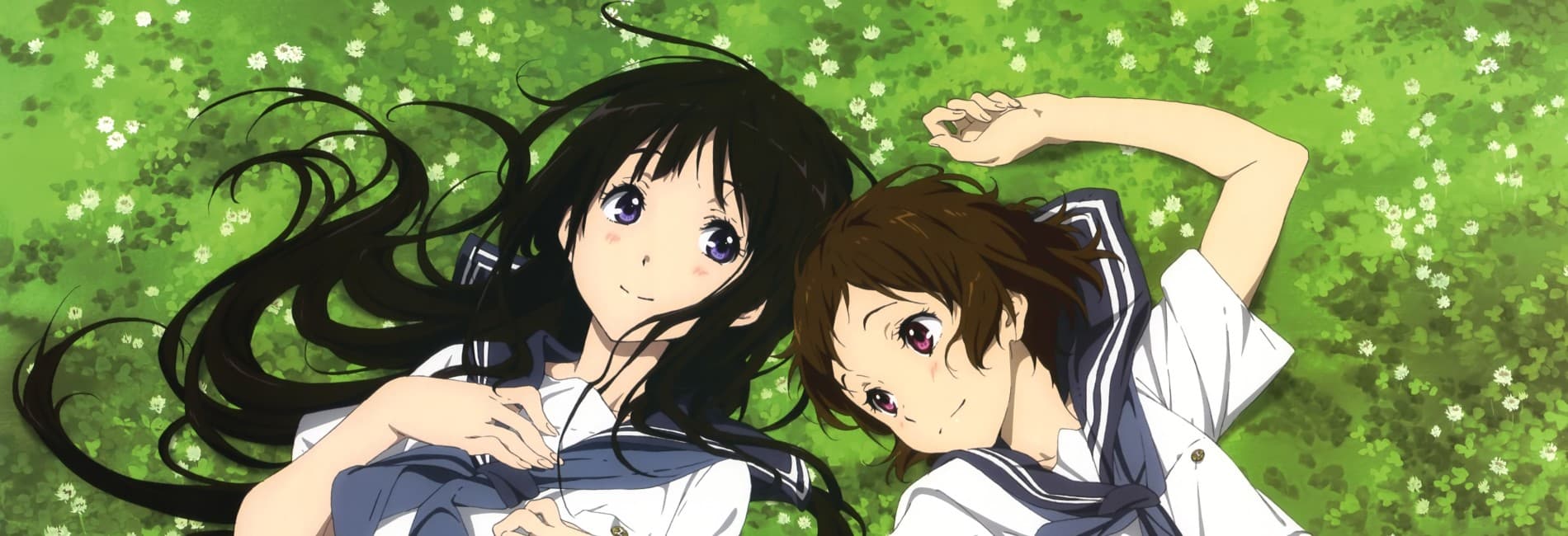
While I would ordinarily criticize a show for appearing not to know what it wants to focus on, it didn’t bother me this time. It was, as a series, so calm and lovely that I grew to love it myself. The calmness extends not just to the tone of the stories and the characters, but also to its entire manner of presentation. The visuals are remarkably colorful and smooth, even by the already-high standards of Kyoto Animation, with a quiet energy that seems to placidly embody everything. The music and sound is perhaps even better than the animation, with a delicate combination of strings, percussion, winds, keyboards, and other ambient noises that keep the serenity soothing.
That serenity is the show’s greatest asset; Hyouka moves more like a stream rather than a river. The current is calm, but still scoops up enough bits of romance, mystery, and slice-of-life along its course, just as a river would pick up trace amounts of earth, rock, and grass. The effect is that it spills into a lake of warm feelings. The gradual planting of ideas can, unfortunately, give the initial impression of nothing happening. The show’s pace is, in a manner of speaking, agonizingly slow. Because there are no large-scale, earthshaking revelations or overtly grand gestures, the plot can seem permanently stuck in neutral. But, each mystery nevertheless moves the characters and their relationships along in some fashion, even if that movement is not so immediately noticeable.
By the time the series is over, the Oreki, Chitanda, Ibara, and Fukube that we have come to know may not be terribly different from the ones that started the show, but there are still differences that make their presence known. It’s this element that gives Hyouka its wings; the show may involve mysteries, but it is not a show about how the mysteries get solved. Instead, it’s about the unusual ways in which life hands us situations or observations that we are, on occasion, forced to deal with, plus the small changes that we undergo along the way. It’s because those changes are small that the show embraces a freer and less-dramatically-bombastic style clothed in an unusual, serene tone, even in its tenser moments. All this it manages to do while staying clear of strict genre categorization.
Throughout the course of writing this review, I have been trying desperately to somehow encapsulate what it is that the show did to me as a viewer. Every descriptor, from the show’s tranquility to its characters and mysteries, somehow don’t feel like they’ve been captured adequately. I’ve edited and deleted this review more times than I could care to count, and the reason why is because this show inspires me to try. Even after my first viewing when I wasn’t as rhapsodic about it as I am now, it simply refused to leave me alone. For lack of a better word, I’m curious. It has opened a kind of exploration into my aesthetic sense that I so rarely come across. I suppose if I had to summarize, it would be that the show…simply worked for me. I know that that’s not the most-compelling talking point and that you might have to simply take me at my word, but it’s the truth. I feel strangely at a loss, but I mean that in the most-complimentary way possible.
_______
Hyouka may be the show most-emblematic of what Kyoto Animation does – reveal the beauty and color in the mundane and everyday. The series is a grower, needing time for its ideas and overall impression to fully bloom both during and after viewing it. While I couldn’t get invested into every mystery and there were a few moments of languishing, watching this show was a unique experience. Its characters, presentation, and overall tone left me with a lush contentment. Though I cannot bring myself to say that it is one of my absolute favorite anime ever, my opinion of has only gotten more positive with time and seemingly has no end in sight. Who knows? Maybe I’ll have to review this again at some point.
62.5 out of 65 users liked this review
