SPOILER-FREE!
This was the very first review I ever wrote over half-a-year ago, now being published. I'd like to think I've come a long way since then.
I’ve taught music and music history at a university, but interestingly enough, music anime and I have a bit of a troubled relationship. I suppose it stems from the fact that I find real-life stories about what music means to people so much more compelling than what fiction usually provides. It’s rare that I come across a music anime like Sound! Euphonium, Vivy: Fluorite Eye’s Song, or Kids on the Slope, which manages to both excite my musical imagination and make me feel compelled to follow the overall drama.
Which brings me to Those Snow White Notes, a show where I wasn’t sure what to expect from it. All I knew going in was that it concerned an instrument that I knew a little bit about, but not anywhere enough to be called an expert. I’ve listened to a few shamisen recordings, but that’s about the extent of it. In a way, it was being out of my element with a new music anime that gave me a nervous, but excited anticipation.
_____
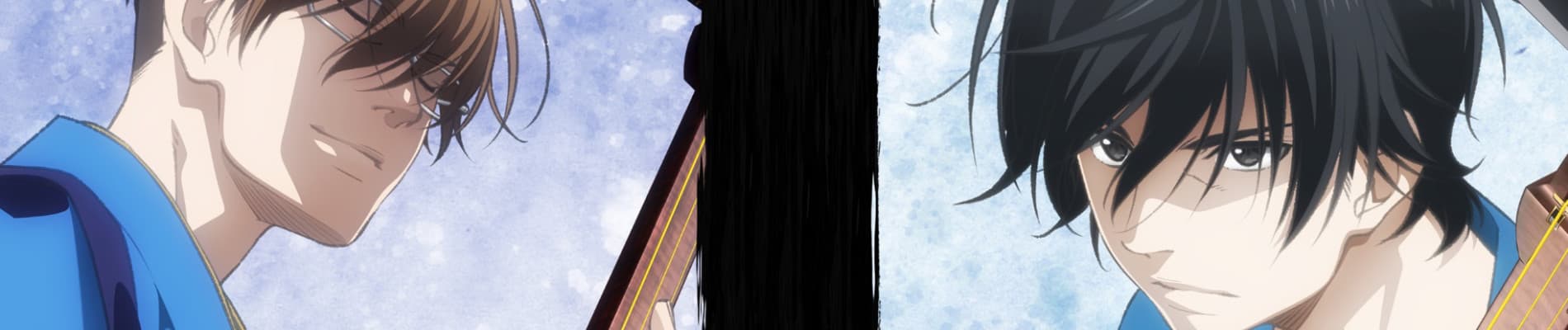
The story follows Sawamura Setsu, the grandson of a famous shamisen player. His grandfather dies and Setsu loses his drive to play the instrument, even going so far as to leave home. Through a series of chance encounters in Tokyo, including a run-in with his pushy mother, Setsu enrolls at a high school and ends up being roped into forming a shamisen club with several others students getting involved. As the story goes on, he tries to discover what it means to create his own sound and stop imitating the sound of his grandfather.
As a concept, I don’t think there’s anything wrong with this. It’s a little basic, but basic is fine so long as the surrounding content is worth it. Setsu as the center of the show manages to be a good presence. He’s a bizarre combination of aloof, tacky, confident, and confused, which is something that can be reasonably-expected for a prodigy at a particular skill. It’s complemented by a quiet aura rather than one bursting with bravado, giving the sense that he’s always being honest and authentic. He can certainly come across as abrasive, but it doesn’t leave the impression that he’s trying to hurt your feelings on purpose.
The cast surrounding him is unfortunately more of a mixed bag. Setsu’s family members and others who have a history with him are certainly given time to stretch their legs, but his fellow students are lacking. Shuri, the main girl that the anime focuses on in the shamisen club, is less of a character and more of a vehicle to get Setsu on his way. She doesn’t have much in the way of personality except for being drawn to Setsu’s playing and perhaps being a little unsure of her own abilities. There’s a plot involving her wanting to reintroduce a shamisen sound to her grandmother’s life, which Setsu recognizes as something that his grandfather wrote. After the plot was over and the grandmother is never seen again, I felt that I learned far more about what the music meant to the grandmother than I did anything about Shuri herself. Something happening to a character is not the same thing as something happening to the character’s family member. One does not substitute the other.
As far as the rest of the main and side characters, they aren’t much in the realm of memorability, with the notable of Setsu’s mother, Umeko. She is, by far, the most-infuriating character in the show because of her helicopter-parenting desire to control her son’s future. Every time she was on-screen, I could feel my stomach get a touch knotted. Despite her robust singing tone in the second episode as Setsu accompanies her, a genuinely good sequence, I did not miss her when she wasn’t on the screen. The manner by which she tries to wrap her hands around Setsu’s destiny was unpleasant, even though I feel that was the point of her character.
The visual style of the show is also strangely unpleasant. Those Snow White Notes opts to remove most instances of shading or more-complex color combinations and designs in exchange for solid colors. I found the visual style to be an unintentional complement to the characters, mostly one-note or lacking in an overall impression. This seemed most evident during the episodes where the characters all wear matching clothes, as there is seemingly-nothing there to give any hint of complexity in the visual design.
The musical sequences themselves, however, are the most aesthetically-rich portions of the series. The recording quality is excellent, and the animation seems to reach a new life with its vividness and energy. Even in the first episode of Setsu going onto the stage to entertain the restless crowd ended up being a beautiful sonic experience. There are a number of these sequences throughout the show, both in terms of actual performances for audiences or the characters playing in private or with no one else around. The abundance of these sequences helps balance out the episodes with slower paces, making each recording feel worth the wait and leaving me eagerly anticipating the next time a sequence would appear.
Despite their quality, these sequences are also dogged with the problem that the characters feel the need to consistently think to themselves about what it is that they’re hearing. Those Snow White Notes doesn’t particularly give the audience watching the chance to form their own conclusions about what the sound is, or what the sound is doing to them. The characters, in essence, serve as the audience surrogate to a fault; if I want to be moved by Setsu or someone else’s playing, then I want to reach my own conclusion about it, not be told how I should react based on what the on-screen character is observing to themselves. As an audience member, I feel cheated by this, as though because I don’t know enough about the shamisen, I need a guide to help me. I have the ability to listen; why can’t I listen uninterrupted?
It’s a sour sticking point because the first episode’s performance is full of people who haven’t heard this type of sound before, yet they were moved by it. If they could be, why not I? If we want to cling to this idea of music’s universal ability to be appreciated, then it should be as unimpeded as possible. I’m not saying that there should be absolutely no commentary, but rather that it went over the line of too much.
This series of interruptions also carries over into Setsu’s overall character arc. While I said I liked his personality earlier, he’s a bit of a flake. It seems that every time he comes close to making some kind of breakthrough, there’s always something that forcibly pushes him back. It’s as though the series is trying to delay his climactic moments rather than allowing them to happen organically. We can only have him ask where his sound is and what he’s feeling so many times before the exercise gets tired. I know that he’s a teenager and thus prone to these kinds of emotional swings, but yet again, it’s just too much over the line.
_________
Those Snow White Notes is ultimately a flawed show with its heart in the right place, but only offers occasional glimpses at what the heart has inside. Even then, those glances are clouded by unnecessary commentary or fluff that leaves the series feeling like for every dramatic step forward it takes, it takes a similar step backwards. It’s not a bad show, but the emotional resonance it’s attempting to reach doesn’t have the necessary strength to get there. The music segments are worth seeing in isolation, and if you should so choose to watch the show as a whole, perhaps you’ll be enchanted by it more than I was.
15.5 out of 16 users liked this review