Hito Hitori Futari
a review by unspecifieduser

unspecifieduser
4 years ago·Dec 2, 2021
40
/ 100
a review by unspecifieduser
4 years ago·Dec 2, 2021
I was drawn to this manga because of the premise. A dead girl serves as a guardian angel to the Prime Minister of Japan, who will die in less than two years and will try to do his best for his country in the time he has left. It’s interesting, original, and sparks the mind with the possibilities that open up from it. The best thing I can say for it is that it is, indeed, creative and new.
It’s also a relatively smooth read; easy to go from one chapter to the next. It doesn’t necessarily hook you into needing to know what happens, but you can coast through the story with little effort.
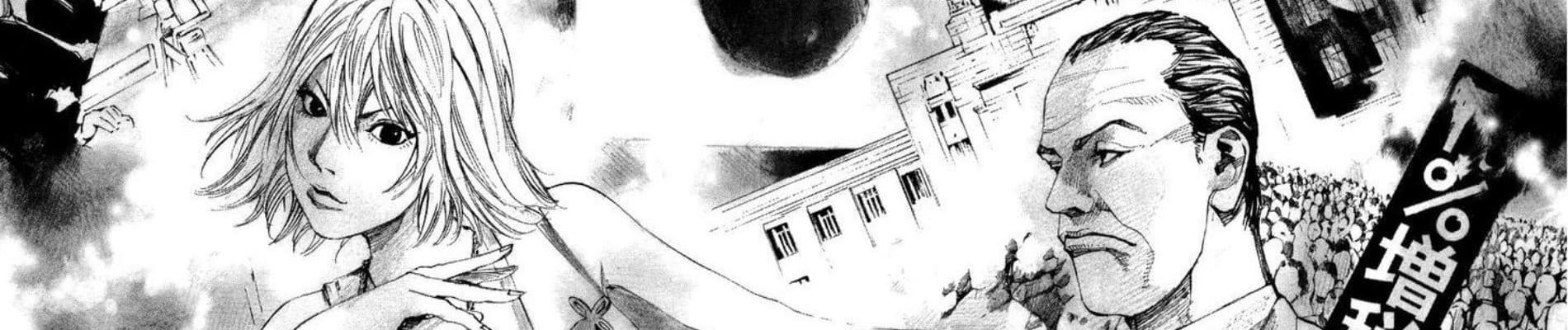
Visually, it’s competent. The characters can look a little messy, and the perspectives and environments aren’t the most appealing. There are some good more abstract pages, with darkness splashing against light in expressive ways.
But despite all the ideas this manga has, few of them are executed well. There’s a constant sense of awkwardness when a manga is trying incredibly hard to make an idea impact the reader, but it just fails to land.
The main characters are decent. Kasuga’s boldness and insights are engaging, and Riyon is likeable enough. Their relationship never gets the nuanced development that it would have deserved, being at the core of the story. Their relationship never seems much deeper than a simple father-daughter-like one, with some shallow themes of self-sacrifice and hiding pain for each others’ sakes.
The political side of the story, which initially excited me, was perhaps the most woefully underdeveloped part. Kasuga has a couple of good speeches, and one excellent symbolic action taken to inspire the people of japan. Those points were memorable, but aren’t very much in an 80+ chapter manga. There’s a severe lack of interesting interpersonal reactions, political strategies, or even just characters persuading each other of things. Nobody gets into serious debates or conflicts about political issues. The most you’ll typically see is brief shots of people on the news shouting their disagreement with Kasuga, but there’s never any direct back and forth between people who disagree on things. This aspect is so shallow that I would absolutely not recommend this manga to anyone looking for an interesting political story.
The “magic” in the story feels entirely unnecessary. I think it should have kept the mystical side of things to Riyon’s existence and presence in Kasuga’s life, developed more of how they supported each other, and shown detailed political maneuvering as he accomplished his goals. Instead, there’s a poorly developed magic system of light and dark energy invading people’s minds. The way that it affects people’s thoughts feels poorly thought out, and how it’s utilized feels unbalanced and contrived for conflict. There’s also Kasuga gaining the power to read the thoughts of those he shakes hands with. Imagine all of the interesting political things that could be done with such an ability. You will see none of them in this manga.
This brings me to one of the two worst aspects of this manga: The one who uses that magic system. The villain, Kubo. Put simply, he’s unabashedly edgy to the point of ridiculousness. He constantly focuses the story around himself, and it hurts it. It’s a shame that the story found his exploits more interesting than actual politics. There were points where I thought that he must have been thrust into a story by an editor who doubted that the manga would be considered interesting enough if it was just about politics. I became less confident in this theory as I got further in the story, and there’s no way of knowing for sure if something like that happened. But his place in this manga feels entirely undeserved.
He has his tragic backstory, meant to justify his pessimistic and antagonistic worldview. The backstory itself honestly isn’t bad. But all of his actions in the present are motivated by a painful-to-read edgy darkness, where he wants to prove love is fake and good people aren’t allowed to try to be heroes, and that using powers similar to his own powers of darkness needs to be punished. I finished the manga, and I honestly couldn’t tell you why he even cared about what Kasuga was trying to accomplish. I guess it was supposed to be a need to prove his worldview right, by destroying one who went against it, but frankly it was just a mess.
Most of the real conflict comes from him using his dark magicks to injure and kill people at a distance. It’s not a very interesting setup. There’s little the protagonists can meaningfully do against it, so there’s no back-and-forth of strategies.
The overall story conflict might have been better if it actually focused on his employer, who originally involved him in the battle against Kasuga. A young ambitious politician who wanted to fight against what he saw as an old, incompetent prime minister. Unfortunately, his role in the story was relegated to doing almost nothing other than tell Kubo they need to do more next. And eventually have some kind of forced “redemption” that didn’t feel justified or explored in any way. The manga might have explained it at the start, but I can confidently say I don’t have the slightest idea why he wanted to fight against Kasuga either. That’s how little it mattered to the story. No political disagreements or even disagreements in philosophy on what a politician can or should do. He didn’t even provide an opposition on the main political conflict in the story.
And, as I get to that conflict, I need to make something clear: This is all my opinion. Obviously, that applies to this entire review, but this deserves special emphasis. Special emphasis because it’s about real-life political issues. Something where good and well-intentioned people can reasonably disagree.
I am not Japanese. I have never lived in Japan. I am not an expert on Japanese political issues. Japanese people may have more informed views on the relevant arguments, and they have a real, personal stake on the outcomes. I recommend anybody interested does their own research on this and takes neither my nor the manga’s word for things.
I am only here to express my personal reaction at the political ideas the story presents, how it presents them, and how that affects the overall experience.
Hito Hitori Futari is astoundingly and unabashedly anti-nuclear energy, to the point where I consistently cringed reading it.
That’s the mission Kasuga gives himself, that he wants to accomplish in his time left: To set Japan on a course of dismantling all of its nuclear facilities. Frightened of a disaster like Fukushima happening again, or a second disaster making the situation at Fukushima worse, he wants Japan to give it up entirely, accepting a more limited lifestyle, in order to avoid any risk of making the country uninhabitable.
It’s certainly noble and well-intentioned. In my subjective view (do your own research!), it’s also utterly ridiculous. Nuclear power is perfectly capable of being safe. As far as I’m aware, the disaster at Fukushima only occurred because of atrocious safety oversights that completely failed to adhere to standards. Furthermore, while nuclear waste is an issue, it’s a much smaller issue than climate change, which unlike coal and oil, nuclear power does not contribute to.
The story ignores all of this. In its eyes, nuclear power is an evil. It is nothing but a danger to the public, an inevitable source of disasters, and something that the Japanese people would love to be freed from if they only had hope for it being possible.
Counter-arguments are never suggested, because they don’t exist here. Oh, the people may have to give up their cell phones, but we never see anybody struggle with this. Nor do we anyone meaningfully disagree. There are a few moments where rival politicians (who don’t matter to the story) shout that it isn’t possible, and nuclear companies certainly have no intention to close. That’s about it. The story once felt like it might go the route of pretending that nuclear companies were simply greedily taking advantage of the people, and needed to be ousted for the country’s good. This isn’t the reality of the issue, but the manga didn’t even go for it. The opposition, functionally, had no presence, because the manga had no intention of exploring the ideas of those who might not want to get rid of a massive source of electricity.
I wouldn’t even recommend this to anyone who agrees with the manga’s stance, as there’s nothing of substance it says about it. No exploration of the nuances of the issues. There is, however, an absurdly hamfisted comparison of the evil psychic powers to nuclear energy — supposedly, they’re both evil sources of power that tempt man yet never should have been touched.
This is not a story. This is propaganda. Propaganda that presents its protagonist as a noble hero for devoting himself to the cause that the author clearly believes you should agree with. The politics are, in my view, ridiculous, but it's not really about the politics. It's about the fact that reading this manga feels like being preached at. There is no subtlety to the ideas. It doesn't ask the reader to think for themselves or come to their own conclusions. It forces its ideas like a screaming baby you can't ignore, pretending its ideas are original or thought-provoking.
Despite everything bad I have to say about this manga, it’s not the worst thing ever. Like I said at the beginning, it’s both original, and very readable and engaging. This is a manga that may disappoint you, but probably won’t bore you. Nor is every writing decision it makes bad. There are plenty of moments over the course of the journey that are decently interesting, plenty of things the main characters do that are likeable. Kasuga’s acceptance of his fate and progression of his quest are engaging enough. But these things are less interesting to explain, and far less impactful on the story, than everything it does wrong.
I would not recommend this manga. But I hope the best for the author and his skills, because he’s capable of far more than those who limit themselves to the generic cliches we’ve seen too many times. As long as he keeps from focusing his stories on real-world political issues, and learns some god forsaken subtlety.
5.5 out of 7 users liked this review