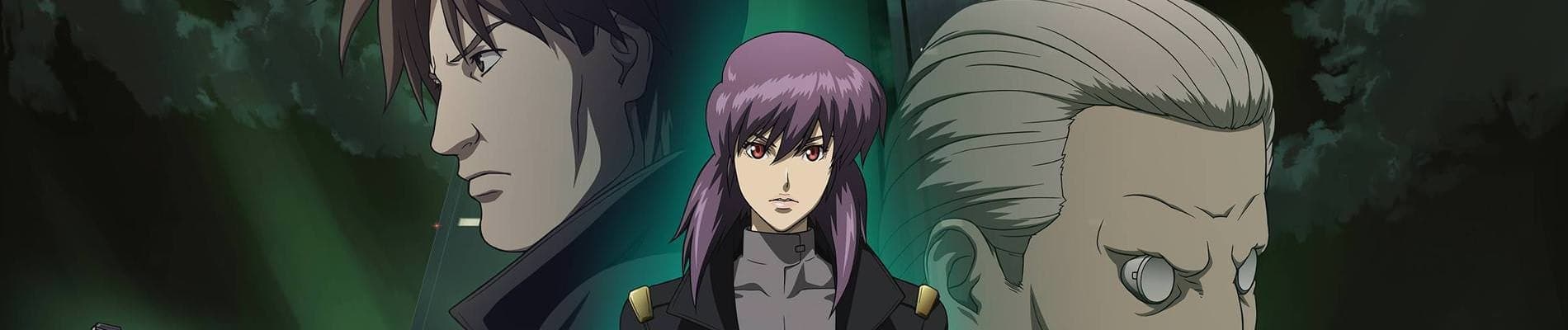
Major spoilers for SAC, the 1995 Mamoru Oshii movie and Solid State Society
The issue with Solid State Society is that it feels like an inconsequential spin-off rather than a sequel in the spirit of SAC. Stand Alone Complex used two types of story-telling, the first being episodic stories (often with a light-hearted tone in Season 1) and the second being the more interesting over-arching narratives which were serious and unraveled over multiple episodes. Solid State Society provides an awkward mix of these two approaches.
The positives of Solid State Society
The setup for Solid State Society promises an intriguing mystery on the level of the multi-episode narratives in SAC. Following on from the end of SAC, Motoko has left Section 9 with Togusa taking over as the head. Batou then encounters Motoko while investigating a string of politically-linked suicides and believes she may be involved. This setup provides ground for interesting character development. What are Motoko's goals and how has she changed since the events of SAC? How will Togusa act as the head of Section 9 and what does his new augmentation mean for him as a character? How will Batou fare without Motoko and how will his suspicions of her impact him?
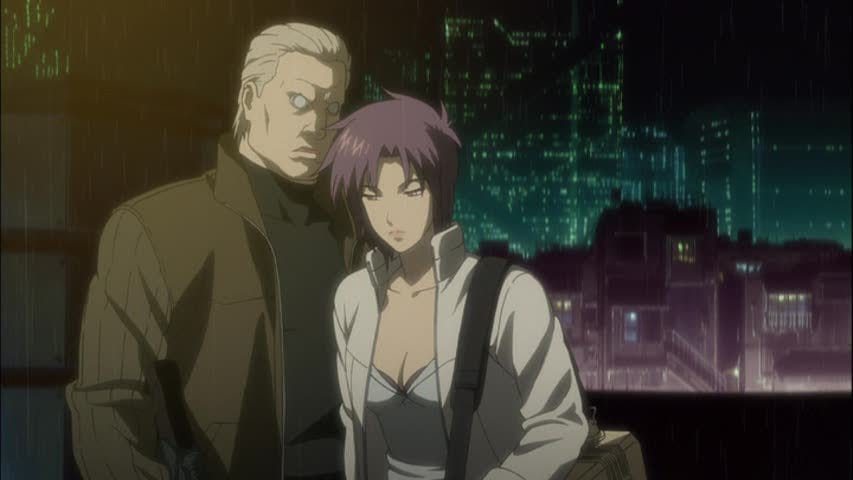 Solid State Society also sets out a mystery with deep political motivations and intricacies per those in SAC. The inclusion of an ominous "Solid State Society" and "Puppeteer" is enough to intrigue the audience. There are certainly entertaining enough action scenes and character moments to be found as the narrative unfolds - Togusa searching for his daughter stands out as a tense scene with high stakes that plays on his character as a family man and new role as head of Section 9.
The sound design, music and animation are all competent enough. Everything is on par with the standards set by SAC, though the movie budget does provide some additional polishes that the show budget prohibits. The soundtrack is done by Yoko Kanno, familiar already to fans of SAC and Cowboy Bebop. The serious moments are underscored well, though some scenes have action music which is all too reminiscent of the standalone, episodic stories in SAC rather than the over-arching stories.
The cracks begin to show
Unfortunately, the grand mystery promised in the Solid State Society and Puppeteer gradually wear out their welcome as the story unfolds. The reveal of the Solid State Society is ultimately underwhelming, lacking the wide scale and political connections found in the Laughing Man or Individual Eleven in SAC. The action scenes begin to lose their stakes and watching Section 9 operate with the Major as the returned head feels like more of the same, except the tone shifts back to a somewhat light-hearted one. Watching Section 9 operate may bring some familiar comfort, but it feels a little out-of-place, like watching an standalone episode with an inconsequential story rather than fitting into the serious narrative initially promised.
The Puppeteer reveals itself, and the 1995 GitS
The final reveal of the Solid State Society comes in the form of the Puppeteer's identity. Before comparing the 1995 Oshii movie and Solid State Society, two arguments should be addressed:
Oshii's Puppet Master climax is much more interesting than the Puppeteer in Solid State Society. The dive in the 1995 movie had implications for Motoko as a character, questioning her identity and finally bringing her to her goal. It functions as the culmination of all the ideas and themes presented throughout the movie, as well as having clear stakes in the approaching snipers which feel urgent.
 In comparison, the dive in Solid State Society feels rushed and unnecessary. Where the Oshii movie builds up to the dive, Solid State Society instead has the lengthy dialogue be mostly outside the dive. The actual dialogue of the Puppeteer feels like a cheap imitation of the one presented in Oshii's version. The abandoned warehouse is substituted with a brightly lit building, lacking the meditative atmosphere of the former. The tension of the scene is missing, with Motoko being surrounded by Section 9 during her dive compared to just Batou. The final reveal that the Puppeteer is a fragment of Motoko's consciousness feels more convoluted than the simplicity of the merge in the 1995 GitS. Where the 1995 GitS has Motoko's identity as the focus and the climax be thematically linked to it, Solid State Society throws in this idea simply to increase the stakes. Ultimately, the fact that the Puppeteer was or was part of Motoko doesn't amount to anything interesting, for her or for Batou.
Conclusion?
The final scenes of Solid State Society feel empty. Motoko returns as head of Section 9, with herself, Togusa and Batou receiving little to no character development. The grand narrative promised proves to be underwhelming and impactless, lacking the scale in SAC. Ultimately, despite the dramatic events that occur throughout Solid State Society, it feels as though nothing has changed for Section 9, reverting to a state similar to that in Season 1 of SAC, before even the character developments of Season 2.
17 out of 23 users liked this review
