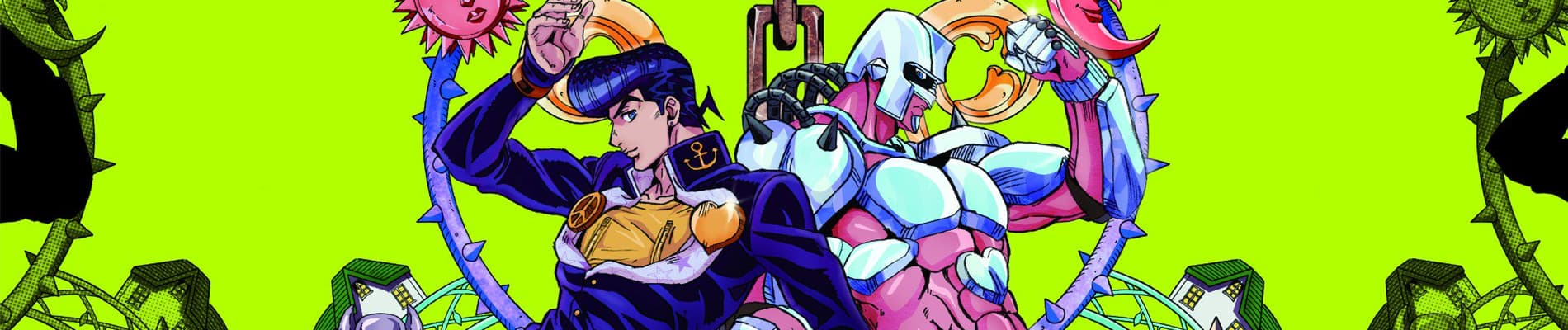
It would be imprudent of me to claim part 4 is the best animated part, given how Stone Ocean currently airs, but I can confidently claim it is the more balanced and polished pre-part 6 addition to the Jojo series, and easily the most cinematic.
Nonetheless, it's being judged here both within the continuum of Jojo as well as a standalone.
Unlike the previous parts which are country-to-country adventures, here the setting is much narrower topologically: the suburb of Morioh, S city. Without going into too much detail, the heroes are called upon to uncover and confront stand-related dangers plaguing their suburb while exploring its various corners.
There are quite a few slice-of-life and suspense elements, the first of which serve to break the mould of repetitive Stand battles, and even serve to toy with or subvert the very concept of a Stand battle as established in Stardust Crusaders. Examples include an original sniper duel in the countryside, and an Italian cuisine episode.

Suspense elements are especially prominent during the second half of the series. Combined with (a)typical Jojo campiness and madness, creative Stand battles, and the aforementioned slice-of-life elements, Morioh's setting kept me constantly in an impression of viewing something "uncannily familiar".
It's somewhat hard to explain, but the idea of a mundane, commonplace Japanese town crawling with oddities and dark secrets that lurk in the alleys, corners and in plain view reminded me of Higurashi and even Uzumaki, two horror media that despite being a far cry from even slightly resembling Jojo involve quite some "horror in plain sight".

I am obliged to point out some flaws, first of all that the story could become too inconsistent or illogical occasionally. An example is a Stand User around the first third of the part, who was perfectly informed on Jotaro's Stand power, without any explicit statement over how they came to know of it. There were also some missed opportunities. For example, Araki introduces a chef, whom he could have used brilliantly as a plot device given this chef's skills and potential, but instead he was totally left out and wasted.
Another was a delinquent flashback that did shed some light on a character trait of Josuke, but did not further build on such an important scene. I believe Araki must have attempted to use this flashback similarly as a plot twist not unlike one in Harry Potter and the Prisoner of Azkaban, only to have forgotten.
Character designs retain typical Jojo traits such as prominent eyebrows and a campy sense of fashion, but are also far more "sculpted" and not buffed to exaggeration. There is healthy variety in individual builds, expressions, etc. Backgrounds alternate between ones of mundane urban landscape (e.g. interiors of buildings) and more unique and memorable scenery (e.g. sunflower fields).

What really surprised me in this part was direction. There was plenty of creative camerawork that made for memorable highlights and amplified the suspense . Another aspect was the color choice in the sky, which made for an overall sickly, "miasmatic" atmosphere. Even a couple of episodes make clear that this part is not limited to a faithful adaptation, but has a clear creative vision behind.
On audio, it does not falter either. Most seiyuu matched perfectly with their characters (even if I preferred some over others), and included a dream cast of quite prominent voice actors such as Sakurai Takahiro, Daisuke Ono and Ohara Sayaka alongside less prominent but nonetheless successful ones.
Audio direction is harmonious, including both timing and delivery of lines, sound effects selection (e.g. Killer Queen's sound effects) and overall, sound was never grating or ill-matching. On music, it is noteworthy how apart from upbeat pop-rock tracks that it includes some quite unusual tracks, such as Killer. This is the main villain's leitmotif, a classical piece that brilliantly encapsulates their personality.
65 out of 69 users liked this review
