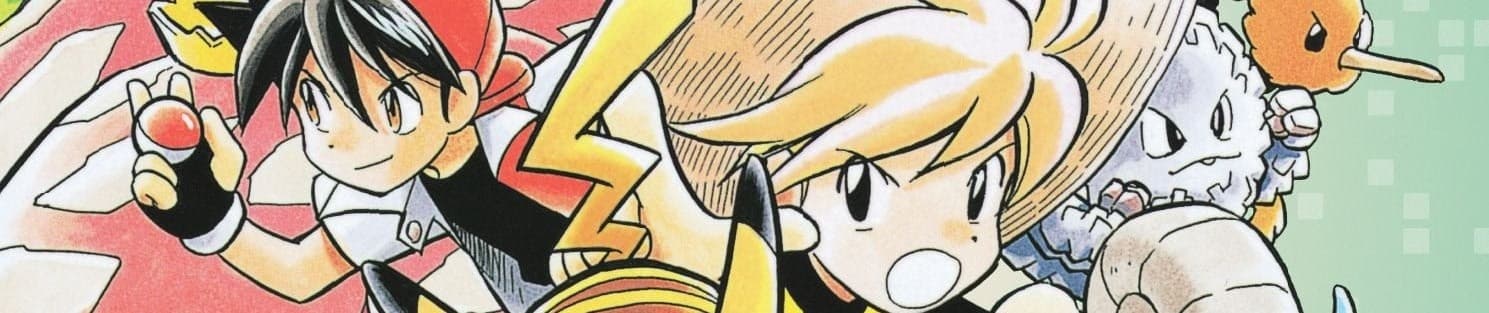

This review will contain no spoilers unless further warned. I will also be calling the rival guy Blue, and the rival girl Green— as to follow their localized names.

Background
The hype surrounding Yellow is rather immense, with many citing it to be a blossom into a more serious venture than originally implied— with plenty of heartfelt moments and great battles along the way. Expectations held in check, once again, I entered the series with one question in mind— what is the goal of Pokémon Adventures: Yellow? Having established the series isn’t merely for nostalgia-driven people— even if it panders— in my previous review, I’ll mostly be disregarding those elements bar some touch-up in later sections. So make sure to check that one out if you want to hear some generally less specific and retaining flaws with the series.
To set the stage, Yellow begins two years after the events of Red, Green, and Blue. Our previous protagonist, Red, has mysteriously gone missing upon receiving a strange challenge from a mysterious challenge. His Pikachu, Pika, returns to Professor Oak’s lab injured and near death; upon seeing this, Professor Oak entrusts Pika to Red’s friend, Yellow. Naturally, Yellow is our protagonist for the part, as we follow his many misadventures looking for Red. Also, yes, if you’ve read Red— Yellow is the kid Red gave the Ratata to. Kind of cool they set it up, I suppose.
Miscellaneous Misadventures

Yellow’s first thirty-or-so chapters attempt to mirror Red’s structure, establishing our main character and the world through various disconnected escapades. Does it succeed at this? Initially, I was going to say no— but upon further thought, there’s a lot to love. They really don’t waste time throwing you into the world; nor do they waste time chucking familiar characters at you. Seriously, I don’t know if they didn’t want to come up with characters not from the games or something, but damn is there a drought of originality here. It’s cool to see Yellow meet each person and form their own dynamic separate to Red, though. I’ll get into how this actually plays out during the characters. If you’re looking for some fun adventure elements you’ll probably find this aspect weaker than Red’s portrayal, but if you’re fine with just seeing Yellow’s perspective on these places, you’ll probably enjoy it.

The exemplary chapter here is one not one many will remember, but it takes the spot of my favorite chapter in the series thus far. Pidgeotto Pick-Me-Up follows Yellow’s Caterpie and Pidgeotto getting into wacky shenanigans as Yellow is off gathering food. It’s so simple, yet brilliant. We get to see the bumbling Caterpie stumble into one hazardous situation after the next, with Pidgeotto saving him from the crux of danger each and every time. You can feel their bond genuinely grow and evolve, fleshing out the needed subtext in their characters, all without dialogue. The pacing draws back for this singular chapter, and bothers to establish things. Even if the rest of the manga rushes off at breakneck speed and hastily bandages over genuine character building, I very much appreciate this isolated moment. It really shows how much better the story could be if they took time building and establishing things. It’s whatever, though, and the Pokémon were woefully underdeveloped anyways.
The Characters

Picking up from where our last section left off— how do our characters mesh? Well, it’s a pretty mixed bag. Yellow is rather weak as a protagonist, at the very least upon an initial viewing. They have none of the charm or unique characteristics that Red has, and end up feeling like a hollow shell because of it. Their only majorly established character trait is that they love Pokémon, which they harp on— which is sometimes fun, mind you— but Red has the same trait, so it comes off as redundant. At least it contributes thematically I suppose, which I’ll get into in the spoiler section.
Blue is surprisingly used to great effect here, honestly. I expected them to pull him back and out of the story considering Red is out of the equation, but they went ahead and tried to play him off of Yellow— which was great. Him being a mentor figure makes him a perfect straight man and creates decent conflict with Yellow’s love for Pokémon being so extreme. Their conversations were generally witty, so it’s a shame we didn’t get to see more of them here. I don’t even have anything to say about Green, though. She really didn’t do much bar some plot-related things, and some fun dialogue with Bill.
Our main antagonistic group, the Elite Four, is a very mixed bag; I could not be more baffled with the character archetypes they chose to put here. Strong but kind-hearted fighting guy? Okay, makes sense. Mysterious and imposing powerful guy? Checks out. Ice cold secretary? Uhhhh….? Old woman with a grudge? Fucking hell lmfao. I don’t think they turned out too poorly, but the character archetypes they chose are incredibly basic and uncharismatic bar Bruno— who’s automatically likable to most due to his jovial and chaotic tone. I couldn’t imagine any of these guys have any chemistry together, either. They don’t really get scenes where they’re all together, so I couldn’t really say, but it’s by far the opposite of compelling. Lorelei is just cold, that’s it. Agatha is just a hateful and evil old woman, with some past thrown in that establishes more about Professor Oak than anything. I will admit Lance, the dragon and serious type, has a bit more put on him, though. The issue is, it doesn’t make any fucking sense! He hates people for polluting the environment which hurts Pokémon? Yeah, that’s a great motivation. That’s a pretty complicated issue, though, I wonder what he’s gonna do to fix such a nuanced problem.

God damn it, Lance. He doesn’t think humans and Pokémon can coexist, so his first solution is to attempt to literally eradicate the entirety of humanity bar an elite few. This guy is presented as a smart political leader lmfao. It’s really needless to elaborate upon why this is utterly idiotic and crass, but point in case the entire crux of their plan will collapse upon completing it. Not only is it logistically impossible, but there will be no one to manufacture or produce what people in modern society need to survive. Not even Pokéballs or Pokémon healing stations. Also, if you only leave your friends who are strong trainers, what’s the point? There’s nothing to be gained from any of this. You could say “Oh, it’s a kid’s manga, it doesn’t have to make sense”— but that doesn’t cut it for me. If other kid’s manga can make sense, Pokémon can too. Obviously leaving the good will for the premise of Pokémon, if the antagonists are so cartoonishly evil and villainistic to superficially inflate the stakes, maybe they should just consider toning it down a bit or justifying their villainous tendencies. Sorry, Lance, but any leeway your philosophy had was eradicated by a sloppily introduced motive. Though, I would like to add the obvious implication that Lance’s viewset diametrically opposes Yellow’s, which leads to a satisfying conclusion.
Getting back on track, Bruno was by far my favorite member of the Elite Four— he was just so god damn charming. He’s most certainly a walking stereotype, so I see why you wouldn’t like him, but his interactions and battles are simply too fun to ignore. Battling above a pit of acid on an Onyx bridge? That’s fucking brilliant, what a lad.
I would be remiss to not mention the Team Rocket leaders from the previous part, and I gotta say— they were okay. Angry girl is just angry girl, and poison guy is just poison guy. Koga— poison guy— did have some relative personality added in his surprising reliability, I suppose, but it’s really nothing that will wow anyone. Lt. Surge made a great return, though. Spinning his militant personality into one slightly more jovial and abrasive was a smart move, as it really accentuates Bill’s cowardness, elevating them both as characters. They got paired against Bruno as well, with everyone within that fight managing to elevate each other.
I feel I may have gone overboard with this section, but finally, it ends at last— with one final caveat. Connecting back the circle, we once again arrive on the main topic of the series: Pokémon. I previously stated, in my last review, that the Pokémon remained woefully underdeveloped for the duration of the series— does that remain true here? Well, yes, but to a slightly lesser extent. For example, cite the Pidgeotto and Caterpie chapter I mentioned earlier. Each Pokémon had their own, unique sense of personality; they really needed that. Especially considering how one-note and bland their names are. I mean, c’mon. Graveller is Gravvy? Pikachu is Pika? Venusaur is Saur? I mean, could they get more uncreative? I wonder what they named Caterpie—

Fuck.
Spoiler, click to viewclick to hide
To touch up on spoilers, I think juxtaposing Yellow and Lance worked fine enough. It really complimented the themes of the series, plus brought new ideas into play. Pollution was a rather smart undercurrent to bring in the forest with this, as it developed the Pokémon world to end far more grounded than it previously seemed. Plus, it makes the villains' motives feel somewhat reasonable. Of course, this culminates in a bombastic and epic final battle— which was alright. We got to see Yellow move past her insistence on not evolving her Pokémon, as she would love all of them anyways. What a phenomenal way of showing her growth over the series, as her superior ideology crushes Lance’s flawed and hypocritical one.For other things regarding the final battle, the twist of Yellow being a girl was odd. I had known it all along; I don’t see how it changes the plot in any manner. Blaine was just like “okay” and moved on, though Red not knowing is pretty funny. Giovanni coming back was neat to see as well, and him running away revealed aspects of his character that we haven’t explored before.
Other than that, Red’s return was cool, but he ultimately didn’t do much. He was best in the arc with his fight against Bruno; also as a mystery element.
Mysteries and Battles

The premise for this part is alluring; I couldn’t help but be intrigued as to where they would take this whole “Red is missing” plot line. As a hook it’s strong, but the true worth lies in how it’s executed. To be concise and curt, it was done pretty well. Red’s whereabouts gave genuine stakes to the plot and pushed it with a sense of urgency, even if that’s somewhat ruined by Yellow’s bumbling around as they travel through a forest of Exeggutor or whatever. Overall the conclusion is satisfying, if a little anticlimactic, and it leads to a brilliant fight scene. On the polar end of the scale, I can’t really say the same for a certain “mystery” revolving Yellow. I won’t say what it is for spoilers sake, but it added nothing to the plot; it was obvious, I literally knew it was that way the whole time. I’m sure people who’ve read it will know what I’m on about here, and I must apologize to those of you who haven’t— but it’s just too strange not to mention.
Surprisingly, I went through the entirety of the last review without discussing the fights once. Even though the climactic battle for Red, Green, and Blue was phenomenal, I didn’t find it worth touching up on here— but for Yellow, I feel it’s an entirely different story. The emphasis is placed far heavier on battles to convey story and character drama, with the entire last stretch of 30 chapters being purely centered around fighting. At its best, Pokémon Adventures can have nuanced fights that involve a great level of strategy and cleverness; at its worst, Pokémon Adventures is inconsistent and simple. Unfortunately, this volley of stories was really a mixed bag; so, let’s break those of the Elite Four Arc down, one by one. If you consider fight match-ups spoilers, feel free to skip the next four paragraphs.
Beginning at a high point, fuck was Lt. Surge and Bill vs Bruno good. I briefly talked about this earlier, but all of the characters compliment each other incredibly well. Lt. Surge’s jovial militancy directly mirrors Bruno’s fight-loving attitude, with these traits making them both extremely charismatic. Bill is a nice addition to Lt. Surge’s side as well, as he adds even more comedic relief to the battle. It’s funny to see him so out of his element, considering he’s a scientist. Once again, the Onyx rock bridge setting was brilliant. It was so wildly creative, and showed off a great amount of flare from Bruno’s side— which is part of why I love him. He was even kind enough to not cheat, though he easily could have. The actual fight itself was a lot of fun, if not short-lived. It was cool to see Bill strategize and Lt. Surge put his plan into action; it really felt like they were a team.
One battle I reflect far less happily upon is Green and Sabrina vs Lorelei, however. I’m sorry, but the whole rivalry between Sabrina and Green is disjointed and forced. What reason do they even have to hate each other? Is it because they’re both petty, or both girls? They may have fought in the past, but even before that they had a peculiar and unjustified rivalry. It’s not a big deal, but it makes one care less about their match-up when their dynamic is neither compelling nor sensible. The opponent they are put up against is rather lame as well. Out of the Elite Four, she perhaps gets the least development. For the most part, her personality consists of being evil and ice-cold— which is ironically reflected by her Pokémon all being ice types. Ultimately, that minor strike of characterization only goes so far, however. So, the characters aren’t exactly up to snuff here— but what about the actual fight? I mean, it was fine. The concept of shackling the two rivals together to create conflict is really fun, despite their lack of chemistry. The events end up being rather short and one-note, however. I won’t complain considering it was a weak match-up, but the fight was ultimately just near meaningless and disappointing.
Koga and Blue vs Agatha is a strange duel; it was executed better than the Loralee fight, at least. They bother establishing connections and history between Blue and Agatha, which adds some tension and nuance to the fight at play, no matter how strong it is. Agatha is ultimately a lame archetype with little for her beyond a past grudge, but I can at the very least appreciate what they did here. Koga shockingly wasn’t too bad, either. Unlike Sabrina, he’s not a fucking pussy, and decided to work with Blue and even be nice for their shared interests. It really gave me a newfound respect for the guy. The fight itself was perhaps the best of these first three, as well. The strategy employed was clever at times, and it’s interesting to see people try and beat an enemy that literally lives in their shadows. Overall, the match-up was shockingly enjoyable.

Lastly, for the climax of the manga, we have Lance vs Yellow. This is the thematic ziptie of the arc, as it closes everything up well. I’ll get to that in the thematic section, however. Otherwise, the structure of the fight is rather well put together. There are two major dramatic twists during the fight— one being the return of a character, and one involving Yellow’s development. It’s ultimately engaging; I dug the contrast and chemistry between the two as they brawled it out. Sorry for being vague as opposed to analytical here, but I really can’t spoil. Either way, this fight was practically the perfect conclusion to what they set up earlier in this part.
The Thematics

Pokémon isn’t exactly known for thematic complexities or nuanced subtleties, but in this case, I think it warrants its own section. Not that I think there’s a lot to analyze here, but I would be remiss not to mention what they explored here. Obviously, the most baseline and simple theme of Pokémon is friendship. This reflected through not only the premise itself, but the main characters as well. Never have I seen it emphasized to such an extent as with Yellow, however— with their love for Pokémon sometimes being a detriment to their character. It really does grind the pacing to a halt at times, with many characters acting shocked that they care about their Pokémon so much, but it ultimately pays off in the finale. As discussed earlier, they directly contrast Lance and Yellow’s philosophies. One full of hatred due to the conditions around him, while the other has a similar understanding of how horrible things can be, but changes things the right way anyways. The touch on pollution was pretty cool as well. They set it up in earlier chapters via having Yellow train in an industrialized wasteland, and they pay it off by having the main antagonist's direct motivation being this destruction that humans breed. For an adult, this is simple— but I think it’s nice for younger kids to consider pollution more. Especially in the way it’s presented, as opposed to something corporate and superficial.
The Conclusion

Pokémon Adventures: Yellow was once again a hit and miss, but it’s attempt at a more serious and structured narrative was a lot of fun to experience. The thematics were fun more often than not, and it wrapped itself up neatly. Not without its flaws, of course— especially with ones that I left out due to the coverage of the last review, such as how the world building is rushed and often pandering. In the end, though, my experience was resoundingly positive. Here’s to Pokémon Adventures: Gold, Silver, and Crystal!