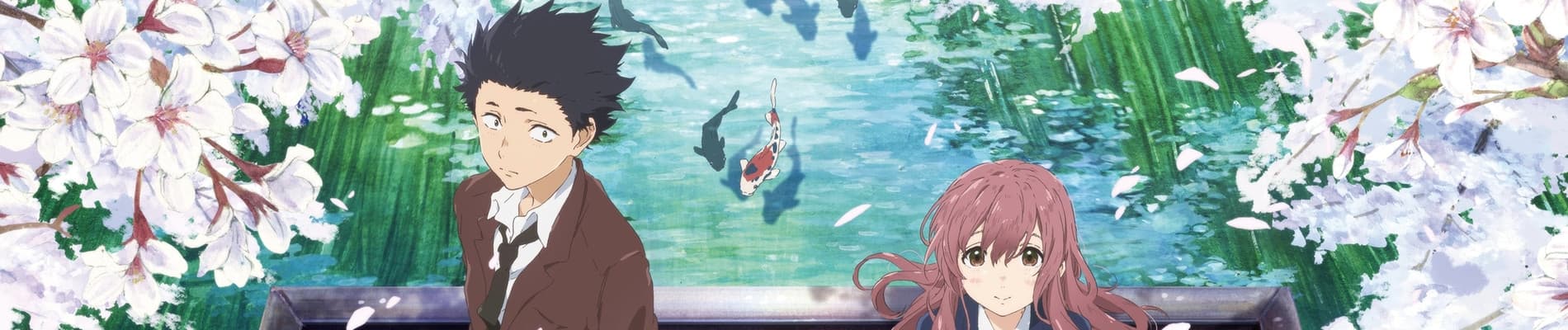
It's incredibly difficult to be critical of something so close to your heart, but here goes.
Koe No Katachi, or A Silent Voice, was one of the first anime films I watched when I got back into the medium. As I've said in previous reviews, I stopped watching anime when I got into high school because of personal issues. I had too much on my plate, and couldn't find the time or motivation watch TV. Four years later, now that I'm in college, I've picked up the hobby again. I had seen more anime films then I had shows; I grew up watching Ponyo, and had seen a few other Ghibli movies throughout my life. But A Silent Voice, this was not by Ghibli or any studio I was well aware of.
The film was made by Kyoto Animation, and headed by director Naoko Yamada. Both of these names were foreign to me, as was the film when I watched it. After watching and doing some research, I learned that Kyoto Animation had became a big name in the anime industry. With shows like Hibike Euphonium, Violet Evergarden, Miss Kobayashi's Dragon Maid, and K-On, they had become prolific in the slice-of-life genre. Naoko Yamada had been apart of the studio for awhile, being the director of the aforementioned K-On. Although I have only seen bits of K-On and Yamada's other works, she has a very distinct style that I fell in love with after watching A Silent Voice.
Something that stuck out to me when I first watched the film is how it's shot. It's strange to say something like that when it's an animated film, but Yamada herself says her directing style is very inspired by live-action camera work. Because of this, the shots you will see in A Silent Voice are extremely varied, making the film quite engaging visually. Specifically, Yamada uses a lot of low-angle shots of the character's feet and legs. This works surprisingly well, and brings out a lot of body language you don't often see. Another aspect I enjoyed was the use of light. I feel like it's no large leap to say that this film is gorgeous. The aforementioned use of light makes the vibrant backgrounds shimmer, and the animation is fluid and eye catching. The character designs are also top notch, it's very refreshing to see characters that have realistic proportions and aspects of their design that reflect their emotions or personality.
The way the characters are written is where the movie shines, though. The film follows Shouya Ishida, a 17 year old in the midst of a deep depression. Ishida's depression can be traced back to his days in elementary school, specifically when a deaf girl name Shoko Nishimya transfers into his class. Although she tries her best to fit in, she is bullied by Shouya and other students, something that is ignored by his classmates and teacher. These childhood parts of the film are hard to watch, as the bullying is extremely explicit. I cringed every time Shouya or other characters ripped out Shoko's hearing aids, or threw dirt in her face. This bullying comes to a head when Shouya and Shoko get into a fist fight, resulting in Shouya's suspension. This is the point in which the rest of the class turns on him, and he is left with no friends. Because of this, Shouya goes through middle school and most of high school as a loner with a deep hatred of himself.
Watching Shoko be bullied was hard to watch, as I had also been bullied in elementary school. But it was even harder to watch Shouya because, though this hurts to admit, I had been a bully myself. Shouya's younger self was a nasty mirror that brought up old memories that I had buried long ago, but I feel like many people could relate to that. Many have been bullied and many have been the bully, it's an unfortunate truth of growing up. This is not the main focus of the film, though. Instead, what it appears to be on the surface, is a story of Shouya Ishida's redemption.
After deciding not to commit suicide at the beginning of the film, Shouya finds himself with a new goal. He had been learning sign language in hopes that one day, if he were to meet with Shoko again, he could actually communicate with her. This happens, and the two begin to reconnect. The film actually makes a very bold choice when it comes to visualizing Shouya reconnecting with people. It's stated that Shouya has a hard time looking people in the eye, and this is expressed by these big blue "X" stickers that are placed on character's faces. This was done after the film was animated as an after-effect, so it comes out pretty well. As Shouya and Shoko begin to reconnect, the stickers begin to fall off of other characters, as the ensemble cast begins to grow.
The supporting cast in this film is great, even if most of the film is focused on Shouya and Shoko. The first friend Shouya makes in high school is a bubbly and emotional classmate named Tomohiro Nagatsuka. The two forge a great connection as Tomohiro helps Shouya open up. He's funny and very sentimental, adding some needed comedic relief to a very heavy film. Theres also Shoko's younger sister Yuzuru, who Shouya grows very close with and helps him express his emotional maturity. Ishida also reconnects with some of his old classmates from elementary school; namely Miki Kawai and Miyoko Sahara. These two help round out the group, and become more important later in the film. Finally, there's Noaka Ueno. Noaka stands in direct contrast to Shouya, as she has matured very little since elementary school. Although not as direct as Shouya could be, Noaka was one of Shoko's biggest bullies. In fact, all these years later, the first thing Naoka does when she meets Shoko again is to rip out her hearing aids, confused to why Ishida is upset by this. All of these characters blend pretty well in the script, and are decently fleshed out.
The film deals with a lot of heavy themes. Suicide, depression, social anxiety, death, it can be very emotionally intense at times. Recall earlier when I said this film is about redemption. I feel like that's not the whole truth. I imagine some of you rolled your eyes as you read that, because a redemption arc is very played out nowadays. But the film isn't completely about that, it's about something that I find incredibly more moving and thought provoking;
The film is about learning to forgive yourself.
Almost all of these characters have to do this, and it left me in tears as the film finished. I struggled through out high school on how to love myself, and sometimes I took that frustration out on other people. It's not something I'm proud of, and am still learning on how to properly move on from it. Seeing this film explore things extremely similar to that left me incredibly impacted. It was touching, inspiring, and comforting. I was teary-eyed through out the film and even found myself crying at points, which is typically rare for me. I watched it just as I had entered college, and it became a safety blanket for me as I worked to rebuild my social life from the ground up. I cannot properly express how personal and important this film is to me.
But even then, I do have one complaint. For those that have already watched the film, you may have noticed I forgot to mention one of the supporting characters; Toshi Mashibasa. That's because he doesn't really contribute much to the film. I later learned that Toshi is more fleshed out in the manga that the film is adapted from, but ultimately his lack of importance doesn't really hold the film back. He just has very little lines and felt confusing as to why he was even included.
And I believe that's all my thoughts. I won't go any further because this film's story is so great, I don't want to spoil it. Like I said earlier, it's been a bit of a safety blanket for me. I've gone through things that the characters go through in this film, and it's relatability has helped me out a lot. It's not afraid to be emotionally intense, nor is it afraid to make you uncomfortable. It's incredibly moving and most importantly human. If you relate to anything I have mentioned in this review and have not yet seen the film, please watch it. It may be exactly what you need right now. I know that's what it was for me.
94.5 out of 102 users liked this review