Sonny Boy
a review by saulgoodman
a review by saulgoodman
Those values referring to the scores after my first watch, a week of post-contemplation and a rewatch. I'm a fickle guy. Rather, I adore the experimental and avant-garde yet sit clueless at times. And that's fine. The uncanniness, the zaniness and the madness; Sonny Boy has been an experience.

Shingo Natsume and the writers were hotboxing in MADHOUSE's planning room, I can't compromise on this opinion. Ditching the orthodox in many senses from the very get-go, the first episode, the first minute, is a horse cock whiplash. Voided of background music and flush transitions; the fever dream only grows by the second. But it doesn't get any more queer than the plot context, rather, the lack of it. With severely scarce flashbacks and musings, the viewers are left to scour scraps of information, lest they leave it all up to imagination.
In a very Lord of the Flies; The Drifting Classroom perhaps more fittingly; fashion, a group of juvenile middle-schoolers are dazed and confused when teleported to "This World". Some scraping for a way home, others somewhat indifferent to the situation. The difference lying in their possession and efficiency of their awoken supernatural powers. Physical prowess, intellectual fortitude, social success; now psychic abilities determine the standings of a class-turned-civilization in the daunting, uncharted world. Chaos, in many respects, ensue, but no greater than the voyeuristic one experienced by the viewers.

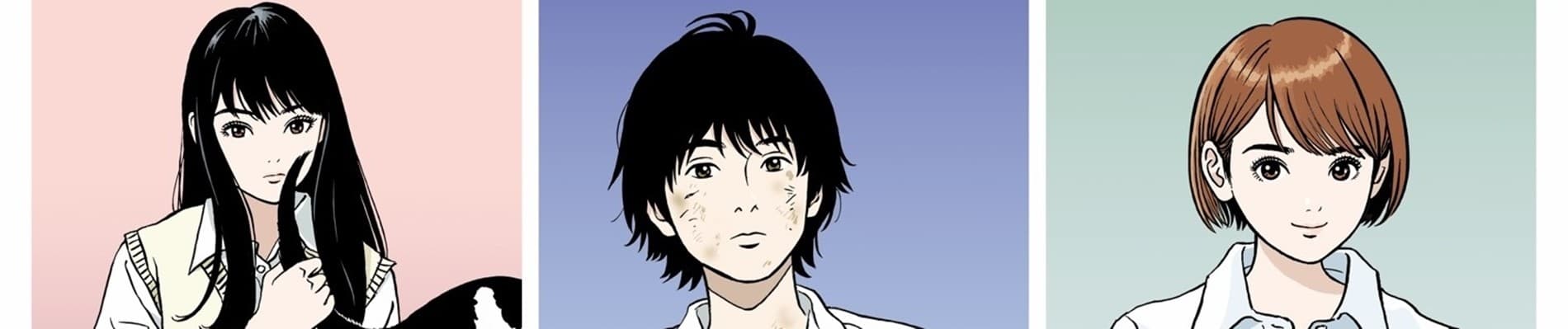
Sonny Boy exhibits a calm, calculating personality juxtaposing its unhinged sprees, shrills and thrills. That is, the show doesn't exist in a vacuum of Shingo jerking himself off with inexplicable nothings. Thoughtfulness and maturity prevail. A lack of background music often accentuates silence as a virtue in character-centric scenes or reveal a cathartic math-rock instrumental towards an episode's end. A minimalist, realist art-style not-so-different from Kyne's force you to rely on the dialogue and interpersonal instead of animated expressions to see what the characters are thinking. Production-wise alone, the otherwise eccentricities are beautifully shaped, but I was never worried about that with Shingo in the first place.
But narratively? Thematically? As much as Sonny Boy loves to shroud itself with various supernatural subplots, it's social and philosophical pondering at heart. The central plot being a group of kids exploring an unknown world and getting back home with a dash of supernatural powers, it's not so strange that concepts like hive-mind, class division, pseudo-religion and the works are present, right?
The prevalence of these supernatural powers isn't so much Saitama vs Boros [1080p] [60 fps] fights or the inventive abilities themselves, but how they change others' perceptions about someone, or self-perception. An apish Cap grows drunk on his mistaken ability to penalize others at his whim. An arrogant Asakaze grows even moreso, albeit with insecurity, and others confirm his right to do so. Social and self-perceptions change in "This World", and so does their common sense and rationale.
The basis of Sonny Boy is its chaotic narrative. More like an anthological work than a linear story, the show tugs back and forth between central plot relevance, thematic ambiguity or somewhere in between. Yeah, it's an episodic mess. However, the various subplots presented and forgotten by the next episode are just as important as the central plot because of their thematic weight. Foretelling small narratives bearing hopelessness, lonesomeness, death, emotional insecurity, the collection of themes, symbolism, imagery, feelings is the frontrunner of the show. These kids are kids and this is their experience. The peculiarities of the unknown are insignificant to their adaptability, or lack thereof, to them. While the episodic nature and thematic focus of Sonny Boy deters details and consistent lore, it paradoxically creates world building. Not so much in the context of exposition, but in how it contributes to the nihilism. Whichever corner of "This World" Nagara and Co. end up in, there's some sort of tribulation forsaking them, their beliefs or their common sense. Rendering them meaningless. "This World" is a scary place not because of how big it is, but what we don't know about it or ourselves.
As much as I'm tempted to discuss the Eva-Sonny Boy cross-comparisons, I'll cut to the chase and agree with one similarity.
Optimism in Nihilism.His grand entrance laid sprawled on a classroom floor staring at the ceiling, indifferent, unbothered and unmotivated. Nagara is as monotone as the necktie and dress shirt pressed on his body. Others have changed, better or worse, in "This World" and its consequences, but Nagara remains the same. The loner, the guy who killed the bird. The one who sent everyone to "This World". Though, could I quote "It's me vs. The World" in spite of Nozomi and Co. joining his ranks? Though, does nakama power prevail through the accusations, distrust, hostility, insecurities, apathy? Ultimately, it's Nagara's story. I will quote one prevalent line.
I mustn't run away. I mustn't run away. I mustn't run away.The Nagara who couldn't defend himself against animal murder accusations, against Nozomi's harsh truth about himself. Yeah, he's still the same. He runs away from the class' and Aki-sensei's accusations, but before his legs give out, something else changed.
The world changed.The episodic cesspool that is Sonny Boy is Nagara's growth period. He sees, meets, experiences, feels new things. Shackled under guilt of his crime, an underground mine (read as Tower of Babylon) appears before him. Not everything is meaningless. Not all hope is lost. Where there's light at the end of the tunnel, there's something to do. And that means no more running away. If the world can change, for better or worse, so can Nagara.
And it turns for worse. The Sun's gone. She's gone. She's here, but she's gone. The world he returned to is monotone compared to his vivid volte-face from the last few episodes. Summer is here but there's nothing to be happy about. School, a shitty part-time job and a friend who ignores you, was the tunnel's subtle illumination a trick of the eyes? Was it all meaningless, after all?
The world he returned to is the same as ever. It's going to beat down on him like the rain. But he can talk to her. He can get up from the floor. He can stop running away. He can help the bird.
There's hope yet in this world ["This World"].

Sonny Boy is Shingo Natsume's weird test tube baby. Weird in every sense. Depicting social commentary and philosophical grub aggressively shelved inside a free-flowing episodic narrative, it's harder to digest than swallow the various subplots with differing intentions. Despite these numerous subplots, the characters are the crux of this beautiful mess. With the minimalist character designs, you'll work hard to analyze them from their monologues and interactions. Under the stress of the central plot, these juvenile characters undergo their own series of changes that go beyond the original premise. Ambient music and silence befit Sonny Boy's subtle nature, making it out to be a hypnotizing experience on top of its psychedelic visuals. Sonny Boy demonstrates merit in creative-thinking, perhaps one of the best in that regard.
Still, I get it. Sonny Boy is a serious mindfuck. No shit why I spent a week thinking about it after watching it and then rewatching it. I act as if I understand Shingo's vision to the minute detail, but never actually expand on it deeply. Because I, or Shingo for this matter, can't tell you what Sonny Boy is. However genuine or perverse, there's no denying that Sonny Boy is trying to say something. You don't have to understand everything. You don't have to like it, either. But I did, a hell of a lot.
71 out of 76 users liked this review
