 ___
#Story : 95/100
___
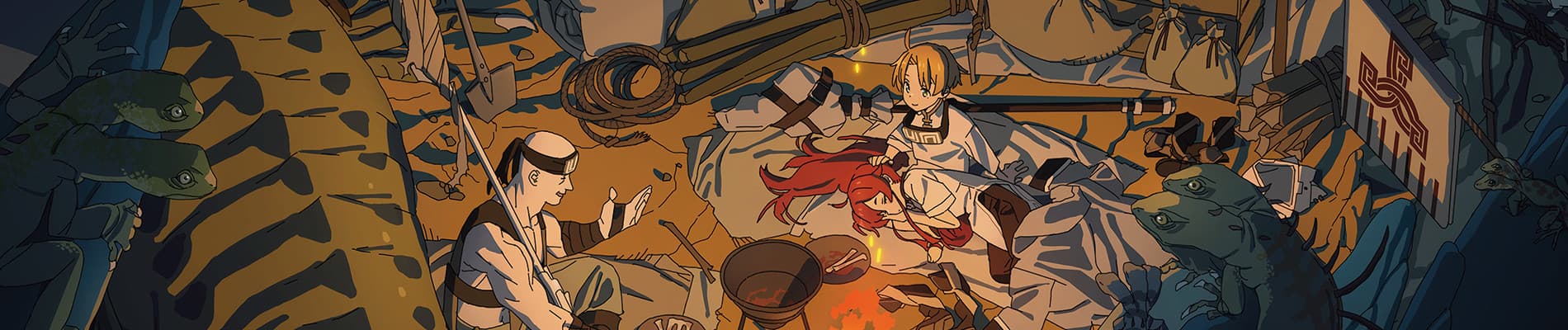
We pick up where the first cour left off after the Metastasis (Mana Calamity Disaster) as our lovely cast goes on a journey, with one goal - to return home. A simple objective, yes, but as they say - it's about the journey, not the destination.
___
#Story : 95/100
___
We pick up where the first cour left off after the Metastasis (Mana Calamity Disaster) as our lovely cast goes on a journey, with one goal - to return home. A simple objective, yes, but as they say - it's about the journey, not the destination.Throughout the adventure, we are introduced to the Six-faced world where Mushoku Tensei takes place, allowing for some key world-building that is imperative for the future storyline. From the Demon Continent to Millis to the Shirone Kingdom our protagonists visit, we are able to experience the vast differences that exist in this universe.
The first major event in this season was certainly Episode 16's reunion between Paul and Rudeus. Like most, I enjoyed this section of the story, though I felt that it could have still been slightly more dramatic (hopefully the BD can help us out here). Along with Episode 18 covering Roxy's return home, I felt that Mushoku Tensei was thorough in stressing the importance of unbreakable bonds between family members and making sure each and every watcher was able to rethink and remember those that matter most to us. It brings to light the different perspectives instead of viewing a situation from one single plane and to see beyond what's on the surface and not jump to conclusions at one's convenience.
Following on, Orsted's encounter was excellent. Episode 21 was crucial in getting the point across that just being isekaied does not mean that one will automatically be the strongest or even close to being at the top of the food chain. It also reveals more information about the world of MT and what some may call a power system by introducing the Dragon God.
Episode 22 as a standalone is absolutely wonderful, showing the departures of two well-loved characters without making it seem too long-winded and unnatural (in Ruijerd case) whilst ensuring that the viewer continues to ask questions about Eris' decisions simultaneously. These 24 minutes also provided us with a sex scene, which I felt turned out superbly. This part of the episode is of utmost importance to Mushoku Tensei in the way that it was executed. It is a fact that MT is a controversial anime, and for good reason - it does what many other shows do not dare to, overstepping the said boundaries and breaking made-up taboos. The show doesn't even try to hide Rudeus' perversion nor shy away from delicate issues - these two cours have shown Mushoku Tensei faces it head-on. Therefore, to those who still say that the show is a simple explosion of ecchiness or perhaps show disgust whenever the series is disputed, I can now safely say that these 23 episodes have done enough justice to show that this is simply art.
If you pay closer attention to the frames in the sex scene, it can be noted that the most sexualised (can you even call it that?) part is their kiss or perhaps their clothes lying on the floor (huge props to the animation directors and those working on what to animate - they chose the path of symbolisation instead - with the wine glass that Rudeus had been holding). Well, to those who want additional pieces of evidence, if you once again pay attention to the other episodes of the season, characters are presented in a manner that could be classified as fanservice but rather as a method to display the Six-faced world to us.
As a final point in this section, I would like to add that this universe is not the same as the one we live in and that characters will do things that are illegal or may be extremely looked down upon in our society. However, saying a show like this is despicable and should be (in the words of a livid Twitter user) cancelled is ridiculous. I said it once and I will say it again, Mushoku Tensei is art and if you cannot appreciate it, then you are the one losing out.
To conclude this first major section, I would say Mushoku Tensei has been able to connect to the viewer on a sentimental level and is able to provide us with an extravagant array of emotions - from excitement to sadness to fulfilment. Overall, I was pleased with the story in the adaptation of MT, and feel it is worthy of a high mark.
 ___
#Characters : 90/100
___
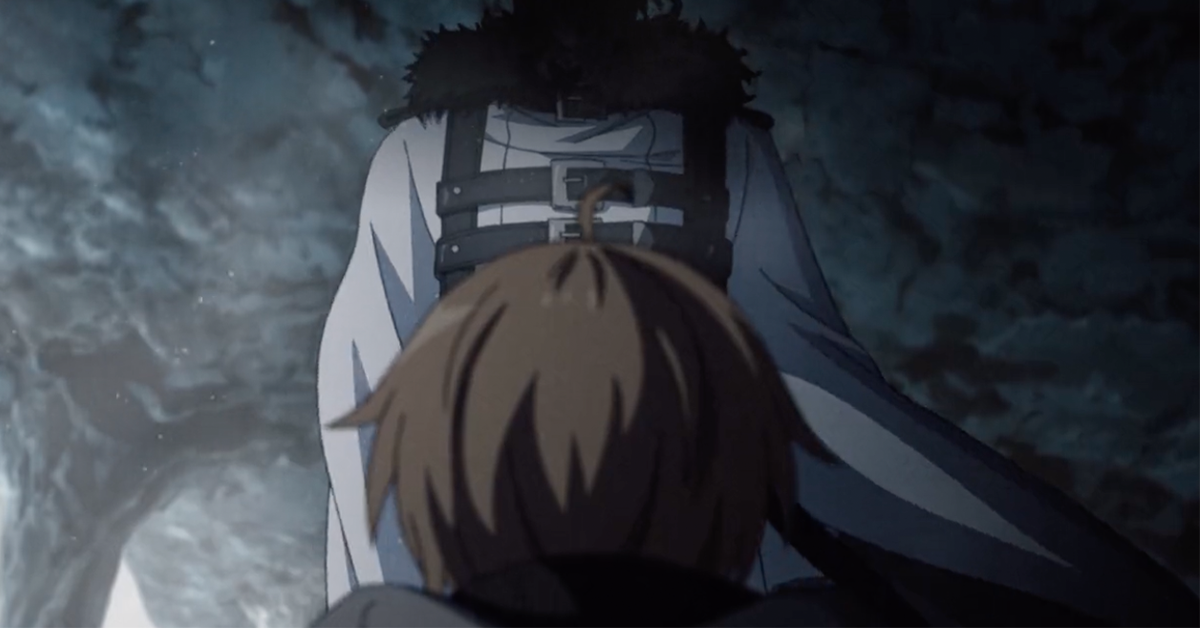
Mushoku Tensei did not fail to ensure that their characters developed and progressed over time. The journey of Dead End lasts for several years - from parts of Eris and Rudeus' childhoods to their early teenage years.
___
#Characters : 90/100
___
Mushoku Tensei did not fail to ensure that their characters developed and progressed over time. The journey of Dead End lasts for several years - from parts of Eris and Rudeus' childhoods to their early teenage years.Before covering the characters would I like to mention that, unfortunately, I do not have enough steam to evaluate every character so I will simply cover those that I feel have the biggest impact this season.
Firstly, I would like to talk about Rudy, our protagonist. He himself has become more mature over the years: developing more self-control (though he is still quite horny) and becoming more adaptable in different situations. As the story progresses and he is constantly met with difficulties, such as his reunion with Paul, he learns to appreciate and be grateful for what he has and to become more empathetic over time. This is something that his former self could have never achieved as a NEET but has finally been able to get out of his comfort zone and face his challenges over and over again. The end of the season shows growth in a subtle way and can be referenced to the ED of the season. Rudeus finds himself in a similar situation to when he was shunned and bullied in his old life (leading to him self-isolating and shutting out others). However, the decisions he makes this time are different, knowing that he cannot curl back into a ball and waste his life away. It is a slow but applaudable coming of age - well-done Rudy!
Eris was too able to grow, though it may be less noticeable. From the violent, selfish tsundere that we met in the middle of the first cour, her experiences on the journey have led to her becoming increasing level-headed and stronger as a warrior. Though keeping some of her tsundere traits, Eris is a great representation of a subtle but progressive change in one's character over time. Her departure in Episode 22 shows a hardened will and determination with a strong motive. To you anime-onlys, please look forward to the future!
Roxy's development in this cour is strikingly similar to Rudy's in the previous cour whereby she faces her past as she returns home for the first time in several decades. Her reunion and flashbacks show the tight family bonds that one must remember, that there will always be someone that wishes us the best.
Finally, Paul's character is excellently represented in the show as, unlike many father figures that we see in anime, he is so clearly a flawed person. He is someone who lacks self-control, is whimsical but he is someone that knows what's important to him and is determined to do what he can to make sure he can fulfil his aims. It is his flaws that make him a wonderful character, in which he can see how human Paul really is.
As a whole, I thought that Mushoku Tensei was able to capture important emotions through the journey of the cast. I look forward to seeing how they fare in the upcoming seasons.
 ___
___
 ___
#Visuals : 90/100
Fortunately, the animation of this season too did not disappoint. The animation retained the smooth, crispness that we saw in the first season and even upped its game in the fight scenes.
___
___
#Visuals : 90/100
Fortunately, the animation of this season too did not disappoint. The animation retained the smooth, crispness that we saw in the first season and even upped its game in the fight scenes.
___
 ___
#Audio : 95/100
The soundtrack this season was sublime, in which we were treated to numerous openings (OPs), one for each region that captured the tone and ambience of the area well. The Shirone Kingdom, for example, resembles both Indo-Chinese and Nepalese lands and uses its instrumental to capture the sounds of those locations. The Chinese instrument, the Èr Hú is used in the OST and in the OP 遠くの子守の唄 in the aforementioned Kingdom. In addition, the OP for the Millis continent reminds one of the Christian hymns (Millis region being very similar to Christianity); these well-crafted melodies allow for the viewer to be immersed in each motif seen in the different regions. The OP we hear in episode 11 is craftily executed as it is the same one we hear during the first 8 episodes of the first cour, reminding us that our cast has made it back home, to the Asura Kingdom.
___
#Audio : 95/100
The soundtrack this season was sublime, in which we were treated to numerous openings (OPs), one for each region that captured the tone and ambience of the area well. The Shirone Kingdom, for example, resembles both Indo-Chinese and Nepalese lands and uses its instrumental to capture the sounds of those locations. The Chinese instrument, the Èr Hú is used in the OST and in the OP 遠くの子守の唄 in the aforementioned Kingdom. In addition, the OP for the Millis continent reminds one of the Christian hymns (Millis region being very similar to Christianity); these well-crafted melodies allow for the viewer to be immersed in each motif seen in the different regions. The OP we hear in episode 11 is craftily executed as it is the same one we hear during the first 8 episodes of the first cour, reminding us that our cast has made it back home, to the Asura Kingdom.Also of note was 風と行く道 , the season's ending song (ED), which brings a nostalgic tune at the end of each episode, almost as if it is allowing the viewer to reflect on themselves and of their past. Moreover, the visuals of the ED are beautiful and boast ingenious foreshadowing along with it.
 ___
#Enjoyment : 100/100
It doesn't even need to be said - my enjoyment of Mushoku Tensei was through the roof.
___
#Final Thoughts :
___
Mushoku Tensei is neither a redemption story nor a battle Shounen. It is a unique journey that does not necessarily need an objective or a goal. The series is unique in unmatchable ways through its magnificent storyline, progressive characters, reliably clean animation, majestic soundtrack while still ensuring that this journey is an enjoyable one.
___
___
#Enjoyment : 100/100
It doesn't even need to be said - my enjoyment of Mushoku Tensei was through the roof.
___
#Final Thoughts :
___
Mushoku Tensei is neither a redemption story nor a battle Shounen. It is a unique journey that does not necessarily need an objective or a goal. The series is unique in unmatchable ways through its magnificent storyline, progressive characters, reliably clean animation, majestic soundtrack while still ensuring that this journey is an enjoyable one.
___
 ___
Now that the curtains have fallen for the second season of this masterclass, as does this review - so let's hope to see each other in the next chapter of this story!
___
___
Now that the curtains have fallen for the second season of this masterclass, as does this review - so let's hope to see each other in the next chapter of this story!
___246 out of 264 users liked this review
