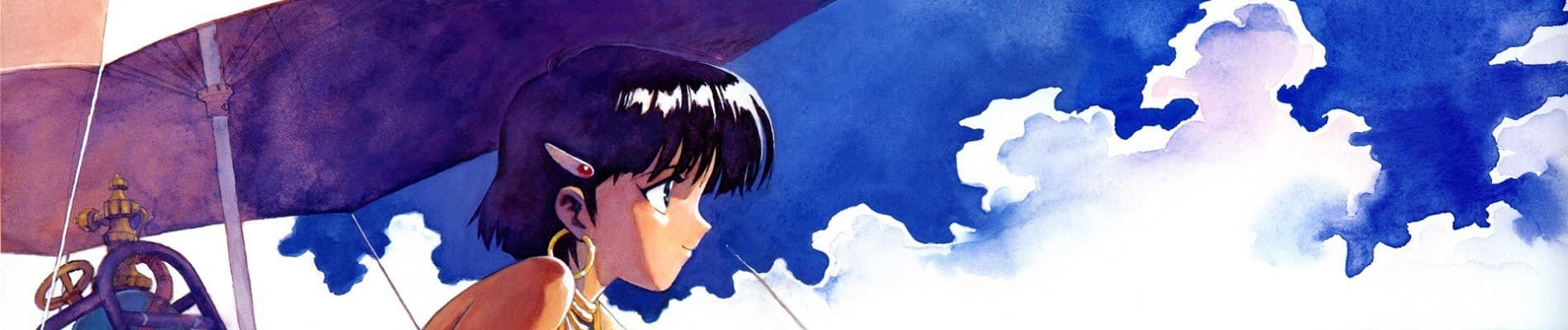


Fushigi no Umi no Nadia is an anime series directed by Hideaki Anno, originally inspired by the works of Jules Verne, particularly "Twenty Thousand Leagues Under the Sea". It was intended to be Hayao Miyazaki's first directed anime television series, however those plans would never come to fruition. It is unclear how much of the original concept was maintained throughout its troubled development, one thing that remains clear though is the strikingly picturesque backgrounds and vibrant colour palette that many tend to associate with Ghibli works. There is a wholesome, family friendly charm instilled in the opening episodes that introduce us to the dynamic cast of characters who inhabit the Nautilus.
Anno would reluctantly agree to helm the project which suffered from a variety of production issues, ultimately resulting in him leaving the director's seat and fall in to a depression that would surely go on to inspire his later work, Neon Genesis Evangelion. It is clear to see where much of the inspiration for the main cast of Evangelion came from in Asuka's lack of a father figure, Rei's maternal love and Shinji's world altering pressure of responsibility. These are all characteristics strongly defined in Nadia herself, who must reckon with the absense of any parental guidance, having to take care of a recent orphan and burdening the blue water, a power capable of transforming the world for better or worse. Anno eventually would return to direct the climax, episodes 35-39, which heavily explore Nadia's character, the guilt she feels for having put everyone in danger and the confusion that comes from her romantic love for Jean, uncapable yet of fully reciprocating those feelings of affection without obfuscating her true feelings through fits of anger directed to those around her. Her emotional immatury and "Tsundere" personality are a result of her growing up in an environment that carefully curated the experiences and emotions she was allowed to feel, to be used as another tool for profit from an adult, unsympathetic to her circumstances, something she shares with the animals of the circus she performs in. It is from this place that we can see Nadia obtain her virtues and moral code from. A common characteristic of Nadia that comes up throughout their adventure is the subject of eating meat, a sore point of discussion for her and Jean that drives a wedge between their romantic pursuits. Nadia cannot stomach the idea of trampling on life to reinforce one's own, a belief which places her in direct opposition to the primary antagonists of the series.
For all the insecurities Nadia herself feels and represents, Jean is the shining beacon of hope for a better tomorrow. His earnest pursuit of science is driven by his optimistic approach to living life as best he can since we "only live once, we've got to make the most of it". It is this charismatic glow that draws him and Nadia together to embark on their adventure. Episode 12 highlights the dichotomy between mankind and nature by having the crew of the Nautilus hunt a deer for dinner. Nadia understandably is upset and has one of her many outbursts, half-heartedly telling herself "I've been living on my own until now, I can keep on living alone". This is very reminiscent of the hedgehog dilemma which posits the challenge of intamacy at the risk of getting hurt, a lack of harmony with oneself and their surroundings in other words. It is in episode 14 that I believe this theme is really driven home. The "snow of the deep sea" is explained by Nemo as being a phenomenon in which dead micro-organisms emit a light after death. It is this light that proves they lived, a powerful piece of visual symbolism that appears later in the (seemingly) untimely demise of Nemo.

Episodes 16/17 are among my favourites in the entire series. We learn about the history of the fallen civilisation of Atlantis and the untimely demise of Jean's father which has been Jean's goal all this time to discover what happened. Confronting this shocking truth leaves Jean somewhat aimless and contemplative, he now lacks a purpose and doesn't know where to find meaning in this journey. It is Nadia's compassion and honest engagement with Jean at his lowest point that reminds him of the words of inspiration he told Nadia in episode 1. "We've got to make the most of it". In the ruins of a lost civilisation, surrounded by the graves of the dead, it is this heartfelt interaction between 2 living, breathing individuals who've had a positive impact on each other's life that reinvigorates Jean and affirm his ultimate purpose in life. "Let's go, back to where everybody is". The dead may be gone but not forgotten, we have a responsibility to live on for those who are still here. One of the final images is of some flowers growing in this desolate landscape. Nadia comments that they're much prettier than the artificial flower garden Gargoyle made. These flowers are the real deal, blossoming among the dirt and rubble of ages past, they're made all the more beautiful in contrast to the hardships they've faced, like a precious gem.

Episode 17 is very upbeat and light in comparison and compliments the darker tone of 16. Invigorated from their prior discussion, Jean resumes earnestly designing a plane to take Nadia in to the skies again as we are treated to some life advice from Sanson and Hanson about what it means to be a "grownup". Jean expresses his desire to quickly grow up while Nadia by contrast doesn't want to become like the adults she so despises. Jean is told twice over now from both Sanson and Hanson that he needs to "fix his own problems", still a kid at heart, he is sheltered and unaware of the various experiences others have had to live with in order to survive. Jean is impatient about growing up because he wants to be more helpful and capable of fulfilling his dreams. However, the truth is, adulthood is much more complicated than that and even the role models in this case don't always live by their word. Sanson capitalises on the flowers Hanson made for their mutual love interest, undercutting his "do it yourself" words of wisdom, while Hanson is more content to take a slower pace in confessing his feelings. Everybody has their own ideals to live by and adults aren't always the flawless "live by example people" they'd have you believe, they're just as flawed. In saying this, Jean recognises what he is and isn't able to do on his own and enlists the help of Hanson, a position Hanson is noticeably more comfortable in and gives him confidence. The climax of this episode resonates these themes through the union of adult (Hanson) and child (Jean) working together to build a plane. The result is a resounding success that executes the episode's themes (as the opening plays over the scene) and presents a holistic view of both selves within the individual, together they are able to fly.

For the sake of keeping this short and not rambling in circles. I'll briefly comment on THAT infamous stretch of episodes between 23-33. It is my understanding that Anno had no part in the direction the series took during these episodes and what they consist of is mostly filler with some loose ideas not thoroughly explored and a complete misrepresentation and lack of understanding of its characters that nearly derails the entire narrative. It is unmistakably awful and if I'm honest, serves almost zero purpose outside some important context within episodes 30 and 31. There is not enough criticism to give to those episodes and it's a stain on an otherwise great experience.

Fushigi no Umi no Nadia is a strong tale of love and human progress. Neo Atla represents the belief that humanity's quest for truth and advances in technology will give way to their ultimate demise, that some things should remain unknown. More personally, it relates these ideas of human morality and unending pursuit to the main characters, Jean and Nadia. Jean is an inventor with a thirst for knowledge, who creates machines capable of flying Nadia and himself around the world, though always ending in failure. Nadia's morality is shaped by the great empathy she has for all life. She does not believe in the grand pursuit of mankind if it is at the expense of life. It is the relationship between these two and the overarching theme of human evolution that forms a singular purpose embedded within the narrative. Neither point of view is inherently wrong, the dangers of technological advances and war are purported by the ultimate destruction of the Atlantis civilisation, who repeatedly destroyed each other until there was nothing left, being relegated to a mere tale of fiction from a bygone era. Their creations, mankind, live on carrying the same faults that plagued their ancestors. However, it is this very same romance between mankind and technology that creates the conditions for Jean to meet Nadia in the first place, beginning their grand adventure. Jean's goodwill and optimism is harnessed through the planes he invents that allows humans to soar through the sky, uncovering a whole new world of possibilities. This uncharted territory for mankind gives Jean and Nadia a new perspective on the capacity for mankind's greatness. It is a declaration of the power of good we command as a species.
Through their travels, they encounter various people with their own beliefs and values, that impart their own perspective on life to Jean and Nadia. Yesterday's enemies become today's friends, youth and adulthood are explored as 2 supportive state of beings, one needs the other to truly flourish. The 2 gems of blue water belong to Nadia and her father, Nemo. It is through Nemo's reflection on his past and encounters with Jean and Nadia that changes his viewpoint and values on the "ends justifying the means". Instead of dying to satiate some guilt he has about the destruction of his home, he lives on to fight for a better tomorrow. Finally giving up the powers of the blue water that he and Nadia possess to save the life of Jean. Our ancestors are the reason we made it to where we are, it is only through the shared pursuit of the Atlantean civilisation and our own that forges the light of tomorrow. The pair of blue waters form an infinite symbol, indicative of humanity's unlimited potential. The sacrifice of this great power is what saves Jean's life and affirms Nadia's place in the world as no one other than herself, unconstrained by the fate and role she was born in to. Emperor Neo plays an important role in saving Nadia's life as his empathy for his sister and strong will overcomes the bounds of science, proving that mankind's capacity for good triumphs over the misuse of science in the end. Nadia's love of Jean shines brighter than any gem and it is in this unmistakably human expression that she discovers her individuality, thus breaking the cycle of violence forced upon those in possession of the blue water.
