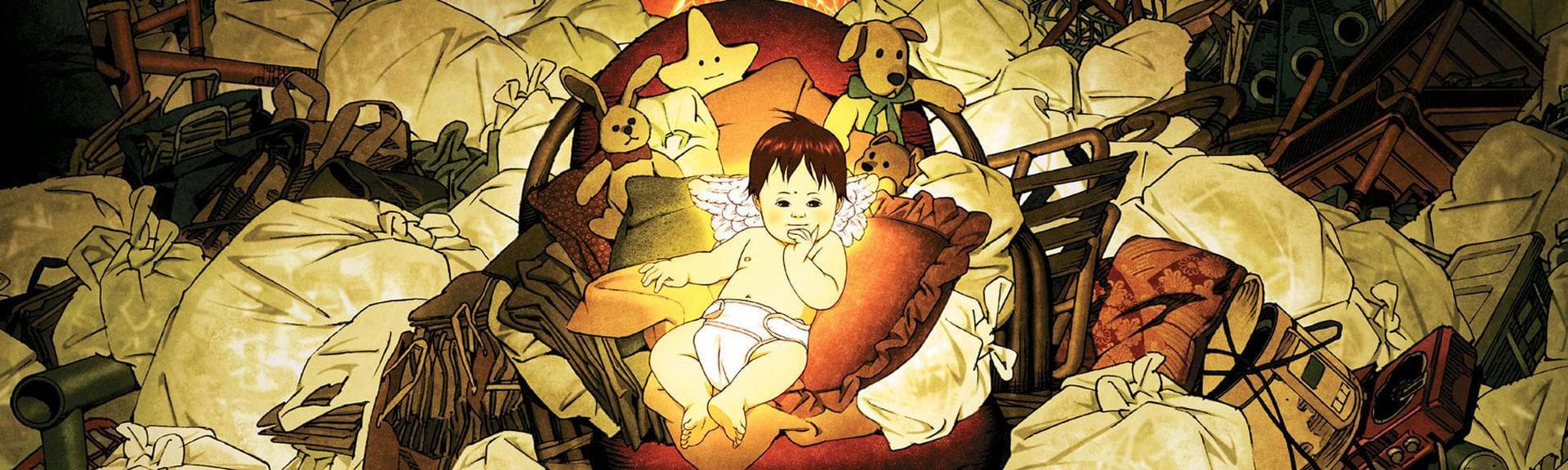
It’s been said that family isn’t always something you’re born into... Sometimes, it’s found, and sometimes in the strangest places. For middle aged outcast Gin, transgendered widow Hana and runaway teenager Miyuki, the family they’d formed was all they had... Until they found out that fate had plans for all of them. While rummaging through a dumpster, they find an abandoned newborn baby, resting in a pile of trash next to a note telling them to take care of her. While they each have a different reaction to the little bundle of joy, they eventually agree(at Hana's insistence) to track down her real parents. This decision will lead them on a winding path through not only Tokyo, but their own pasts... Lies long held, mistakes long regretted, identities long forgotten. Somewhere along the way, they'll have to come to terms with the fact that the lonely infant in their charge isn't the only one who needs to find their way home.
The name Satoshi Kon carries some significant weight in Japan. A director who was taken from us far before his time, he was a visionary on the level of David Lynch or Stanley Kubrick... A force of nature who created not for profit or notoriety, but to explore themes and deliver messages he was passionate about, and Studio Madhouse was more than happy to spend the best years of their existence helping him do it. Unlike a lot of anime directors, who design their characters in a cartoony fashion that could only loosely be recognized as human, Satoshi Kon paints his characters as unmistakably human... And not only that, but they are unmistakably Japanese, to the point that it’s usually pretty easy to tell someone’s ethnicity the second they’re introduced, without relying on stereotypes. This distinct level of detail is something Studio Madhouse keeps coming back to in general, but it never felt quite as palatable as it did when Kon was involved, and this particular title is no exception.
It’s a level of detail that allows all three main characters to look like perfectly normal, every day people, the likes of which you’d likely see standing around unblinking in the background of any other anime, but they’re still expressive and memorable enough to stand out against a world of extras who look just as normal as they do. The backgrounds themselves are exquisitely detailed on a number of different levels... The trash and grime, the clutter of an over-crowded city, the random assortment of odds and ends that make up the entire wardrobe and possessions of people who don’t have the means to be picky about what they survive on, even the sheen of wet surfaces that formerly hosted now-melted snow, there is not a single corner of space in this movie that doesn’t feel alive and/or lived in. There’s a lot going on in the background, not only due to the fact that there’s a world going on outside of the main cast’s plight, but also on a deeper level that we’ll get into later.
The movement animation is mostly fluid, this show clearly had a lot of money poured into it(Never let it be said that Madhouse didn’t spoil Satoshi Kon rotten) and yet with the over-all astronomical ambition of the production, they still had to cut corners in a few places. There are several moments where the animation resorts to a slightly less messy version of the ‘runny eggs’ aesthetic, that cost-cutting style where you break a character’s frame in order to give them exaggerated movements, and while it doesn’t look nearly as bad as it does in certain modern shows... Look up my FMA Sacred Star of Milos review to find out just how ugly this approach can get... I did personally find it a little distracting. It was used sparingly, and only really for comedic over-reactions and running scenes, but it’s a personal pet peeve of mine, and it’s really my only gripe about the visuals of an otherwise stunningly beautiful anime.
The musical score was composed by Keiichi Suzuki, member of Japanese rock group Moonriders. As you might expect of a rock musician, he brings a harder edge to the background music, using actual instruments to pull off what most anime would achieve with computers. There are some melancholic and seasonal-sounding tunes throughout, but the ones that’ll stick with you the most are the bouncy tunes that play when the cast are walking from place to place, playing up the calamity and chaos of every day life. There are also a few songs, including some charming Japanese renditions of Christmas carols, but my favorite piece is the ending credits song No9, a jazzy rendition of Beethoven’s Ninth Symphony, with original lyrics that add a new layer to the grueling life of a Japanese vagrant... The singer starts by complaining about his circumstances, then seemingly goes through the stages of grief before ending with a begrudging acceptance.
For the longest time, there was no English dub for this movie. It was just one of those titles you had to accept was always going to remain in Japanese... Until recently, when it was rescued and rereleased by Gkids, the same studio that brought us the Miyazaki films that Disney wouldn’t touch. They recently followed it all up by giving Millennium Actress the same treatment, and while I haven’t seen their dub of that classic yet, they’ve given me every reason to believe that they’re going to knock it out of the park, because I haven’t been this satisfied with an english dub since Toradora. The entire cast is absolutely perfect for their roles, especially classic film/voice actor Jon Avner as the rough and gritty Gin, whose gravely, snarling delivery is full of warmth, pain and regret. I was initially disappointed that they didn’t cast Crispin Freeman as Hana, as he’s claimed in the past that she is the one character he’s always wanted to play, but the actor they chose, real life trans woman Shakina Nayfack, is absolutely delightful in her first ever voice acting role. I’m also not gonna complain about any dub that casts Jamieson Price as various side roles, alongside Crispin Freeman, who, hey, he got to be in the movie anyway.
So what exactly makes the best kind of Christmas movie? Well, that’s obviously a matter of opinion, but for me, it’s when Christmas itself isn’t really the focus. I don’t need santa or his reindeer, or some vague pop culture icon ‘saving’ Christmas for someone(I also really dislike movies where Santa is confirmed as real, don't ask why, I'm just weird). That might have done it for me as a kid, but nowadays, I usually gravitate toward stories that take place during the holiday season, and the Christmas spirit takes on a more important role than the holiday itself, giving characters the push they need to overcome exaggerated, yet still realistically grounded situations. I like movies where Christmas isn’t just some yearly reminder that people should be kind to each other, but where that lesson goes into action, and people find that little bit of extra warmth, generosity or even endurance to go above and beyond what would have previously been their limits, to overcome whatever struggle... Inside or out... had been placed in front of them. John Hughes was really good at this, and I was really surprised to see a Satoshi Kon movie nail it so well too... And for a few reasons.
First off, while Satoshi Kon’s main cinematic influences lie more on the western side of the equation than the eastern side, and his work could best be compared to that of a few select American directors, he tends to go out of his way to make the stories he tells as Japanese as possible. I mentioned before how this works in his character designs, but he also likes to focus tightly on Japanese society, culture and social issues. What’s interesting about all this is that while a western-style story is arguably the best environment for a Christmas movie, Christmas is kind of a niche thing in Japan. Christianity is kind of a minority religion over there, and Christmas is celebrated only by a small portion of the population... And in ways we probably wouldn’t recognize. On top of all that, Satoshi Kon isn't a huge fan of religion, and when you put all of this together, there’s a lot about this movie that just doesn’t feel like his work.
The reason for this is because Satoshi Kno wasn’t the only mind behind this project. Working alongside him was screen writer Keiko Nobumoto, a woman with an impressive body of work despite the small number of titles attributed to it, and who unfortunately passed away earlier this month. There are parts of this movie that feel more Shinichiro Watanabe-esque than others, and that’s likely because Nobumoto was a long time collaborator of Watanabe’s. She worked on Wolf’s Rain, Cowboy Bebop, Samurai Champloo and even Space Dandy, so it should come as no surprise that the film features a strong theme of found families being bonded together by fate and similar circumstances, a fascination with unexpected living conditions and a memorable cast of side characters... Things that, if we’re being honest, Satoshi Kon was never great at. He was far more interested in delivering messages and focusing on a few main characters at a time, while Keiko Nobumoto preferred to paint with a wider brush when translating the human experience.
Needless to say, these two approaches by these two highly distinguished auteurs mix flawlessly in this film. Right from the start, you’re introduced to characters with no hope in their lives, who have carved out a little niche for themselves to survive in society on a day to day basis, having all abandoned their previous lives for some selfish reason. They have nobody left to depend on them, no families outside of each other... and they all have to live a variety of lies just to make THAT work. Finding a baby and deciding to find her parents IS a perfectly acceptable inciting incident, but it means so much more for them, as whether they accept it at first or not, it offers them an opportunity to reconnect with the world, not only by caring for this poor infant after spending various amounts of time caring only about themselves, but by constantly finding moments throughout their journey to show kindness towards others, and none of it ever feels random, as it either reveals something about the characters to us(as well as to THEM in some cases) or it propels them to the next step on their journey.
As flawed as these characters are, they’re extremely likeable and relatable. You probably haven’t personally experienced the circumstances that lead them all to the streets, but I’ll bet a pretty penny you’ve gone through something comparable, and whether it was from forces you couldn’t control or a flaw in yourself that you couldn’t overcome, you’ve at least felt the temptation to run away from everything, and seeing the cold, bitter shells they’ve retreated into start to break is immensely satisfying, even if it’s too late for some of them to make amends than others. I’ve heard some people express disappointment that the film includes a transgendered protagonist but it doesn’t go explicitly into the struggles of trans people living in Japan, but it’s generally considered a good rule of thumb among writers that if you’re going to include a character from a minority group you don’t belong to, along with avoiding stereotypes, you don’t want to write about their struggles unless you have some kind of first hand knowledge of those struggles.
The other major criticism I’ve seen a few people bring up is that the story tends to rely way too heavily on coincidence, and I can understand this one a little better. This is a very human story, insofar as the fact that it explores the long and short term connections between people who have been brought together by fate and circumstance, and while it makes for a steady and consistent tone, I can see why people who expect logic in their stories might freak out when the entire cast leaves a restaurant right before a truck crashes through it, or when the cop pursuing them just happens to be one of their relatives, or when saving one random man’s life just happens to bring you to an event where an old enemy is about to get married. If it wasn’t for the Christmas setting, this would feel like RPG story-telling at best, but the thing is, I don’t think it is coincidence... I've always kind of thought this was a story of Christmas miracles and divine intervention, rather than just stuff happening. It doesn't really make sense to me that someone would leave a baby in a dumpster with an 'adopt me' note, rather than a diner, a church, someone's porch... I'd rather believe God gave them an abducted baby to set all four of them on the path home. I don't know, maybe I'm reaching, but it does tie everything up nicely, doesn't it?
Tokyo Godfathers is available from Gkids, and it’s a pretty easy movie to find both in physical stores, Rightstuf.com from their holiday sale, and even just streaming online.
Tokyo Godfathers is a hard movie to talk about without staying deliberately vague to avoid spoilers, praising the tragically departed individuals behind it, or going off on a tangent about your personal experience with it, and I’ve certainly done a fair amount of all three thus far. I hope that I’ve managed to convey just how much Tokyo Godfathers means to me, both as my favorite anime movie and as my favorite Christmas movie, and I especially hope I’ve inspired you to check it out for yourself. It’s a very unique film in the fact that it’s positive and uplifting, while at the same time gritty and honest, with a sense of both darkness and warmth that can only be expressed by the best holiday media, and a wicked sense of humr to boot. It works for me on just about every level, both above the surface and below, and while it may not be a perfect movie, I think you’d be hard pressed to find a Christmas movie that comes closer to perfection than this one does.
I give Tokyo Godfathers a 10/10.
41 out of 43 users liked this review